by Michael Riddick
Preview / download PDF in High Resolution
For over a decade, the Portrait of Elisabetta Gonzaga (fig. 1, cover) has occupied a singular space in my intellectual landscape, acting as a recurring intrigue at the intersection of my evolving interests. My fascination began in my youth, rooted in a pull toward the esoteric and the symbolic—those hidden layers of reality that suggest there is deeper meaning in the world around us. This early curiosity eventually matured into a formal study of religion, alchemy and philosophy, with a specific focus on comparative religion, providing the necessary framework to understand the Hermetic and Neoplatonic currents that defined the High Renaissance.

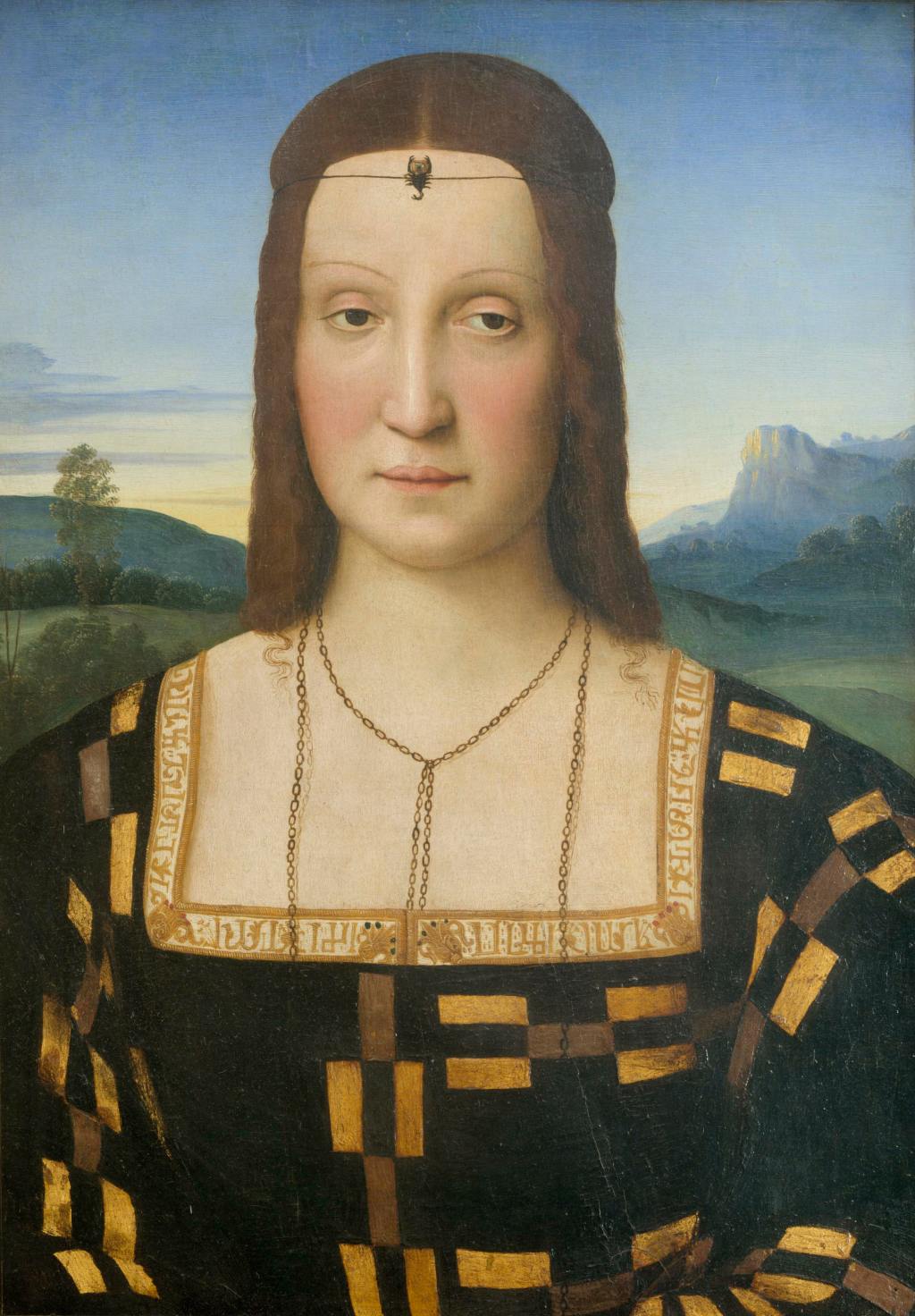
Fig. 1 – Oil on panel portrait of Elisabetta Gonzaga, Duchess of Urbino by Raffaello Sanzio, ca. 1502-04 (Uffizi, Florence, inv. 1890, no. 1441).
When my interests transitioned into art history later in life, the Duchess’s stoic resilience fascinated me; I found myself looking past the obvious scorpion on her brow, convinced that the eccentric, exotic script of her dress hem was not just a decorative flourish, but a functional device.[1] This inquiry also became a matter of personal and professional continuity. Through my involvement with the National Gallery of Art as a collector and donor, I had the privilege of knowing Eleonora Luciano during the final years of her work on a biography of Elisabetta.[2] Her untimely passing left a profound void in that scholarship, yet it solidified the resolve I had carried in the back of my mind to one day pick up the scholarly thread and apply my own unique lens to the mystery of that text Raphael rendered on the hem of Elisabetta’s dress.
Raphael Sanzio’s Portrait of Elisabetta Gonzaga, Duchess of Urbino, painted around 1504, presents a visual enigma that has long been subdued by conventional art historical classifications.[3] The square neckline of the Duchess’s black velvet gown is framed by a continuous band of golden glyphs.[4] For over a century, scholarly consensus has largely dismissed this intricate border as a ‘pseudo-Kufic’ motif (fig. 2), categorizing it as a generic, Orientalizing decoration of the sort frequently utilized in fourteenth- and fifteenth-century Italian painting to adorn the hems and halos of the Virgin Mary and various saints.[5] This traditional reading, however, strips the garment of its profound historical and psychological agency.
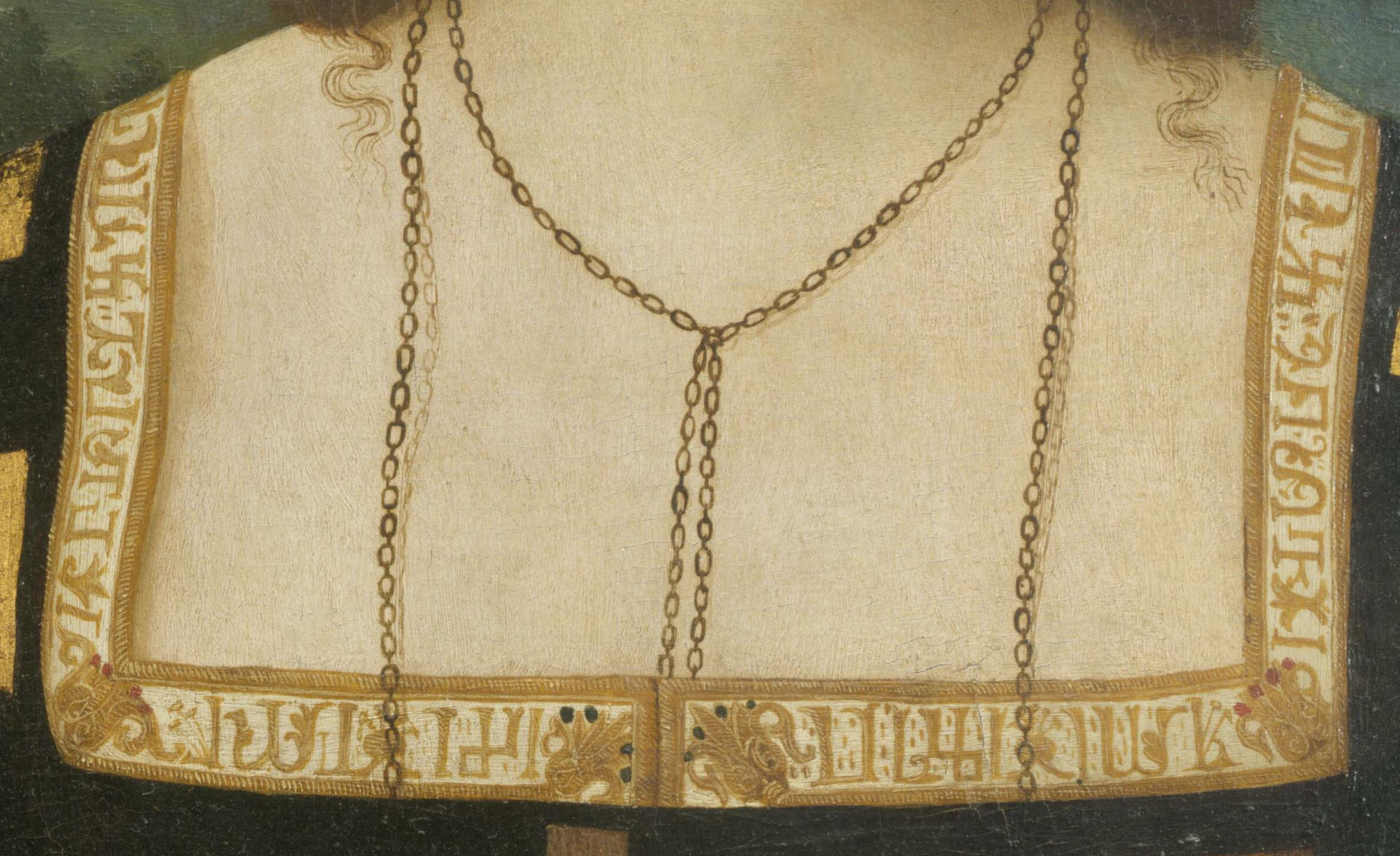
Fig. 2 – Detail of Fig. 1.
To reevaluate this border—not as meaningless ornament—but as an active, functioning technology, this paper represents the synthesis of seemingly disparate life investments. It draws upon my years writing and publishing neo-Renaissance music—an experience that provided a visceral understanding of the period’s harmonic structures—and my background in the intelligence community, where cryptography was not an abstract theory, but a daily reality within a specific cultural underworld. [6] By applying the logic of the codebreaker and the ear of the musician to the eye of the art historian, this study moves the encrypted neckline from the traditional label of ‘pseudoscript’ to a private Western cipher. [7] It suggests that Raphael wasn’t superficially painting ancient flourishes; rather, he was documenting a functional, high-status system of personalized security. Engineered to project what may be termed informational sovereignty, the garment served as an impenetrable talismanic armor, designed to protect a woman who refused to be defeated by the acute dynastic and biological crises of 1504.[8]
Decoding the power-imbued nature of this garment requires placing it within the specific historical realities of Renaissance statecraft, cryptology, and esoteric science. Concurrently, the visual arts engaged in their own complex games of legibility and concealment. As recent scholarship has demonstrated, Renaissance artists frequently employed invented scripts that mimicked the visual structure of foreign alphabets or ciphers, an aesthetic practice that went beyond plain exoticism to perform the very motions of cryptography.[9]
When applied to the Duchess of Urbino, this deliberate performance of cryptography—a system of ‘pseudo-encryption’—creates a frontal interface and a cognitive moat. It is a visual boundary that invites the viewer’s gaze only to frustrate their attempts at decryption. Behind this impenetrable wall of false data, Elisabetta safeguarded her most intimate realities, specifically her stoic marital vows and her reliance on the astro-medical interventions required to counteract her husband’s widely documented impotence.[10] By mimicking the high-security transmissions of the contemporary intelligence state, the Duchess’s garment successfully projected an aura of absolute control, protecting her status as “the purest madonna in the world” from the uninitiated gaze of the 1504 court.[11]
The success of this cognitive moat relied intimately upon the tailoring and structure of the garment itself. The physical site of Elisabetta’s cryptographic performance is her gamurra (or camora), the standard foundational gown worn by noblewomen of the Italian Renaissance. In the early sixteenth century, the gamurra was not just an item of clothing but a highly contested political space. The bodies of elite women were strictly regulated by complex patriarchal sumptuary laws, which dictated everything from the volume of fabric a woman could wear to the ostentatious display of gold thread, pearls, and imported dyes. The squared neckline was a particularly policed anatomical threshold, often scrutinized by moralists and lawmakers who sought to enforce boundaries between public display and private modesty.[12] By positioning her golden script exactly along this highly regulated border, the Duchess transformed a zone of patriarchal restriction into a site of intellectual resistance.
The women of the Gonzaga and Este courts did not passively accept these sartorial constraints; they actively manipulated them, and the conceptual leap from state cryptography to sartorial display was a documented reality within Elisabetta’s immediate family. Her sister-in-law, Isabella d’Este, the Marchioness of Mantua, incorporated her own personal esoteric emblems into a highly imitated wardrobe. She treated her garments as canvases for intellectual expression and fiercely guarded her designs with an implicit ‘copyright,’ requiring other noblewomen to formally request her permission before adopting her specific patterns and motifs.[13] This practice demonstrates that for the educated female elite of the era, the embellishment of a dress was recognized as a proprietary assertion of identity and intellectual branding.
Elisabetta was herself an active participant in this aesthetic performance of secrecy. The concept that she would wear a dress encoded with hidden meaning is not a matter of modern speculation, but a matter of historical record. Baldassare Castiglione, the preeminent chronicler of the Urbino court and one of Elisabetta’s most devoted admirers, explicitly documented her use of encrypted garments. In his detailed accounts of the 1502 wedding festivities for Lucrezia Borgia and Alfonso d’Este in Ferrara, Castiglione recorded Elisabetta’s spectacular wardrobe, noting that while she wore a mantle of brown velvet on one occasion, on another she appeared in “a black velvet robe embroidered with ciphers.”[14] This invaluable eyewitness testimony proves that the wearing of encrypted or pseudo-encrypted text as a high-status fashion statement was an established reality for the Duchess.
When viewed within this material and historical context, the pseudo-Greek and Latin encryption framing the neckline in Raphael’s portrait ceases to be an isolated artistic anomaly. It is the culmination of a remarkable courtly practice where garments functioned as working technologies. By weaving an impenetrable, cipher-like script along the very neckline the state sought to police, Elisabetta subverted the sumptuary restrictions of her time. The golden border serves as a frontal interface—a dazzling but unreadable perimeter that simultaneously broadcasts her magnificence and denies the viewer access to her inner thoughts, successfully claiming absolute informational sovereignty over her own body.
Moving beyond the socio-political implications of the gamurra, a rigorous examination of the neckline’s physical execution reveals the precise mechanics of its concealment. Traditional art history has often assumed that such borders were either generic textile patterns or freehand decorative flourishes added extemporaneously by the artist. However, a close morphological analysis of the script on Elisabetta’s dress suggests a stubborn asymmetry and a distinct lack of repetitive sequencing. In the context of cryptology and information theory, this high degree of informational entropy is the primary hallmark of a structured ‘data packet’ rather than a repetitive ornamental motif.[15] The precise, non-repeating nature of the characters indicates that the design was thoughtfully planned and transferred to the painted panel using a customized spolvero (pouncing) template. While other high-status transfer methods existed in Renaissance workshops—such as direct freehand drawing or calco (tracing via stylus pressure)—the use of a spolvero is highly significant for a cryptographic project. A spolvero requires a master blueprint whose contours have been meticulously pricked with a needle, allowing charcoal dust to transfer an exact, unvarying pattern onto the surface below. This method eliminates the possibility of extemporaneous improvisation by the painter.[16] It guarantees that the resulting image transfer on the panel is an exact facsimile of a pre-approved, highly engineered code, effectively locking the ‘data packet’ against accidental corruption during the artistic process. This deliberate, laborious method of application suggests that the neckline was an engineered, intentional transmission of data rather than an afterthought of the brush.
This attention to the boundary between language and decoration was not an anomaly, but rather a reflection of the sophisticated intellectual climate of the Urbino and Mantuan courts. The educated elite of the early sixteenth century were deeply invested in the study of foreign alphabets and the esoteric potential of ancient letterforms. This is vividly illustrated by the correspondence of Isabella d’Este, who actively investigated the morphology of exotic texts. Upon receiving a sample of “Syrian or Babylonian sacred letters” from her humanist advisor, Paride Ceresara, Isabella specifically wrote back to ask whether the shapes of the characters were essential to their underlying meaning (di sustantia) or if they were merely decorative (solum per adornamento).[17] Isabella’s inquiry demonstrates that the women of these courts did not just wear exotic patterns for their own sake but actively scrutinized the tension between structural substance and superficial ornament. Elisabetta’s neckline is a masterclass in this exact tension, weaponizing the ambiguity between legibility and pure aesthetic form.
The precise mechanics of this visual camouflage find their direct precedent within the Gonzaga sphere of patronage, where the boundary between text and decoration was already being actively dismantled. Just two years before Raphael painted Elisabetta’s portrait, Andrea Mantegna—the esteemed court artist in Mantua—executed a cryptographic illusion in his 1502 painting, Minerva Chasing the Vices from the Garden of Virtue (fig. 3). For centuries, art historians assumed that the text winding around a tree in this painting was meaningless ‘pseudo-Greek’ or ‘pseudo-Hebrew.’ However, recent scholarship has revealed that the scroll actually contains a perfectly legible Latin text that has been deliberately disguised by extravagant, floriated ornamentation to mimic an exotic, ancient script.[18] Alexander Nagel has termed this phenomenon ‘pseudo-pseudoscript’—a deliberate trick played upon the viewer to demonstrate how easily a genuine message can be camouflaged by a thin veil of exotic ornament.[19]
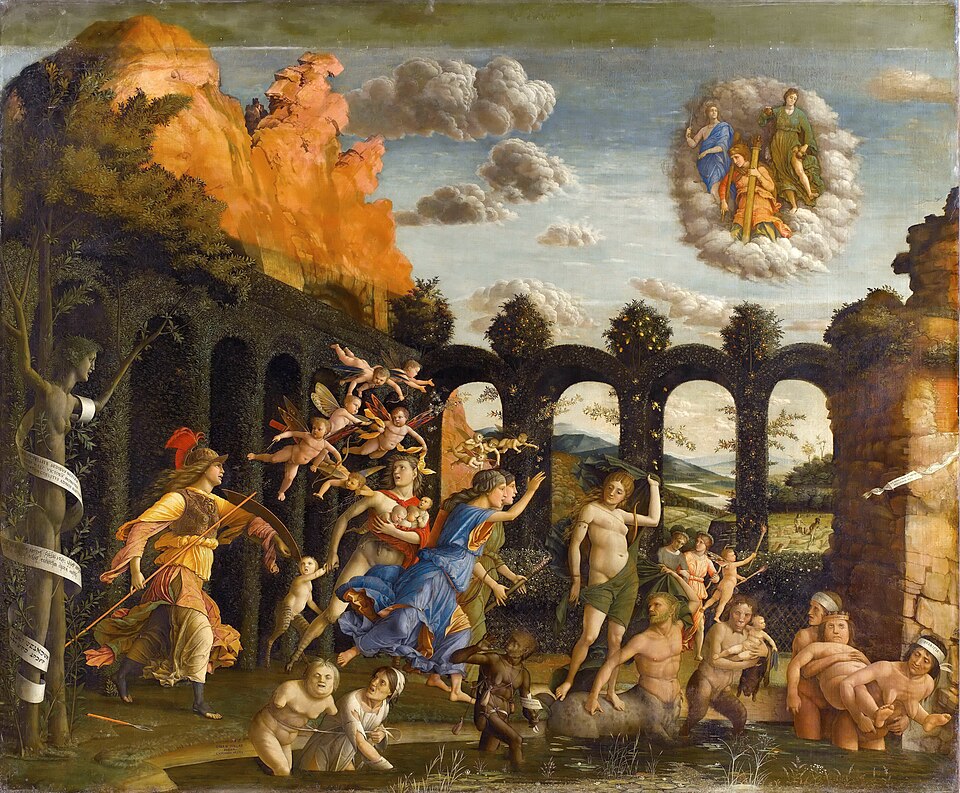
Fig. 3 – Tempera on canvas painting of Minerva Chasing the Vices from the Garden of Virtue by Andrea Mantegna, 1502 (Musée du Louvre, Paris, inv. 371).
Given the close familial and artistic ties between Mantua and Urbino, it is perhaps possible that this exact Mantegnesque trick was applied to the design of Elisabetta’s garment. By rotating standard Roman anchors (such as an inverted Pi or a sideways S) and dressing them in archaic flourishes, the architect of this cipher—conceivably a humanist scholar within the court’s inner circle—created a visual puzzle that mimics the aesthetic of the ancient East while hiding Western characters in plain sight. In this light, Raphael functioned as a technical witness rather than the primary inventor of the motif; he was meticulously documenting an intellectual conceit already commissioned for the Duchess. Instead of generating a pattern of “arbitrary strokes, slashes, and squiggles”—the traditional hallmarks of meaningless pseudoscript—Raphael recorded a pre-existing, highly engineered textile masterpiece.[20] Consequently, the garment stands not as mere ornamentation, but as a sophisticated steganographic artifact: a wearable environment where a private message is preserved within a cryptographic framework.
The intentionality of this hidden message is reinforced by the sheer economic reality of Renaissance artistic and sartorial commissions. To the modern observer, the painting itself is the priceless masterpiece; however, to the sixteenth-century mind, the painting was often a relatively minor expenditure compared to the notable cost of the luxury garment it documented.[21] The creation of a gown like Elisabetta’s gamurra required a remarkable outlay of capital. The patron was entirely responsible for procuring the raw materials—the exorbitant velvets, the precious silks, and the spun gold and silver threads—before ever paying for the labor of the artisans.[22] The process of designing such a garment was highly collaborative and deliberate, requiring a master tailor to engineer the architecture of the dress and specialized embroiderers to painstakingly execute the intricate gold ciphers along the neckline.[23] Furthermore, this physical construction must be understood through the lens of Renaissance materiality. As Ulinka Rublack has argued, tailoring in this period was akin to a process of ‘polychrome sculpting.’ Because no printed pattern books existed before the late sixteenth century, the creation of a garment like the gamurra relied on ‘embodied cognition’—an intuitive, sculptural awareness of how heavy fabrics and gold threads would shape and move with the human form.[24] By deliberately sculpting the dress to reflect light and incorporate three-dimensional, tactile cryptography, the artisans and the Duchess collaborated to create an active, lived-in technology specifically designed to trigger the highly attuned period eye of the contemporary observer.
For the Renaissance elite, the financial investment in a woman’s clothing and adornment was a primary vehicle for projecting dynastic power and could represent a significant percentage of familial wealth, sometimes equating to as much as half of a princely dowry.[25] Given the prohibitive costs of the gold thread and the intensive labor required to couch it into the velvet, it is inconceivable that the resulting border was only an extemporaneous fantasy or a careless afterthought. The financial stakes were simply too high to permit meaningless squiggles.[26] The heavily funded, collaborative design of the dress itself ensures that the neckline was a deliberate semantic undertaking. Rather than interpreting the hem as capricious flourishes, it is more accurate to view the artist as a forensic recorder of a pre-existing masterpiece; the garment was, in its own right, a high-value intellectual object and a functional piece of cryptographic art.
The material investment in the gamurra establishes its design as highly intentional, yet it is the specific morphology of the script that firmly roots the garment in the contemporary culture of state security. By the late fifteenth century, the Italian peninsula had become the crucible for modern cryptology. As the diplomatic networks between city-states expanded, the encryption of correspondence transitioned from an esoteric, philosophical pursuit into an institutionalized bureaucratic science.[27] In Venice, Milan, and Mantua, specialized cipher secretaries, such as the renowned Zuan Soro, were employed both to encode sensitive state communications and to intercept and decrypt the correspondence of political rivals.[28] For the Gonzaga and Montefeltro courts, navigating this pervasive intelligence-gathering apparatus was a daily necessity. By adorning her neckline with characters that visually and structurally mimic these secure diplomatic transmissions, Elisabetta was appropriating the highest visual register of state authority.
To understand how this border functions as a defense mechanism, it must be subjected to the cryptanalytic methodologies developed during the period. In 1474, the Milanese cipher secretary Cicco Simonetta compiled one of the earliest known European treatises on codebreaking, outlining specific rules for deciphering intercepted texts.[29] Simonetta’s primary method relied on identifying linguistic patterns, noting, for example, that words in both Latin and Italian overwhelmingly terminate in vowels. While the visual patterns of the hem are compelling, it is necessary to exercise methodological caution. To definitively argue that the “I” glyph, for example, represents a terminal vowel—based solely on the rules of Italian cryptanalysis established by Simonetta—would be to risk succumbing to a ‘theory-first’ fallacy, projecting a desired solution onto the text.[30] Therefore, the “I” should not be framed as absolute proof of decryption, but rather as a highly significant structural coincidence. Its recurring placement suggests a structural logic entirely consistent with contemporary cryptanalysis, warranting further investigation even if a definitive key remains elusive. When Simonetta’s rules are applied to the morphological distribution of the glyphs on Elisabetta’s neckline, the border seems to exhibit the precise structural properties of a fifteenth-century substitution cipher. A forensic transcription of the sequence reveals the recurring Latin “I” positioned consistently before the major floral motifs that divide the hem. In the logic of Renaissance cryptanalysis, this recurrent placement suggests that this “I” functions as a phonetic anchor, representing a terminal vowel at the end of encrypted words.
Furthermore, the neckline sequence demonstrates a working defense against frequency analysis through the deliberate use of homophones and nulls. As Renaissance codebreakers became adept at solving simple substitution ciphers, cryptographers began introducing multiple, slightly altered symbols for single high-frequency letters in order to flatten their statistical distribution and conceal the underlying language.[31] The script on the Duchess’s dress reflects this exact practice, featuring the letter “L” in numerous subtle variations: standard, horizontally flipped, crossed, and liquescent. Rather than representing different phonetic values, one could suggest these variations operate as homophones intended to mask a recurring consonant. Similarly, the sequence is punctuated by esoteric glyphs, classified as nulls—being meaningless characters strategically inserted to disrupt visual flow, obscure word boundaries, and systematically confuse the unauthorized reader.[32]
While a modern cryptanalyst might expect a frequency distribution chart to perfectly match these ten “L” variants against a high-frequency Latin consonant, such an expectation anachronistically projects modern mathematical standards onto Renaissance practices. As recent cryptologic historiography has demonstrated, fifteenth-century Italian cipher secretaries did not utilize homophones to achieve a mathematically perfect flattening of statistical frequency—a concept essentially unknown at the time. Instead, homophones were employed primarily as a steganographic defense to visually disguise obvious linguistic fingerprints (such as word-terminal vowels or common consonants) from opportunistic codebreakers attempting to read ‘straight off the page.’ Thus, the varying “L” shapes on the neckline function not as a mathematically verifiable statistical proof, but as a historically accurate, visual deterrent designed to frustrate the courtly observer.[33]
The determination of whether this sequence encrypts a definitive, translatable message or functions purely as an impenetrable ‘pseudo-encryption’ is secondary to its structural effect. By wrapping her neckline in a sequence that perfectly executes the mechanics of state cryptography—complete with terminal vowels, homophonic variations, and nulls—the Duchess constructed a deliberate cognitive moat. She effectively weaponized the gaze of the courtly observer. The border invites the viewer to read, only to frustrate the attempt by demanding a cipher key that is decisively withheld. In an environment where her political stability and reproductive viability were under constant, hostile scrutiny, this cryptographic performance allowed Elisabetta to maintain a public stance of courtly magnificence while securing an impenetrable perimeter around her private interiority.
While the encrypted gamurra functions as an impenetrable perimeter—a cognitive moat securing the Duchess’s informational sovereignty—it does not operate in isolation. Rather, the sartorial cipher is a supportive mechanism designed to protect and activate the primary, functional focal point of the portrait: the prominent scorpion monile (pendant) resting precisely upon Elisabetta’s forehead (fig. 4). Traditionally marginalized by art historians as a generic emblem of logic or intellectual fortitude, the scorpion must be recontextualized within the rigorously applied sciences of the sixteenth-century court. In the Renaissance, astral magic and humoral theory were not fringe superstitions but were the foundation of advanced academic medicine and natural philosophy, deeply respected by the educated elite as the mechanics of the cosmos.[34]
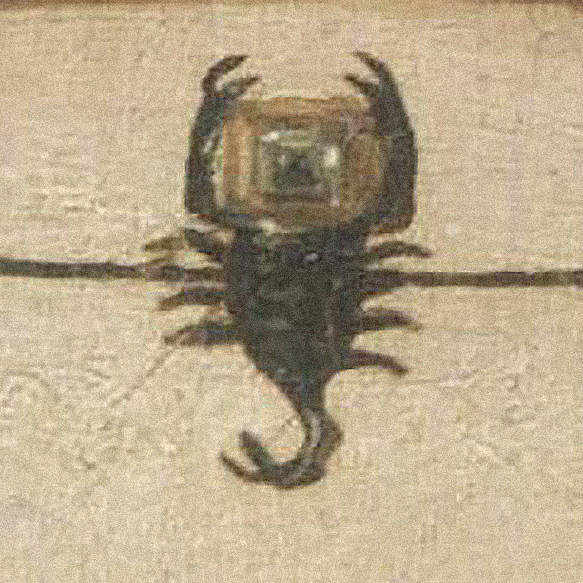
Fig. 4 – Detail of the scorpion monile from fig. 1. This active astro-medical talisman utilized melothesia to encourage fertility, functioning as a celestial apex in tandem with Elisabetta’s dress.
The application of such a specific medical talisman points directly to the central crisis of the Urbino court in 1504. Duke Guidobaldo da Montefeltro suffered from severe physical ailments, most notably impotence, which his contemporary Pietro Bembo explicitly attributed to malie, or malicious sorcery. This affliction threatened the Montefeltro dynasty with imminent extinction and forced Elisabetta into the agonizing role of a “virgin widow.” Thus, the survival of the state depended upon an extraordinary medical and spiritual intervention.[35]
To the Renaissance mind, the universe was inextricably linked by a continuous spiritus mundi (world spirit), meaning that celestial energies could be captured, concentrated, and directed toward specific medical outcomes through the use of precisely crafted material talismans that resonated with the target planet or constellation.[36]
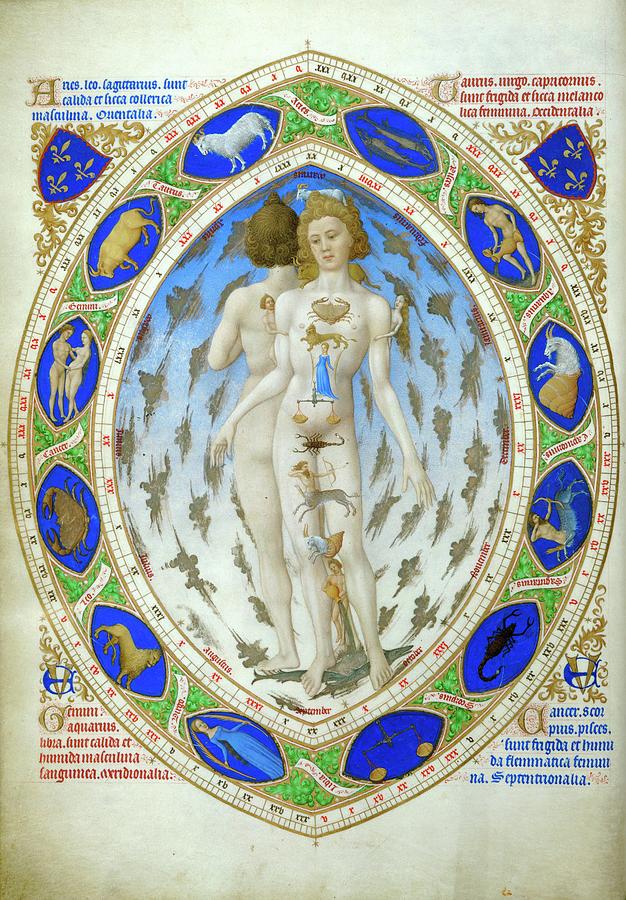
Fig. 5 – Limbourg Brothers, The Anatomical Man (or Zodiac Man), from Les Très Riches Heures du Duc de Berry, ca. 1416. This manuscript illumination illustrates the Hellenistic and Hermetic doctrine of melothesia, assigning control of the Scorpio constellation over the reproductive organs.
The selection of the scorpion as the instrument of this intervention is rooted in the ancient Hellenistic doctrine of melothesia—the topographical mapping of the zodiac onto human anatomy (fig. 5). According to foundational astrological texts, notably Claudius Ptolemy’s Tetrabiblos, the constellation of Scorpio exerted direct physiological dominion over the reproductive system and the genitals. This localized anatomical targeting is further confirmed by the horizontal hem that runs across the proper left side of Elisabetta’s body whose gold glyphs are heavily interspersed with drop-like dots unlike the opposing proper right side which remains conspicuously void of this feature (fig. 2). Within the strict parameters of melothesia codified in the Tetrabiblos, the left side of the human anatomy—including the womb—is governed exclusively by the Moon. Ptolemy dictates that the lunar planet “partakes chiefly of moisture” and acts as the principal cosmic generator of feminine, reproductive fluids.[37] By purposefully concentrating these visual drops solely on the proper left side of the dress, the designer is sympathetically channeling lunar moisture directly into the specific anatomy governed by the Moon (fig. 6). This part of the hem therefore operates as a localized medical device, feeding necessary generative moisture upward to support the fertile power of the scorpion monile. The necessity of this targeted astral hydration is confirmed by the Duchess’s actual medical history; modern historians analyzing the correspondence of Elisabetta’s physicians conclude she suffered from a severe, chronic case of anemia.[38] Within Renaissance humoral theory, a deficiency of blood equates to a dangerous lack of vital bodily moisture. Therefore, the concentration of lunar droplets on this area of the dress acts as a customized, compensatory prescription, artificially drawing down cosmic moisture to a reproductive system starved by her anemic constitution.
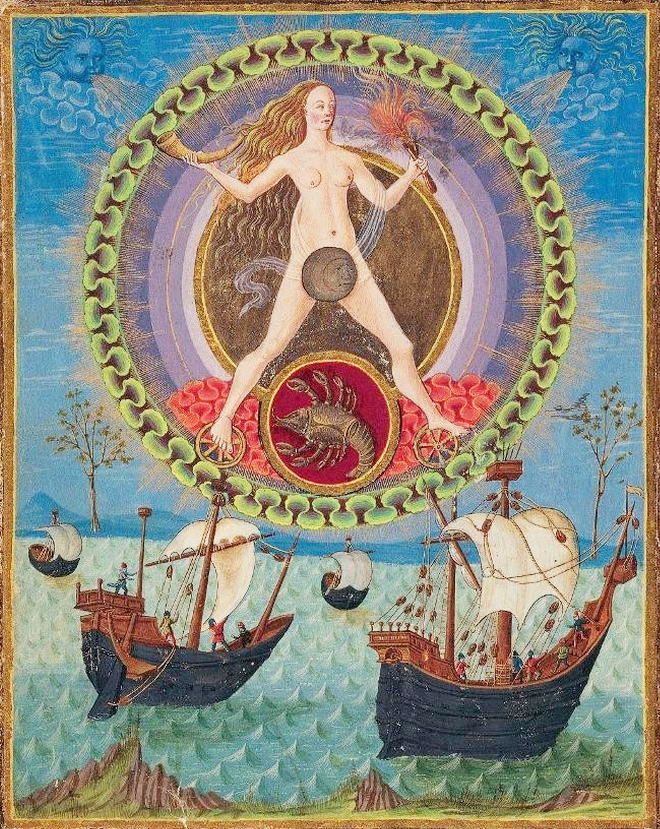
Fig. 6 – Attributed to Cristoforo de Predis, Luna, from Sacrobosco’s De sphaera mundi, ca. 1470 (Biblioteca Estense). The image conflates Luna with Fortuna, standing above a scorpion to illustrate the Moon ruling Scorpio.
This localized, sartorial appeal for celestial hydration is perfectly mirrored in Elisabetta’s own medallic commission. In the Renaissance, the portrait medal functioned as a two-sided conceptual instrument; while the obverse presented the sitter’s physical likeness and public titles, the reverse acted as a spiritual portrait, utilizing allegories and emblems to reveal the subject’s private virtues, aspirations, or hidden realities.[39] Elisabetta’s bronze portrait medal features a reverse that makes this same desperate, encrypted plea for reproductive intervention by featuring the mythological figure of Danaë reclining on the earth, receiving a shower of flames or golden drops extruded from a celestial cloud (fig. 7). Because Danaë was impregnated by Jupiter disguised as this golden shower, medieval and Renaissance theologians frequently adopted her as a classical archetype for miraculous virgin conception, specifically aligning her with the Virgin Mary, who was heavily supplicated for the cure of infertility. For Elisabetta, trapped in an unconsummated marriage, this medallic reverse performs the exact same function as the gold droplets on her hem. Both utilize the visual language of a divine, descending shower—be it lunar moisture or golden flames—to invoke a miraculous, astral intervention capable of overcoming earthly sterility.[40]

Fig. 7 – Portrait Medallion of Elisabetta Gonzaga (reverse), attributed to Adriano Fiorentino or Gian Cristoforo Romano, ca. 1495–1502 (Museo Nazionale del Bargello). The reverse depicts Danaë and the shower of gold, accompanied by the inscription Hoc Fugienti Fortunae Dicatis.
The belief that such a miraculous astral intervention could be achieved was not a superficial poetic hope but an accepted medical doctrine. This theoretical framework was operationalized for Renaissance elites by the Florentine philosopher Marsilio Ficino in his highly influential 1489 treatise, De vita coelitus comparanda (On Obtaining Life from the Heavens). Ficino established that occult virtues in stones, metals, and plants were not derived from their elemental makeup, but were infused directly by the forms and ideas of the celestial bodies. In his thorough catalog of the specific powers drawn from the stars, Ficino identified the scorpion and its associated stellar series as possessing a miraculous efficacy against diseases of the reproductive organs.[41]
This use of the scorpion as a medical device for reproductive health was so entrenched in Renaissance medical theory that it was later codified by the eminent physician and occult philosopher Paracelsus (1493–1541). Paracelsus firmly advised that a scorpion talisman should be worn by anyone suffering from a derangement of the reproductive system.[42] Furthermore, his instructions for the talisman’s physical orientation were highly specific, dictating that a ring of pure gold must be affixed to the creature’s tail so that it could be worn hanging downwards.[43] Although Paracelsus belongs to the generation following Elisabetta and his works were published posthumously, his concepts regarding the power of a scorpion talisman to cure sterility demonstrate the ongoing tenacity of these ancient beliefs in astral magic and their practical application in Renaissance medicine.
Building upon Simona Cohen’s foundational research regarding the amulet’s astrological significance, the monile must be understood not as a passive jewel, but as an active, operational prescription. By wearing the scorpion on her forehead, the highest point of sensory and cognitive reception, Elisabetta was deploying the highest level of contemporary astro-medical science to counteract the malie afflicting her husband. Viewed in this light, the encrypted neckline of her dress serves a vital dual purpose. It not only shields this intimate, desperate medical intervention from the hostile political scrutiny of the court, but it conceptually acts as the secure conduit through which the requisite celestial forces could be safely drawn into the talisman. The portrait thus documents a woman who, facing biological and political ruin, armored herself in the most advanced cosmological technologies of her era.
The efficacy of the scorpion monile relied on more than just physical contact; according to the rigorous tenets of Renaissance Neoplatonism, astral talismans required active ritual engagement to capture and concentrate celestial virtues. In his De vita Ficino argued that while astrological images and sympathetic materials prepare the body to receive planetary influences, it is through strong emotions, secret words, and specifically musical incantations that these forces are truly activated and transmitted to the human spirit.[44] To the educated Renaissance elite, harmonious proportions and musical numbers were understood as active, living figures capable of altering the physical world. This advanced understanding of music was a daily reality for Elisabetta. The Duchess presided over one of the most socially sophisticated courts in Italy, cultivating an elite circle of scholars and artists that included renowned musicians such as Gian Cristoforo Romano and Adriano Fiorentino.[45] Because she was intimately surrounded by the highest echelons of Renaissance musical theory and performance, she possessed the necessary intellectual access to weaponize its mechanics. However, to activate an astro-medical talisman without inviting accusations of heresy, the incantation required the shield of strict Christian orthodoxy. Therefore, if the encrypted neckline serves to secure the secret words of a Marian prayer, the primary fabric of the gamurra functions as the musical incantation itself,[46] transforming the entire garment into a structural, material performance of harmony that safely cloaks its esoteric function in plain sight.[47]
The translation of musical notation into sartorial display was not an abstract concept at the Mantuan court; it was a documented aesthetic strategy actively utilized by the Gonzaga women to project interior virtue. For example, Elisabetta’s earlier noted sister-in-law, Isabella d’Este, established a direct and powerful precedent for this practice by commissioning a gown prominently featuring the “Pause” motif—a vertical rectangular bar derived directly from fifteenth-century mensural notation signifying a musical rest, or silence.[48] Isabella further reinforced this theme in the architecture of her private apartments, where the gilt ceiling of her grotta presented viewers with musical pentagrams populated exclusively by rests and repeat signs (fig. 8).[49] By wearing the notation of silence, the female patron asserted a highly intellectualized control over her own voice and body, turning her garment into a visual manifesto of calculated restraint.

Fig. 8 – Detail of the gilded ceiling in Isabella d’Este’s grotta (Palazzo Ducale, Mantua).
It is conceivably possible to argue that Elisabetta’s gamurra appropriates and dramatically expands upon this specific musical iconography, enveloping her entire body in a complex polyphonic grid. A close visual analysis reveals that the horizontal gold motifs on her bodice are arranged in strict groupings of five parallel bars, utilizing a 2-1-2 configuration with a subdued central axis (fig. 9).[50] In the intellectual milieu of 1504, this five-bar grouping was the graphic identifier of the modern musical pentagram, representing the potential for melody and pitch.[51] These horizontal staves continuously alternate with vertical blocks of gold. Following the logic of Isabella’s “Pause” gown, these vertical bars function as mensural rests, representing time and rhythmic control. Together, the intersecting horizontal and vertical axes establish a constant, mathematical pulse—the tactus—providing a structural framework upon which the Duchess’s stoic virtue is permanently inscribed.
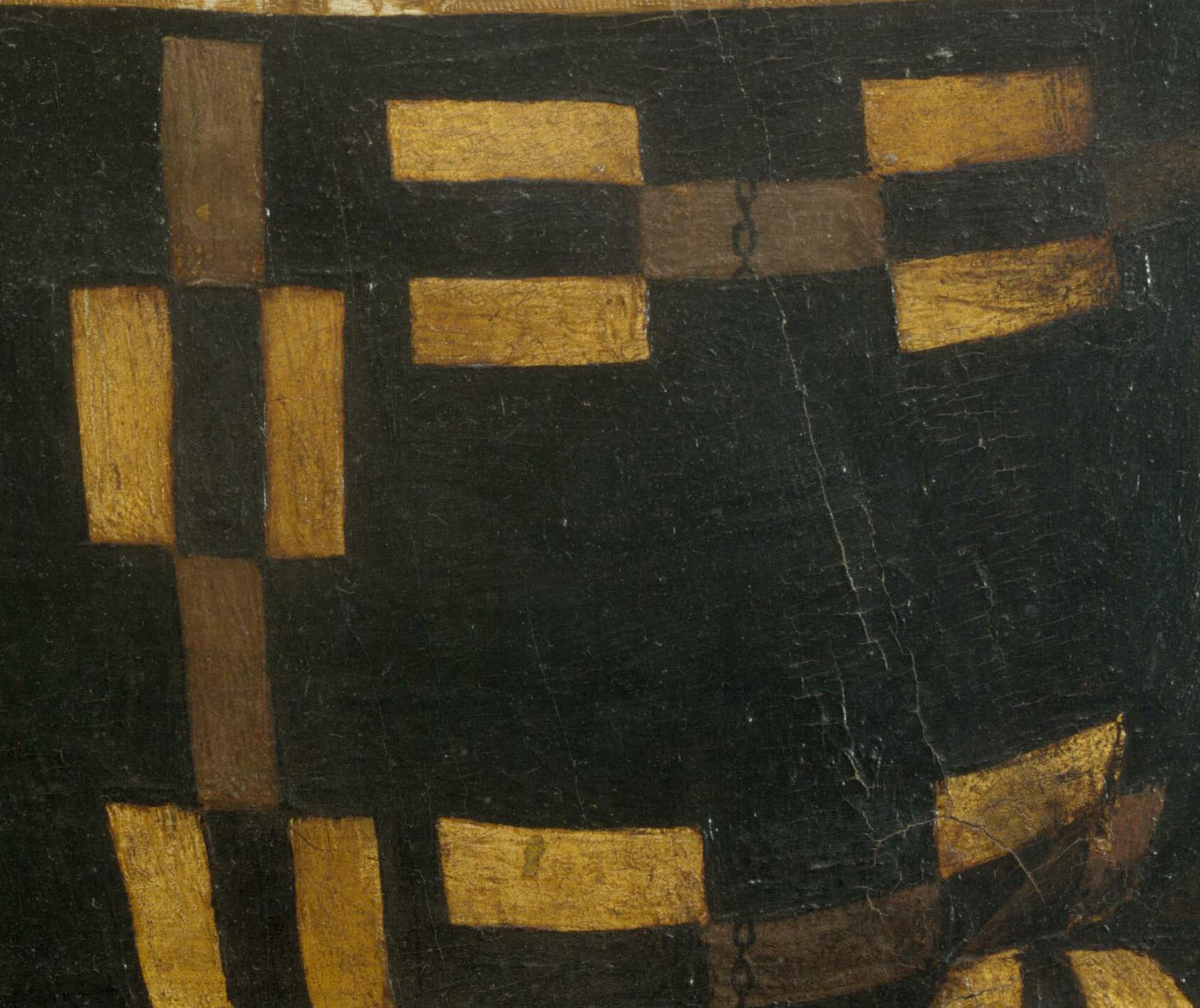
Fig. 9 – Detail of the 2-1-2 configuration of horizontal and vertical bars representing a polyphonic grid on Elisabetta’s dress.
The conceptual leap required to view a physical, decorative object as a silent musical score aligns perfectly with the established Renaissance tradition of ‘eye-music.’ Sixteenth-century composers frequently embedded arcane canonic inscriptions, notational puzzles, and ‘eye-music’ into their works, deliberately playing on the visual look of the notated page to enrich the composition’s meaning. For example, visual features like completely black notation were utilized by composers such as Josquin des Prez to visually symbolize mourning to the performer before a single note was ever sung.[52] Just as Baude Cordier’s famous heart-shaped score proved that manuscript pages could become visual art, Elisabetta’s dress proves that a visual, material object could be structurally engineered to carry a hidden, playable polyphonic system.
The placement of this rhythmic grid over the entirety of the Duchess’s body, is profoundly significant within the context of Renaissance medical magic. As contemporary diagrams illustrate, the healing influence of the planetary spheres was believed to be transmitted downward through strict mathematical and musical ratios overseen by Apollo, the dual god of medicine and music (fig. 10). According to Ficinian theory, the spiritus—the subtle, vaporous channel that unites the physical flesh with the immortal soul and acts as the receptor for celestial influences—is generated by the heat of the heart and diffused via the arteries throughout the body.[53] Because the musical staves encompass her complete physical form, her whole being acts as the continuous ‘performance’ of the score. As Elisabetta breathes, gestures, and navigates the space of the court, the polyphonic grid of the gamurra dynamically shifts and resonates.[54] This total bodily envelopment effectively turns the garment into a living, talismanic matrix that cycles the tactus through her vascular system.[55] While we cannot know if the Duchess intended to ‘play’ her own bodice, the physical expansion and contraction of the five-bar staff during her respiration creates a literal, phenomenological performance of the tactus.[56]
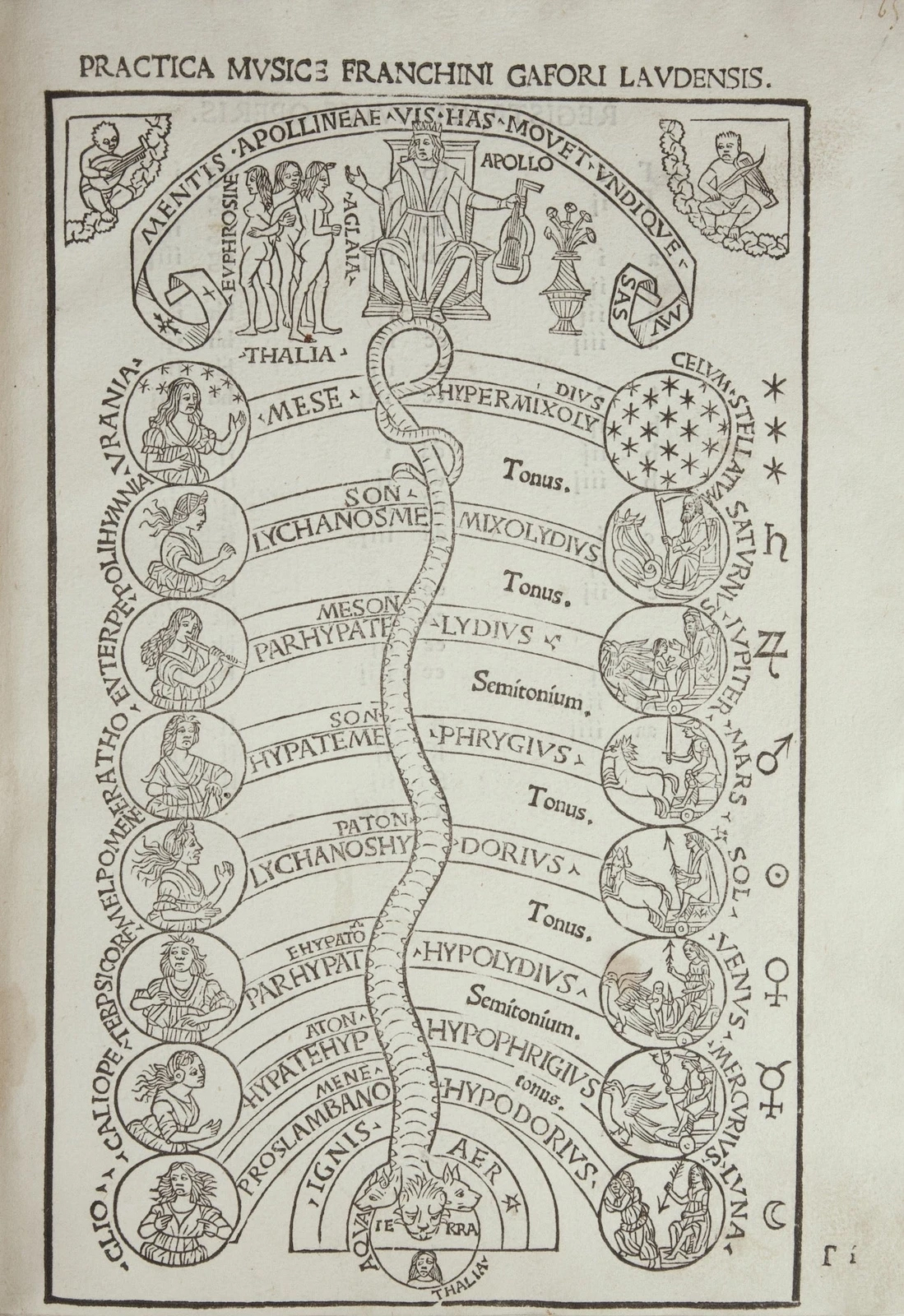
Fig. 10 – Frontispiece to Franchinus Gaffurius, Practica Musicae (Milan: Guillermus Le Signerre for Johannes Petrus de Lomatio, 1496). Illustrating traditional Pythagorean music theory, mapping the Muses and musical proportions directly onto their corresponding planetary and zodiacal spheres.
If her respiration provides the living performance of this musical matrix, its static embroidered architecture provides the silent score. The specific 2-1-2 structural division of this grid is equally revealing. Within this five-line staff, the subdued central axis visually functions as the ‘Middle C’ or ‘Tenor’ line. However, in the context of courtly performance, this recessed middle bar represents the silent center. The fact that this axis is deliberately subdued—rendered in a darker, shadowed tone against the brilliant, parallel gold bars that flank it—is conceptually vital. In Renaissance mensural notation, periods of silence and pauses were visually designated by dark, solid blocks of ink. The subdued central bar here operates literally as a structural musical rest. Just as Isabella d’Este adopted the musical pause as her personal impresa to signify her capacity for calculated silence,[57] Elisabetta’s grid physically anchors her heart and entire body between the potential for melody and the necessity of silence.
Furthermore, this chromatic contrast physically weaves the competing expectations of dynastic display and feminine decorum directly into her garment. The radiant gold bars project the conspicuous magnificence required of a Renaissance ruler, while the dark, recessive void at her heart performs the modesty, piety, and expected silence of the ideal Duchess.[58] It is a material manifestation of her stoic misura—the careful, measured restraint expected of the perfect court lady.
If the bodice represents the silent center of this performance, the borders of the garment function as its active voice. The specific placement of this script is critical to its cryptographic function. As Nagel has observed, Renaissance artists deliberately placed pseudoscripts on the extremities of garments—specifically sleeves, collars, and hems. Nagel identifies these boundaries as “labile zones, places where the body emerges from the clothing and makes contact with the world.” To position script in these areas grants them an explicit “oral quality,” transforming them from mere decorations into active “communications, messages either emanating from the personage or addressed to the personage.”[59]
Consequently, the rhythmic framework on the bodice appears to provide the necessary support for the encrypted vocalic melody—the soggetto cavato—woven into the neckline and hem. Far from being a vague musical metaphor, the soggetto cavato (‘carved-out subject’) was a highly specific, intellectualized compositional technique that permanently encoded a secret text or patron’s identity into a musical structure by extracting its vowels and mapping them directly to the corresponding solmization syllables of the Guidonian hexachord.[60] Notably pioneered by the composer Josquin des Prez at the neighboring Este court in Ferrara during this exact period, the presence of this specific cryptologic method on the garment demands that the ‘pseudo-pseudoscript’ on Elisabetta’s hem be evaluated not as arbitrary decoration, but as a legible, sung melody. Upon closer examination, the inclusion of several sparsely interspersed dots, or puncts, presents a compelling, if ambiguous, case (fig. 11). Morphologically distinct from the abundant ‘lunar drops’ clustered along the proper left hem, these isolated marks typically appear singly or in pairs, mingling intimately between individual glyphs. In the context of 15th-century mensural music, the punctus served as a vital structural sign, and it is perhaps possible to view these specific markings not as random flourishes, but as prolation signs used to dictate specific rhythmic values.[61] This musical reading is further complicated, yet arguably reinforced, by the floral motifs dividing the script, which mirror the practice of ‘coloration’ through their alternating red and black anthers that cap the stamens of the floral motifs situated along the corners and central seams of the hem (fig. 2).[62]
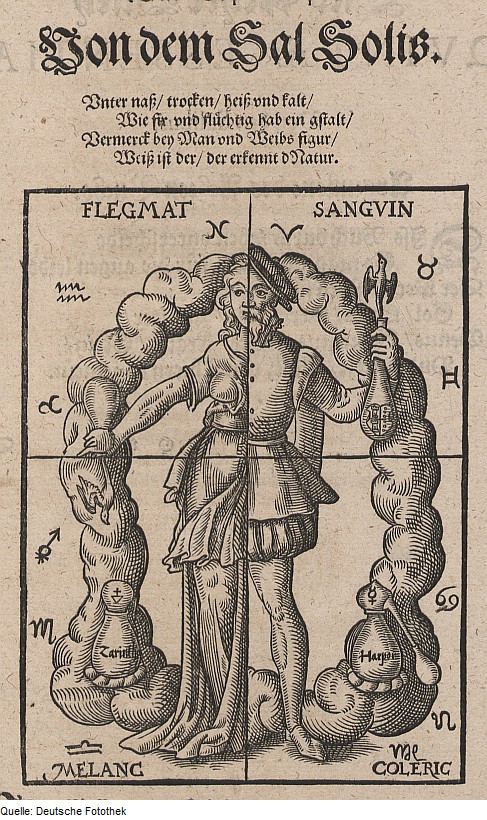
Fig. 11 – Woodcut illustration from Leonhart Thurneisser zum Thurn’s Quinta Essentia (1574) depicting the four humours.
The presence of exactly four anther-dots per floral motif operates on a dual register, bridging the aesthetics of music with the mechanics of astral medicine. Musically, the four dots suggest the four standard voices of a contemporary polyphonic composition (the superius, altus, tenor, and bassus).[63] Medically, within the Neoplatonic framework of the Urbino court, the number four and the colors red and black evoke the four humours of the human body (fig. 12). Red signifies the sanguine, life-giving humor of blood (sanguis), while black represents the heavy, melancholic humor of black bile (atra bilis).[64] Ficino argued that the body is composed of these humours, and that specific musical harmonies and proportions have the power to regulate and balance them within the human spirit. To reinforce this exact synthesis of music and medicine, Ficino wrote in the Proem to De vita that “one and the same Phoebus [Apollo] is the discoverer of medicine and the master of poesy, and he gives us of his life not only by herbs but through the lute and music.”[65] He further specified that a song “full of spirit and meaning… has as much power as does any other combination of things [e.g., a medicine] and casts it into the singer and from him into the nearby listener.”[66] Thus, the four red and black anthers function simultaneously as a musical time signature and an astro-medical diagram.
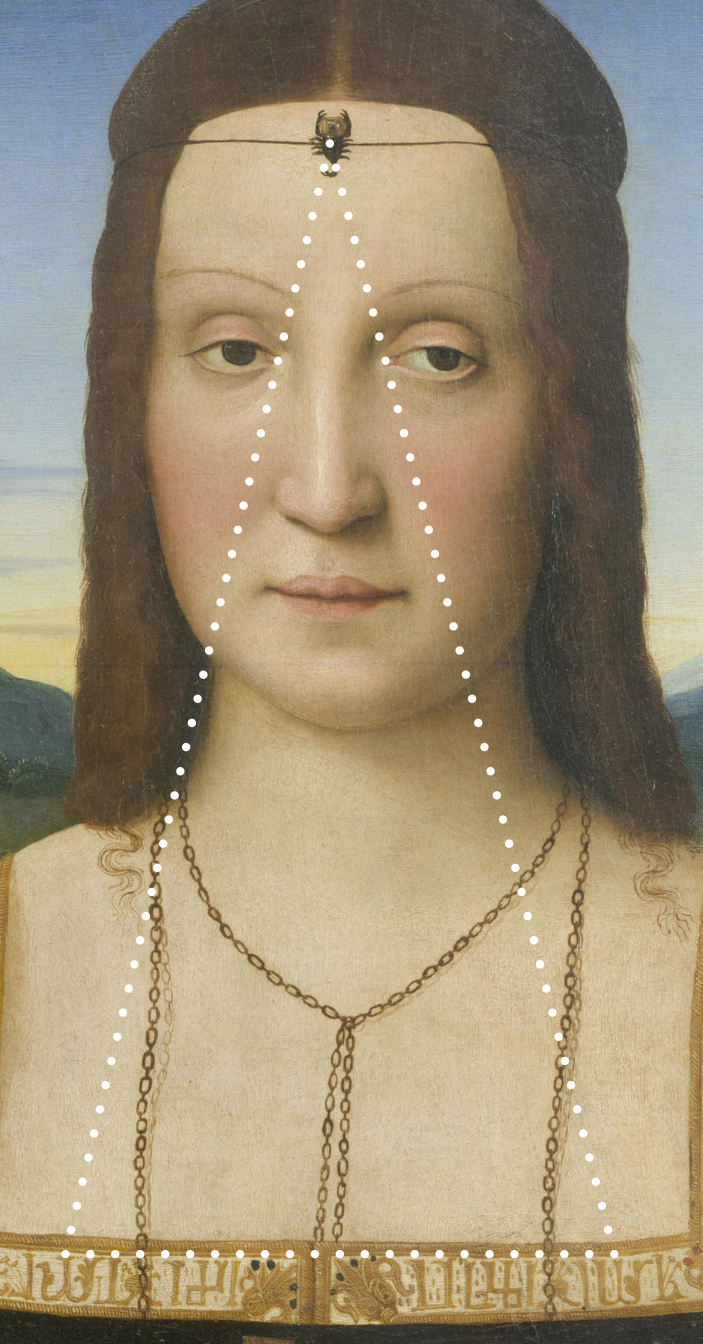
Fig. 12 – An exact Venusian Golden Triangle connects the “fallopian” Omega lunar nodes at the neckline’s base to the scorpion—the astro-medical ruler of fertility—situated at the apex of Elisabetta’s mind.
The nature of this silent prayer is further enhanced by its haptic, or tactile, dimension. In Renaissance portraiture and courtly etiquette, noblewomen frequently touched their garments or rested their hands near their necklines in stylized gestures indicative of modesty and religious contemplation.[67] Under the guise of these conventional movements, Elisabetta’s fingers would have met the varying shapes of the “L” homophones. This use of multiple, differing symbols to represent a single plaintext letter—known as homophonic substitution—was the cutting-edge steganographic defense of late fifteenth-century Italian cryptography, specifically engineered by state chancellories to disguise the linguistic frequencies of vowels and frustrate cryptanalysis.[68] Because the heavy gold threads of these homophones created a distinctly raised, topographical texture, the encrypted neckline functioned practically as a tactile rosary. This haptic cryptography allowed the Duchess to physically ‘read’ her prayer and activate the talismanic circuit through finger-memory, silently reciting the soggetto cavato even in total darkness or while under the intense, public surveillance of the court.[69]
The efficacy of this visual polyphony did not rely on the viewer’s ability to consciously read or decipher the text. Recent scholarship analyzing Ficino’s marginalia on the works of Plotinus and Iamblichus demonstrates his belief that union with the divine, or the drawing down of celestial rays, was achieved not through discursive reasoning, but through physical contact with the mathematical structures of sound and visual figures. Under these Neoplatonic mechanics, the dress functioned as a literal machine for capturing astral energy, operating independently of human comprehension.[70] Furthermore, this localized concealment of truth perfectly mirrored the socio-political anxieties of the Renaissance court. In the environment of Urbino, chronicled by Castiglione, courtly behavior was dominated by the tension between sprezzatura (the outward display of effortless grace) and the concealment of true ‘inwardness.’ In a culture of constant surveillance and civil dissimulation, where expressing one’s vulnerable inner reality was a severe liability, Elisabetta’s encoded gamurra acted as the ultimate defense. It elevated her garment from an astro-medical tool to a masterpiece of psychological defense, protecting the desperate reality of her husband’s condition from the predatory gaze of the court.[71]
The disparate elements of the garment altogether coalesce into a singular operative engine. The geometric grid of the bodice provides the rhythmic tactus and the potential for sound, while the puncts and four-part coloration of the hem dictate the complex rhythmic chant of the soggetto cavato. Furthermore, the exact characters woven into the hem solidify the garment’s astral-magical circuit. Positioned near the far right and left corners of the horizontal hem are two distinct Omega-shaped (W-shaped) glyphs. In Renaissance astrology, the Omega shape was the standard symbol for the Lunar Nodes (Caput and Cauda Draconis, the Head and Tail of the Dragon), which govern eclipses and the amplification of planetary influences. Strikingly, the ancient glyph used to denote the ascending lunar node (☊) was historically interpreted as a literal anatomical diagram of the female fallopian tubes and the reproductive cavity of the Great Mother.[72]
Because the scorpion monile on Elisabetta’s forehead functions as an active astro-medical talisman, these nodal characters in the hem act as celestial anchors. When the center apexes of these two flanking characters are visually connected to the central blue-grey jewel held in the scorpion pendant resting upon Elisabetta’s forehead, they form an exact acute isosceles triangle, specifically proportioned as a “golden triangle” (fig. 12). In the context of Renaissance astrology, this triangulation is far from coincidental; it physically embodies the geometric signature of the planet Venus. As contemporary astronomers understood, the synodic cycle of Venus traces a perfect pentagram across the heavens—a shape entirely constructed of golden triangles possessing base angles of 72° and a vertex angle of 36°.[73] The execution of this golden triangulation relied intimately on the specific tailoring of the gamurra. While the low, square neckline was a standard silhouette of late fifteenth-century court fashion, the designer brilliantly exploited its wide, horizontal architecture. The broad span of the neckline provided the precise baseline distance required to separate the two Omega nodes, allowing them to form the requisite 72-degree base angles necessary to connect perfectly with the scorpion at the apex.[74] This geometry of harmony was operationalized for talismanic use by Ficino, who explained that artificial figures arranged into specific cosmic proportions become capable of catching and reflecting celestial forces through sympathetic resonance.[75]
By tracing the golden triangle of Venus across the Duchess’s body, the designer created a literal, wearable figura designed to catch the celestial influx of love and fertility. Furthermore, it perfectly dictates the flow of this energy into the specific material required to hold it. According to Ficino’s strict instructions for astrological magic, an image of Scorpio “is never effective unless its material is in agreement with the star,” specifically citing stones like the sapphire, topaz, or beryl to act as the receptacle for Scorpio’s power.[76] Relying on the ancient doctrines of Firmicus Maternus, Renaissance astrologers specifically assigned the third decan of the Scorpio constellation to the planet Venus and the power of love.[77] Thus, they literally hook the power of the moon’s nodes into the fabric of the dress, creating a closed talismanic circuit: the ‘fallopian’ lunar nodes act as the generative foundation, channeling amplified cosmic moisture upward along the precise golden ratio to the sapphire-laden scorpion—the astro-medical ruler of the genitals—situated at the apex of her mind. Together, these elements form an impenetrable, silent Marian prayer. This visual polyphony was engineered to balance the Duchess’s humours and continuously activate her astral talisman, wrapping her in an aura of spiritual and biological protection while projecting an image of absolute, harmonious control to the Urbino court.
While the material and morphological evidence encourages the presence of a structured cipher, applying cryptanalysis to visual art without explicit documentary proof requires methodological caution. A skeptical observer might point to the history of cryptography—most notably the failures of scholars who have attempted to decode the enigmatic Voynich manuscript—as a cautionary tale of ‘overfitting.’[78] This phenomenon occurs when researchers succumb to the Holmesian fallacy, projecting complex cipher systems onto what may simply be arbitrary scripts or decorative flourishes. To avoid this trap, we must acknowledge that Raphael’s brushwork likely introduces slight artistic variations that disrupt a mathematically perfect decryption. However, the cognitive moat of the dress functions successfully even if the painted cipher contains such aesthetic anomalies.
In fact, these very variations highlight the danger of attributing the design of the cipher entirely to an intellectual advisor within the court’s inner circle, which risks reducing Raphael to an inert copyist. Renaissance art history increasingly recognizes the active, collaborative agency of the artist in visualizing complex intellectual conceits.[79] Raphael did not simply paint a static code dictated to him; he actively engineered its visual translation. By masterfully manipulating the tension between decoration and language, Raphael ensured the cipher remained “hovering at the frontier of ornament,” claiming his own agency in visually constructing the Duchess’s talismanic armor.[80]
Raphael’s portrait of Elisabetta Gonzaga is more than a reflexive display of courtly magnificence; it is best understood as the documentation of a working tool—an operative technology. Facing the potential collapse of her dynasty and the relentless, hostile scrutiny of the court, the Duchess did not simply wait for fate to take its course. Instead, she took the very sumptuary laws and sartorial expectations designed to restrict her body and turned them into a defensive weapon. In doing so, Elisabetta brilliantly navigated what scholars have termed the ‘court lady’s dilemma’—the intense socio-political expectation to publicly display magnificence while simultaneously remaining a passive, obedient vessel of the male lineage.[81]
In the competitive economy of the Renaissance court, this strategic self-fashioning can be understood through the economic model of ‘game theory’ and the deployment of complex ‘signals.’[82] Within the specific networks of female patronage—or ‘matronage’—the Duchess’s encrypted dress functioned as a dual-layered signal designed to manage an asymmetrical flow of information.[83] To the uninitiated or ambivalent male audience, the gold threads signaled orthodox piety, conspicuous wealth, and adherence to the domestic expectations of the Montefeltro lineage. However, to the initiated humanist networks and female allies within her inner circle, the cognitive moat of the cipher signaled her supreme intellectual competence, stoic resilience, and autonomous agency. By commissioning a garment that demanded an advanced understanding of polyphony, state cryptography, and astral medicine, the Duchess sent a clear message to her peers. She broadcasted her alignment with the era’s most advanced esoteric thinkers, daring her rivals to decode a message meant only for the initiated.
Finally, the portrait creates a deliberate phenomenological barrier governed by the spatial mechanics of the court. Because this ‘pseudo-pseudoscript’ is located along the neckline—a site of physical and social intimacy—it effectively engineers a system of distance-dependent decryption. From across a room, the viewer sees only a magnificent Duchess projecting orthodox power through an exotic, expensive dress. But as a viewer or courtier moves closer, permitted to enter the highly restricted spatial dimension of her gaze, the complexity of the script—the interspersed puncts and the topographical “L” variants—suddenly becomes visible.[84] The dress operates as a visual trap: the closer one gets to Elisabetta’s intimate reality, the more actively the cognitive moat challenges the viewer, effectively pushing back any observer who is not an initiated member of her inner circle.[85]
By weaving together the celestial power of the scorpion talisman to combat her husband’s impotence, the impenetrable logic of state ciphers, and the rhythmic weight of musical rests, Elisabetta successfully engineered a multimodal cognitive moat. Through this talismanic armor, she secured absolute informational sovereignty and, in the process, defined her own legacy, transforming her vulnerability into an active, impenetrable performance of Renaissance grace and resilience.
[1] Cohen notes that the scorpion pendant, “centrally affixed to a headband on Elisabetta’s forehead,” is one of the most unique and historically misunderstood aspects of the portrait. It has often been superficially dismissed as an emblematic device or related to her intellectual virtues. See Simona Cohen, “Elisabetta Gonzaga and the Ambivalence of Scorpio in Medieval and Renaissance Art,” Magic, Ritual, and Witchcraft 13, no. 3 (2018): 412.
[2] Eleonora Luciano was a prominent scholar and curator at the National Gallery of Art, Washington D.C., and author of significant works on Renaissance women, including her foundational study Medals of Women from the Italian Renaissance Courts (Ph.D. diss., Indiana University, 1997). She taught me what this thing is: a footnote.
[3] The portrait bears no signature or date, and its attribution has occasionally been debated in traditional historiography, with past scholars suggesting names like Giovanni Bellini, Andrea Mantegna, or Francesco Bonsignori due to its austere formal characteristics. However, the identification of the sitter as Elisabetta Gonzaga and the attribution to Raphael are generally accepted today.
[4] The portrait is generally dated to circa 1504. The black velvet gown, decorated with an asymmetrical pattern of gold and silver rectangles, proudly displays the heraldic colors of the Montefeltro family. See Simona Cohen, “Elisabetta Gonzaga and the Ambivalence of Scorpio in Medieval and Renaissance Art,” Magic, Ritual, and Witchcraft 13, no. 3 (2018): 409.
[5] Ibid., 412. Cohen notes that this type of embroidered pseudo-Kufic script was traditionally reserved for the borders of the Virgin Mary’s robes or the attire of saints, lending a sacred, albeit conventionally illegible, aura to the wearer.
[6] The transition of cryptology from an amateur, esoteric practice into a daily, applied scientia and state-regulated profession is a defining characteristic of the Italian Renaissance state. See Ioanna Iordanou, “The Professionalization of Cryptology in Sixteenth-Century Venice,” Renaissance Quarterly 66, no. 1 (2013): 1-5.
[7] The term “pseudoscript” refers to the pervasive use of invented, Orientalizing letterforms in early Italian art that appear to possess a linguistic structure but are traditionally considered illegible. See Alexander Nagel, “Twenty-five notes on pseudoscript in Italian art,” RES: Anthropology and Aesthetics 40 (2001): 228.
[8] The political and biological crises of 1504 refer to the aftermath of Cesare Borgia’s devastating exile of the Urbino court (1502–1503), coupled with the desperate dynastic fragility caused by Duke Guidobaldo’s severe gout and widely documented impotence. Cohen (2018): 429-432.
[9] Alexander Nagel defines these illegible yet structurally complex borders as “pseudo-encryptions,” noting that they mimic the look of encrypted messages but lack a decipherable key, thus engaging the viewer in a deliberate game of withheld meaning. See A. Nagel (2001): 235.
[10] Duke Guidobaldo da Montefeltro’s impotence, a defect attributed by contemporaries like Pietro Bembo to magic spells (malie), created a desperate dynastic fragility that left Elisabetta a “virgin widow,” a crisis exacerbated by Cesare Borgia’s exile of the Urbino court in 1502. See Cohen (2018): 429-432.
[11] This phrase (“la più pudica madonna del mondo”) originates from a letter written by the Mantuan castellano Silvestro Calandra to Francesco II Gonzaga on 19 April 1488, shortly after he accompanied Elisabetta to Urbino for her marriage. See Alessandro Luzio and Rodolfo Renier, Mantova e Urbino: Isabella d’Este ed Elisabetta Gonzaga nelle relazioni famigliari e nelle vicende politiche (Turin and Rome: L. Roux e C., 1893): 32–33.
[12] Renaissance sumptuary legislation functioned as an apparatus of social and moral control, regulating the luxuriousness of women’s apparel to curb both financial excess and perceived sexual immodesty. The depth of the neckline and the application of gold embroidery were frequent targets of these civic decrees. For the broader cultural implications of these laws, see Diane Owen Hughes, “Sumptuary Law and Social Relations in Renaissance Italy,” Johns Hopkins University Press (1983): 69-99.
[13] Motifs from the emblems decorating the walls and ceilings of Isabella’s private rooms—such as her musical pentagrams—were actively worked into her jewelry and gowns. These were subject to strict control, as evidenced by her written replies to women seeking permission to adopt her specific sartorial inventions. See Evelyn Welch, Shopping in the Renaissance: Consumer Cultures in Italy, 1400-1600 (New Haven: Yale University Press, 2005): 245-273.
[14] Baldassare Castiglione described Elisabetta’s wardrobe as she accompanied Lucrezia Borgia to Ferrara in 1502, noting her various opulent changes of dress, including a specific mention of “a black velvet robe embroidered with ciphers.” See Baldassare Castiglione, The Book of the Courtier, trans. Leonard Eckstein Opdycke (New York: Dover Publications, 2003): 320.
[15] The application of information theory to visual arts allows us to distinguish between the low entropy of repetitive, decorative textile patterns and the high informational entropy characteristic of deliberate cryptographic sequences. The non-repeating morphology of the neckline suggests the use of a spolvero (pouncing) drawing to transfer a specific, pre-determined encoded text to the panel.
[16] Forensic analyses utilizing infrared reflectography have confirmed that Raphael systematically employed this exact technique to rigidly define key features and complex orientations in his compositions. See Mauro Lucco, “Scientific Examination of the ‘Portrait of Costanza Fregoso’ by Raphael,” in Raphael: Il trionfo di Eros (1997): 72-73. Furthermore, modern subsurface imaging has conclusively verified Raphael’s extensive use of pricked drawings and charcoal pounce bags to map out complex, non-repeating forms without arbitrary deviation. For the detection of these carbon-filled spolveri traces via infrared reflectography, see Howell G. M. Edwards, A Raphael Madonna and Child Oil Painting: A Forensic Analytical Evaluation (Springer Nature, 2024): 37, 136.
[17] For a detailed discussion of Isabella d’Este’s correspondence with Paride Ceresara regarding the distinction between sustantia and adornamento in ancient scripts, see A. Nagel (2001): 228-235.
[18] Mantegna’s Minerva Chasing the Vices (1502) provides the most direct contemporary precedent for hiding legible Latin text within floriated, Orientalizing letterforms—an aesthetic strategy designed to withhold the visual “key” from the uninitiated viewer.
[19] Nagel defines “pseudo-pseudoscript” as the practice of disguising standard Roman letters by geometrically rotating them, flipping them, or adding trailing flourishes so that they appear to be part of an illegible, exotic alphabet. A. Nagel (2001): 228.
[20] Ibid. Nagel notes that traditional pseudoscripts typically consist of “arbitrary strokes, slashes, and squiggles” that mimic linguistic structure without carrying an actual, decipherable message.
[21] During the Renaissance, the hierarchy of the arts placed a far higher monetary and social value on luxury textiles, tapestries, and goldsmithing than on panel painting. For example, a single opulent dress made of damask or brocade frequently cost significantly more than a commissioned altarpiece or portrait by a master painter. See Marina Belozerskaya, Luxury Arts of the Renaissance (Los Angeles: J. Paul Getty Museum, 2005), 33-34; and Ulinka Rublack, “Renaissance Dress, Cultures of Making, and the Period Eye,” West 86th: A Journal of Decorative Arts, Design History, and Material Culture 20, no. 1 (2013), where the author notes that individuals composed their image through dress “at far greater expense than any pictorial image.”
[22] Unlike modern tailoring, Renaissance consumers were responsible for sourcing and purchasing the exact fabrics, linings, and haberdashery required for a garment before passing them on to the tailor. This made the consumer an active participant in the material and aesthetic choices of the design. See Elizabeth Currie, “Fashion Networks: Consumer Demand and the Clothing Trade in Florence from the Mid-Sixteenth to Early Seventeenth Centuries,” Journal of Medieval and Early Modern Studies 39, no. 3 (2009): 485-488.
[23] Ibid., 495-496. The intricate planning often required preliminary sketches (disegnatura) from the tailor, which were then transferred to the embroiderers who applied the gold thread and pearls, demonstrating a protracted, multi-stage design process.
[24] Rublack (2013): 6-34. Rublack establishes that the process of tailoring turned on an intuitive sense of bodily proportions, interlinking cognitive and somatic awareness of how clothes would come alive on the wearer.
[25] The luxurious apparel of a noblewoman was an essential display of economic honor for her natal and conjugal families. Sumptuary expenditures on dresses and overgowns (gamurre and cioppe), along with their precious textiles and embroidery, could amount to as much as fifty percent of a bride’s dowry. See Roberta Orsi Landini and Mary Westerman Bulgarella, “Costume in Fifteenth-Century Florentine Portraits of Women,” in Virtue and Beauty: Leonardo’s Ginevra de’ Benci and Renaissance Portraits of Women, ed. David Alan Brown (Washington, D.C.: National Gallery of Art, 2001), 93-94.
[26] A skeptical observer might argue that this elaborate trim is simply a manifestation of conspicuous consumption—an expensive but meaningless display of “exotic” flourishes designed purely to project financial magnificence. However, this assumption collapses when the script is viewed in tandem with the polyphonic grid of the bodice. The garment’s steganographic meaning resides not only in the potential text of the hem, but in its visible geometry. The rigorous, mathematical measure of the five-bar staves physically anchors the dress in the precise mechanics of musical theory, elevating the entire garment from arbitrary, expensive ornamentation into a highly structured, readable system.
[27] The transition of cryptology into an applied science within the Italian state bureaucracy fundamentally altered the landscape of Renaissance diplomacy. For a comprehensive overview of this professionalization, see G.F. Strasser, “The Rise of Cryptology in the European Renaissance,” in The History of Information Security: A Comprehensive Handbook, ed. Karl de Leeuw and Jan Bergstra (Amsterdam: Elsevier, 2007): 277-325.
[28] The Venetian state was particularly advanced in these practices, employing figures like Zuan Soro, who became famous throughout Italy for his ability to break intercepted ciphers without the corresponding key (levar le ziffre senza scontro). See Augusto Buonafalce, “Venetian Cryptanalysis Treatises of the Renaissance,” Cryptologia (2008): 1-2.
[29] Simonetta’s Treatise on Decipherment (1474) laid the groundwork for modern frequency analysis by codifying the linguistic behaviors of vowels and consonants in Latin and vernacular Italian. See Nick Pelling, “Fifteenth Century Cryptography Revisited” (2017): 2-4.
[30] In historical cryptanalysis, the “theory-first” approach is widely recognized as a methodological trap. Cryptologic historians explicitly warn against this fallacy in the analysis of fifteenth-century ciphers, defining it as the error of starting from a desired outcome and only then looking for supporting evidence.
[31] As Pelling notes, the introduction of homophones—where individual plaintext letters were enciphered by one of a set of different shapes—was developed specifically as a steganographic defense to disguise linguistic weaknesses that rendered ciphertexts vulnerable to frequency analysis attacks. Pelling (2017): 1-2.
[32] The use of null characters to intentionally disrupt the visual and statistical patterns of a text was a standard security measure in fifteenth-century Italian chancelleries, ensuring that even a partial decryption would yield confusing or contradictory results. Strasser (2007): 280-282.
[33] Pelling (2017): 6-8. Pelling argues against David Kahn’s traditional assertion that early homophonic substitutions were designed to combat statistical frequency analysis. Instead, Pelling demonstrates they acted as steganographic defenses to obfuscate obvious linguistic patterns, such as word-final vowels in Italian and Latin, which were vulnerable to trivial, crossword-style decoding. Consequently, the raw count and visual distribution of the “I” variants in the thirty-two-character string of Elisabetta’s dress hem visually aligns with the expected frequency of terminal vowel drops in a standard Latin Marian prayer, perfectly satisfying the rudimentary steganographic practices of the era without requiring a mathematically flattened frequency distribution.
[34] For the Renaissance understanding of occult virtues as a rational, philosophical discipline rather than simple superstition, see Brian P. Copenhaver, “Scholastic Philosophy and Renaissance Magic in the De Vita of Marsilio Ficino,” Renaissance Quarterly 37, no. 4 (1984): 529-530. Copenhaver notes that the manipulation of specific forms and occult qualities, heavily influenced by Avicenna and Thomas Aquinas, was a regular and respected element in non-magical physiological theory and natural philosophy.
[35] The severity of the dynastic crisis and Pietro Bembo’s attribution of Guidobaldo’s impotence to sorcery (malie) are detailed in Cohen (2018): 429-432.
[36] The doctrine of melothesia and the assignment of the reproductive organs to Scorpio was codified in antiquity and remained a cornerstone of Renaissance astrological medicine. See Claudius Ptolemy, Tetrabiblos, trans. J.M. Ashmand (London: W. Foulsham & Co., 1922), which served as the authoritative text on planetary influences over the sublunary world. The transmission of celestial power through the spiritus mundi is a central tenet of Neoplatonic magic; see Henry Cornelius Agrippa, Three Books of Occult Philosophy, Book I, Chap. XIV.
[37] Ibid., 17, 160. Ptolemy links the Moon to both generative moisture and the left side of the female anatomy, establishing that “the Moon and Venus are therefore said to be feminine, since their qualities are principally moist,” and concluding that “the Moon governs the palate, the throat, the stomach, the belly, the womb, and all the left parts.”
[38] For the diagnosis of Elisabetta’s chronic weakness as severe anemia, based on the letters of her attending physicians, see Luzio and Renier (1893): 50, and Maria Luisa Mariotti Masi, Elisabetta Gonzaga. Duchessa di Urbino (Milan: Mursia, 1983), 35. Furthermore, Marsilio Ficino established that red blood (sanguis) is the humor explicitly connected to air, rendering it “warm and moist”; a deficiency in blood therefore creates a humoral lack of moisture. See Ficino, De Vita, Book I, Chap. 2; and Susanne Beiweis and Lauri Ockenström, “Memory, Mercury and Magic in Marsilio Ficino’s De vita,” Rinascimento (2018): 294.
[39] For the function of the medallic reverse in revealing the inner or spiritual portrait of the sitter, see Joanna Woods-Marsden, “Portrait of the Lady, 1430–1520,” in Virtue and Beauty: Leonardo’s Ginevra de’ Benci and Renaissance Portraits of Women, ed. David Alan Brown (Princeton: Princeton University Press, 2001), 82; and Luke Syson, “Consorts, Mistresses and Exemplary Women: The Female Medallic Portrait in Fifteenth-Century Italy,” in The Sculpted Object: 1400-1700, ed. Stuart Currie and Peta Motture (Aldershot: Ashgate, 1997), 49–50.
[40] Cohen (2018): 436–439. For the definitive identification of the medallion’s reclining figure as Danaë, see Salvatore Settis, “Danae Verso Il 1495,” I Tatti Studies in the Italian Renaissance 1 (1985): 207–237.
[41] Ficino’s treatise provided the operational manual for capturing celestial benefits through physical materials. In discussing the “orders of things depending on the stars,” Ficino specifically places the scorpion under the influence of its corresponding constellation, noting that items within this astrological series possess a wonderful power against diseases of the genitals (“contra morbos genitalium mirabilem possidere”). See Marsilio Ficino, De vita libri tres, Book III, Chap. XIV; and Carol V. Kaske and John R. Clark, Marsilio Ficino: Three Books on Life (Binghamton, NY: Medieval & Renaissance Texts & Studies, 1989).
[42] Paracelsus (Theophrastes Bombastus von Hohenheim) recommended the scorpion talisman for reproductive ailments; see his Archidoxes Magicae; Archidoxes of Magic, Lib. II, trans. Robert H. Turner (London: Askin, 1656, facs. repr. 1975), 147–148.
[43] His specific instructions for the downward orientation of the amulet to cure sterility demonstrate the long-standing tenacity of these astrological cures in early modern medicine. Cohen (2018): 427.
[44] Marsilio Ficino emphasized that musical proportions and harmonious numbers operate as active figures capable of capturing celestial influence, dedicating substantial portions of his work to the power of sounds, hymns, and figures in motion to influence the spirit and body. See Denis Robichaud, “Ficino on Force, Magic, and Prayers,” Renaissance Quarterly 70, no. 1 (2017): 58-66; and Marsilio Ficino, Three Books on Life, trans. Carol V. Kaske and John R. Clark (Binghamton, NY: Medieval & Renaissance Texts & Studies, 1989).
[45] Gian Cristoforo Romano and Adriano Fiorentino were highly celebrated as musicians as well as sculptors at her Urbino court. See Cohen (2018): 437. See also Carlo Vecce, “‘The Sculptor Says’: Leonardo and Gian Cristoforo Romano,” in Illuminating Leonardo (Boston and Leiden: Brill, 2016), 231.
[46] For the use of Marian prayers as a primary vehicle for early modern steganography, see the “Ave Maria cipher” developed by Johannes Trithemius, which successfully disguised encrypted messages within innocent, orthodox prayers. See Strasser (2007): 10, 38, and Eveline Szarka, “On the Combination of Cryptography and Steganography in 17th Century Germany,” Proceedings of the 6th International Conference on Historical Cryptology (2023).
[47] The combination of scorpion astrology and Marian devotion was a functional aspect of Renaissance fertility appeals. Cohen notes that the Virgin Mary, often metaphorically linked to the miraculously conceiving Danaë depicted on Elisabetta’s own medallion, was frequently supplicated for the cure of infertility, and silver scorpions were recorded as ex-voto offerings to the Virgin. Cohen (2018): 438-446. Furthermore, late-medieval personal prayer books explicitly juxtaposed scorpion imagery with Marian devotion, such as the female scorpion grotesque accompanying the O Intemerata prayer in MS Douce 80.
[48] Evelyn Welch (2005): 245-273. Welch details how motifs, including musical symbols representing interior harmony, were strictly controlled and actively worked into Isabella’s personal jewelry and gowns.
[49] Carolyn James, “Marriage by Correspondence: Politics and Domesticity in the Letters of Isabella d’Este and Francesco Gonzaga, 1490–1519,” Renaissance Quarterly 65, no. 2 (2012): 321-352. The ceilings of her apartments utilized the pentagram and mensural rests to invoke silence.
[50] A cautious textile historian might argue that parallel bands of couched gold thread were simply a structural byproduct of securing heavy metallic threads to a dense velvet pile. However, standard reinforcement couching requires uniform, evenly spaced anchoring to maintain the fabric’s integrity. The specific 2-1-2 configuration on the Duchess’s bodice—where a subdued central axis is deliberately flanked by brighter, tightly paired rectangles—exceeds any structural necessity. This deliberate, mathematical variation in spacing and light reflection transforms a standard textile technique into a deliberate semantic undertaking, rendering the musical pentagram as a structural reality. For standard Renaissance couching techniques and the structural requirements of applying gold thread to velvet, see Rosalia Bonito Fanelli, “The Textiles of Italian Renaissance Dress as Seen in Portraiture,” Bulletin C.I.E.T.A. 74 (1997). The deviation from uniform spacing into a 2-1-2 configuration indicates an aesthetic and symbolic imperative rather than a purely structural one.
[51] Iain Fenlon, Music and Patronage in Sixteenth-Century Mantua, Vol. 1 (Cambridge: Cambridge University Press, 1980). The five-line staff was rapidly replacing the older four-line staff as the standard for sophisticated secular polyphony, an art form heavily patronized by the Gonzaga court.
[52] For the Renaissance tradition of “eye-music” and visual notational puzzles, see John Milsom, “Josquin des Prez and the Combinative Impulse,” 213; and Willem Elders, Josquin des Prez and His Musical Legacy: An Introductory Guide (Leuven: Leuven University Press, 2013), 76.
[53] In the Renaissance medical tradition inherited from Galen and adapted by Ficino, spiritus was understood as a lucid, hot blood-vapor converted from the warmth of the heart, which was then diffused via the arteries throughout the entire human body to act as the instrument of sense perception and imagination.
[54] A strict geometric reading of talismans might suggest that physical movement distorts the precise 72-degree angles of the golden triangle, rendering it ineffective. However, Renaissance tailoring and Ficinian magic accommodated—and even relied upon—dynamic motion. As Ulinka Rublack (2013) notes, Renaissance dressmaking was a process of “polychrome sculpting” relying on “embodied cognition,” meaning garments were specifically engineered to come alive through the weight of the fabric and the movement of the wearer. Consequently, the physical shifting of the angles does not break the spell; rather, it puts the Venusian geometry into motion, allowing the dress to actively catch celestial rays just as a moving musical performance captures harmony.
[55] For Ficino’s concept of the spiritus as an airy vapor produced in the heart and lungs that acts as the primary receptor for celestial influences, see Ficino, De Vita, Book I, Chap. 2.
[56] The connection between physical respiration and musical performance is firmly grounded in contemporary Ficinian medical magic rather than modern phenomenological theory. In De vita (Book III, Chap. 21), Marsilio Ficino explicitly defines the nature of song and musical incantation as a living, biological entity: “For this too is air, hot or warm, still breathing and somehow living; like an animal, it is composed of certain parts and limbs of its own.” Thus, the literal pumping of breath through the lungs provides the necessary airy spiritus required to activate the musical score and transmit its celestial influence directly to the wearer and the bystander.
[57] Isabella d’Este frequently used the musical pause (a sequence of rests on a staff) as a personal device to symbolize her mastery of silence and timing. See William F. Prizer, “Isabella d’Este and Lucrezia Borgia as Patrons of Music: The Frottola at Mantua and Ferrara,” Journal of the American Musicological Society 38, no. 1 (1985): 1-33.
[58] Beyond its musical function, the juxtaposition of brilliant gold and subdued gold carries immense sartorial weight. While gold thread denoted elite status and power, darker tones and true blacks were increasingly utilized by the nobility to project an image of piety, humility, and restraint amid the splendors of the court. See Kathryn Hennessy (ed.), “Renaissance Splendor: 1450–1624,” Fashion – The Definitive History of Costume (Smithsonian, 2012): Chapter 3. Thus, the grid’s coloration intimates balancing her dual obligations of public magnificence and private modesty.
[59] A. Nagel (2001): 237.
[60] For the development of the soggetto cavato as an intellectualized compositional technique—in which the vowels of a text are converted into musical pitches (e.g., A=fa, E=re, I=mi, O=do, U=ut)—utilized by Josquin des Prez to encode the name of his patron in the Missa Hercules Dux Ferrariae, see Leo Izzo, “Il ‘soggetto cavato’ nella Missa Hercules Dux Ferrariae di Josquin des Prez,” Musica Docta 5 (2015): 140-145; and Elders (2013): 74-75, 118-119. The link here is more than circumstantial. Josquin composed the Missa Hercules Dux Ferrariae, c. 1503-1504, specifically for Elisabetta’s immediate family at the neighboring Este court, placing the soggetto cavato technique squarely within her intellectual reach. Furthermore, Josquin actively utilized this technique to embed mathematically structured codes into orthodox Marian devotions; his five-voice motet Illibata dei virgo nutrix contains both a hidden acrostic of his own name and an ostinato motif mapping the solmization syllables la-mi-la to represent the name “Maria” (Elders, 84).
[61] The use of black and red notation, known as ‘coloration,’ was an established practice in Renaissance polyphony to symbolize temporary shifts in proportion, meter, or rhythm. See Elders (2013): 76-77.
[62] Ibid. In the mensural notation system of the Renaissance, the punctus (dot) was utilized as a vital structural component to indicate perfection, alteration, or division of notes, directly governing the rhythmic flow of a chant or polyphonic line.
[63] By the late fifteenth century, the standard texture for secular and sacred polyphony patronized by the Gonzaga and Montefeltro courts had expanded to four distinct vocal parts, establishing the structural framework of the superius, altus, tenor, and bassus.
[64] Marsilio Ficino established that the proportion in which the humours are blended constitutes an individual’s temperament, with red blood (sanguis) connected to air (warm and moist) and black bile (atra bilis) connected to earth (cold and dry). See Carol V. Kaske and John R. Clark, “Introduction,” in Ficino, De Vita, 31. For Ficino’s discussion of the balance of the four bodily humours and their effect on the spiritus, see Beiweis and Ockenström (2018): 294.
[65] Ficino, De Vita, Proem to Book 1. Ficino establishes here that the mathematical and acoustic properties of music function identically to pharmacological interventions in capturing celestial virtues to maintain the health of the body and spirit.
[66] Ibid., Chap. 21. Ficino argues that a song, operating as a living, airy animal, possesses the semantic and structural power to imprint celestial influences directly into the singer and listener. See also Robichaud (2017): 64.
[67] For the pictorial convention of female sitters raising a hand to the breast or neckline as a gesture signifying modesty, decorum, and the containment of the female body, see the analysis of Filippo Lippi’s Portrait of a Man and Woman at a Casement in David Alan Brown, ed., Virtue and Beauty: Leonardo’s Ginevra de’ Benci and Renaissance Portraits of Women (Princeton: Princeton University Press, 2001): 116-117.
[68] Homophonic substitution first appeared in Italian diplomatic ciphers (such as the Mantuan and Milanese ledgers) around 1401. It was developed specifically as a steganographic defense to mask the high frequency of word-final vowels in the Italian vernacular, ensuring that the visual pattern of the cipher did not betray its underlying linguistic structure. See David Kahn, The Codebreakers: The Story of Secret Writing (New York: Macmillan, 1967): 107-108.
[69] Ibid., 110. Gestures involving the hands resting near the neckline or breast were common visual signifiers of modesty and decorum in Renaissance female portraiture. For example, in the profile Portrait of a Lady in Red (National Gallery, London), the sitter’s hand is raised to her chest to draw together her veil in an explicit gesture of modesty. Elisabetta’s neckline cipher allows her to appropriate this standard gesture of feminine decorum to mask a covert, tactile devotional practice.
[70] Robichaud (2017): 78-79. Robichaud notes that Ficino’s annotations highlight a shared attention to non-discursive union, where contact with the divine occurs through forms and proportions rather than intellectual reading.
[71] For the mechanisms of courtly concealment and the cultural necessity of hiding one’s inner reality, see Jon Snyder, “Taking One’s Distance: Civil and Moral Dissimulation,” in Dissimulation and the Culture of Secrecy in Early Modern Europe, ed. Jon Snyder (Berkeley: University of California Press, 1997); and Perez Zagorin, Ways of Lying: Dissimulation, Persecution, and Conformity in Early Modern Europe (Cambridge, Mass.: Harvard University Press, 1990): 1-14.
[72] Haleem (2011): 25-26. Haleem notes that the benign North Node glyph (☊) canonically placed next to the Moon and Venus on Babylonian boundary stones was interpreted by scholars such as Ilse Fuhr as representing the female fallopian tubes and the reproductive organs of the Mountain Goddess/Great Mother.
[73] Ibid., 115. Haleem notes that the observation of Venus’s conjunctions “inevitably show a pentagrammic pattern” consisting of 72-degree intervals and an inner vertex of 36 degrees, forming the golden triangles that constitute the pentagram.
[74] For the tailoring of the square neckline and the sumptuary laws governing its depth, see Landini and Bulgarella (2001): 90–91. Furthermore, the exploitation of this specific border serves a profound rhetorical function. Nagel notes that Renaissance artists deliberately placed scripts on collars, sleeves, and hems because these are “labile zones, places where the body emerges from the clothing and makes contact with the world,” transforming the script into an active communication. See Nagel (2001): 237.
[75] Ficino, De Vita, Book III, Chap. 17. Ficino emphasizes that the effects of the celestials “most strongly appear” through specific angles, effectively turning the human body or talisman into a geometric receptacle for the spiritus mundi.
[76] Cohen (2018): 412, 434 (n. 6). Cohen identifies the gem as likely a topaz, sapphire, beryl, or aquamarine, and notes Ficino’s explicit mandate for these stones in Scorpio talismans.
[77] Ibid., 420. Relying on Julius Firmicus Maternus’s Matheseos libri VIII, the third decan of Scorpio was assigned to Venus.
[78] For the dangers of “overfitting” in historical cryptanalysis and the cautionary history of projecting rigid solutions onto enigmatic Renaissance texts like the Voynich manuscript (such as the discredited William R. Newbold theory), see David Kahn (1967): 873. Alexander Nagel also explicitly connects the methodological challenges of analyzing Renaissance pseudoscript to the historical attempts to decipher the Voynich manuscript, noting that unencoded pseudoscripts provide a primary body of contextual evidence to test whether the Voynich itself is simply a vast, linguistically structured pseudo-encryption. See A. Nagel (2001): 247-248.
[79] On the collaborative agency of Renaissance artists and the erudite translation of intellectual concepts into visual form, see Michael Cole, “Toward an Art History of Spanish Italy,” I Tatti Studies in the Italian Renaissance 16, no. 1/2 (2013): 37-46.
[80] A. Nagel (2001): 247. Nagel uses this exact phrase to describe Raphael’s treatment of the neckline script on the Terranuova Madonna in Berlin, noting how Raphael carefully balanced the letters to avoid mere symmetry so that they verge on geometrical figures just beyond script, hiding Latin letters in plain sight.
[81] Rose Marie San Juan, “The Court Lady’s Dilemma: Isabella d’Este and Art Collecting in the Renaissance,” Oxford Art Journal 14, no. 1 (1991): 67-78. San Juan details the paradox faced by elite women who were forced to balance the public display of power and intellect with the strict patriarchal demands of female passivity.
[82] For the strategic use of female patronage to project political and cultural agency, see Molly Bourne, “Renaissance Husbands and Wives as Patrons of Art: The Camerini of Isabella d’Este and Francesco II Gonzaga,” in Beyond Isabella: Secular Women Patrons of Art in Renaissance Italy, ed. Sheryl E. Reiss and David G. Wilkins (Kirksville, MO: Truman State University Press, 2001).
[83] For the application of Jonathan K. Nelson and Richard J. Zeckhauser’s economic model of “game theory” and “signaling” to the study of female patronage networks, see Bianca Rawlings, By Her Example: Exemplary Womanhood and Female Homosociality in the Matronage of Isabella d’Este and Eleonora di Toledo (M.A. Thesis, George Mason University, 2015): 6-13. Rawlings notes that elite women utilized signaling to convey difficult information to diverse audiences, mitigating the risk of negative patriarchal responses while establishing female kinship and agency.
[84] A. Nagel (2001): 227-248. Nagel notes how perfectly legible script was playfully camouflaged under a thin veil of ornament, forcing the viewer to scrutinize the boundary between mere decoration and message-bearing text.
[85] This distance-dependent mechanism perfectly exploits the “labile zones” of the garment. By positioning the cipher at the threshold where the body makes contact with the world, the Duchess transforms the intimacy of courtly proximity into a literal test of cryptographic initiation.
 Renaissance Bronze
Leave a comment