by Michael Riddick
Preview / download PDF in High Resolution
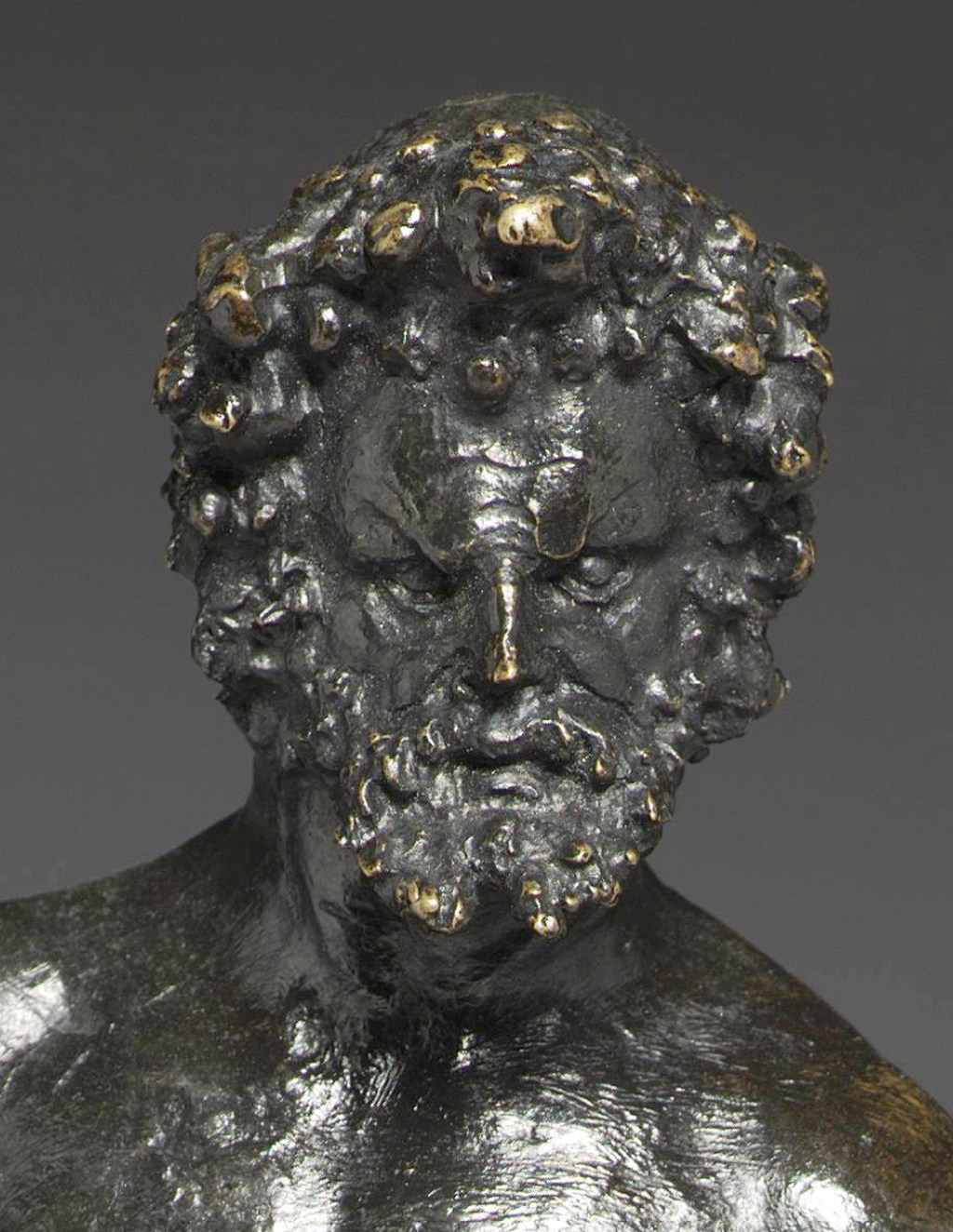
The present study was born from a long-standing curiosity concerning a funny and confounding bronze statuette, c. 1500, and measuring approximately 31 cm in height (fig. 1). The figure depicts an elder male nude poised with balanced tension atop a laurel wreath—a composition that represents one of the more challenging unsolved small bronze subjects of the Renaissance. Two primary versions are known: one at the Cleveland Museum of Art1 and an almost identical version in Paris at the Musée Jacquemart-André.2 While the Paris version has traditionally been described as a figure of Jupiter, the Cleveland version has been more broadly dubbed the Standing Figure of a Man.
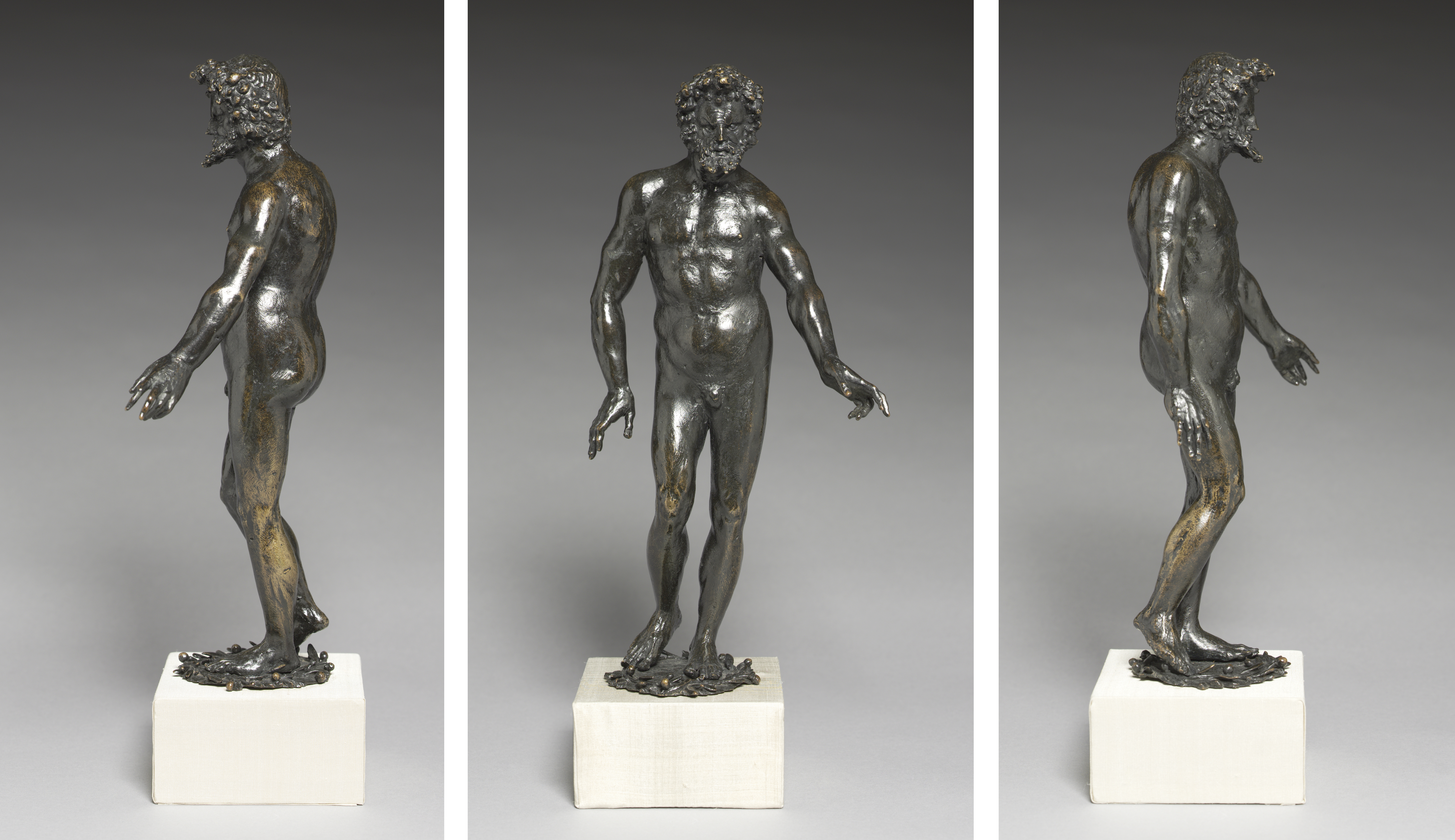
Fig. 1. Standing Figure of a Man on a Laurel Wreath, possibly an Allegory of Time Refined by Virtue. Bronze, three views, ca. 1490–1504, attributed to Francesco di Giorgio Martini (Cleveland Museum of Art, inv. 1947.509).
For the present author, the initial encounter with this bronze sparked an urge to resolve its idiosyncratic style, which seemed to defy regional categorization. My early observations focused on the fluid, almost liquid-like musculature, leading to a preliminary (and ultimately discarded) hypothesis of a superficial relationship to the influence of Agostino Busti, il Bambaia. In correspondence regarding an early draft of this paper years ago, the renowned connoisseur Patricia Wengraf offered a vital caution against publishing my thoughts, encouraging a period of further gestation. This silence proved providential; it allowed the bronze to linger in my imagination until the specific nuances of its subject and style revealed a much more potent intellectual source. A re-evaluation of the bronze suggests a daring and atypical stylistic observation: the figure serves as a bridge between the collaborative circles of Leonardo da Vinci and Francesco di Giorgio Martini.
Early 20th-century scholarship, however, largely failed to see this bridge. Otto von Falke first assigned the Cleveland statuette to a mid-16th century Netherlandish follower of Michelangelo, misinterpreting its muscular torsion for a later Mannerist impulse.3 Olga Raggio encouraged a Florentine origin, following an early attribution to Michelangelo’s mentor, Bertoldo di Giovanni, citing the expressive ferocity of the head as a hallmark of the Florentine studiolo tradition, an idea which existed with the sculpture while in the early 20th century collection of Dr. Ernő Wittmann.4 It was Erwin Ybl who eventually dismissed these suggestions in favor of Francesco di Giorgio Martini, identifying the bronze angels for the Siena Cathedral as a primary point-of-reference (fig. 2).5
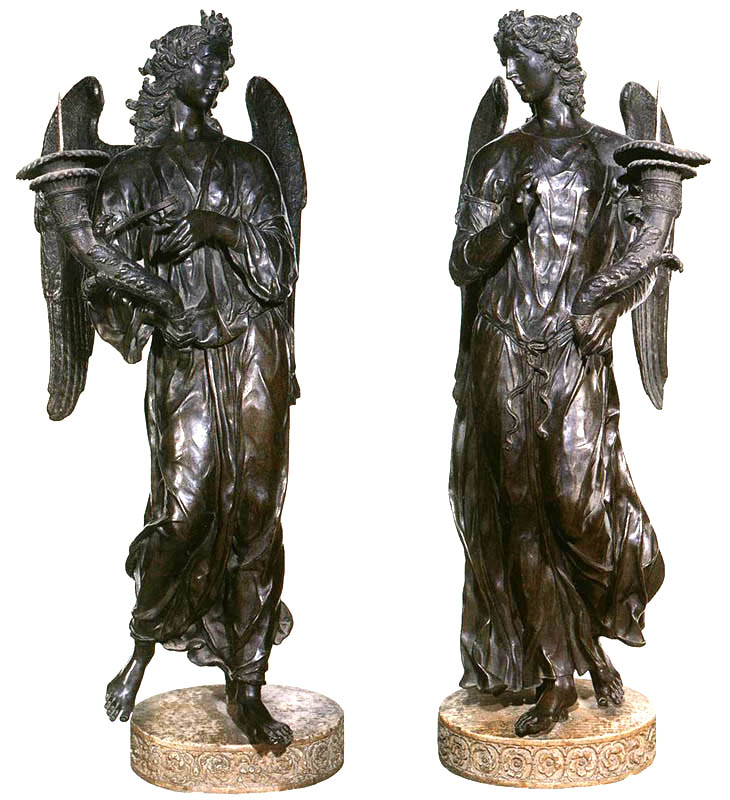
Fig. 2. Francesco di Giorgio Martini, Bronze Angels, ca. 1495–97 (High Altar of the Duomo, Siena).
While Ybl’s attribution was largely accepted or tempered to Francesco’s orbit yet championed by William Milliken in 1948,6 the Cleveland Museum’s own handbooks from 1958 to 1978 show a gradual retreat from a specific authorship to a more cautious ‘Circle of Martini’ attribution.7 However, by framing Ybl’s attribution within the present author’s inquiry into the object’s material and iconographic origins, we may hopefully reconcile this challenging statuette from a generic ‘circle of’ label to a specific material witness of the professional intersection of Martini and Leonardo in 1490.
The competition for the tiburio (the crossing tower) of the Milan Cathedral, initiated in 1487, acted as a locus of talent, drawing the era’s most formidable intellectuals like Leonardo da Vinci, Francesco di Giorgio Martini, and Donato Bramante, into a shared sphere of experimental inquiry.8 As Leonardo and Martini later journeyed together to Pavia in June of 1490 to consult on that city’s cathedral, their dialogue extended beyond the structural mechanics of domes and vaults into the very representation of the human form as a microcosm of architectural order.9 Leonardo notably possessed and annotated a manuscript copy of Martini’s Trattato di architettura (Codex Ashburnham 361), which serves as an extraordinary witness to this exchange.10
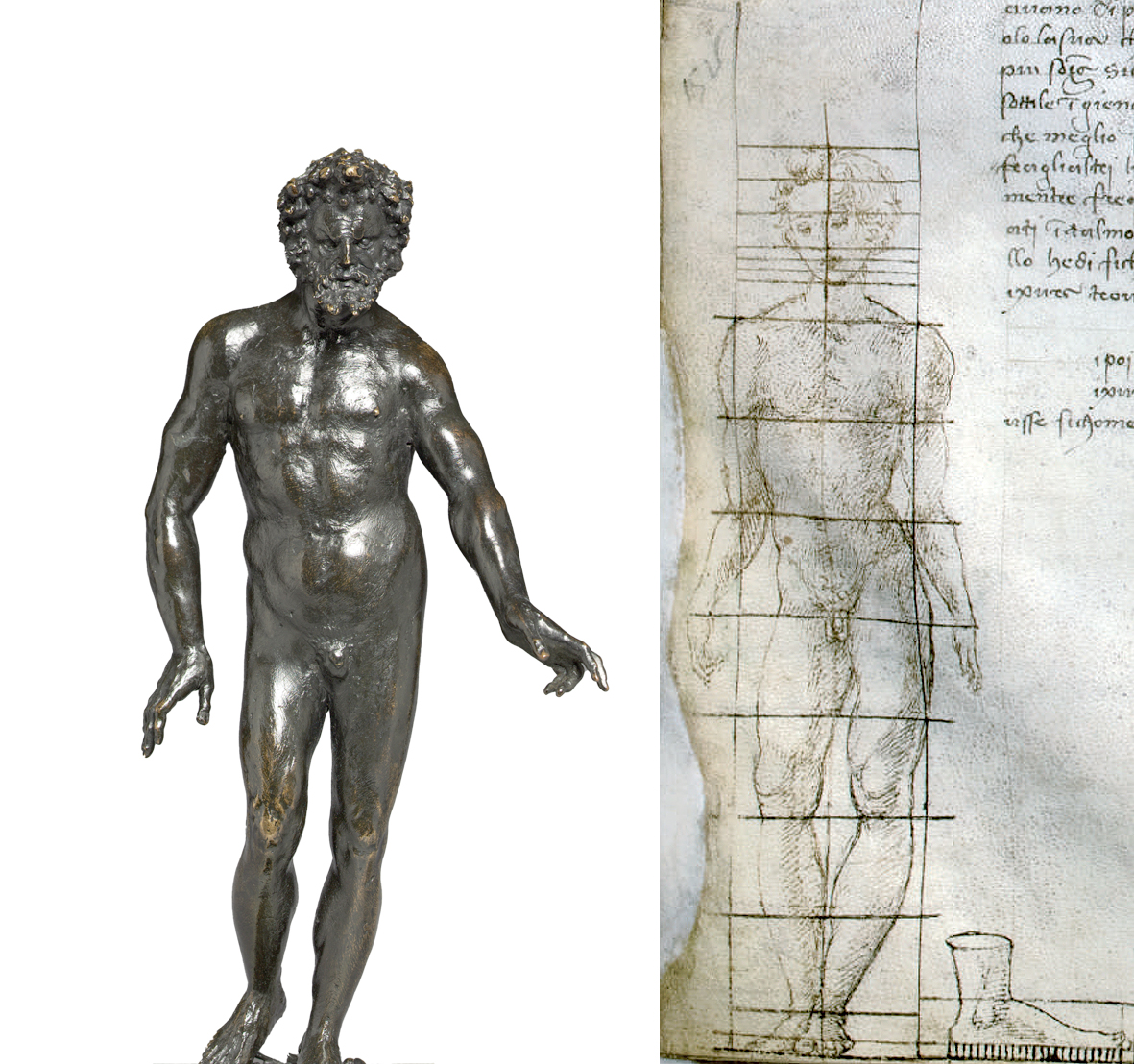
Fig. 3. Standing Figure of a Man (left; Cleveland Museum of Art) and a marginalia detail from Leonardo da Vinci’s copy of Francesco di Giorgio Martini’s Trattato di architettura (right; Codex Ashburnham 361) depicting Martini’s Vitruvian ideal, attributed to an anonymous copyist or follower of Neroccio di Landi, ca. 1480-82.
A pivotal, yet frequently overlooked detail to this collaborative engagement is found on Folio 15 verso of the Codex Ashburnham 361 (fig. 3). This page contains Martini’s fundamental discourse on the relationship between human anatomy and architectural proportion. In the upper margins, Leonardo has left two significant autograph annotations (fig. 4). Above the left column of Martini’s text, Leonardo writes the authoritative heading: “anatomia”; directly above the right column, he provides a specific procedural instruction: “il modello de l’omo si debbe fare di cera” (the model of the man should be made of wax).11
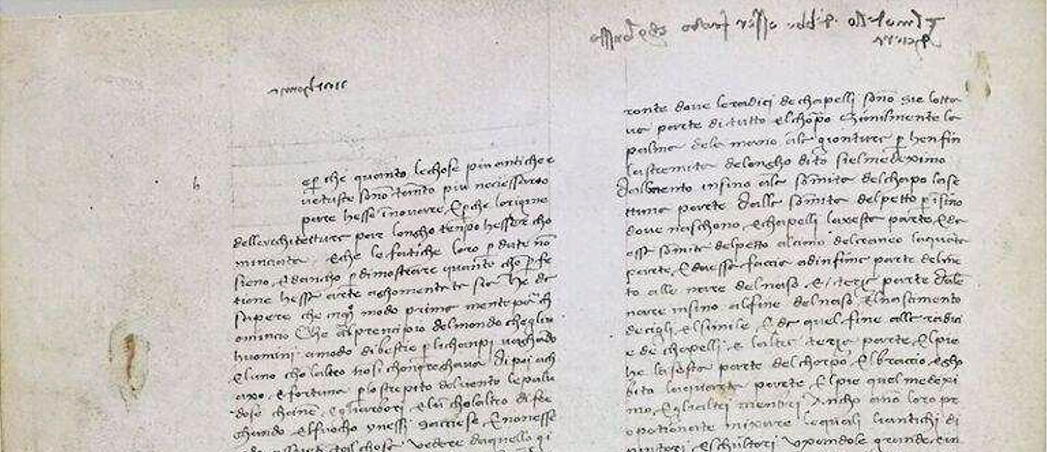
Fig. 4. Codex Ashburnham 361, Folio 15 verso (Biblioteca Medicea Laurenziana, Florence). Detailed view showing Leonardo’s autograph annotations in the upper margins: “anatomia” (left) and “il modello de l’omo si debbe fare di cera” (right)
This specific instruction aligns perfectly with Leonardo’s documented working method for resolving complex three-dimensional problems. In a comparable anatomical study, Leonardo explicitly commands: “have one made of wax a finger long” (fanne un picholo di cera lungho un dito), confirming that the fabrication of small-scale wax maquettes was his standard procedure for analyzing form—a rigorous method he seemingly imposed upon the Sienese architect to verify their theoretical discussions.12
This annotation effectively shifts the nature of their 1490 sojourn from a purely graphic or theoretical exchange to a concrete, three-dimensional study. It suggests that the anatomical discussions held between Leonardo and Martini were prompting active plastic exploration. The small nude male figure sketched in the lower margin of this folio—attributed to the circle of Neroccio di Landi—captures a moment of poised, anatomical tension that serves as a conceptual catalyst for the Standing Man. Leonardo’s autograph directive to translate this type of Vitruvian proportion into wax provides a veritable missing link in the bronze’s presumed origins. It verifies that collaborative plastic study was explicitly demanded as a tool for resolving their shared anatomical inquiries, a theoretical challenge that Martini, as a master bronze-caster, was perfectly equipped to realize.
The illustrations in Martini’s Trattato—such as the drawing of a standing young male body in full prospect on Folio 15 verso of Codex Ashburnham 361 (fig. 3, right)—advocate for a strictly proportional, static human geometry as the basis for architectural design, rooted in Vitruvian ideals of harmony.13 While Leonardo owned and annotated this text, his own independent graphic studies from this period provide a stark conceptual counterpoint. In his separate sheets of character heads and physiognomic studies, Leonardo demonstrates a desire to map the internal moti dell’animo (motions of the mind) onto the external surface of the skin, replacing static measurement with an anatomy of psychic resonance.14 These figures are defined not by strict mathematical limit or idealized perfection, but by a latent, internalized torsion where the aging musculature appears gripped by the sudden exertion of thought and lived experience.15
The Standing Man appears to be the physical embodiment of this synthesis between Martini’s and Leonardo’s genius. It retains the elongated, slender proportions of the Sienese tradition—specifically the lanky limbs and hipless torso observed in Martini’s Bronze Angels—yet it is infused with a Leonardesque anatomical tremor of the limbs, where the rough casting preserves a sense of the biological pulse beneath the surface. This departure from the idealized Quattrocento nude moves toward a scientific naturalism that favors the reality of the aging, active body—the human machine at its peak of wisdom—over the perfection of the traditional classical idol.16
The specific plastic choices in the bronze further underscore this departure from the static ideal. The pot-bellied profile and the knobby articulation of the joints suggest a skeletal structure under internal pressure—a physical manifestation of the moti dell’animo that treats the aging physique as a site of lived experience rather than a decorative form.17 This scientific naturalism is punctuated by the articulation of the hands, which are relaxed, splayed, and suspended in a state of rhetorical poise.
The hypothesis that the Standing Man derives from a Leonardesque influence is encouraged by the graphic practices of Leonardo’s immediate circle. The splayed, rhetorical hands of the bronze—acting as conduits for intellectual agency—find a direct echo in the highly finished red-chalk studies of Cesare da Sesto (fig. 5). While previously attributed to Leonardo himself, modern scholarship securely recognizes these studies at the Gallerie dell’Accademia as the work of Cesare, an artist who was profoundly shaped by his proximity to Leonardo and who used drawing as a deliberate means of appropriating the master’s inventions.18 Cesare’s rigorous studies of hands and arms demonstrate the degree to which he assimilated Leonardo’s style and spirit into his own visual vocabulary.19 Rather than viewing Cesare’s drawing as a completely independent creation, it should be understood within the complex ‘chain-like repetitions of designs in Leonardo’s workshop,’ where motifs were heavily circulated and exchanged.20 Therefore, the striking anatomical and gestural parallels between Cesare’s drawing and the Standing Man suggest that the bronze embodies a core Leonardesque influence—one so fundamental to the master’s aesthetic that it was actively copied, studied, and preserved by his closest followers.
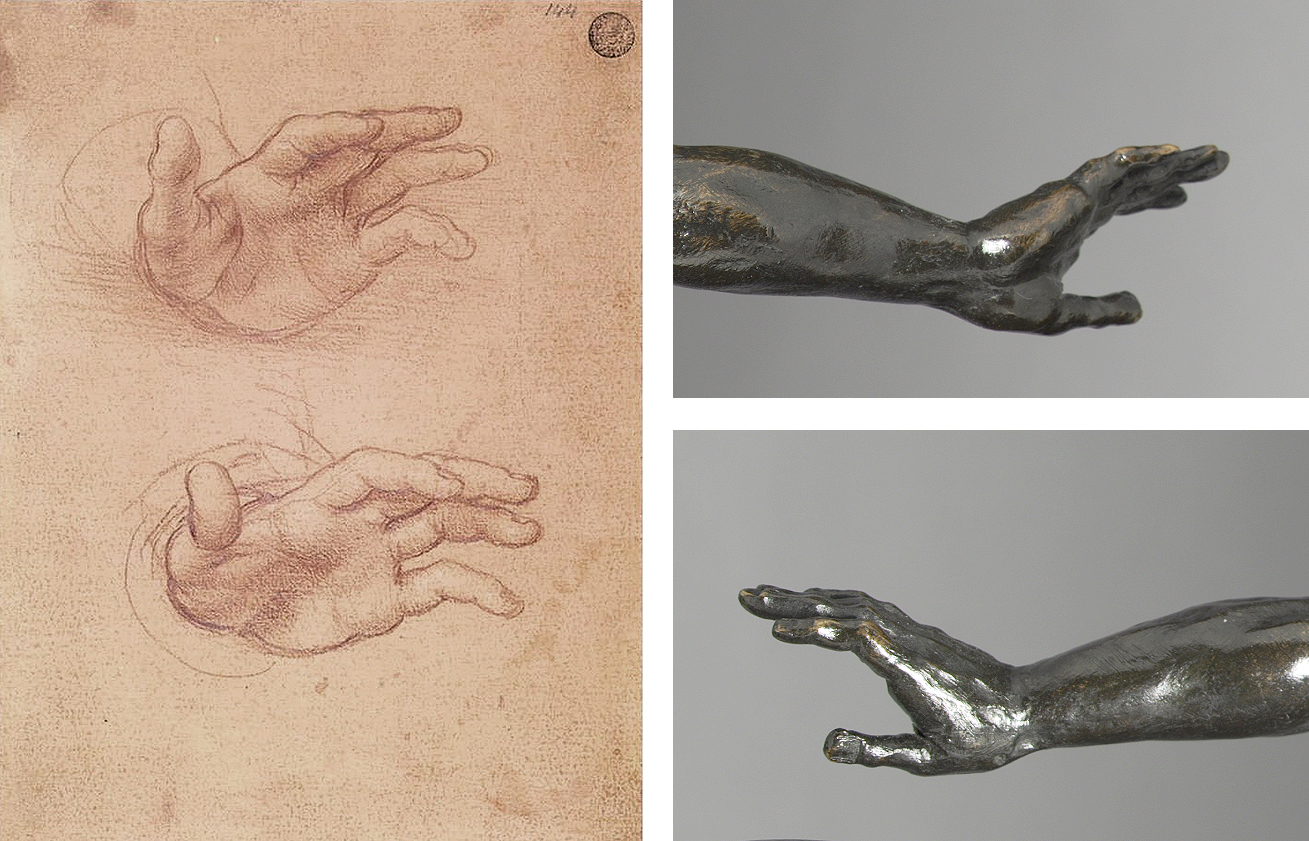
Fig. 5: Left: Cesare da Sesto, Study of Left Hands (Gallerie dell’Accademia, Venice, inv. 140). Right: Detail views of the splayed, rhetorical hands of the Standing Man bronze, acting as conduits for intellectual agency.
The crude quality of the casting in the Standing Man should be interpreted not as a technical deficiency, but as a deliberate aesthetic strategy. By eschewing the highly polished finish typical of the Paduan-Venetian tradition, the present author suggests the maker sought to preserve the raw, tactile energy of the original wax manipulation. This preservation of the “artist’s touch” demonstrates Martini’s deep assimilation of the Leonardesque aesthetic of the componimento inculto.21 By retaining the finger-pressed texture of the hair and face in the final bronze, the sculptor deliberately prioritizes the spontaneous vitality of a primo pensiero (first thought) over the sterility of a perfect finish. Furthermore, as Edoardo Villata has observed regarding small sculptural models produced in the Leonardesque milieu, technical imperfections or a lack of high polish should not lead critics to hastily dismiss a work’s relevance; for a studio model or bozzetto intended for internal workshop reference rather than commercial sale, such roughness is not only expected but serves as a hallmark of its function and genesis.22
While the visual evidence of the casting suggests a Renaissance origin, this hypothesis would surely require further scientific corroboration. Future X-ray fluorescence (XRF) analysis of the alloy is necessary to definitively situate the statuette within the leaded-bronze tradition of the late Quattrocento, distinguishing it from later high-zinc surmoulages, a methodology successfully applied to the Budapest Horse to distinguish genuine experimentation from later imitation.23
The hypothesis that the Standing Man derives from a Leonardesque influence is encouraged by a specific corpus of red chalk studies originating from the Milanese workshop, such as those by Giovanni Agostino da Lodi.24 Traditionally cataloged as character studies or testa virile, these drawings demonstrate how Leonardo’s private, often “grotesque” physiognomic experiments were codified into a repeatable visual vocabulary. A red chalk study in the Biblioteca Ambrosiana by Lodi (fig. 6) provides a useful thematic comparison for the bronze. While frequently identified as a study for Saint John the Baptist—owing to the wild, energetic hair and intense gaze—its exploration of tousled curly hair and a pointed beard reflects the same artistic preoccupations seen in the Standing Man.
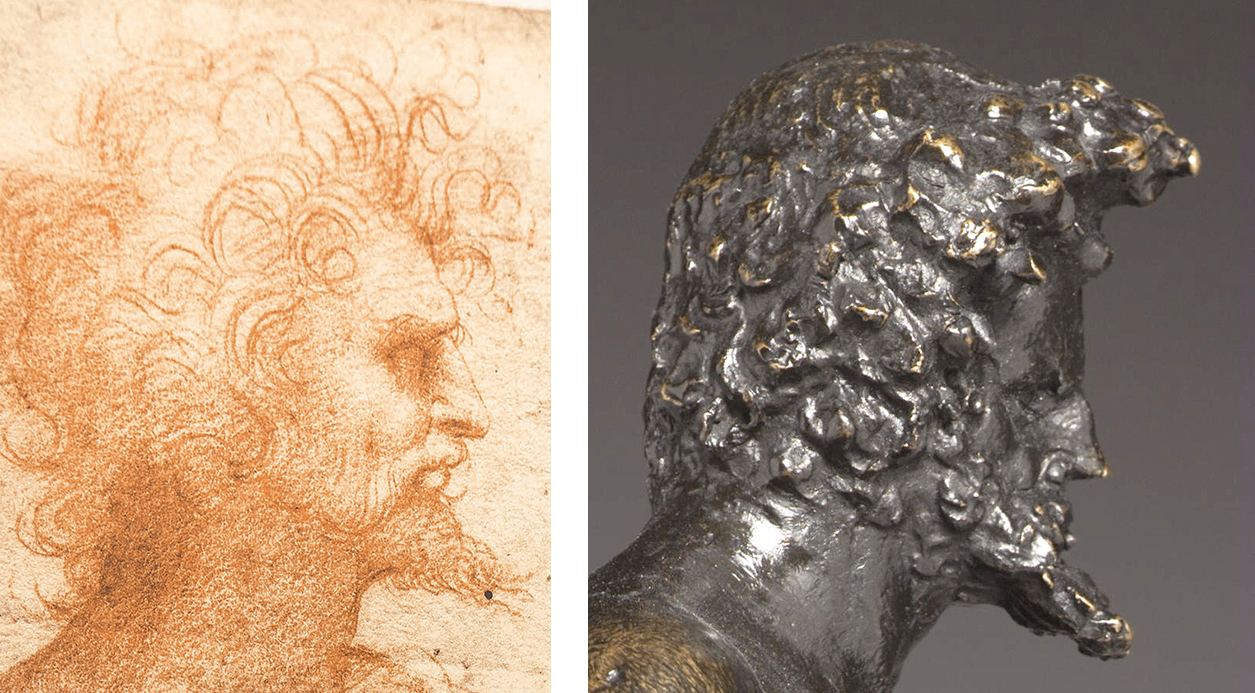
Fig. 6: Left: Giovanni Agostino da Lodi (after Leonardo da Vinci), red chalk study of a male head, Biblioteca Ambrosiana (inv. F 263 inf., sheet 52). Right: Profile view of the bronze Standing Man.
This thematic parallel suggests a shared engagement with a specific Leonardesque vocabulary of high psychological tension. In both the bronze and the Ambrosiana sketch, one observes a severe pursing of the brow—a Leonardesque trope for signifying intense intellectual or spiritual concentration.25 Rather than assuming the statuette derives from this specific secondary source, the immediacy and tactile quality of the bronze’s face suggest it belongs to the broader culture of three-dimensional character studies produced in Leonardo’s orbit.
Consequently, the relationship between the bronze and the graphic study may not exist in a simple hierarchy of copyist and original drawing.26 Both the bronze and Lodi’s sketch participate in the shared physiognomic experiments that permeated Leonardo’s Milanese workshop. Such cross-pollination was fundamental to Leonardo’s pedagogical method; as documented by his pupil Francesco Melzi—who annotated one of his own drawings of an old man as being ‘first derived from the relief’ (cavata de relevo)—Leonardo actively required his assistants to copy from plastic models.27 Thus, while the Ambrosiana drawing cannot be definitively proven to be a direct copy after Leonardo, it serves as a graphic record of the exact type of grotesque character studies that Leonardo and his circle were exploring in both two and three dimensions during the exact window of his interaction with Martini.
Perhaps the most suggestive evidence for this shared aesthetic milieu is the treatment of the figure’s hair. Departing from the stylized, rhythmic curls typical of the Sienese Quattrocento, the Standing Man displays a burst of unkempt, wiry, and springy hair. This treatment finds a conceptual parallel in several of Leonardo’s own sketches—specifically his studies of “monstrous” or “grotesque” heads—where hair is actively explored as a chaotic, organic extension of the figure’s internal energy (fig. 7).28 Rather than representing a direct, literal translation of a specific two-dimensional sketch, the wiry quality of the beard and the finger-pressed texture of the locks in the bronze reflect a broader Leonardesque ideal: the desire to capture the spontaneous, fluid vitality of a primo pensiero directly within the malleable medium of wax.
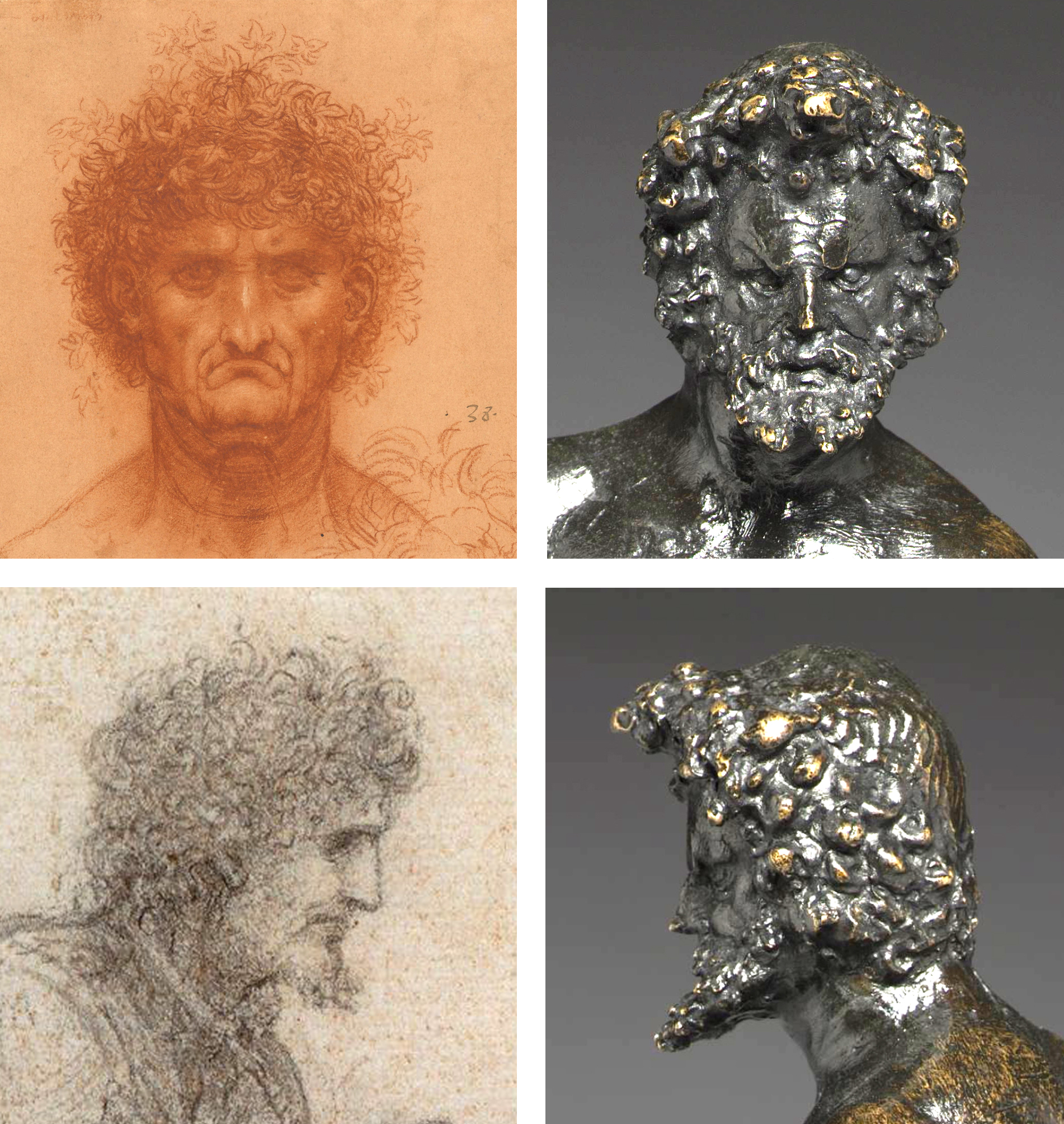
Fig. 7. Details of drawings by Leonardo da Vinci: Top-Left: Royal Trust Collection, UK, inv. RCIN 912502; Bottom-Left: Royal Trust Collection, UK, inv. RCIN 912573; and the Standing Man bronze.
Earlier studies on the subject of this bronze figure suggested mythological identities like Jupiter or Apollo yet overlooked the specific context of the laurel wreath as it was understood in the circles of the Sienese elite and the broader intellectual milieu of late fifteenth-century Milan. While the anatomical impetus for the figure likely derives from the Vitruvian exchanges between Leonardo and Francesco di Giorgio Martini regarding the human microcosm, its placement atop a laurel wreath suggests a deliberate conceptual shift. This appropriation may have been a specific addition to the initial wax model, intended to transform an experimental anatomical study into a finalized, allegorical bronze figure. Endowed with this symbolic base, the statuette would have been elevated from a private workshop reference to a sophisticated object, presumably destined for a humanist studiolo or functioning as a prestigious diplomatic trophy. By evaluating how this specific iconography resonated within the interconnected worlds of its makers, one might delineate two compelling prospects for the bronze’s original audience.
Apart from serving as a structural stabilizer for the bronze itself, the figure’s act of standing atop a laurel wreath29 finds its intellectual justification in Petrarch’s Collatio laureationis (Coronation Oration). In this seminal text, Petrarch redefined the laurel not as a sign of military glory, but as a boundary between the virtuous mind and “vulgar concerns.” His principle—Vulgaria oportet linguere sub pedibus (Vulgar concerns are left most properly beneath one’s feet)30—provides a literal reading for the bronze’s composition. By placing the figure atop the wreath, the sculptor presents us with a “Philosopher-Victor” who has risen above the material rewards of his struggle.
This profound, poetic allegory would have found a highly receptive audience within the refined humanist culture of the Sienese elite. Families such as the Piccolomini—who boasted the “great Humanistic Pope” Aeneas Silvius Piccolomini (Pius II)—cultivated an environment where such sophisticated literary motifs and all’antica vocabulary thrived.31 Francesco di Giorgio Martini was deeply embedded in this intellectual milieu; when he rewrote his Trattato di architettura (Trattato II) in the late 1480s, he deliberately adopted the model of a learned humanist commentary, explicitly incorporating dozens of citations from authoritative texts, including those of Aristotle, Vitruvius, Cicero, and Petrarch.32 This confirms that Petrarchan philosophy was actively circulating in Martini’s immediate working vocabulary during the exact period the bronze was likely conceived.
Such an interpretation is consistent with the antiquarian reconstructions produced in Martini’s immediate circle. The Yale Album (Yale Center for British Art), a corpus of drawings derived from Francesco’s workshop, frequently combines fragmentary ancient inscriptions with invented sculptural figures to create hybrid monuments that bridge the gap between archaeological record and imaginative reconstruction. Notably, the album contains figures of similar gravity, including a bearded figure crowned with a laurel wreath which, like the Standing Man, defies simple imperial categorization in favor of a more philosophical or allegorical reading.33
As Max Seidel explores in ‘Il Palazzo del Magnifico a Siena,’ the courtly environment of Pandolfo Petrucci was a hub for high-level artistic exchange where Sienese traditions met the ‘modern’ influences encountered by Martini during his travels to Milan and beyond,34 making him a probable candidate for delivering or embellishing a bronze born from a Leonardo-inspired modello that would have served as a valued studiolo object or diplomatic trophy.
The collaborative counterpart to this work, Leonardo da Vinci, was also keenly aware of the symbolic weight of the laurel in Petrarchan discourse. While Leonardo approached the subject with his characteristic pragmatism and wit—mocking the humanist trope in his notebooks by stating, “If Petrarch was so fond of bay [laurel], it was because it is of a good taste in sausages and with tunny; I cannot put any value on their foolery”35—his commentary verifies that the association between Petrarch and the laurel was a lively topic of debate in his immediate world. Ultimately, this shared awareness between Martini and Leonardo forms a crucial intellectual bridge, allowing the Standing Man to function simultaneously as a materialization of advanced Milanese anatomical science and a sophisticated Sienese humanist allegory.
Alternatively, the identification of the figure as Saturn provides a compelling bridge between the sculpture’s elder anatomy and the specific intellectual atmosphere of the 1490 Milanese intersection. Unlike the idealized, youthful Apollos found in contemporary Paduan bronzes, the Standing Man exhibits a weathered, “monstrous” physiognomy and a distinct pot-bellied profile that aligns with the late fifteenth-century conceptualization of the melancholic deity. In the Neo-Platonic rhetoric of the era, the Saturnian temperament was inextricably linked to deep contemplation, natural philosophy, and profound wisdom36—qualities that provide a functional explanation for the sculpture’s psychological intensity and its heavily articulated moti dell’animo.
This Saturnian identity resonates powerfully with the propagandistic themes of the Sforza court, particularly during the 1490 Festa del Paradiso, for which Leonardo designed the spectacular revolving heavenly machinery. While Jupiter presided over the theatrical cosmos, Saturn played a pivotal role in the narrative. In Bernardo Bellincioni’s libretto for the event, Saturn descends to the stage to offer the gift of time, declaring: “I’ vo’ che gli anni d’Isabella eterni / Al mondo sien, e da mie man sicuri” (I want Isabella’s years to be eternal in the world, and safe in my hands).37 A bronze depicting a muscular but aged Saturn, born from Leonardo’s anatomical studies during this exact period, would serve as a sophisticated material witness to this Sforza-Sienese political rhetoric. By placing this elder nude atop a laurel wreath—a symbol of undying virtue—the sculptor creates a profound, lasting image of “Time refined by Virtue.”
Regardless of whether the final bronze was destined for a Sienese humanist or a Milanese courtier, Francesco di Giorgio Martini stood as the most viable candidate to realize its material form. Possessing a singular combination of high-level diplomatic access to both spheres. He was a practiced plastiatore and virtuoso caster whose existing corpus demonstrated the technical facility required to transpose avant-garde Leonardesque anatomical breakthroughs into the sophisticated medium of bronze. In this light, Martini emerges as an ideal intellectual collaborator, capable of synthesizing Leonardo’s theoretical concepts and giving them permanent, material form as collectible objects for the studiolo.
To fully evaluate the Standing Man, one must look toward its sibling in Paris. The example held at the Musée Jacquemart-André provides a vital benchmark. Because a modern physical juxtaposition of the two bronzes is challenging, Erwin Ybl’s 1929 firsthand analysis of both figures remains an essential comparative touchstone. Ybl recognized that both casts share the exact same lanky proportions—which he identified as a hallmark of Francesco di Giorgio’s Sienese vocabulary—alongside the pinched facial expression and springy hair, strongly suggesting both were derived from the same original wax or clay archetype.38
Yet, despite their shared genesis, there are subtle differences in their after-work and surface treatments. The Cleveland version retains a rugged, tactile surface—a modello-like finish that Ybl historically observed still bore an “original lacquer patina”39—while the Paris version displays a marginally smoother, unpatinated finish. This variance is typical of Renaissance workshop practice, where multiple casts from a single matrix could be finished to varying degrees based on the patron’s aesthetic preference. The existence of these two high-quality versions reinforces the idea that the figure was not a one-off experiment, but a recognized “type” celebrating the anatomical breakthroughs of the 1490 collaborative period between Leonardo and Martini. The successful synthesis of these complex, internalized anatomical concepts into a three-dimensional bronze establishes a critical collaborative paradigm, one that reflects their shared dialogue and directly anticipates the sculptural endeavors of Leonardo’s later career.
This collaborative synergy between Leonardo and Martini anticipates Leonardo’s later, documented involvement with Giovanfrancesco Rustici during the creation of the St. John the Baptist Preaching for the Florence Baptistery (1506–1511). Just as Leonardo’s Ashburnham annotations provided the intellectual and plastic anima for the Standing Man, Vasari records that Leonardo was ‘never absent’ while Rustici modeled the St. John group, often providing the preparatory sketches and clay modelli that Rustici then translated into bronze.40 The Standing Man may thus serve as an early precursor to this collaborative dynamic. However, rather than functioning strictly as ‘delegated sculpture’—where a caster merely executes Leonardo’s orders42—the bronze represents a profound intellectual synthesis. It stands as a material testament to Martini actively absorbing Leonardo’s avant-garde theories on the moti dell’animo and translating them through his own virtuoso Sienese casting traditions to achieve a final, permanent form.
The Standing Man thus represents far more than a calculated attempt to integrate Leonardo’s anatomical breakthroughs into the lyrical tradition of Sienese bronze-casting, rather, it is the physical culmination of their 1490 intersection. It stands as a work touched by the influence of Leonardo, born from a deliberate synthesis where theoretical Vitruvian debates were actively translated into a wax modello. Whether it functioned as a “Philosopher-Victor” for a Sienese humanist or an allegory of Saturnian Time for the Sforza court, the bronze preserves the raw, expressive energy of Leonardo’s moti dell’animo within Martini’s elegant framework. By recognizing this collaborative synergy, this challenging statuette is firmly reallocated from the generic margins of the “Circle of Martini.” It remains instead a definitive material witness to a fleeting moment when two of the greatest minds of the High Renaissance gave permanent, metallic form to their shared genius.
Endnotes:
1 Cleveland Museum of Art, Inv. 1947.509.
2 Musée Jacquemart-André, Inv. 453.
3 Otto von Falke, Die Sammlung Richard von Kaufmann (Berlin, 1917), no. 254.
4 Olga Raggio, Early Renaissance Sculpture from Northern Italy 1440-1540 (New York, 1973).
5 Erwin Ybl, Francesco di Giorgio Ismeretlen Bronzszobrocskája (Budapest, 1929), 109-117.
6 William Milliken, “A Renaissance Bronze from Sienna,” Bulletin of the CMA 35, no. 9 (1948).
7 See the Handbook of the Cleveland Museum of Art editions from 1958, 1966, and 1978.
8 Giulia Ceriani Sebregondi, “The Design Process and the Building Site: Leonardo da Vinci at Milan Cathedral as a Case Study,” Architectural Histories 10, no. 1 (2022).
9 Documents confirm Leonardo and Martini were together in Pavia in June 1490. See ASMi, Autografi, 102, f. 34 (8 June 1490) and ASMi, Comuni, 48 (10 June 1490).
10 Biblioteca Medicea Laurenziana, Florence, Codex Ashburnham 361.
11 Codex Ashburnham 361, fol. 15v.
12 For Leonardo’s habit of using wax models for anatomical and structural analysis, see Leonardo da Vinci: Anatomist (Royal Collection Trust, 2012), 254; see also Martin Kemp, “Leonardo e il modello di cera di un cavallo ben proporzionato,” in Leonardo: Dagli studi di proporzioni al Trattato della pittura, eds. Pietro C. Marani and Maria Teresa Fiorio, exhibition catalogue, Castello Sforzesco (Milan, 2007), 47–55.
13 The drawing illustrates the Vitruvian concept (Vitruvius 3. 1. 1-9) that the harmony of the human body serves as a model for architecture. See Antonio Corso, Drawings of Francesco di Giorgio Martini inspired by ancient texts and monuments (Grecobooks, 2023), 23.
14 On Leonardo’s shift from ideal proportions to the psychological realism of the moti dell’animo (or passioni dell’anima), see Carmen C. Bambach, Leonardo da Vinci: Master Draftsman (New York: Metropolitan Museum of Art, 2003), 16.
15 Ibid. Leonardo’s physiognomic studies deliberately juxtaposed idealized youth with the realities of age and deformity to explore the physical capacity for gesture.
16 On the departure from the idealized nude, see Kenneth Clark, The Nude: A Study in Ideal Form (1956).
17 For Leonardo’s concept of moti dell’animo, see Pietro C. Marani, “I ‘moti dell’animo’ da Leon Battista Alberti a Leonardo,” in Leonardo da Vinci 1452–1519. Il disegno del mondo (Milan: Skira, 2015).
18 For the attribution of these red-chalk studies to Cesare da Sesto and their provenance, see Annalisa Perissa Torrini, Leonardo e la sua cerchia: disegni di Leonardo e dei suoi seguaci alle Gallerie dell’Accademia (Venice: Electa, 1992), 403, n. 6; see also Elizabeth H. Bernick, “Drawing Connections: New Discoveries Regarding Cesare Da Sesto’s Sketchbook.” Master Drawings, vol. 57, no. 2, (2019), pp. 147–96.
19 Elizabeth Bernick (2019).
20 On the intense circulation of motifs, shared visual vocabulary, and pedagogical copying practices among the Leonardeschi, see Carmen C. Bambach, Leonardo da Vinci Rediscovered, vol. 3 (New Haven and London: Yale University Press, 2019).
21 Carmen C. Bambach (2003), 21–22, 94–95; for Leonardo’s specific concept of the componimento inculto and its relationship to invenzione, see 107, n. 95.
22 Edoardo Villata, “Some Notes on Leonardo da Vinci as a Sculptor,” in Leonardo da Vinci & the Budapest Horse and Rider (Budapest, 2018), 73-91. Villata discusses the nature of the bozzetto and studio model. See also Gary Radke, Leonardo da Vinci and the Art of Sculpture (Yale University Press, 2009).
23 On the necessity of alloy analysis to distinguish Renaissance lead-tin bronzes from later zinc-rich casts, see Pietro C. Marani, “A Problem of Style: Old and New Considerations on the Budapest Horse and Rider,” in Leonardo da Vinci and The Budapest Horse and Rider (Budapest: Museum of Fine Arts, 2018), 31–48. For the definitive XRF analysis establishing the New York variant as a nineteenth-century high-zinc surmoulage of the Budapest cast, see Shelley Sturman, Katherine May, and Alison Luchs, “The Budapest Horse: Beyond the Leonardo da Vinci Question,” in Making and Moving Sculpture in Early Modern Italy, ed. Kelley Helmstutler Di Dio (Farnham, 2015), 25–46. For foundational technical analysis regarding the organic nature of authentic Renaissance surface finishes, see also Richard E. Stone, “Organic Patinas on Small Bronzes of the Italian Renaissance,” Metropolitan Museum Journal 45 (2010): 107–124.
24 Giovanni Agostino da Lodi’s red chalk drawings are discussed in C. Bambach (2003), 173. For the drawing see Biblioteca Ambrosiana, inv. F 263 inf., sheet 52. For a related sketch see also Getty Museum, inv. 90.GB.116.
25 Michael W. Kwakkelstein, Leonardo da Vinci as a Physiognomist: Theory and Drawing Practice (Leiden: Primavera Pers, 1994).
26 On Leonardo’s pedagogical requirement to draw from 3D models, and Melzi’s cavata de relevo notation, see Edoardo Villata (2018), 74-78.
27 Melzi’s documentation of this practice is preserved in the Trattato della pittura; see Biblioteca Apostolica Vaticana, Codex Urbinas Latinus 1270, fol. 38v, cited in Carlo Vecce, ed., Leonardo da Vinci: Libro di pittura (Florence: Giunti, 1995), 182, no. 76; additionally, Martin Kemp notes the role of circulating workshop models in Leonardo da Vinci: Experience, Experiment and Design (London: V&A Publications, 2006). See also the Codex Atlanticus, fol. 888r (324r).
28 On the “grotesque” heads and hair vortices, see also Codex Leicester, sheet 15.
29 In his 1929 publication, Erwin Ybl incorrectly identified the foliage on the base as an ivy wreath (borostyán). However, close visual inspection of the Cleveland bronze reveals elongated, lanceolate leaves accompanied by large, bulbous berries—the unmistakable botanical features of the sweet bay laurel (Laurus nobilis). This botanical correction is crucial; an ivy wreath would traditionally connote Dionysian or Bacchic revelry, whereas the definitive presence of the laurel securely roots the figure in the humanist, Petrarchan contexts of virtue and triumph proposed in this study. Furthermore, the sculptor’s careful, naturalistic inclusion of the laurel’s berries reflects the exact kind of botanical precision Leonardo da Vinci demanded in his own treatises on the representation of plants.
30 Francesco Petrarca, Collatio laureationis (c. 1341).
31 Selwyn Brinton, Francesco di Giorgio Martini of Siena: Painter, Sculptor, Engineer, Civil and Military Architect (1439-1502). Part I, (London: Besant & Co. Ltd., 1934.)
32 Elizabeth M. Merrill, “The Trattato as Textbook: Francesco di Giorgio’s Vision for the Renaissance Architect.” Architectural Histories 1, no. 1 (2013): 1–19.
33 On the Yale Album and Francesco di Giorgio’s workshop practice of reconstructing antiquity, see Michael J. Waters, “Francesco di Giorgio and the Reconstruction of Antiquity,” Pegasus: Berliner Beiträge zum Nachleben der Antike 16 (2014): 9–102 (specifically noting the creative assemblage of inscriptions and figures in the Yale and Houfe albums).
34 Max Seidel (ed.), Siena e il suo territorio nel Rinascimento, Vol. III, Florence: La Nuova Italia, 1990.
35 Jean Paul Richter, The Literary Works of Leonardo da Vinci, Vol. 2 (1883), note 1332.
36 Raymond Klibansky, Erwin Panofsky, and Fritz Saxl, Saturn and Melancholy: Studies in the History of Natural Philosophy, Religion and Art (London: Nelson, 1964).
37 Bernardo Bellincioni, La Festa del Paradiso (1490), as quoted in the contemporary libretto texts.
38 Erwin Ybl (1929).
39 Ibid.
40 Giorgio Vasari, Lives of the Most Excellent Painters, Sculptors, and Architects (1568), Life of Giovanfrancesco Rustici.
41 Tommaso Mozzati, Giovanfrancesco Rustici: le “Battaglie” di terracotta (Florence: Leo S. Olschki, 2008), 45-62. Mozzati discusses the specific nature of Leonardo’s “interventions” and his role in guiding the modeling process of his collaborators. See also: Philippe Sénéchal, Giovan Francesco Rustici, 1475-1554: Un sculpteur de la Renaissance entre Florence et la France (2007).
42 Pietro C. Marani, “A Problem of Style,” in Leonardo da Vinci and The Budapest Horse and Rider (2018), 34–35; confirming the hypothesis that Leonardo’s sculptural ideas were often realized through the technical hands of associates like Rustici.
 Renaissance Bronze
Leave a comment