by Michael Riddick
Preview / download PDF in High Resolution
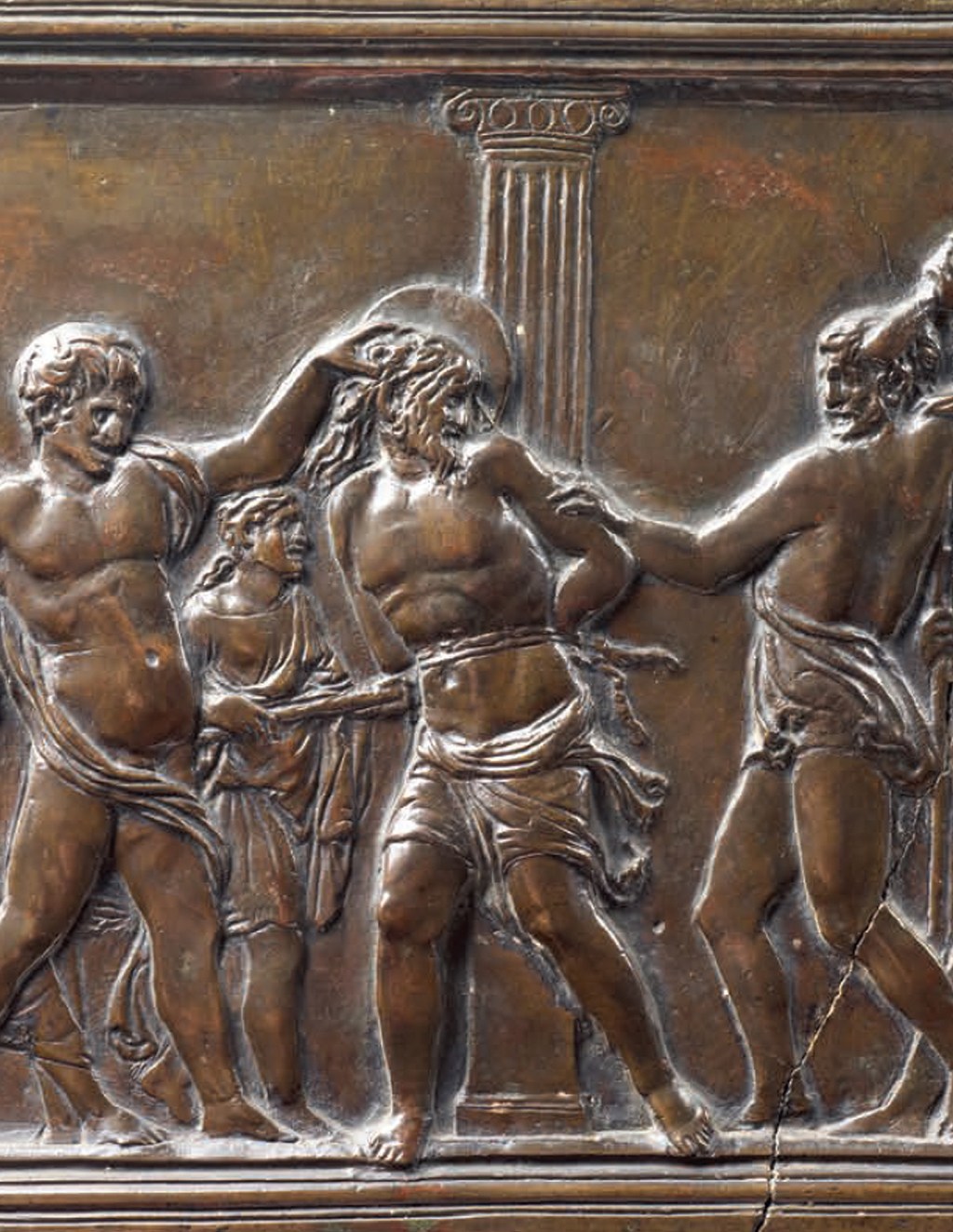
The historiography of the bronze Flagellation of Christ (fig. 1, cover) serves as a definitive case study in the shifting methodologies of Renaissance art history over the last century and a half. The relief has long been the subject of a conceptual “tug-of-war” between those who sought the hand of Donatello’s genius and those who found only the footprint of his workshop. This debate is firmly rooted in the late nineteenth-century era of “connoisseurship as conquest,” a period where the Berlin museums, under the formidable leadership of Wilhelm von Bode, sought to define the master’s corpus with an almost voracious inclusivity.1
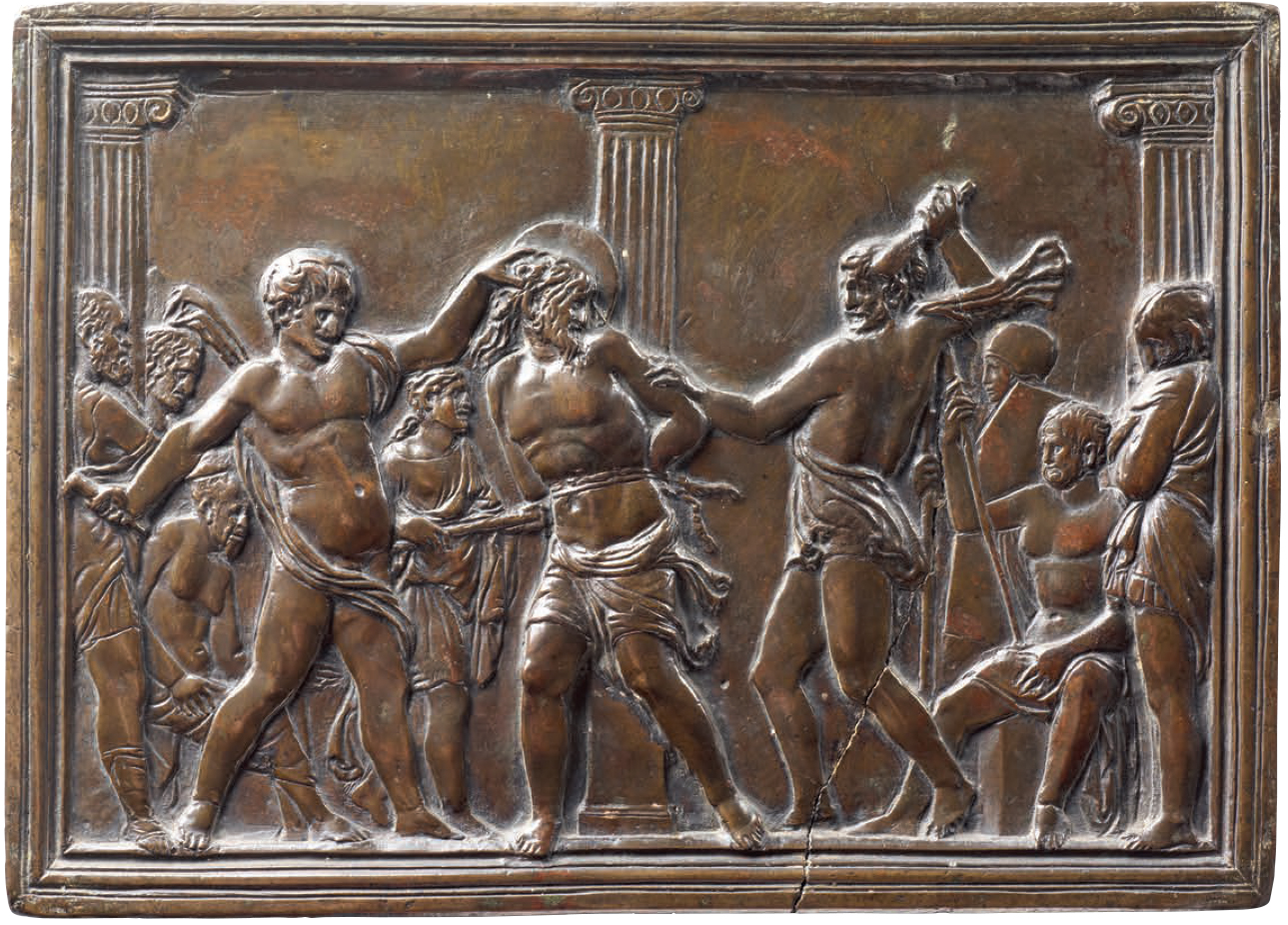
Fig. 1: Bronze plaquette of the Flagellation of Christ, possibly by Ratko Brajković (?), after models by Giorgio da Sebenico, ca. 1460s (Louvre, inv. OA 6176)
Bode’s initial assessments were more than attributional, they were manifestos of a specific type of connoisseurship that equated the sketch-like qualities and non-finito execution of Donatello’s relief work with autograph spontaneity.2 For Bode, the impressionistic surfaces of the Berlin and Louvre bronzes of the Flagellation were proof of Donatello’s late-style terribilità. He saw in the frantic—sometimes erratic—chasing of the bronze, a rejection of Ghibertian polish in favor of a raw, emotive energy that he believed only the master himself could summon.3 This view was codified by Paul Schubring, who placed the relief at the center of Donatello’s Paduan activity (c. 1443–53), characterizing the work as a pinnacle of Quattrocento dramatic expression.4
Recent archival research by Volker Krahn has complicated the material history of the relief. Krahn reveals that Bode, in a moment of museological “sleight of hand” around 1891, secretly exchanged the original Berlin Kunstkammer cast (now identified as the version in Strassburg, fig. 2, left) for a more non-finito version (fig. 2, right).5 6 Bode preferred the newer version, believing its faults reflected a closer proximity to a primary wax model. Consequently, the Strasbourg cast, described by Bode as an “old aftercast,” is actually the more historically documented object, having been noted by Franz Kugler as early as 1838, while the the Berlin-Moscow version (inv. 1027) is now understood as the result of a tired mold with excessive cold-work by a later finisher trying to recapture lost detail. It is the furthest removed from the original model, representing the end of a production run in a secondary foundry.7
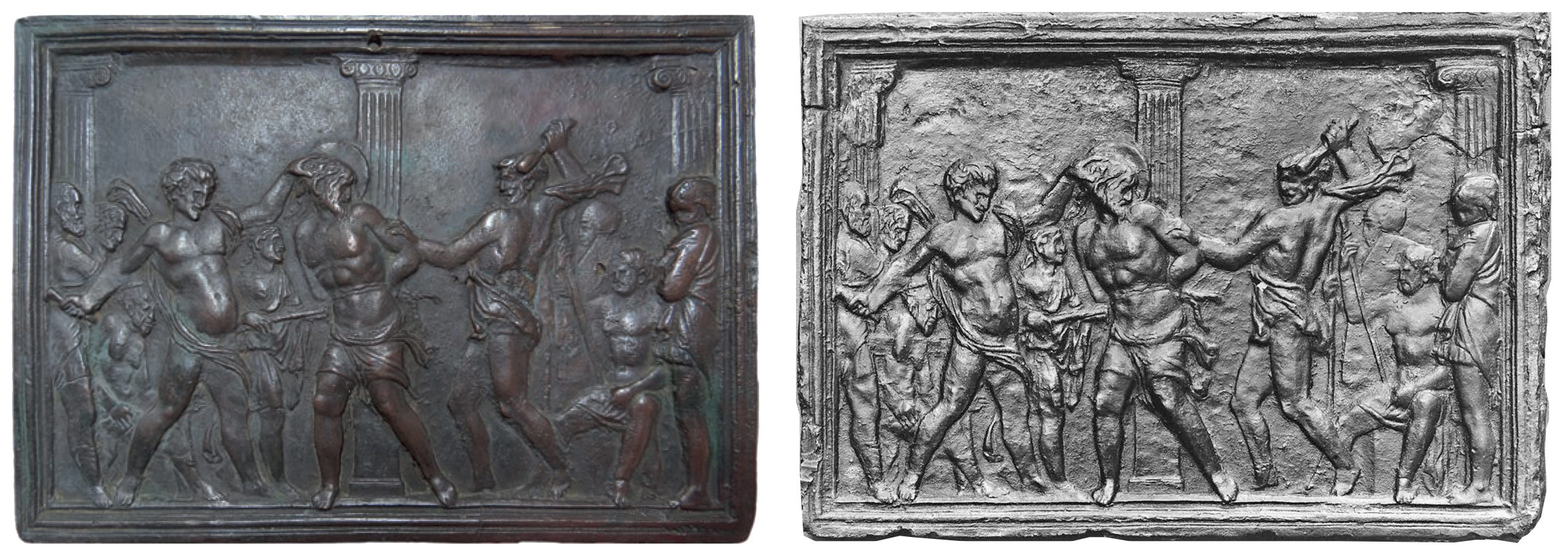
Fig. 2: Bronze plaquettes of the Flagellation of Christ, possibly by Ratko Brajković (?), after models by Giorgio da Sebenico, ca. 1460s (left, Straßburg, Musée de l’OEuvre Notre-Dame; right, formerly Staatliche Museen zu Berlin, Skulpturensammlung, and now in the Pushkin State Museum of Fine Arts)
Not noted in previous literature are two additional bronze variants that illustrate the long afterlife of the Flagellation plaquette. The first is a cast preserved in the Budapest Museum of Fine Arts (fig. 3, left), an example apparently overlooked entirely in previous scholarship. This relief presents a subdued image, likely the result of successive aftercasting; however, the presence of intentional chasing—particularly on the column capitals—suggests a workshop attempt to revive the crispness of the original relief. While its provenance remains unknown to the present author, its existence suggests a wider distribution of the relief than was previously known.
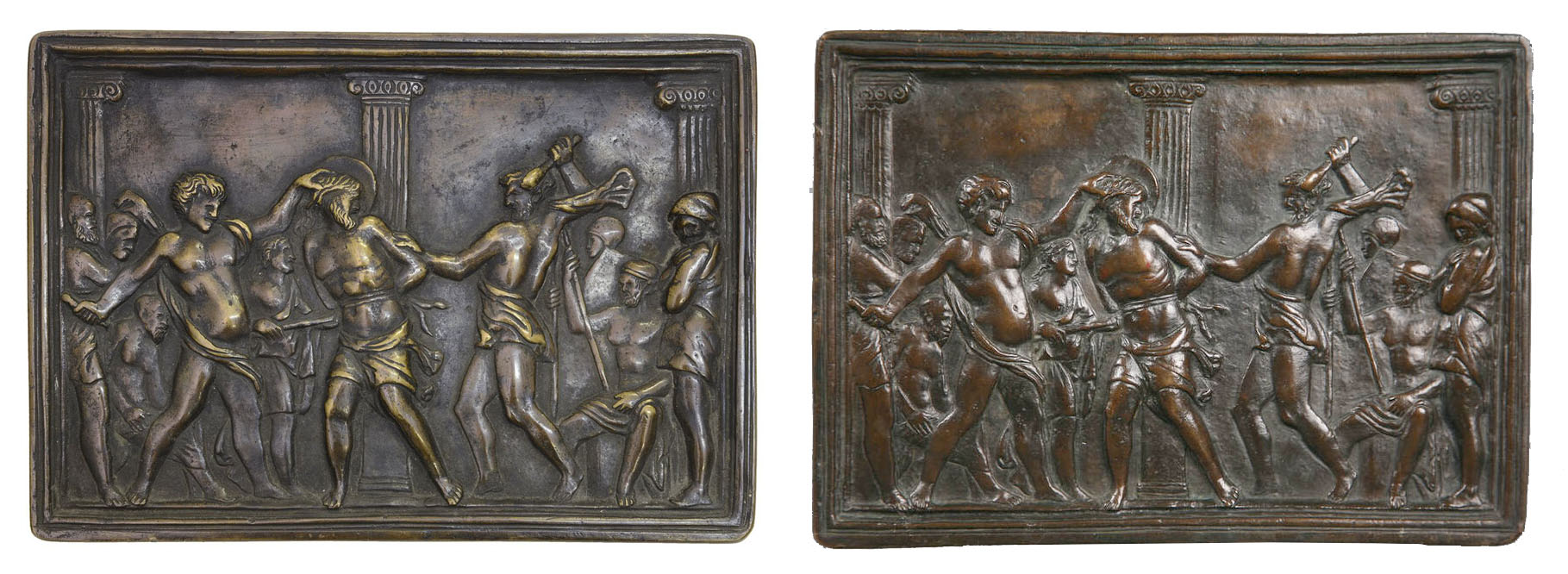
Fig. 3: Bronze plaquettes of the Flagellation of Christ, possibly by Ratko Brajković (?), after models by Giorgio da Sebenico, ca. 1460s (left, Budapest Museum of Fine Arts, inv. 51.899); right, bronze Flagellation of Christ, probably late 19th century cast (art market with Gallarus Fine Arts, NY)
A second example is a clearly modern cast (late 19th or early 20th century) which, despite its beautiful and convincing patina, betrays its late origin through a significant thickness and mechanically machined back and edges (fig. 3, right). This version appears to be taken from a surmoulage of the Louvre relief, likely utilizing a plaster intermediate. The existence of such unchecked intermediates points directly to the unauthorized practices of Eugène-Denis Arrondelle, the chef d’atelier of the Louvre’s Atelier de Moulage between 1880 and 1907. As Milena Gallipoli has documented, Arrondelle frequently engaged in the clandestine production and sale of plaster copies from the museum’s collection.8 These illicit plasters provided the perfect, unregulated raw material for commercial Parisian foundries—most notably those associated with Louis Richard and his successors (such as Ferdinand Liard)—who capitalized on the 19th-century demand for Renaissance antiquities by translating these plasters into deceptive bronze surmoulages, complete with sophisticated, artificially aged patinas.9
As the twentieth century matured, a new skepticism, fueled by the rigorous formalist critiques of H.W. Janson and Ulrich Middeldorf, began to dismantle Bode’s construct.10 Janson’s 1957 Donatello monograph demoted the Flagellation to the status of a “posthumous homage,” identifying what he termed an “academic coldness”—a rigidity in the architectural perspective and a certain naivety in the anatomical transitions—that felt fundamentally alien to the master.11
As Hans Folnesics first intuited in 1914, the relief’s rigid architectural perspective and specific anatomical tensions suggest a master operating outside of Tuscany. Folnesics’ observation led him to suggest a possible origin for the relief in Dalmatia, an idea largely overlooked for the past century.12 While Folnesics sought to locate the authorship of the Flagellation within the Dalmatian oeuvre of Niccolò Fiorentino another overlooked observation by Stanko Kokole pivoted the subject again toward an Adriatic origin by identifying a precise iconographic citation of the Flagellation composition within the sculptural program of the Rector’s Palace in Dubrovnik (fig. 4)—a project overseen by Giorgio da Sebenico (Juraj Dalmatinac).13
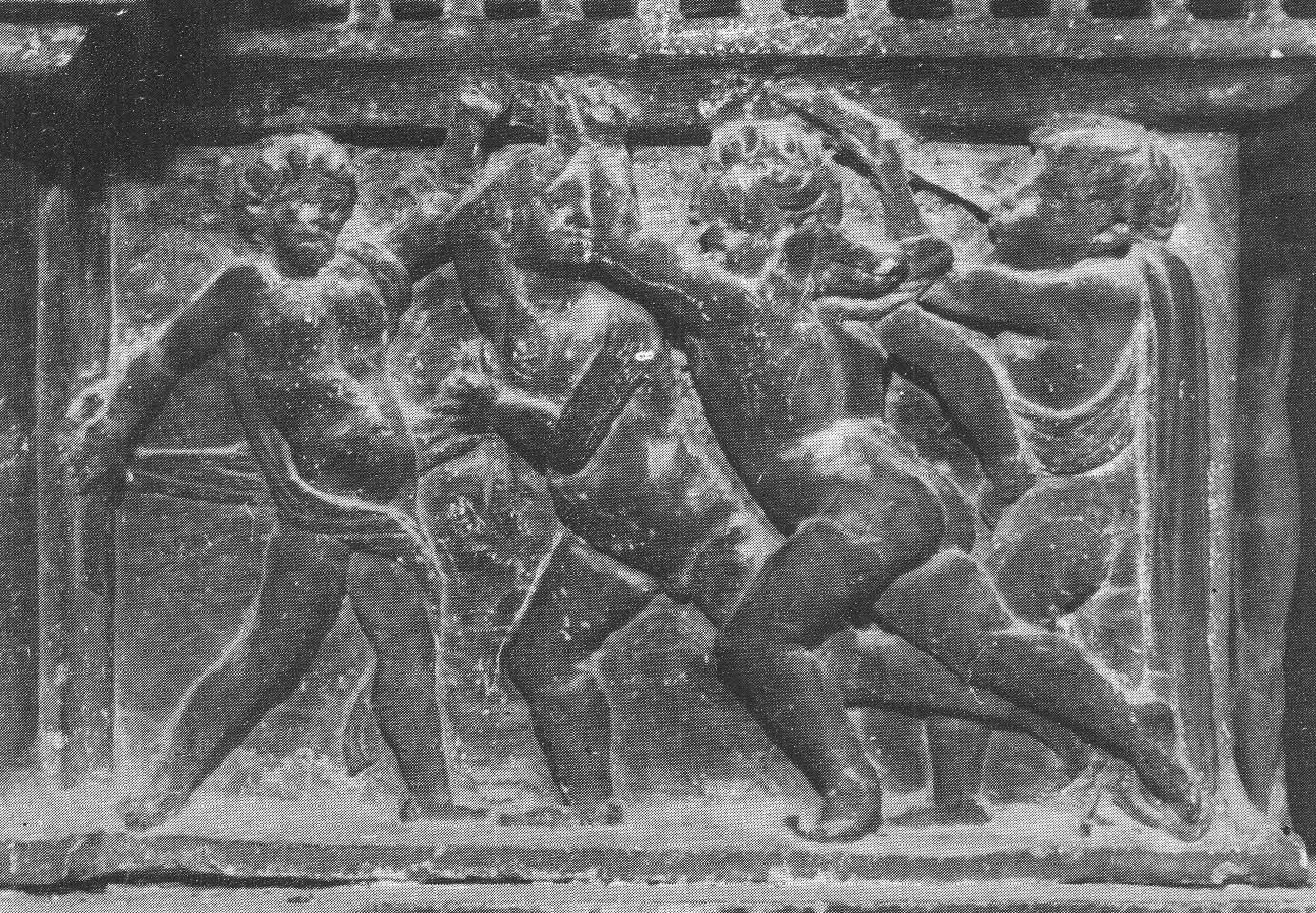
Fig. 4: Detail of a stone impost relief by Ratko Brajković (workshop of Giorgio da Sebenico) at the Rector’s Palace in Dubrovnik, Croatia, 1464
Expanding upon this observation is Folnesic’s early identification of an additional, distinct citation of the composition on the altar of St. Anastasius in the Cathedral of Saint Dominus in Split (fig. 5). By correlating these repititions from the relief, the present author posits a more technically grounded origin, moving beyond the traditional view of the bronze Flagellation as a diaspora object produced by distal followers of Donatello. Instead, the relief should be recognized as the nucleus of a localized “pattern archive”—a sophisticated repository of high-style visual references utilized by the Sebenico workshop to systematically modernize the artistic landscape of the Eastern Adriatic coast.
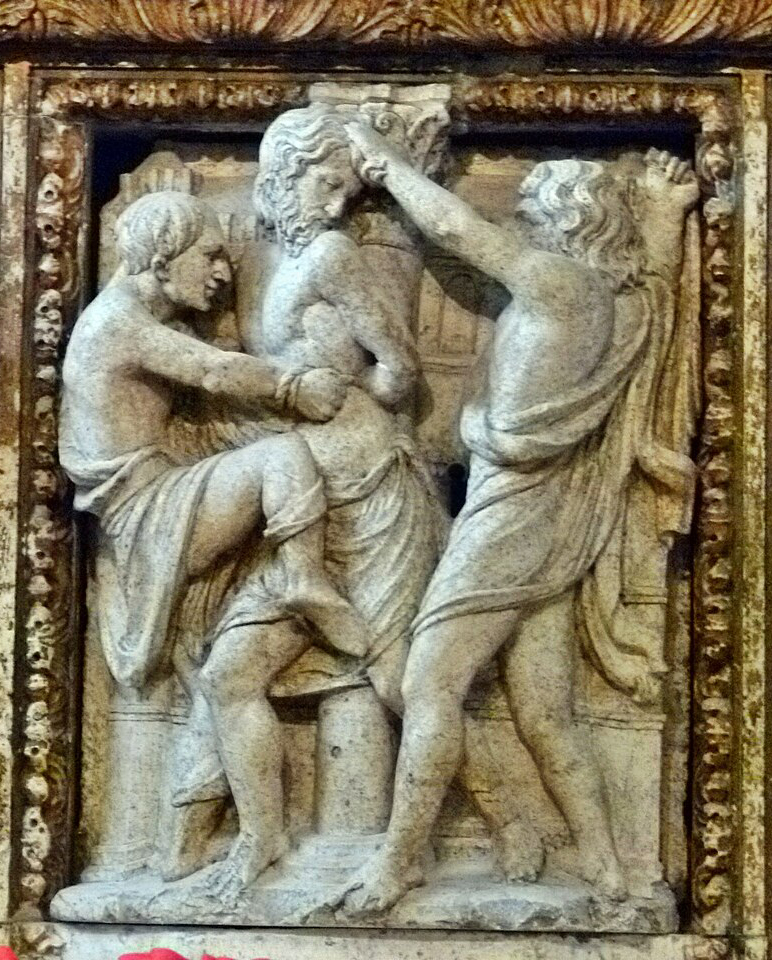
Fig. 5: Detail of the Flagellation of Christ stone relief from the center of the predella for the Altar of St. Anastasius at the Cathedral of Saint Dominus, Croatia, attributed to Giorgio da Sebenico, 1448
The chronological anchor for this artistic transition is the construction phase of the Šibenik Cathedral known in local scholarship as the ‘Malipiero section’ (Malipierova partija, 1465–1468). This term refers specifically to the northern wall of the northern choir chapel, which is dated by the coat-of-arms of the Venetian Rector Stefano Malipiero. This specific constructive phase represents the definitive penetration of a classicizing decorative repertoire into Dalmatian masonry. The stylistic congruence between the architectural decoration of this section and the Flagellation relief suggests that the composition was part of the broader ‘New Style’ being systematically deployed across the Adriatic coast by the Sebenico workshop during the late 1460s.14
The Flagellation composition represents a sophisticated synthesis of the Paduan-Donatellesque idiom, particularly as codified in the terracotta altar of the Ovetari Chapel (c. 1448–1457). This specific sculptural language was developed by Niccolò Pizzolo and Giovanni da Pisa, two sculptors who worked directly as assistants to Donatello during his consequential period in Padua. Their influence on the bronze is most manifest in the rigorous articulation of the intimated deep barrel vault and the emphasized, almost brutal, muscularity of the executioners. Within the Dalmatian context, the highly-charged designs of the Pizzolo-Giovanni da Pisa circle functioned less as aesthetic inspiration and more as standardized mechanical templates. This physical migration of models is proven by the fact that motifs from their Ovetari altar—such as a frieze of dancing putti—were copied ‘line by line’ into stone at the Rector’s Palace in Dubrovnik by the workshop of Giorgio da Sebenico. In this environment, these patterns were disseminated among an itinerant collective of skilled craftsmen, most notably Ratko Brajković, who acted as the principal agent in translating these aggressive Donatellesque designs into the characteristic local limestone.15
The most compelling evidence for a Dalmatian context for the Flagellation is situated within the aforenoted sculptural program of the Rector’s Palace, as first observed by Kokole. Archival records from July 1464 document a payment to Ratko Brajković for his contributions to the palace portal, providing a chronological anchor for the earliest documented use of the Flagellation pattern.16 On the portal’s left impost, Brajković executed a relief of an “awkwardly twisted nude” which Kokole identifies as a rigorous citation of the left-hand flagellator from the bronze matrix (fig. 4).17 This is not a generalized stylistic resonance, but a precise iconographic repetition involving the specific torsion of the torso, the flexion of the knee, and the idiosyncrasies of the narrow drapery. Such a point-for-point correspondence confirms that the composition was already serving as a foundational workshop model by the mid-1460s.18
The relationship between the 14 x 19.6 cm bronze Flagellation and the stone relief on the altar of St. Anastasius in Split (fig. 5) further substantiates the existence of a unified master pattern. In both media, the figure of Christ is characterized by an identical anatomical tension—a heavy contrapposto coupled with a specific figural definition derived from Paduan precedents.19 This continuity extends to the architectural framing; the column of the scourging in both the bronze and the stone features a shared morphology, reflecting the architectural sensibilities of the Sebenico circle.20
Furthermore, the right-hand flagellator in the bronze is mirrored with such fidelity in the Split relief that it precludes the possibility of one being a direct three-dimensional copy of the other. Given the early date of the Split predella (1448), the foundational ‘master’ initially circulated within the Sebenico workshop was almost certainly a graphic prototype, such as an accurate model drawing. Both objects thus appear as independent, high-status manifestations of a singular, unified pattern archive. While the early stone relief served to anchor the composition within a monumental liturgical setting,21 the graphic design was subsequently codified into a durable, three-dimensional matrix—the bronze plaquette (or its carved stone prototype)—which functioned as a portable master to facilitate the mechanical circulation of the ‘New Style’ in later decades.22
As Kokole has convincingly demonstrated, the workshop of Giorgio da Sebenico functioned as a repository for model drawings and three-dimensional casts, which facilitated the precise, line-by-line reproduction of sophisticated motifs across disparate media.23 In this context, the Flagellation relief must be categorized as more than a singular sculptural object; it represents a limited workshop production that served as a specialized currency of style. Much like the engravings of Mantegna allowed for the rapid circulation of North Italian designs throughout Europe, the bronze plaquette functioned as a vehicle for the Donatellesque visionary manner, enabling it to be possessed by the Adriatic elite or utilized as a compositional blueprint by Giorgio’s circle.24
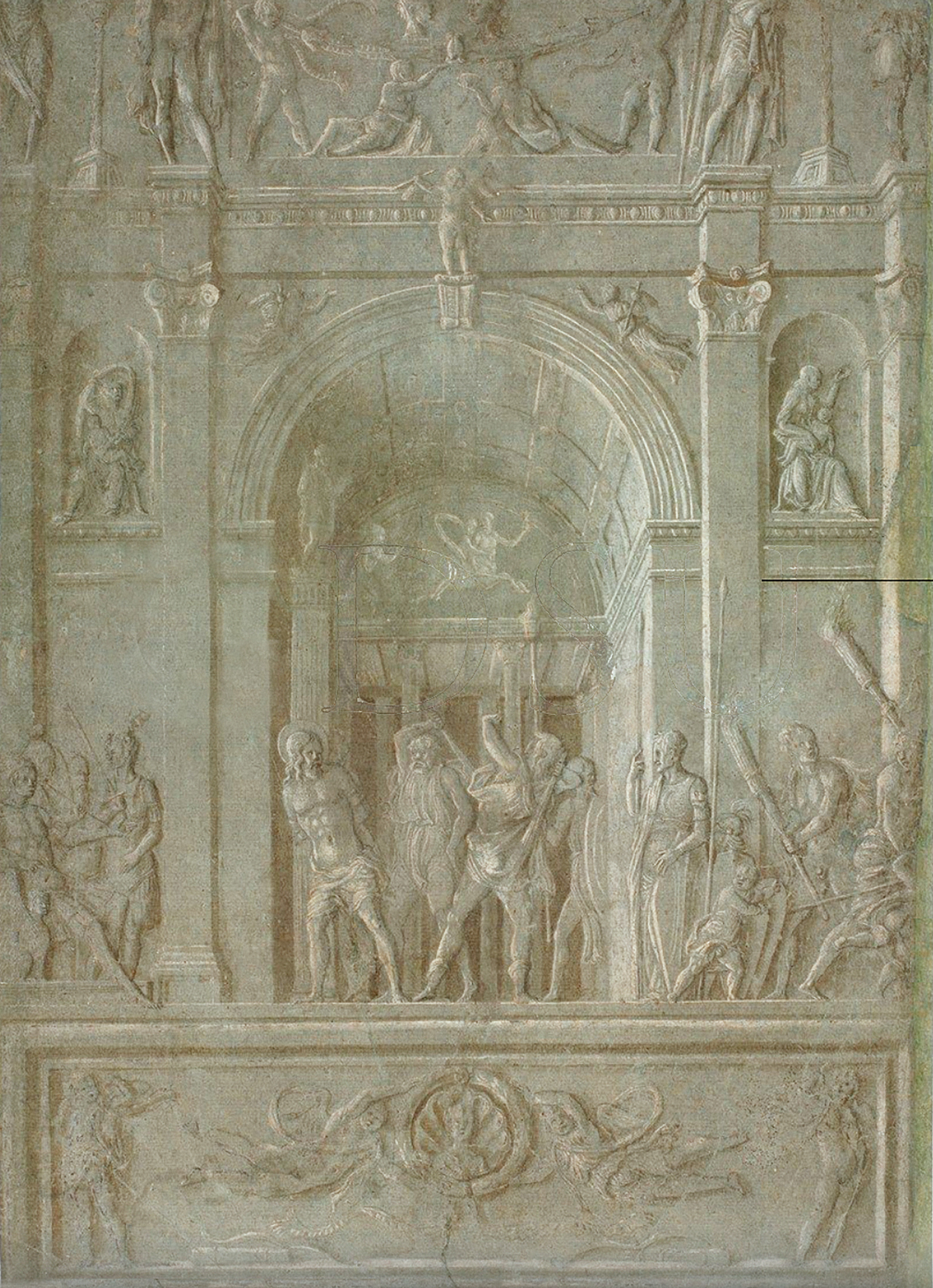
Fig. 6: Drawing of the Flagellation of Christ, 15th century, associated with Giovanni Bellini (Uffizi, inv. 6347 F recto)
The spatial logic of the Flagellation is rooted in a circulating visual lexicon common to the Veneto-Adriatic cultural sphere. The composition shares ties with a drawing in the Uffizi (fig. 6), associated with the circle of Jacopo Bellini, as well as a sketch in the “Florentine Picture Chronicle” depicting Jephthah Sacrificing His Daughter on an Altar (fig. 7).25 The Uffizi drawing, in particular, provides a conceptual impetus for the superficial architectural and figural staging of the relief. These were visual commonplaces—procedural “memories” of the Florentine all’antica style—that allowed diaspora masters to reconstruct a Tuscan atmosphere within an Eastern Adriatic framework.
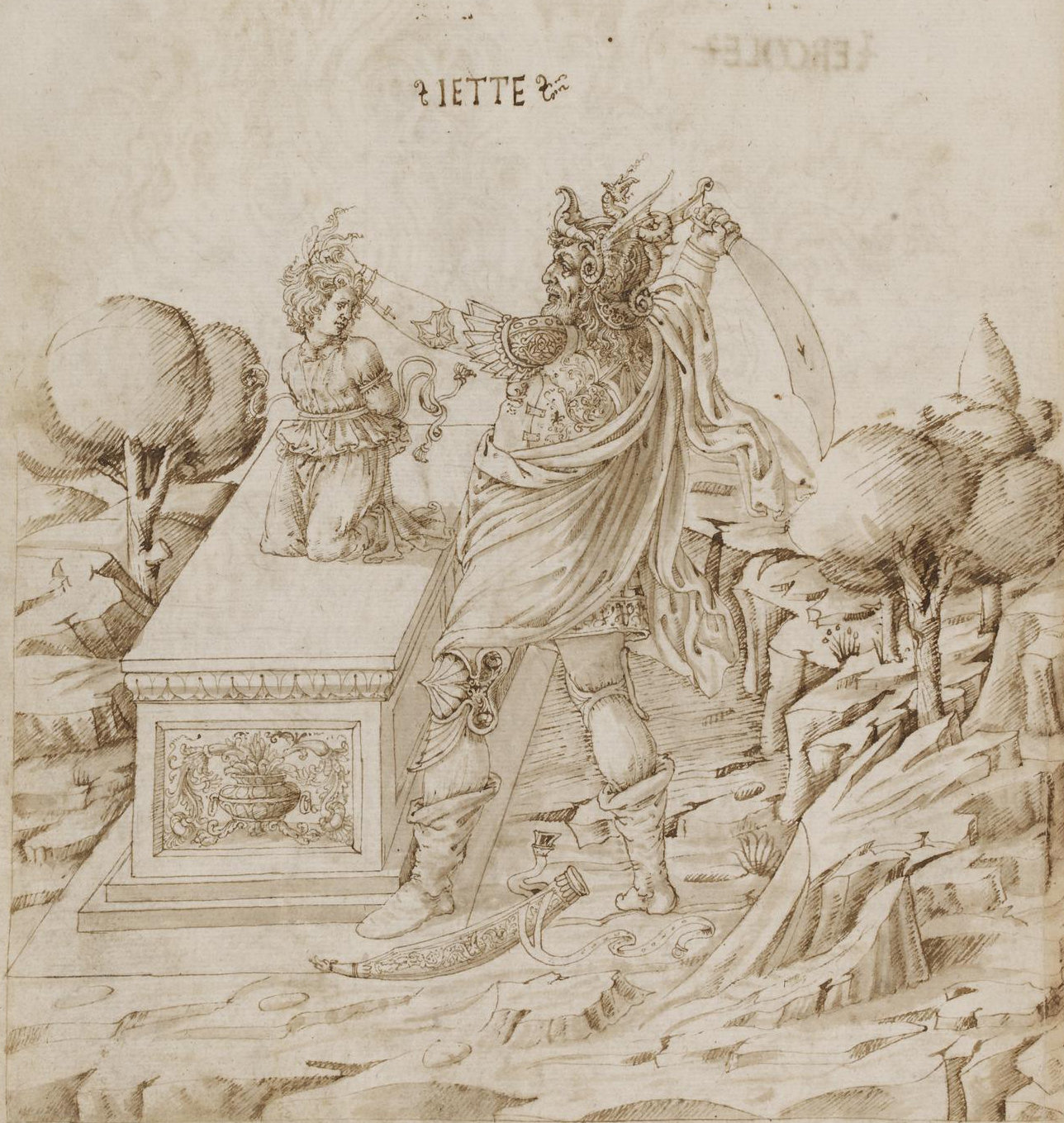
Fig. 7: Detail of a drawing of Jephthah Sacrificing His Daughter on an Altar, 15th century, associated with Maso Finiguerra, from the “Florentine Picture Book Chronicle (British Museum, inv. 1889,0527.32)
The physical mechanism of this pattern transmission is elucidated by historical precedents of drawing circulation between major Tuscan masters and regional workshops.26 A letter from Lorenzo Ghiberti to Giovanni Turini in Siena, dated April 16, 1425, documents the master’s urgent request for the return of his ‘drawings of birds’ (charte delli ucielli), which had migrated from a goldsmith to a woodcarver. This specific instance highlights how portfolios of model drawings functioned as portable, liquid assets. It also explains how specific iconographic units—such as the Ovetari Chapel putti or the Flagellation composition—could bypass geographic barriers to settle in Sebenico’s repository without requiring the master’s physical presence in Florence.27
Furthermore, the assimilation of such imported graphic prototypes was a documented phenomenon in the region. Recent scholarship confirms that the drawings and designs brought to the Adriatic by Florentine masters—such as Michelozzo and Michele di Giovanni—were routinely left behind and quickly became a permanent part of the decorative repertoire for numerous sculptural workshops in Dubrovnik and its surroundings. Local masters, such as Radivoje Bogosalić, actively copied and translated these imported Renaissance motifs into stone, proving that the ‘Master Matrix’ concept was the standard mechanism for stylistic modernization in the Dalmatian crucible.28
Rather than copying a single lost prototype by Donatello, the artist of the Flagellation synthesized several distinct memories of the master’s spatial experiments, most notably the architectural compression and perspective seen in the Resuscitation of Drusiana in the Old Sacristy of San Lorenzo.29 This process of synthesis explains the relief’s inherent architectural dissonance: while the intimated barrel vault follows a strict perspectival logic, the execution of the column and the figures exhibit a distinct hardening.
This duality is the hallmark of a kind of synthetic Florence—a unique stylistic milieu where high-style compositional visual references were filtered through a provincial, craft-based execution. That this specific visual reference was established in the Dalmatian repertoire at an early date is substantiated by the stone Flagellation relief executed by Giorgio da Sebenico for the predella of the altar of St. Anastasius in the Cathedral of Saint Dominus (Split), documented as early as 1448.30 This early stone iteration confirms that the workshop’s engagement with the Flagellation, or its early components, predates the later bronze casts, positioning the composition as a foundational element of the workshop’s long-term pattern archive.
The stylistic congruence between the bronze Flagellation and the impost reliefs of the Rector’s Palace suggests not only a shared workshop atmosphere, but the distinctive hand of a single executor: Ratko Brajković, encouraging a compelling attributional proposal. While Giorgio da Sebenico would have provided the conceptual and perspectival oversight, the physical execution of the master relief—the prototype from which the bronzes were derived—exhibits the specific mechanical habits of a stone-cutter.
This reliance of stone-cutters on fixed workshop patterns was a documented Ragusan building protocol. Archival records confirm that the domestic architecture of the local elite served as literal physical models for subsequent commissions; for example, in December 1431, the local masters Brajko Bogosalić and Dobrašin Radinović were specifically contracted to produce architectural elements for Marino de Mislien ‘modelled upon’ those in the house of Georgio de Gozze. Such contracts provide evidence that the act of ‘rhetorical imitation’—the literal extraction and reproduction of a canonical motif from a high-status source—was a standard professional and legal requirement for Dalmatian craftsmen like Brajković long before the production of the Flagellation matrix.31
The master-matrix was possibly a small-scale stone or plaster relief, a physical object from which individual figures could be extracted for architectural collages or reproduced in its entirety for bronze casting. This subtractive logic—the process of carving away material to find the form—is fundamentally different from the additive logic of the wax-modeling tradition prevalent in Florence. In the Germanic tradition of the fifteenth century, masters utilized fine-grained Solnhofen limestone to carve intricate models for medals and plaquettes, taking advantage of the stone’s ability to hold sharp, refined detail.32 A similar material condition existed in Dalmatia, where the high-quality, fine-grained limestones of Brač or Korčula would have allowed a carver like Brajković to achieve a level of crispness that would survive the transition into a bronze mold.
The hardness and staccato energy often critiqued in the Flagellation bronzes should not be viewed as a failure of the casting process or the hand of the artist, but as a faithful reproduction of this chisel-driven style. When a stone-cutter models even in a temporary medium like wax or clay, they frequently carry over a subtractive mindset, conceptualizing figures in rigid, blocky planes rather than fluid, additive volumes. This is vividly apparent in the anatomy of the Flagellation torturers; their limbs are rendered with a planar severity that suggests the stroke of a chisel rather than the smoothing of a thumb.
Alternatively, this feature may suggest a reliance on two-dimensional graphic sources—specifically workshop drawings—rather than a three-dimensional model. This architectural shorthand is a hallmark of the “Florentine Picture Chronicle” (c. 1460s), where spatial depth is signaled through a synthetic memory of classical motifs rather than a rigorous, three-dimensional construction.33 Brajković, acting as the workshop’s translator, likely synthesized these graphic patterns into a stone master-relief, quite possibly, in or around 1464, when we observe Brajković’s quotation of the composition in the Rector’s Palace decorative schema.
The translation of the Flagellation composition from a localized stone-carver’s pattern into a series of bronze casts finds its logical historical resolution in the administrative and physical landscape of mid-fifteenth-century Dubrovnik. As archival research by Danko Zelić has established, the reconstruction of the Rector’s Palace in 1464 served as the primary administrative and artistic epicenter of the Ragusan Republic.34 It was within this specific, high-priority environment that the workshop of Giorgio da Sebenico intersected with the technological infrastructure of the state foundry, providing the necessary mechanism for the material transformation of the Flagellation design.
The metallurgical expertise required for this production was introduced to Ragusa in 1457 by Maso di Bartolomeo. Maso’s Florentine workshop had long established a precedent for what may be termed “tertiary production”—the manufacture of small-scale liturgical objects alongside larger commissions. Evidence from Maso’s tenure in Italy confirms that his shop produced refined works such as the Reliquary of the Holy Girdle for Prato Cathedral, as well as paxes and bronze appliques.35
These smaller-scale commissions were frequently delegated to a sophisticated, tight-knit circle of practitioners within Maso’s shop, comprising his brother Giovanni di Bartolomeo, Pasquino da Montepulciano, and Michele di Giovanni da Fiesole (commonly known as il Greco). Michele’s engagement with Maso’s environment likely began as early as the 1440s, evolving into a formal partnership that saw them collaborating on prestigious projects such as the portal for the façade of San Domenico in Urbino between 1449 and 1454.36 This collaborative unit remained intact during their transition to the Eastern Adriatic in service to the Ragusan Republic. However, the workshop’s trajectory was violently altered in 1458 when a cannon explosion during a test firing—an occupational hazard of the dual-purpose military and artistic foundry—resulted in Maso’s death. Following this tragedy, Michele di Giovanni immediately assumed the mantle of lead founder in Ragusa, ensuring the technical and administrative survival of the workshop’s specialized assets.37
The Alberghetti family of Venice serves as the definitive regional archetype for this porous demarcation between military engineering and fine art. Operating for three centuries beginning in the late 15th century, the Alberghetti dynasty served as the primary cannon-founders for the Venetian Republic while simultaneously producing highly refined household bronzes, bells, and mortars. This industrial reality demonstrates that the production of small-scale artistic reliefs within a state-controlled foundry was not an anomaly but a standard practice in the Venetian-Adriatic sphere. In this context, the ‘armorer’s finish’ of the proposed Ragusan Flagellation bronzes is a logical byproduct of a workshop environment where the same masters—such as Michele di Giovanni—were commissioned as both ‘magistro ad faciednum bombardas’ (cannon maker) and ‘magistro ad laborandum de scharpello’ (sculptor).38 In Ragusa, the Flagellation bronzes (notably the Strasbourg and Louvre casts) betray the distinctive environment of this military-industrial complex.
Unlike the fluid, wax-driven chasing typical of Florentine bronzes, the Flagellation reliefs exhibit what may be described as an ‘armorer’s finish.’ The surfaces are articulated not with the soft modeling of a goldsmith, but with the tools of the bombard-maker: heavy punches, rigid chisels, and high-impact stamps. This technical determinism provides a material explanation for the “academic coldness” perceived by earlier scholars like H.W. Janson.39 The rigidity and planar aesthetic were not a failure of artistic vision, but a direct result of utilizing the heavy-duty infrastructure of a state foundry to realize a stone-cutter’s subtractive logic.
The material legacy of the Brajković matrix probably extended beyond the initial Ragusan casting. Following the death of Giorgio da Sebenico in 1473, the workshop’s archive—a repository of drawings, lead casts, and stone patterns—passed to Niccolò di Giovanni Fiorentino.40 Niccolò, having succeeded Giorgio as protomaestro of the Šibenik Cathedral after the latter’s death in 1473, became the primary steward of this ‘Paduan-Ovetari’ archive.
During this secondary phase, the original Ragusan molds likely underwent decades of reuse, resulting in the calcification of the forms seen in coarser iterations like the Metropolitan Museum of Art’s version (inv. 19.76.54, fig. 8). The MET relief represents a freehand re-invention where the internal anatomy is reimagined through an oversaturated application of stippling and punch-work.41
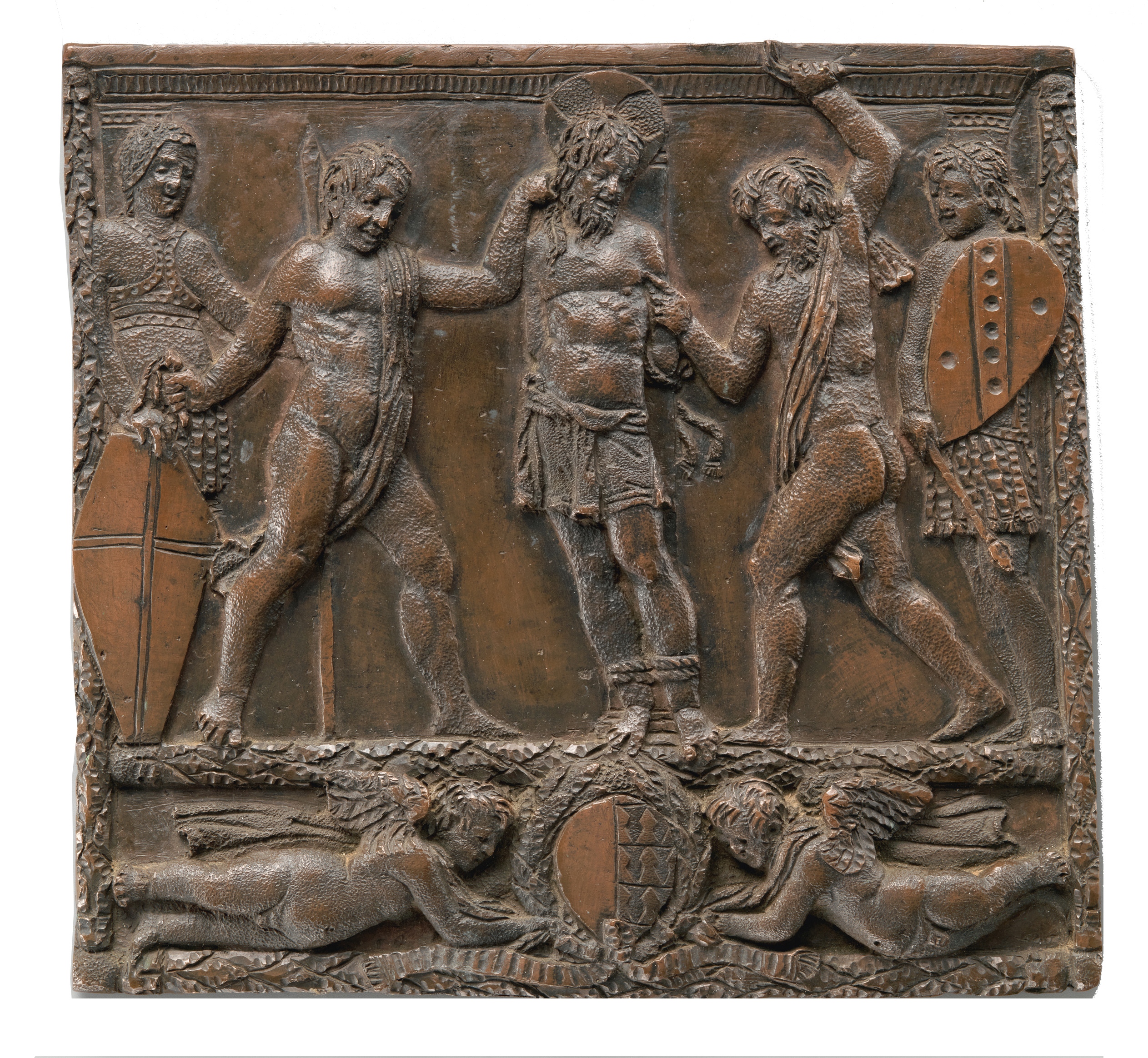
Fig. 8: Freehand bronze plaquette of the Flagellation of Christ, possibly after Ratko Brajković (?), late 15th century (Metropolitan Museum of Art, inv. 17.190.2094)
The production of the Flagellation would have required a confluence of high-level financing, access to state-controlled industrial resources, and a specific intellectual agenda. In the Dalmatian Quattrocento, this convergence existed in only two spheres: the civic government of the Republic of Ragusa and the elite humanist bishoprics of the Zadar-Split axis.
The first, and perhaps most historically grounded, possibility is that the Flagellation was commissioned by the Rectoral Council of Dubrovnik (Ragusa) between 1463 and 1465. This window corresponds precisely with the arrival of Giorgio da Sebenico to the city and the peak activity of the state foundry under Michele di Giovanni.42
The administrative realities of this exact window provide a compelling catalyst for the merging of Florentine and Dalmatian aesthetics. In July 1464, Giorgio da Sebenico arrived in Dubrovnik and immediately assumed the post of Ingeniario Comunis (chief engineer), directly replacing the Florentine master Michelozzo di Bartolomeo, who had held that exact position from May 1461 to June 1464. Giorgio and his primary stone-cutter, Ratko Brajković, were thus physically inheriting Michelozzo’s workspace and, inevitably, the Florentine pattern archive left behind by Michelozzo and his foundrymen.43
Following the catastrophic explosion of the Rector’s Palace in August 1463, the Ragusan government sought to repair the building while redefining the Republic’s image. As Zelić has established, the reconstruction was a highly centralized effort, merging the roles of the state engineer, the architect, and the military founder.44 By securing Giorgio da Sebenico—the most “modern” master in the region—the Council was engaging in a form of cultural competition with the Italian maritime republics.
The Flagellation matrix, here suggested as authored by Ratko Brajković under Giorgio’s oversight, appears at the very heart of this state project. The fact that Brajković was documented in July 1464 carving fragments of this exact composition into the Palace portal suggests that the design “belonged” to the project.45 A bronze version of this artwork would have served as the ultimate civic symbol: a portable, indestructible distillation of the Republic’s new architectural and artistic identity.
The existence of a ‘Master Matrix’ for the Flagellation did not require a highly advanced theoretical understanding from the local craftsmen; rather, it relied on their everyday workshop protocols. Archival documents, such as a 1431 contract binding Ratko Brajković to reproduce a sink exactly ‘modelled upon’ one in a patrician home, demonstrate that line-by-line replication of high-status prototypes was the standard legal and mechanical practice in Dubrovnik. The humanist elite simply borrowed this mundane culture of the architectural copy, utilizing the craftsmen’s habit of strict replication to mechanically disseminate their new, all’antica intellectual manifesto across the Adriatic.
The Rector’s Palace served as the administrative and diplomatic epicenter of the Republic, a highly centralized space where the ruling elite conducted state business and received foreign guests. A bronze relief of the Flagellation would have been an ideal commission for a private devotional setting within the Rector’s own apartments or the state offices. Given the ‘Romanitas’ of the design—the Ionic columns, and the stoic pathos—the relief would have functioned as a sophisticated rhetorical tool, signaling to foreign dignitaries that Ragusa was no longer a provincial outpost, but a cosmopolitan center of the ‘New Style.’
The administrative proximity of the state foundry to the Palace construction site cannot be overstated. Since the foundry was a government asset, its shift from casting bombards to casting fine art would have required a direct state mandate.46 If the Rector’s Council commissioned the relief, it would explain why Brajković was allowed to use the “Master Matrix” as a repertoire of visual quotations for the Palace portal; he was simply reusing state-owned patterns across different media.
The second possibility, and one that accounts for the relief’s sacred leanings, centers on the figure of Archbishop Maffeo Vallaresso (r. 1450–1495) and his circle in Zadar. The impetus for the Flagellation was likely rooted in a pressing religious and cultural demand for modernization. Vallaresso was a vanguard humanist who viewed the all’antica style as a visual link to the Roman heritage of the Dalmatian coast. His correspondence serves as a manifesto for this vision. As early as 1453, Vallaresso was actively seeking “colored drawings of festoons designed by ‘Donatellus’” to serve as models for local craftsmen.47 This confirms that the highest religious authority in the region was intentionally importing the Donatellesque lexicon to guide a new Adriatic synthesis of modern ideas.
This intellectual agenda for modernization is given physical form in the tombstone of Canon Matej Sturarius in the Church of Our Lady of the Olives in Zadar. Sturarius—the son of the builder Damjan Sturčić—was a close collaborator of Vallaresso, as evidenced by the placement of both their coats-of-arms on the local cistern.48 His tombstone, attributed to Niccolò di Giovanni Fiorentino, is characterized by a range of visual and perspective innovations derived directly from Donatello’s late 1440s Pecci tomb in Siena.49 The presence of such a ‘visually innovative’ monument in Zadar proves that the high-style Donatellesque lexicon sought by Vallaresso was being actively translated into the local limestone repertoire by masters within the Sebenico-Fiorentino circle during the exact window of the Flagellation’s production.
The Flagellation provided a prestigious, durable, and portable image of the Passion that would have satisfied both the devotional requirements of the Church and the aesthetic ambitions of the Dalmatian prelates. For a man like Vallaresso, the Florentine perspective would have been a rhetorical tool used to align his bishopric with the cultural center of the Renaissance.
Material proof of this culture is found in the silver shrine of Saint Simeon in Zadar (completed 1497). As Kokole and Ivo Petricioli have demonstrated, the shrine features repousse reliefs that were modeled directly from all’antica plaquettes.50 This confirms that by the 1460s and 70s, the elite circle of Zadar was already using plaquettes as a vehicle for high-style transmission.
The “academic coldness” and rigidity that Janson identified in the relief were likely its greatest selling points for the Zadarene elite. The clarity of the perspective and the hard style of Brajković’s execution emphasized the architectural “Romanitas” they sought to emulate. To Vallaresso, the relief would have been a visual bridge—a way to claim the legacy of the Roman Empire for the Dalmatian Church. In this context, the Flagellation was less a work-of-art in the modern sense and more a liturgical image meant to be circulated among craftsmen to standardize the “New Style” across the region.51
It is entirely possible that these two possibilities are not mutually exclusive. The mobile nature of Giorgio da Sebenico’s workshop—moving between Ancona, Zadar, Šibenik, and Dubrovnik—suggests that a commission could have been state-sponsored but prelate-driven.52
Maffeo Vallaresso’s influence extended throughout the Adriatic; he may have provided the impetus and the Paduan patterns, while the Ragusan Republic provided the infrastructure of Maso’s foundry and the artist, presumably Ratko Brajković. In this scenario, the Flagellation bronze relief would have been the result of a high-level collaboration between the most powerful civic and religious forces in Dalmatia, intended to serve as the definitive typology for a new era of Adriatic art. By the time Niccolò Fiorentino inherited these patterns in the 1470s, the Flagellation may have already achieved the status of a sort of canonical text.
Ultimately, the singular nature of the Flagellation composition—characterized by its deep perspective and aggressively planar figures—finds its intellectual justification in the humanist culture of the mid-Quattrocento Adriatic. As Marko Špikić has observed, the creative process within Giorgio da Sebenico’s circle was one of rhetorical imitation.53 Drawing on the theories of the Paduan professor Gasparino Barzizza, the workshop treated visual archetypes as a flexible vocabulary to be re-assembled into new “orations.” In this light, the Flagellation relief functions as a master text. When Ratko Brajković extracted the figure of the left flagellator for the portal of the Rector’s Palace in 1464, he was engaging in a form of visual quotation. The stiffness of the anatomy in Špikić’s framework, could be deemed deliberate stylistic adjustments made to fit a Florentine idea within the specific requirements of a Dalmatian state commission.54
Furthermore, the production of these bronzes cannot be understood in isolation from Giorgio da Sebenico’s trans-Adriatic career. As Samo Štefanac has documented, Giorgio’s activity in Ancona proves that his workshop was a maritime entity, shifting patterns between the Italian Marche and the Dalmatian coast.55 This “Geographic Triangle” provided the circuit necessary for the dissemination of the matrix. The Ragusan State Foundry served as the physical hub and under the supervision of Michele di Giovanni (il Greco), the foundry transformed Brajković’s presumed stone patterns into the “International Gothic-Renaissance Synthesis” that defines the region’s signature style.56
While Florence, Rome, and Mantua are traditionally cited as the primary centers of fifteenth-century plaquette production, Dalmatia warrants recognition as a modest, although critical, early possible locus for the medium’s development. This regional activity should be viewed not as an isolated phenomenon, but as a direct procedural extension of mid-century Florentine innovation. The conceptual seed was likely planted in Florence during the 1440s, where Maso di Bartolomeo and Michele di Fiesole observed firsthand the transformative success of the Della Robbia workshop. In Luca della Robbia’s perfection of the serial facture of glazed terracottas, these masters encountered a new paradigm of artistic reproducibility—one that moved beyond the unique object toward the power of the multiple.57
Upon their arrival in Dalmatia, Maso and Michele likely introduced this ‘Robbiesque’ logic of the matrix to the local artistic environment, translating the concept of serial production into the more durable medium of bronze as they did slightly earlier in Florence. In this light, the bronze Flagellation is a primary artifact of the fifteenth-century revolution in artistic reproducibility.
Endnotes:
1 Wilhelm Bode, Denkmäler der Renaissance-Sculptur Toscanas (Munich: F. Bruckmann, 1894), II, pl. 92; Wilhelm Bode, “Ein Blick in Donatellos Werkstatt,” Monatshefte für Kunstwissenschaft 1, no. 1-2 (January–February 1908): 5; Wilhelm Bode, Die italienische Plastik, 5th ed. (Berlin: Georg Reimer, 1911), 75.
2 Ibid.
3 Ibid.
4 Paul Schubring, Donatello (Stuttgart: Deutsche Verlags-Anstalt, 1907).
5 The Strasbourg cast (Berlin inv. 1957), being the original Berlin Kunstkammer cast of noble provenance, possesses a clearer architectural framework than the Bode-acquired example of 1891, lacking the frantic, over-chased surface that Bode mistook for autograph spontaneity. The Strasbourg cast represents the standard workshop production—clean, generally legible, and functional—expected of its time.
6 Volker Krahn, “Ein Blick in Donatellos Werkstatt: Berliner Bronzen – Wilhelm von Bode und die Zuschreibungsfragen,” Jahrbuch der Berliner Museen, 57 (2015): pp. 53-65
7 Believed lost after WWII, the plaque secretly entered the Pushkin State Museum of Fine Arts in 1946; its reemergence has been recently published and scientifically evaluated by Vasily Rastorguev. The plaquette was damaged by the fires of May 1945 with the heat warping the relief and causing the upper right corner to break. The patina also became yellowed due to the melting of a galvanoplasty restoration made to the relief at an unknown date (fig. 9). See Neville Rowley (inv. SKS 1027). SMB-Digital Online Collections Database, 2016, smb-digital.de (accessed January 2026).
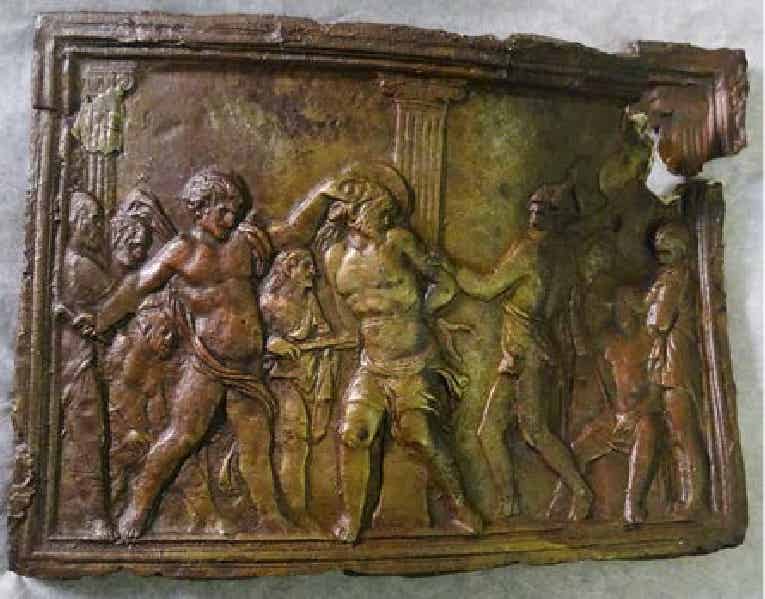
Fig. 9: Bronze plaquette of the Flagellation of Christ, possibly by Ratko Brajković (?), after models by Giorgio da Sebenico, ca. 1460s (formerly Staatliche Museen zu Berlin, Skulpturensammlung, now located in the Pushkin State Museum of Fine Arts)
8 Milena Gallipoli, “Unauthorized Plaster Casts at the Louvre’s Atelier de Moulage under the Direction of Eugène-Denis Arrondelle (1880-1907),” RIHA Journal 0321 (March 2025).
9 Philippe Malgouyres, De Filarete à Riccio: Bronzes italiens de la Renaissance (1430-1550). La collection du musée du Louvre (Paris: Louvre éditions, 2020), 10, 144–146, 249–251. Malgouyres details how Louis Richard and his son-in-law Ferdinand Liard actively produced commercial bronze surmoulages of Renaissance objects, including the famous Cellini cup, medals, and the Martelli mirror, directly from intermediate molds.
10 Ulrich Middeldorf, “Review of Hans Kauffmann, Donatello,” The Art Bulletin 18, no. 4 (1936); H. W. Janson, The Sculpture of Donatello (Princeton: Princeton University Press, 1957).
11 Janson, Sculpture of Donatello (1957).
12 Hans Folnesics, “Niccolo Fiorentino und die Geißelung Christi,” Kunstgeschichtliches Jahrbuch (1914). To the present author’s knowledge, Rastorguev is the only one to have recently revived this notion. See Vasily Rastorguev, “Donatello Re-discovered? A Name for the Author of the Berlin Flagellation and the Hildburgh Relief,” in Florence, Berlin and Beyond: Late Nineteenth-Century Art Markets and Their Social Networks, ed. Lynn Catterson (Leiden: Brill, 2020), 455.
13 Stanko Kokole, “Renaissance Imposts in the Portal of the Rector’s Palace in Dubrovnik,” Zbornik za umetnostno zgodovino (1986).
14 Samo Štefanac, “Zacetki arhitekture allantica na obalah Jadrana v 15. stoletju,” Annales: Series Historia et Sociologia 23, no. 1 (2013), 61-62.
15 Kokole, “Renaissance Imposts” (1986).
16 Ibid., 237. The surviving archival document dated July 9, 1464, records a payment made to Ratko Brajković for work done “pro palatio communis” (for the communal palace).
17 Ibid., 245.
18 Ibid.
19 Hans Folnesics, “Niccolo Fiorentino” (1914), 190. see also Stanko Kokole, “Auf den Spuren des frühen Florentiner Quattrocento in Dalmatien: Das toskanische Formengut bei Giorgio da Sebenico bis 1450,” Wiener Jahrbuch für Kunstgeschichte 42 (1989): 155–167.
20 Samo Štefanac, “Zacetki arhitekture” (2013), 61-64.
21 Kokole, “Renaissance Imposts” (1986), 245-246.
22 Marko Špikić, “Percepcije starina u umjetnosti ranoga humanizma u Dalmaciji,” Peristil 49 (2006), 64.
23 Kokole, “Renaissance Imposts” (1986), 64.
24 Samo Štefanac, “Giorgio da Sebenico, Niccolò di Giovanni Fiorentino, Giovanni Dalmata,” in Emilia e Marche nel Rinascimento (2005).
25 Vasily Rastorguev, “Donatello Re-discovered?” (2020), 472. See also Janez Höfler, “Signorelli und Schongauer. Zur Rezeption früher transalpiner Druckgraphik in Italien,” Wiener Jahrbuch für Kunstgeschichte 51 (1998): 63–75.
26 B. Degenhart and A. Schmitt, Corpus der italienischen Zeichnungen 1300–1450 (Berlin: Gebr. Mann, 1968).
27 Stanko Kokole, “Florentiner Quattrocento in Dalmatien” (1989), 164.
28 Predrag Marković, “The Artists of Michelozzo’s Circle in Dubrovnik and the Reflections of their Activity in Dalmatia,” Historia Artis Magistra (2012), 230.
29 Janson, “Sculpture of Donatello” (1957), 132.
30 Stanko Kokole, “Florentiner Quattrocento in Dalmatien” (1989), 164.
31 Renata Novak Klemenčič, “Locating and analysing the appearance of private houses in the 15th century Dubrovnik: The case of Georgio de Gozze house,” in Mapping Urban Changes, ed. Ana Plosnić Škarić (Zagreb: Institut za povijest umjetnosti, 2017), 186–187.
32 Jeffrey Chipps Smith, German Sculpture of the Later Renaissance, c. 1520-1580 (1994); Marjorie Trusted, German Renaissance Medals: A Catalogue of the Collection in the Victoria and Albert Museum (1990).
33 Marko Špikić, “Humanizma u Dalmaciji” (2006), 64.
34 Danko Zelić and Ana Plosnić Škarić, eds., Dubrovnik: Civitas et Acta Consiliorum 1400–1450 (Zagreb: Institut za povijest umjetnosti, 2017).
35 Michael Riddick, “A Remarkable Florentine Pax,” Renbronze.com (2017), accessed January 2026; Ulrich Middeldorf, “The Reliquary of the Holy Girdle in Prato,” Burlington Magazine (1978).
36 Janez Höfler, “Maso di Bartolomeo und sein Kreis,” Mitteilungen des Kunsthistorischen Institutes in Florenz 32 (1988): 537–546.
37 Predrag Marković, “The Artists of Michelozzo’s Circle” (2012), 221-230.
38 F. Rossi, The Alberghetti and the Venetian Foundry Tradition (Venice, 1994); see also Philippe Malgouyres, De Filarete à Riccio: Bronzes italiens de la Renaissance (1430-1550). La collection du musée du Louvre (Paris: Louvre éditions, 2020), 174–176.
39 H. W. Janson, “The Sculpture of Donatello” (1957), 240–242.
40 Samo Štefanac, “Giorgio da Sebenico” (2005), 39-53.
41 P. Malgouyres, “De Filarete à Riccio” (2020), 118–121.
42 Predrag Marković, “The Artists of Michelozzo’s Circle” (2012), 223.
43 Ibid.
44 Danko Zelić and Ana Plosnić Škarić, eds., “Dubrovnik: Civitas et Acta Consiliorum 1400–1450” (2017); see also Nada Grujić, “Knežev dvor u odlukama dubrovačkih vijećā od 1400. do 1450. godine,” in Mapping Urban Changes, ed. Ana Plosnić Škarić (Zagreb: Institut za povijest umjetnosti, 2017), 160–179.
45 Kokole, “Renaissance Imposts” (1986).
46 Danko Zelić and Ana Plosnić Škarić, eds., “Dubrovnik: Civitas et Acta Consiliorum 1400–1450” (2017).
47 Samo Štefanac, “Niccolò di Giovanni Fiorentino e la cappella del beato Giovanni Orsini a Traù: il progetto, l’architettura, e la decorazione scultorea,” in Quattrocento Adriatico: Fifteenth-Century Art of the Adriatic Rim, ed. Charles Dempsey (Bologna: Nuova Alfa Editoriale, 1996), 129.
48 Ivo Petricioli, “Ruke kanonika Sturariusa, prilog Nikoli Firentincu,” Prilozi povijesti umjetnosti u Dalmaciji 39 (2001–2002): 303–310.
49 Samo Štefanac, “Nekoliko bilješki o Nikoli Firentincu i nadgrobnoj ploči kanonika Sturariusa,” Ars Adriatica 4 (2014): 251–258.
50 Ivo Petricioli, L’arte del Rinascimento a Zara (Zagreb, 1974); see also Stanko Kokole, “The Silver Shrine of Saint Simeon in Zadar,” Studies in the History of Art 70 (2014).
51 Marko Špikić, “Humanizma u Dalmaciji” (2006), 59.
52 Samo Štefanac, “Giorgio da Sebenico” (2005).
53 Marko Špikić, “Humanizma u Dalmaciji” (2006), 59-60.
54 Ibid., 63–64.
55 Samo Štefanac, “Giorgio da Sebenico” (2005).
56 Predrag Marković, “The Artists of Michelozzo’s Circle” (2012), 221-223.
57 Michael Riddick, “Michele di Giovanni da Fiesole and the Origins of the Florentine Plaquette,” Renbronze.com (2020), accessed January 2026.
 Renaissance Bronze
Leave a comment