by Michael Riddick
Preview / download PDF in High Resolution
My personal curiosity for the enigmatic “Master IO.F.F.” began with the acquisition of an unsigned Allegory of Constancy, giving birth to my succeeding passion for the study of these challenging objects (fig. 1).1 Unlike the high-drama, multi-figure mythological narratives or the densely populated Livian battle scenes that typically define the work of IO.F.F., this relief presents a stark, emblematic encounter. In the bronze, a bull with its head lowered in a posture of unwavering resilience awaits the descent of a predatory lion from a rocky incline; above them, a cartouche suspended by a ribbon bears the simple epigraphic inscription CONST/ANTIA. As the first plaquette I ever owned, it served as an intellectual puzzle: why would a master die-cutter, renowned for translating complex, university-driven Greek and Roman epics into bronze, produce such a minimalist, stoic motto? The answer to this anomaly lies not in passive artistic preference, but in the volatile socio-political matrix of Renaissance Bologna and the fierce economic realities of its metallurgical trade.
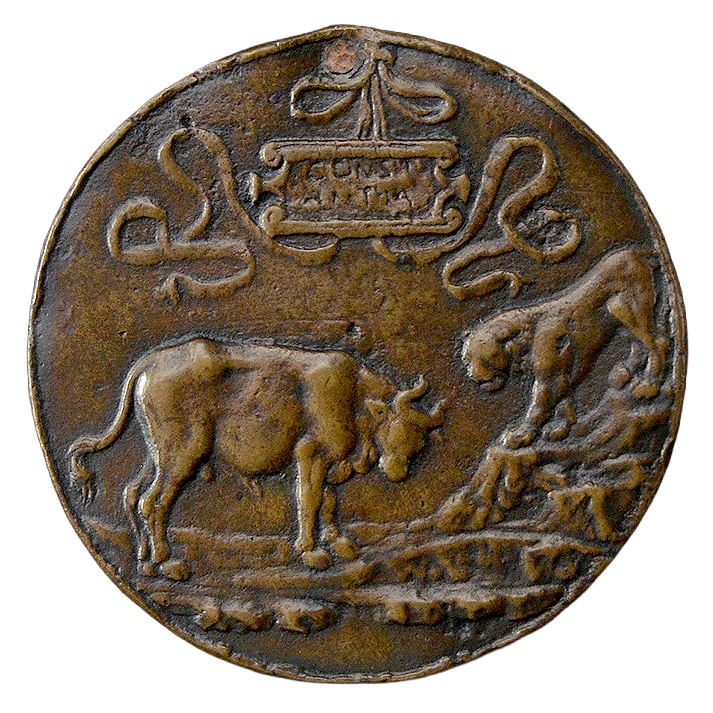
Fig. 1: Bronze plaquette depicting a Bolognese Allegory of Constancy against the Papal States, ca. 1502-06, by Giovanni Francesco Furnio (present author’s former collection)
The artistic flourishing of the late Quattrocento in Bologna was inextricably linked to the de facto rule of Giovanni II Bentivoglio, whose courtly atmosphere rivaled the major principalities of Northern Italy and fostered a rich culture of humanistic inquiry centered around the city’s ancient university. Within this vibrant environment, the Società delle Quattro Arti—a corporate guild that united goldsmiths, painters, shield-makers, and swordsmiths—facilitated a unique cross-pollination of the mechanical and liberal arts.
The historiography of Bolognese Renaissance goldsmithing in this era has traditionally been viewed through the monopolistic lens of Francesco Francia, who proudly signed his paintings as aurifex (goldsmith). Yet, emerging from the shadow of Francia’s workshop is the brilliant plaquette artist known as Master IO.F.F. Rather than viewing IO.F.F. as an enigmatic, isolated craftsman, a close material and historiographical analysis reveal a highly adaptable, entrepreneurial genius. By defining his identity and tracing his deliberate pivot from elite sacred silver to the mass-produced secular arms trade, we can observe an artist who acted as the primary plastic translator of Bologna’s university-driven humanist discourse.
For over a century, the true identity of Master IO.F.F. has perplexed scholars, with early critics fruitlessly attempting to link him to distant figures, gem engravers like Giovanni delle Corniole, or even Francesco Francia’s own son, Giacomo.2 However, recent historiographical breakthroughs first proposed by Christopher Fulton—and more recently championed and further elaborated by Marco Collareta3 and Jeremy Warren—have tentatively but convincingly identified IO.F.F. as the Bolognese goldsmith and die-cutter Giovanni Francesco Furnio. Warren astutely highlights a crucial literary endorsement from the Bolognese humanist Giovanni Filoteo Achillini, who, in his poem Il Viridario (written in 1504 and published in 1513), explicitly praises Furnio’s supreme mastery in crafting “every relief, round, half or low” (d’ogni rilevo tondo, mezzo o basso).4
The attribution to Furnio is further strengthened by a process of elimination within the archival records of the Società delle Quattro Arti. While the guild matriculation lists contain several masters active during the 1490s, none possess names that comfortably align with the monogram, and alternative candidates can be confidently discounted on stylistic grounds. But if Furnio was indeed the leading sculptor of Bolognese bronzes, why does his name not feature prominently in the surviving guild matriculas? Three historical realities explain this absence: first, the severe lacunae and lack of surviving documentation that plague Bolognese guild archives of this specific period; second, the possibility that Furnio operated as a highly skilled journeyman or associate within a larger officina (like Francia’s) rather than a registered master of his own shop; and third, the frequent use of courtly dispensations. Just as Giovanni II Bentivoglio allowed favored foreign or local artists to circumvent strict guild regulations for prestigious commissions, Furnio likely enjoyed a similar elevated, extra-corporative status.
In this context, the consistent use of the prominent monogram “IO.F.F.” (Johannes Franciscus Furnius Fecit) must be read as a calculated act of professional branding. In a city where the dolcezza and towering reputation of Francesco Francia monopolized the high-end metallurgical market, Furnio utilized his monogram to aggressively assert his independent artistic identity, ensuring his highly distinct, classical inventions were recognized as his own.
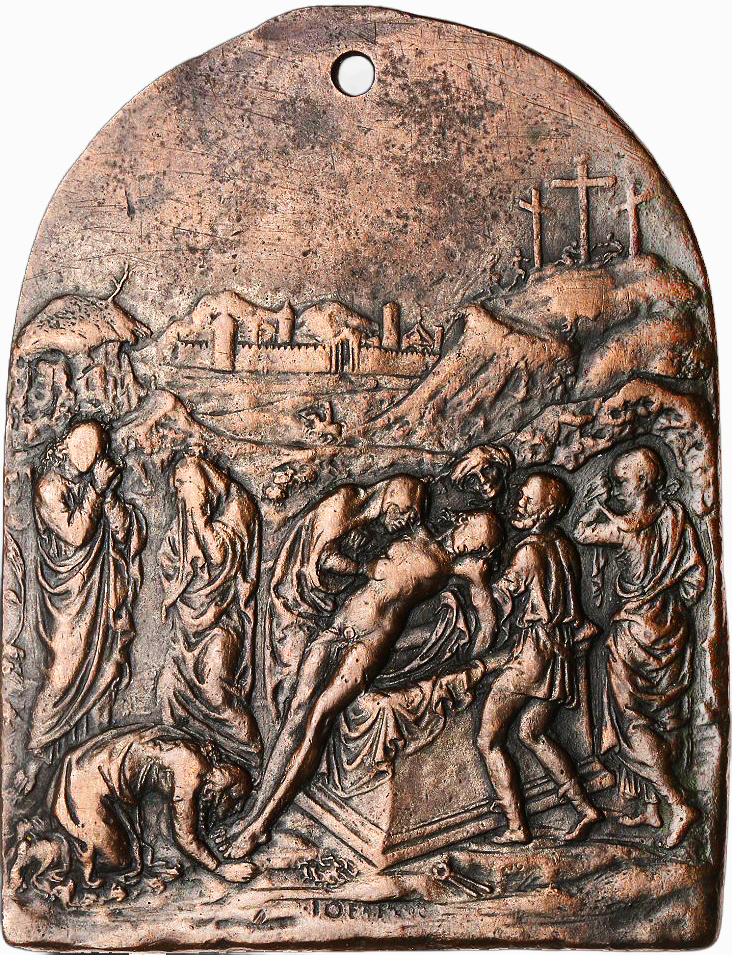
Fig. 2: Bronze plaquette of the Entombment, ca. 1496-99, by Giovanni Francesco Furnio (Jeremy Warren collection)
Before IO.F.F. came to dominate the secular arms trade, he achieved extraordinary, albeit brief, success in the realm of sacred silver. A critical historiographical correction is required here regarding his output. In a minor editorial misstep Fulton accidentally described IO.F.F.’s signed and arched Entombment plaquette as a “rectangular composition.”5 In reality, there are two distinct Entombment reliefs in IO.F.F.’s oeuvre. The first is the exceptionally rare, autograph arched plaquette, explicitly designed for mounting in a liturgical pax and surviving in casts such as those formerly in Berlin and now at the Pushkin State Museum (Russia),6 the Speed Art Museum7 and Warren’s private collection (fig. 2).8
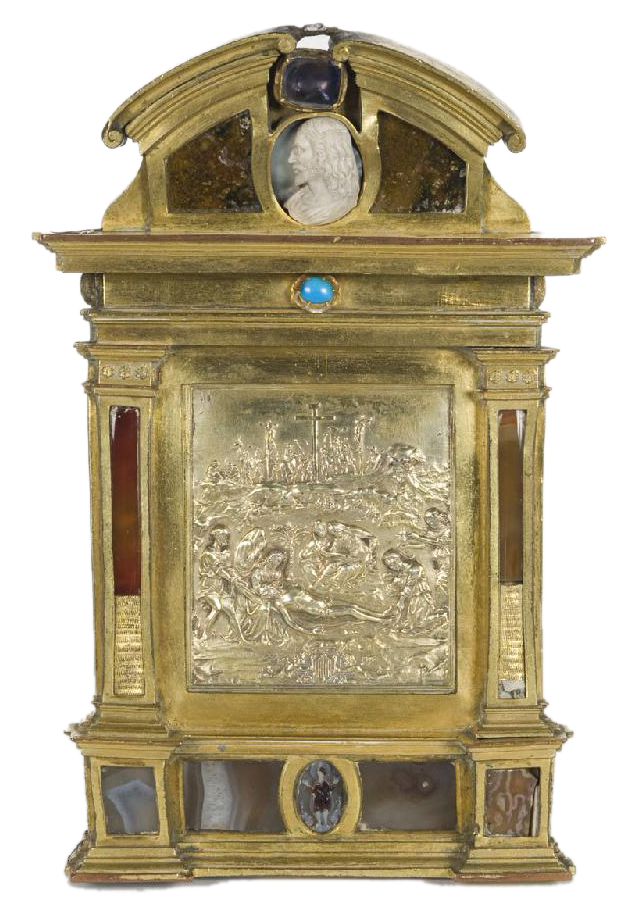
Fig. 3: Silver relief of the Entombment, attributed Giovanni Francesco Furnio, probably 1498, set in a later ca. 1530s-40s gilt silver frame with enamel and hardstone embellishments (Treasury of the Cathedral in Cividale del Friuli, Italy)
The second is an unsigned rectangular relief, famously preserved in the mid-sixteenth century mounting of the Grimani Pax in Cividale del Friuli (fig. 3).9 Plaquette casts of this relief are equally as rare, known by examples also in the Warren collection, one in Berlin and now in Russia,10 the Hood Museum,11 and one at the Musei Civici di Vicenza.12 While Emilè Molinier,13 Wilhelm von Bode14 and Ernst Bange15 grouped this relief within the oeuvre of the Master IO.F.F., Davide Gasparotto has expressed skepticism regarding IO.F.F.’s authorship of this relief. Gasparotto assigned the relief to an anonymous master, noting its “cursive and disorganic” language was imbued with late fifteenth-century moods that leaned toward the influence of the Veronese master Galeazzo Mondella (Moderno).16 However, adhering to the earlier assessments of Molinier, et al, the present author leans into a continued association with IO.F.F., noting the Master’s early command of flat, painterly relief before his technical pivot toward the more sculptural, structural requirements of the high-end hilt trade. Furthermore, the relief is deeply rooted in the Bolognese-centric visual vocabulary of the 1490s. The spacing of the crosses and the gathering of soldiers in the background along the upper register of the relief precisely mimics the central predella panel of Ercole de’ Roberti’s Crucifixion in San Giovanni in Monte (fig. 4, left), while the contortion of the thieves echoes the “passionate grief” of Roberti’s lost frescoes in the Garganelli Chapel.17 The heavy, supine plasticity of the dead Christ directly imitates the in-the-round terracotta compianto executed by Vincenzo Onofri for San Petronio (fig. 4, right). Additionally, an observation of the finely cast Hood Museum plaquette (back cover) secures the emblematic delicate facial character and lanky forms that define IO.F.F.’s stylistic oeuvre.
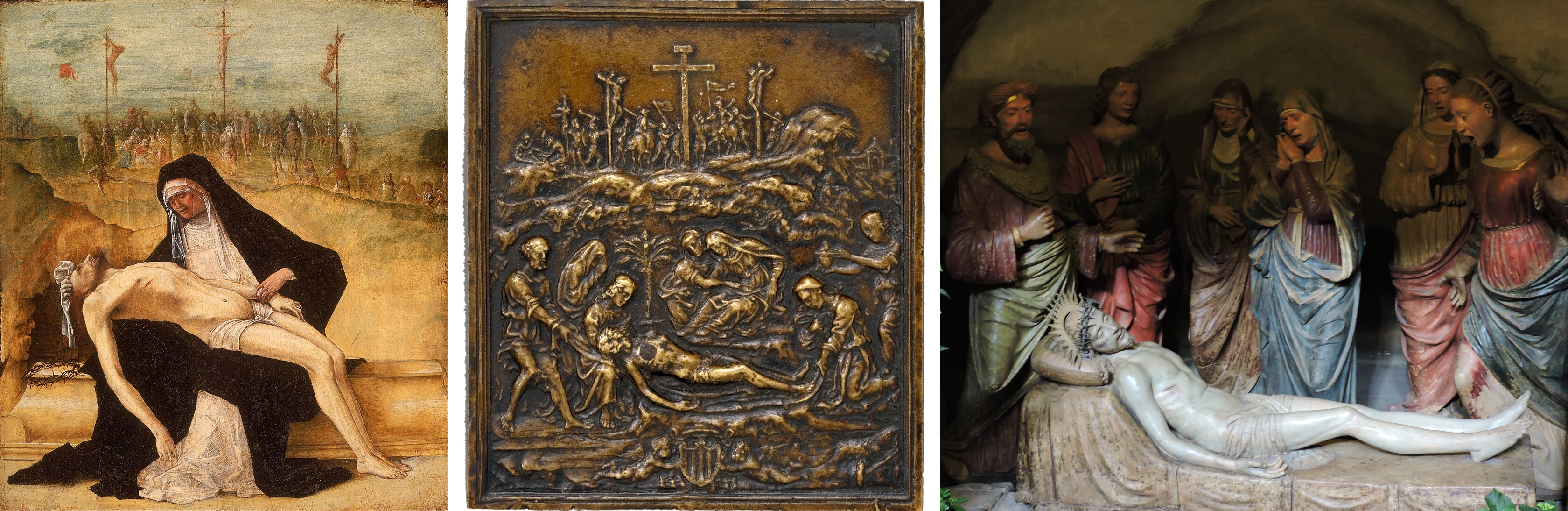
Fig. 4: Central predella panel, oil-on-panel, from the Chiesa di San Giovanni in Monte, Bologna, by Ercole de’ Roberti, ca. 1482-86 (left; National Museums Liverpool, UK); bronze plaquette of the Entombment, attributed Giovanni Francesco Furnio, probably 1498 (after a silver original in fig. 3) (center; Roger Arvid Anderson collection); polychrome terracotta Compianto by Vincenzo Onofri, last years of the 15th century (right; Basilica di San Petronio, Bologna)
Operating at the zenith of ecclesiastical patronage around 1498, IO.F.F. would have executed the primary silver relief of his rectangular Entombment composition for Cardinal Domenico Grimani, a towering figure in the Roman-Venetian Curia, whose family armorial is featured integrally along the base of the relief. The commission likely celebrated either Grimani’s appointment as Patriarch of Aquileia in February 1498 or his ordination as Bishop of Aquileia in April 1498. That the Grimani family selected IO.F.F. over Francia for such an exceptional liturgical instrument demonstrates his immense prestige among the elite Curia of the period.
Despite his success with sacred reliefs, the extreme scarcity of IO.F.F.’s Entombment casts—especially when compared to the vast survival rate of his secular works—serves as the physical proof of a dramatic commercial pivot. Unable or unwilling to continually compete with Francia’s monopoly on the local Bolognese market for sacred silver, IO.F.F. strategically abandoned the ecclesiastical genre. His workshop’s reproductive energy shifted entirely toward cornering a new, highly lucrative niche: outfitting the Bolognese patriciate with decorated weaponry.
Beyond escaping Francia’s shadow, Furnio’s pivot to the secular arms trade was also likely driven by the harsh material realities of ecclesiastical commissions. The Libri di Spesa (Expense Books) of the Fabbriceria di San Petronio from 1490 to 1510 reveal that religious goldsmithing was often a protracted and economically frustrating endeavor.18 Constrained by bullion scarcity, Bolognese goldsmiths were frequently reduced to melting down older, broken liturgical items (rotti) simply to acquire the raw material necessary to execute new designs. For an ambitious master like IO.F.F., the rapidly expanding market for bronze and steel weaponry offered a far more lucrative and less restricted avenue for his ingegno.
This transition to hilt-themed plaquettes, accelerating circa 1499–1500, was catalyzed by the deeply intertwined relationship between Bolognese metalworkers, the prolific printing industry, and the Società delle Quattro Arti. Operating in close proximity with the university’s burgeoning book trade, the connection between these artisans was profoundly physical. Many Bolognese goldsmiths actively transitioned their burin skills from engraving metal plates for jewelry to cutting the actual metal punches required for printing typefaces. This technical crossover cemented a daily, collaborative relationship between the goldsmithing community and the city’s entrepreneur-publishers, such as the Libri and the Benedetti families.19 To fully grasp this ecosystem, one must look to the figure of Peregrino da Cesena, a master niellist operating within Francesco Francia’s circle and the Bologna Mint (Zecca).20
Often identified in archival records as Stefano Pellegrini, Peregrino served as a crucial bridge between the tactile world of goldsmithing and the emerging graphic arts.21 His direct involvement in the secular arms trade is witnessed in the surviving models for knife handles (manici di coltello) attributed to him at the Castello Sforzesco in Milan which confirm that his expertise was actively sought for the physical mounting of luxury weaponry.22 Furthermore, Peregrino’s mastery of niello—a method of filling engraved metal plaques with a dark, enamel-like sulfide paste—utilized the exact same burin techniques and equipment required for the damascening and etching of wide-bladed swords like cinquedeas.23
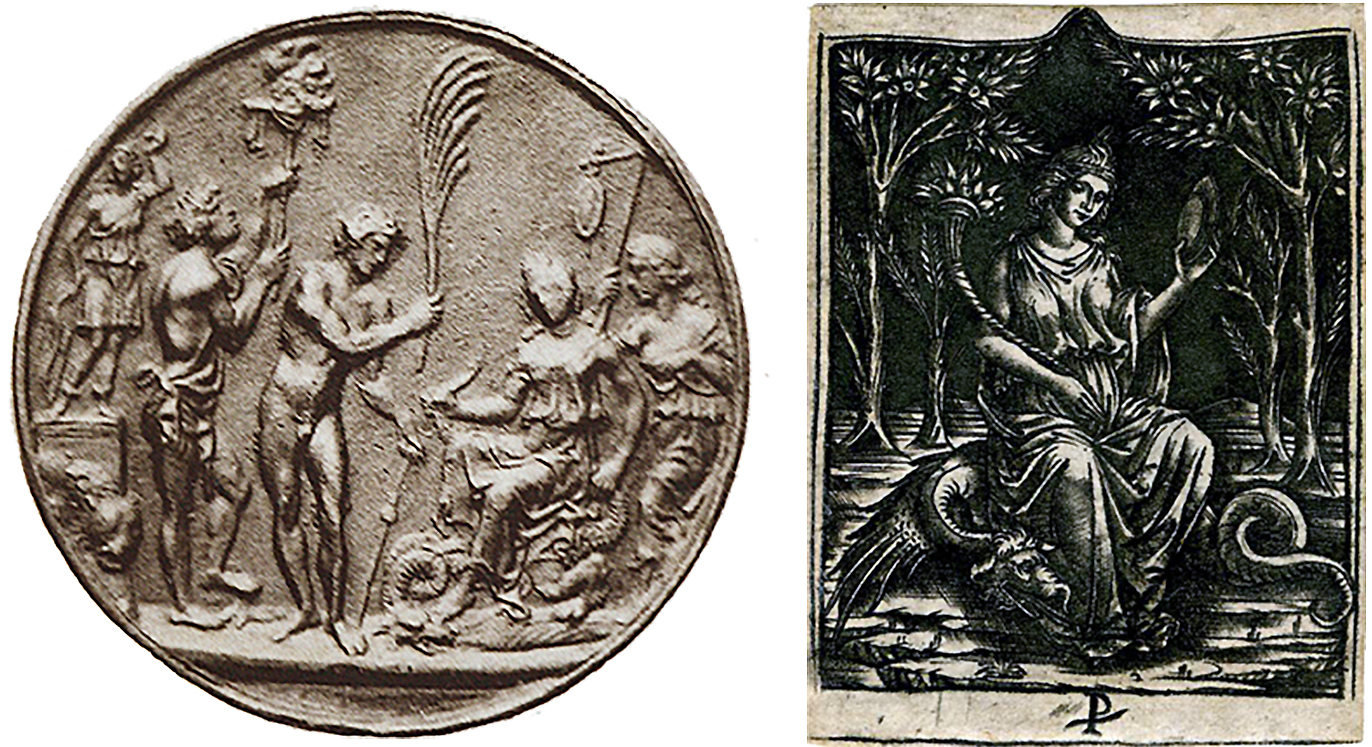
Fig. 5: Bronze plaquette of an Allegory of Prudence or The Apuleian Isis by Giovanni Francesco Furnio, ca. 1500-1506 (above; ex-Gilbert collection); niello print of an Allegory of Prudence by Peregrino da Cesena, ca. 1500 (below; British Museum, inv. 1868,0822.5)
This environment fostered a shared erudite atmosphere where motifs flowed freely. A prime example of this is the connection between IO.F.F.’s Allegory of Prudence (depicting a woman taming a dragon) and a corresponding niello print produced by Peregrino da Cesena (fig. 5). Rather than one copying the other, IO.F.F. and Peregrino were independently interpreting the exact same humanist inventio provided by local scholars. Because artists in Peregrino’s circle occasionally conceived their prints as fundamental designs for three-dimensional metalwork, his nielli functioned as transferable models for other craftsmen.24 This coordinated production resulted in bladesmiths etching the same allegories onto steel blades—or integrating Peregrino’s actual silver niello plaques directly into the guards and hilts—evincing the philosophically dense weaponry production to which IO.F.F. was privy.
The thread of contact between IO.F.F. and Peregrino is further emphasized through a presumed shared graphic repertoire. As Fulton has pointed out, a Bolognese ‘Bacchanal’ niello print associated with Peregrino or his school reproduces the same right-hand figure as observed on IO.F.F.’s Ariadne on Naxos plaquette, a subject entirely reproduced in another niello also associated with Peregrino or his school (fig. 6).25
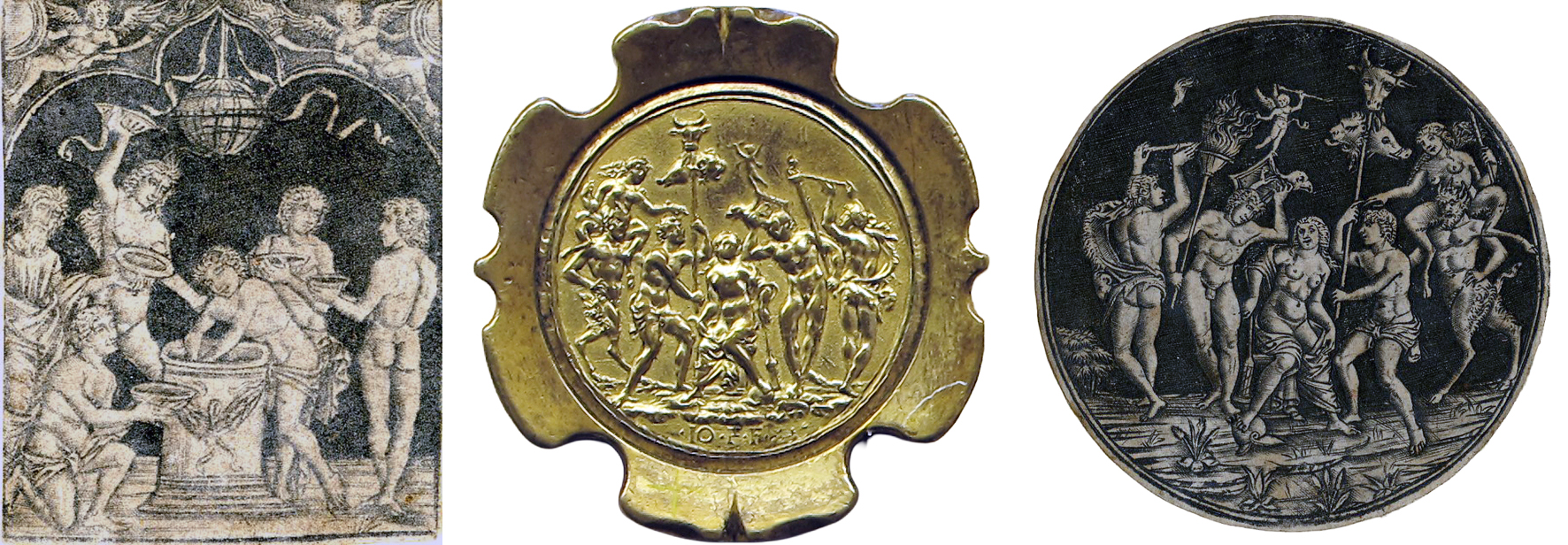
Fig. 6: Niello print of a Bacchanal, ca. 1500 (left; British Museum, inv. 1842,0806.1); gilt bronze plaquette and sword pommel depicting Ariadne on Naxos by Giovanni Francesco Furnio, ca. 1500 (center; Museo Nazionale del Bargello, inv. 1696C); niello print of the same subject, ca. 1500 (right; British Museum, inv. 1868,0822.4)
While the bronze pommels of standard cut-and-thrust swords provided a primary canvas, IO.F.F.’s circular plaquettes were also highly prized for smaller, specialized edged weapons. Most notably, these circular reliefs were perfectly sized to cap the splayed ends of the “ear dagger” (daga alle stradiotte). While the weapon originated with rough Albanian stradiot mercenaries, the ear-dagger had become a highly fashionable, luxury dress accessory among the Italian elite by 1500, making it a fitting canvas for IO.F.F.’s erudite humanist motifs. To accommodate the ergonomic requirements of these specific hilts, some of IO.F.F.’s circular reliefs were deliberately cast in a slightly convex form (fig. 7). When resting in its scabbard at the waist, the inner surfaces of the “ears” were highly visible, allowing the owner to prominently display IO.F.F.’s designs.26
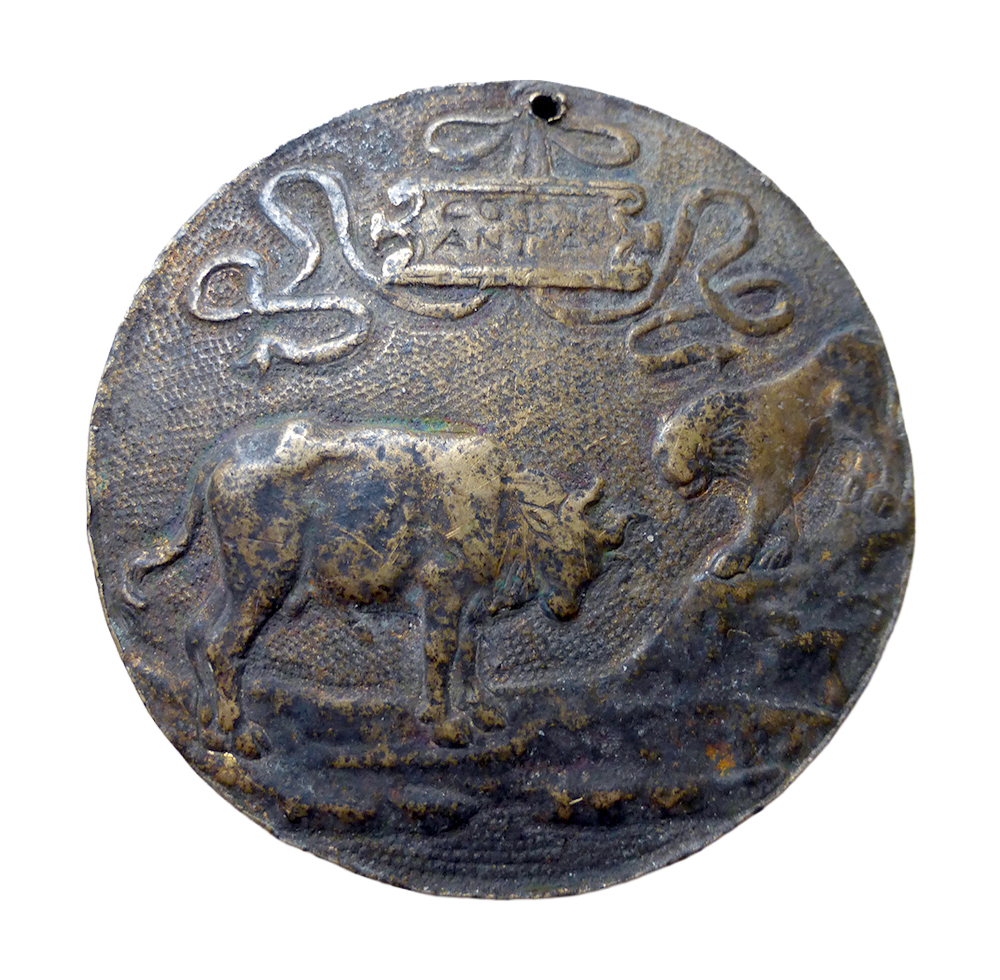
Fig. 7: A convex bronze aftercast plaquette depicting a Bolognese Allegory of Constancy against the Papal States, after Giovanni Francesco Furnio (Sandro Ubertazzi collection)
The Master IO.F.F.’s commercial success may have been rooted in his ability to act as an influential conceptual architect for the weapon ecosystem, rather than just a supplier of loose, inset reliefs. A close examination of surviving Renaissance swords reveals that he likely designed the cast bronze frames and pommels that housed his plaquettes. Three standard pommel forms—most notably an ornate cartouche shape with heavy scrollwork and a circular frame featuring heavy lobes and pointillé—were specifically tailored to tightly encase IO.F.F.’s reliefs (fig. 6, center).27 Furthermore, IO.F.F.’s distinct figural style shares an unquestionable congruence with the raised, modeled designs on the finest surviving leather sword scabbards—such as the famous scabbard of Cesare Borgia—and the etched steel blades of contemporary cinquedeas.28 By coordinating the aesthetics of the bronze pommel, the etched blade, and the tooled leather sheath, IO.F.F. established a unified, highly desirable decorative brand for Bolognese weaponry. The sheer prestige of this unified aesthetic is evidenced by its appeal to the most formidable military and political figures of the era; Fulton has noted, for example, close stylistic affinities between IO.F.F.’s distinctive relief designs and the magnificent Borgia scabbard, as well as etched cinquedeas bearing the arms of Bologna’s ruling Bentivoglio family.29
While Master IO.F.F. successfully fled the shadow of Francesco Francia’s dolcezza to establish his own lucrative monopoly, his dominance over the secular arms trade did not go unchallenged. Francia, an astute artist-bureaucrat, recognized the immense profitability of this specialized market. Although he had been a prominent member of the Goldsmiths’ Guild since 1482, the historical record reveals that on December 23, 1503, Francia officially matriculated into the Società delle Quattro Arti.30 This 1503 matriculation was almost certainly a calculated business maneuver, legally embedding Francia within the arms-trade guild so that he could collaborate directly with swordsmiths and capture a share of IO.F.F.’s domain. Consequently, it is no coincidence that Francia’s own earliest ventures into the medium of secular, decorative bronze plaquettes, some of which appear on hilts—such as the Apollo and the Serpent Python and the Allegory of Virtue and Vice—emerge shortly thereafter, dating precisely to the circa 1505–1506 window, as previously proposed by the present author.31
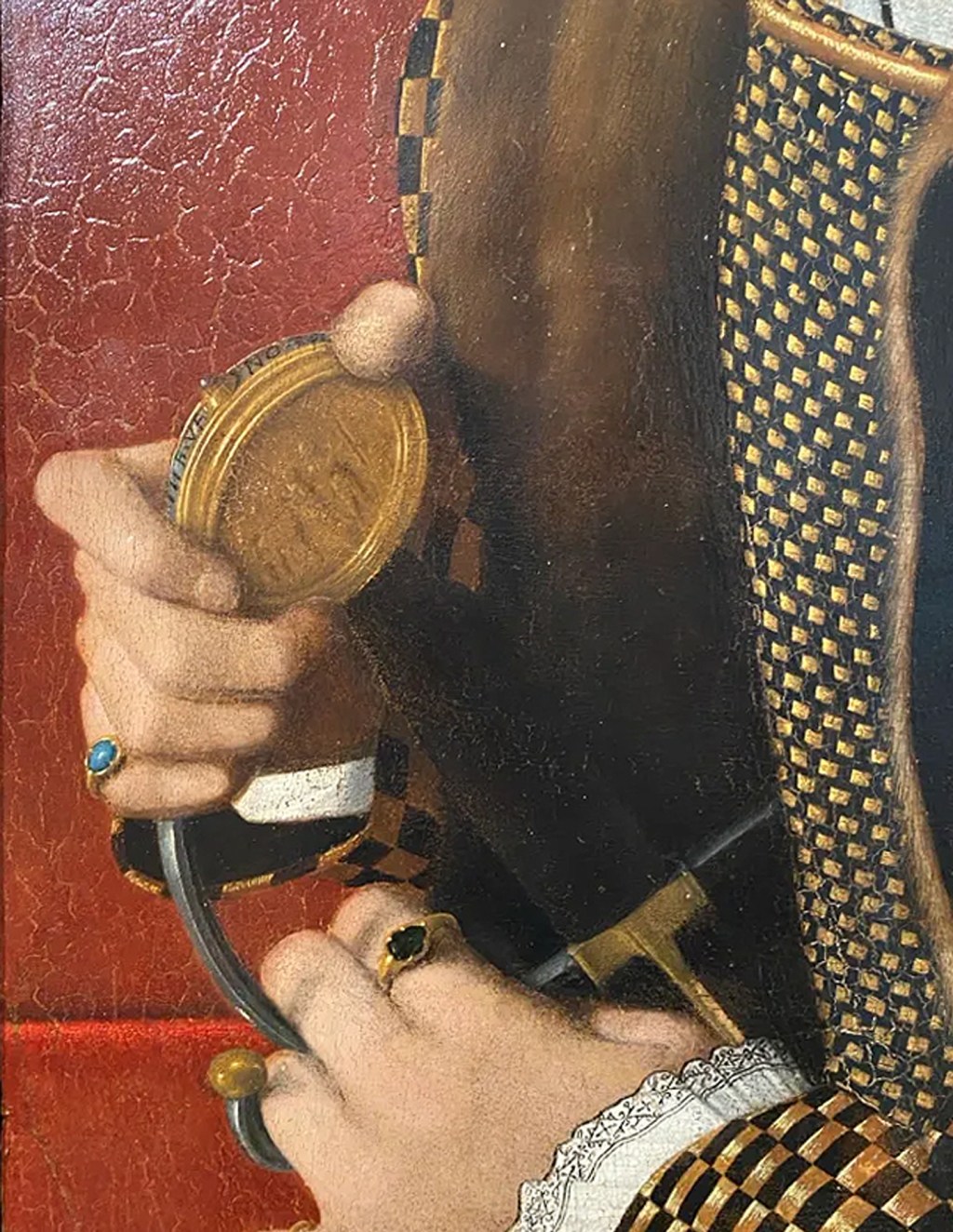
The significant demand for IO.F.F.’s decorated pommels cannot be fully understood without acknowledging Bologna’s unique status as an international epicenter for martial arts. The Bolognese patrician did not carry a sword only for ceremonial display, but rather was actively trained in a highly formalized, local school of civilian combat. The University of Bologna hosted a famous fencing academy founded in the early fifteenth century by Lippo Dardi, which sparked a lineage of celebrated Bolognese fencing masters.32 In the turbulent streets of early sixteenth-century Bologna, the sword was an everyday tool of survival and a profound marker of honor. For the university-educated patrician, carrying a sword adorned with IO.F.F.’s stoic pommels synthesized high-minded academic philosophy with deadly, practical reality (cover).
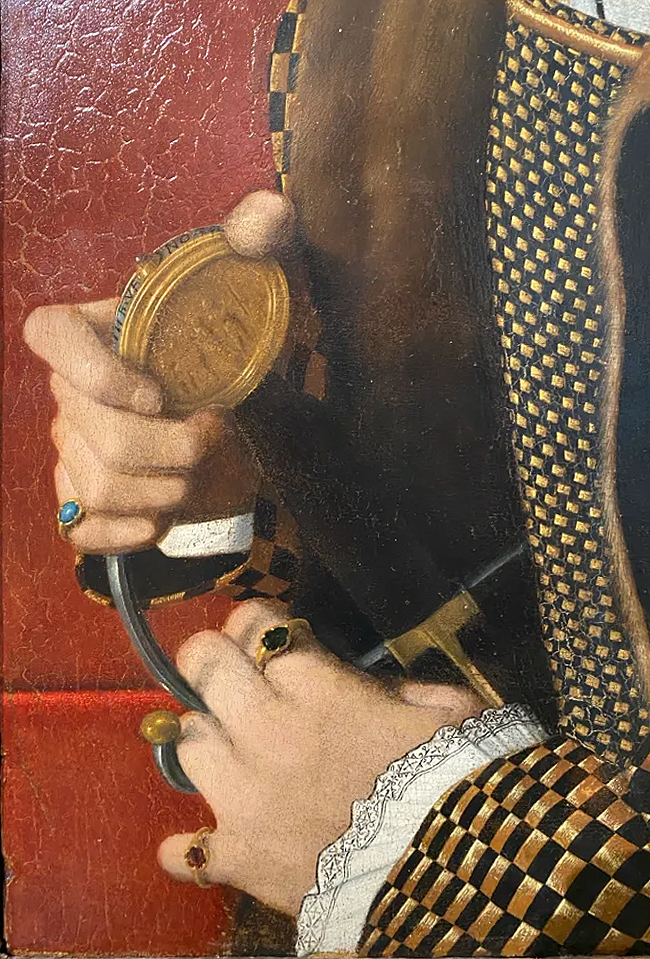
Front cover: detail of a Portrait of a Man by Bartolomeo Veneto, ca. 1520, depicting a sword hilt featuring Giovanni Francesco Furnio’s Trial of Mucius Scaevola plaquette (Museo Nazionale di Palazzo Barberini, Rome)
This intellectualization of combat permeated the highest literary circles of the city. In 1504, the prominent Bolognese humanist—and previously discussed poet—Achillini embedded practical instructions for the use of the sword and buckler directly into his epic poem, Il Viridario, by utilizing the common vocabulary of fencing methodology in a humanist text decades before the first printed fencing manuals of Manciolino and Marozzo. Achillini’s poem demonstrates that the Bolognese patriciate was not simply reading about classical warfare in their studioli but actively codifying the mechanics of it in contemporary swordsmanship.33
In Renaissance Bologna, the educated elite rejected mythology as a “playful narrative of pure entertainment,” preferring it as a “viaticum to knowledge and ethical apprenticeship.”34 Around 1499–1500, IO.F.F.’s initially preferred circular format focused on mythological subjects deeply informed by local humanist trends. His highly popular Judgment of Paris plaquette reflects the Homeric lectures of Antonio Urceo (Codro) and the monumental 1500 commentary on Apuleius’s The Golden Ass by Filippo Beroaldo the Elder (fig. 8). This monumental commentary was specifically printed in Bologna in November 1500 by the publisher Benedictus Hectoris Faelli.35 This exact publication date tightly bookends the circa 1499–1500 timeline established for the influx of new printed texts, demonstrating how rapidly local metalworkers within the Quattro Arti assimilated the university’s newest intellectual products. Faced with the challenge of adapting his figures to a circular format, IO.F.F. filled the empty vertical sky with an aerial cupid. Far from a mere spatial filler, as occasionally suggested in literature, this Cupid acts as a vital allegorical pointer, visually manifesting the overwhelming force of Love that dictates Paris’s fateful choice.
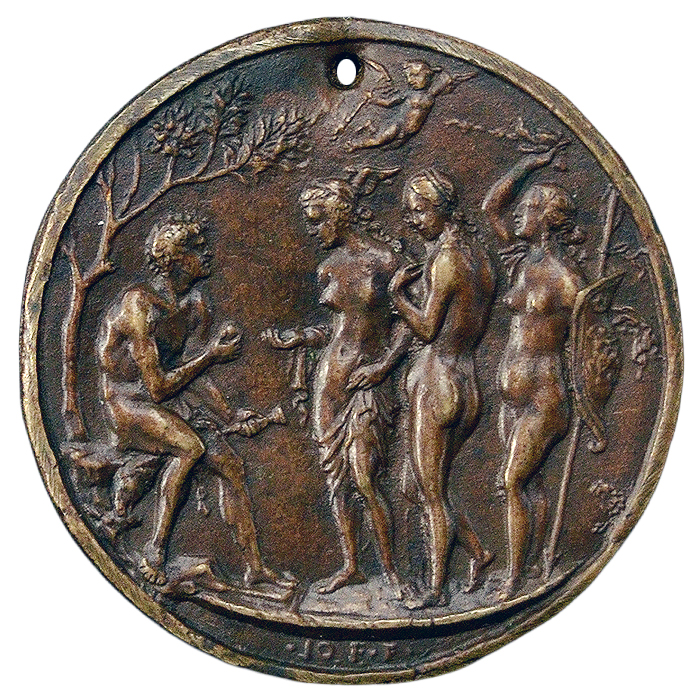
Fig. 8: Bronze plaquette depicting the Judgment of Paris by Giovanni Francesco Furnio, ca. 1500-1502 (present author’s former collection)
A closer visual inspection of the Judgment of Paris plaquette reveals a profound, previously under-examined layer of iconographic warning embedded in the composition. While Paris is draped in a lamb’s skin—a nod to his peaceful, pastoral guise as a herdsman on Mount Ida—he is juxtaposed with instruments of impending doom. As Warren has noted, the relief features a staff terminating in a fire-breathing dragon head, a motif that likely symbolizes the irrationality of base passions and visually foreshadows the literal burning of Troy.36 Even more striking is the decoration upon the shield held by the goddess (presumably the martial Minerva or Juno), which appears to depict the centaur Nessus abducting Deianira.37 This minute detail functions as a brilliant mythological mise-en-abyme. The abduction of Deianira was the catalyst that brought about the agonizing ruin of antiquity’s greatest hero, Hercules. By placing this specific tragedy on the shield, IO.F.F. provides a direct moral mirror to Paris’s own impending choice: yielding to Venus and abducting Helen will unleash catastrophic destruction. For the Bolognese patrician carrying this sword, the pommel was therefore not a celebration of romance, but a stark, stoic warning against the destructive power of luxuria (lust). This complex, cautionary reading perfectly explains why later, provincial aftercasts of this specific IO.F.F. design were explicitly modified to include the humanist inscription: IVDICIO PARIDIS INCLITA TROIA IACET (“By the judgment of Paris, famous Troy lies in ruins”).38
While conventional scholarship has often read IO.F.F.’s Ariadne plaquette as a passive romantic tragedy, its immense popularity on Renaissance sword hilts suggests a far more profound, philosophical application. Rather than a simple myth, the scene functions as a moral allegory that recasts the Bacchic procession as a triumphant exhibition of reason over subjugated animalistic passions, culminating in the peaceful rest of a purified soul. For the Renaissance swordsman, this relief would have served as a potent visual guarantee that his martial actions were not brutish, but a disciplined, classically sanctioned defense of personal virtue and civic order.
Equally reflective of these dense academic readings is another of IO.F.F.’s less commonly encountered circular reliefs, the Allegory with a Woman on a Dragon. While older antiquarian scholarship sometimes cataloged the image as an Allegory of Unity or a purely mythological event, its iconographic vocabulary functions as a complex moral emblem, heavily leaning toward an Allegory of Prudence, previously discussed (fig. 5). The relief centers on a fully clothed woman seated upon a dragon, accompanied by a female figure holding a disc or mirror—a traditional humanist attribute of Prudence and self-knowledge. Before them stands a naked youth holding a palm of victory, while a second youth behind him carries a decapitated male head wearing a Phrygian bonnet on a spear. The extreme left of the composition is anchored by an altar bearing a statue of Diana with a lion at its base. The subjugation of the dragon (a traditional symbol of irrationality and base passions), combined with the mirror of truth and the martial trophies of victory over a “barbarian” (Phrygian) enemy, reads as a triumphant moral fable. By adorning his weapon with this specific scene, the Renaissance swordsman would have carried a layered, portable manifesto about the victory of disciplined intellect and moral rectitude over primal chaos.
However, when viewed through the specific lens of the collaborative exchange between Bolognese scholars and artists, this relief transcends a passive moral emblem to function more clearly as an active cosmographic talisman. The seemingly disparate iconographic elements directly parallel the syncretic invocation of the goddess Isis found in Book 11 of Apuleius’s The Golden Ass, whose text was deeply embedded in the local intellectual consciousness through Beroaldo’s commentary. In Apuleius’s narrative, Isis appears in a vision wearing a crown featuring a flat disk resembling a mirror or the orb of the moon, and proclaims that she is worshipped across the cosmos under various names, explicitly identifying herself as the “Phrygian” Mother of the Gods and as the Cretan “Diana”. IO.F.F. translates this cosmic revelation into bronze: the female figure represents Isis (historically identified by ancient authors as the “Mother of Wild Beasts”), while the naked youth holding the palm embodies the purified Apuleian initiate who has stripped away his base, animalistic nature to achieve spiritual rebirth and salvation. Within a city profoundly invested in the science of the stars, championed by university professors of astrology and medicine like Girolamo Manfredi, this layered imagery transformed the weapon into a potent magical instrument. Rather than reminding the wielder of prudence, the display of the lunar mirror, the subjugated dragon, and the severed Phrygian head invoked the supreme protection of the cosmos, offering the Renaissance swordsman a magically charged, astrological guarantee of martial triumph and survival.
The thriving economic market for IO.F.F.’s luxury weaponry was underpinned by the Renaissance moral philosophy of “Magnificence.” Derived from Aristotle and promoted by humanists, magnificence was the virtue of expending significant wealth on public display in a way that was decorous and appropriate to one’s high status.39 Because the intrinsic financial value of a bronze pommel was relatively low compared to gold or silver, its capacity to confer nobility relied entirely on the ingegno (genius) of its design and its accurate command of the visual languages of antiquity.40 Purchasing an IO.F.F. embellished sword was therefore a calculated economic act of magnificence, proving that the owner possessed not just money, but refined, classical discrimination. Furthermore, this discrimination demanded original invention (inventio). While the Renaissance market was flooded with what early scholars termed a “bastard breed” of plaquettes—cheap, direct casts mechanically reproduced from ancient Roman coins or gems—IO.F.F. did not simply pass off pseudo-antiquities.41 Instead, he provided his patrons with entirely original, modern humanist thought wrapped in classical armor, elevating his bronze hilts from mere copies to dynamic, modern interpretations of antiquity.42
In the turbulent streets of early sixteenth-century Bologna, the sword was an everyday tool of survival and a profound marker of performative martial masculinity and honor. Criminal records from courts like the city’s newly formed Tribunale del Torrone paint a grim picture of a society plagued by factional clashes and honor-based demonstrative violence, where an attack on one’s reputation demanded a bloody, public response. In this extreme environment, a patrician commissioning an IO.F.F. hilt was attempting to intellectualize this brutal reality. The classical art on the pommel served to legitimize the violence of the blade, framing the wearer’s actions as honorable, stoic, and rooted in antiquity rather than simple criminal butchery.43
Furthermore, the consumption of these luxury weapons solved a unique economic dilemma. The Bolognese government continuously issued strict sumptuary laws designed to curb excessive expenditures on clothing and precious metals, which were seen as blurring the visual boundaries between social classes. Because the intrinsic financial value of a bronze pommel was relatively low compared to solid gold or silver, a heavily decorated bronze sword did not violate sumptuary restrictions.44 Its immense value lay entirely in the artist’s ingegno and its sophisticated classical vocabulary. By purchasing IO.F.F.’s work, a patron could safely project Aristotelian “Magnificence” and elite discrimination without running afoul of the city’s magistrates.
Traditionally, the appreciation of classical antiquity was centered in the domestic studiolo—a private space where the elite studied ancient coins, gems, and bronzes to cultivate personal virtue.45 By mounting IO.F.F.’s all’antica plaquettes on the hilt of a sword, the Bolognese patrician effectively took the elite, contemplative virtues of the private studiolo and projected them into the public sphere of the street. This emerging fashion for richly decorated dress swords was specifically designed to appeal to those who aspired to be recognized as connoisseurs of art, literature, and philosophy as well as formidable swordsmen (fig. 9).46 Indeed, contemporary fencing manuals, such as those by the Anonimo Bolognese, reflect this intellectualization of violence, elevating combat from a medieval trade into a science governed by geometry and adorned by physical and mental virtues.47
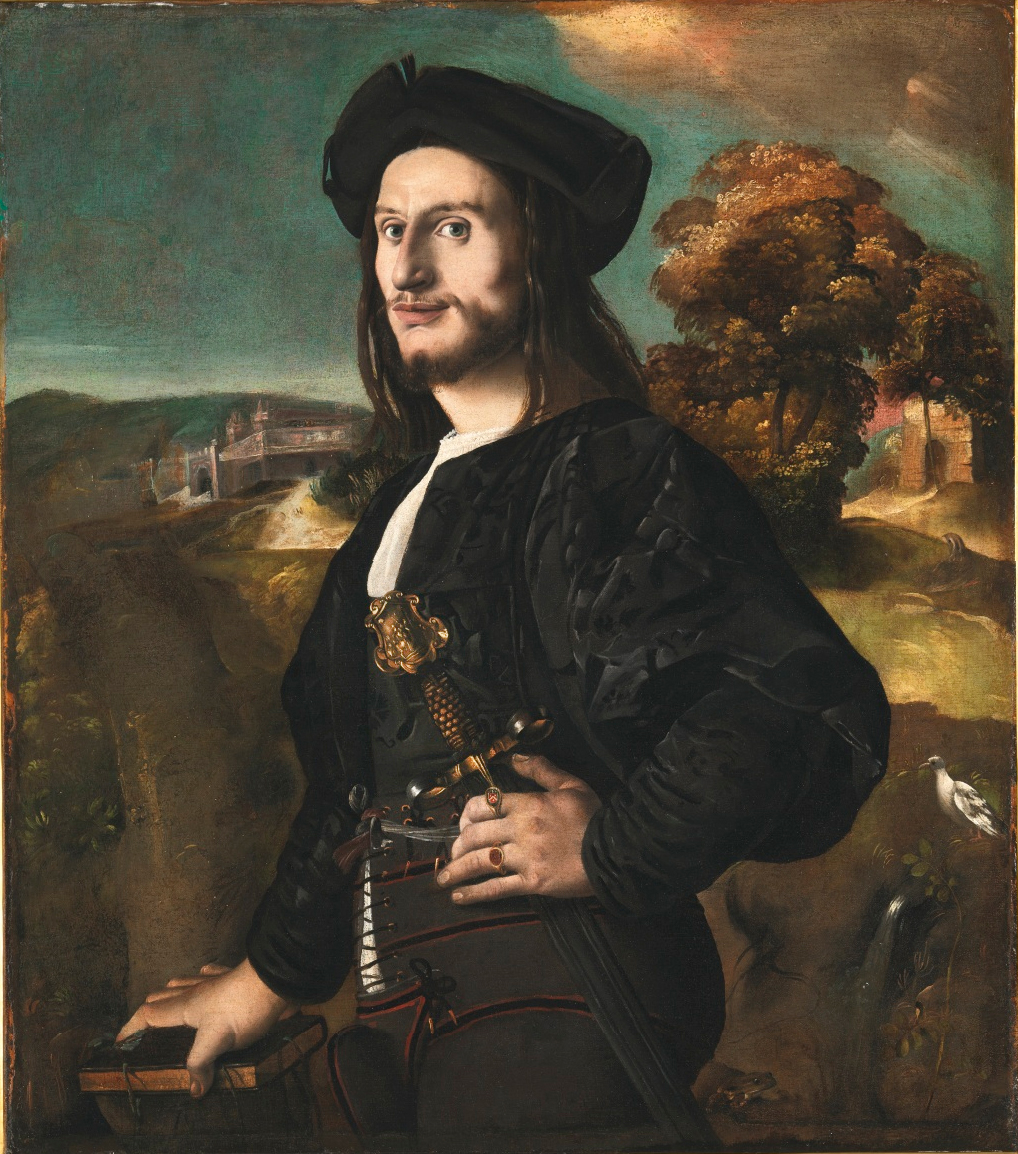
Fig. 9: Amico Friulano del Dosso’s Portrait of a Man, ca. 1515-20, holding a high-value Furnio-Frizzi manufactured sword with a relief plaquette depicting the Sacrifice of Marcus Curtius (private collection)
Furthermore, the transition of the sword into an everyday item of civilian dress carried heavy gendered and psychological implications. In a volatile society, the dress sword functioned as a highly visible marker of performative martial masculinity and honor. The physical design of these weapons played directly into this projection; the gradual taper of heavy Renaissance sword pommels down toward the guard was sometimes designed to subtly suggest an erect phallus, reinforcing the weapon’s association with youthful virility and masculine dominance.48 This gendered perspective also explains IO.F.F.’s deliberate formatting choices. As noted by Fulton, a strict division exists in his secular oeuvre with his circular plaquettes exclusively featuring mythological subjects involving female figures (such as the Judgment of Paris or Ariadne), while his shield-shaped plaquettes exclusively feature hyper-masculine Roman heroes with no female figures present.49 Patrons could thus select specific shapes and subjects from IO.F.F.’s catalog to project targeted facets of their masculine identity—either as cultured, virile lovers or as stoic, martial defenders of the republic.
As the political climate of Bologna became strained, IO.F.F.’s subjects underwent a dramatic transition. In October 1502, as Bologna faced an imminent and terrifying attack by Cesare Borgia and Pope Alexander VI, Filippo Beroaldo delivered his impassioned Oratio ad tribunos plebis to the heads of families gathered in San Giacomo. Drawing heavily on the histories of Livy, Beroaldo exhorted the Bolognese citizens to defend their libertas against tyranny, elevating their immediate civic duty to the level of ancient Roman fortitude.50
Beroaldo’s Livian rhetoric did not fall on deaf ears, as he was speaking to a populace already religiously and militarily conditioned for defiance. In Bologna, spiritual devotion and political autonomy were inextricably fused through the civic Cult of Saint Petronius; the city’s patron bishop was explicitly championed as the ultimate guarantor of Bolognese libertas and the defender of the autonomous commune. Furthermore, this civic theology was backed by physical force. Bologna’s political structure relied heavily on the Società delle Armi (Societies of Arms)—neighborhood militias that marched alongside the craft guilds and were explicitly organized to defend the popular government against aristocratic overreach. The swords IO.F.F. helped manufacture were therefore not just for solitary duels or elite display; they were the standard equipment of a highly organized, armed citizenry.51
It is precisely this Livian, anti-tyrannical rhetoric that IO.F.F. translated into his cartouche-shaped sword pommels. The enigmatic “stick breaker” plaquette precisely illustrates one of the great triumphs of Roman democracy from Livy’s texts: the Revolt of Volero Publilius in 473 B.C. as elucidated by Louis Waldman (fig. 10).52 The relief depicts ragged Roman plebeians rallying around the veteran Volero to physically break the scourging rods of the oppressive consular lictors. Above this scene, IO.F.F. filled the sky with a minotaur and a putto. While older scholarship has dismissed these figures as a superficial zodiacal pastiche meant to fill the vertical space of the cartouche,53 the dense astrological culture of the Bolognese Studium suggests a far more potent reading. In a city saturated with printed prognostications and astrological treatises—such as Lorenzo Spirito’s Libro della Ventura (printed in Bologna c. 1498)54 —astrology was frequently weaponized for civic defense, as seen in the astrologer Guido Bonatti’s use of talismanic bronzes to protect nearby Forlì.55 By placing the revolt under the celestial auspices of Taurus (a symbol of unwavering constancy) and Gemini (divine agency), IO.F.F. elevated the earthly rebellion into a cosmic imperative. The astrological sky visually guaranteed to the swordsman that the defense of Bolognese libertas was a divined destiny, firmly sanctioned by the stars.
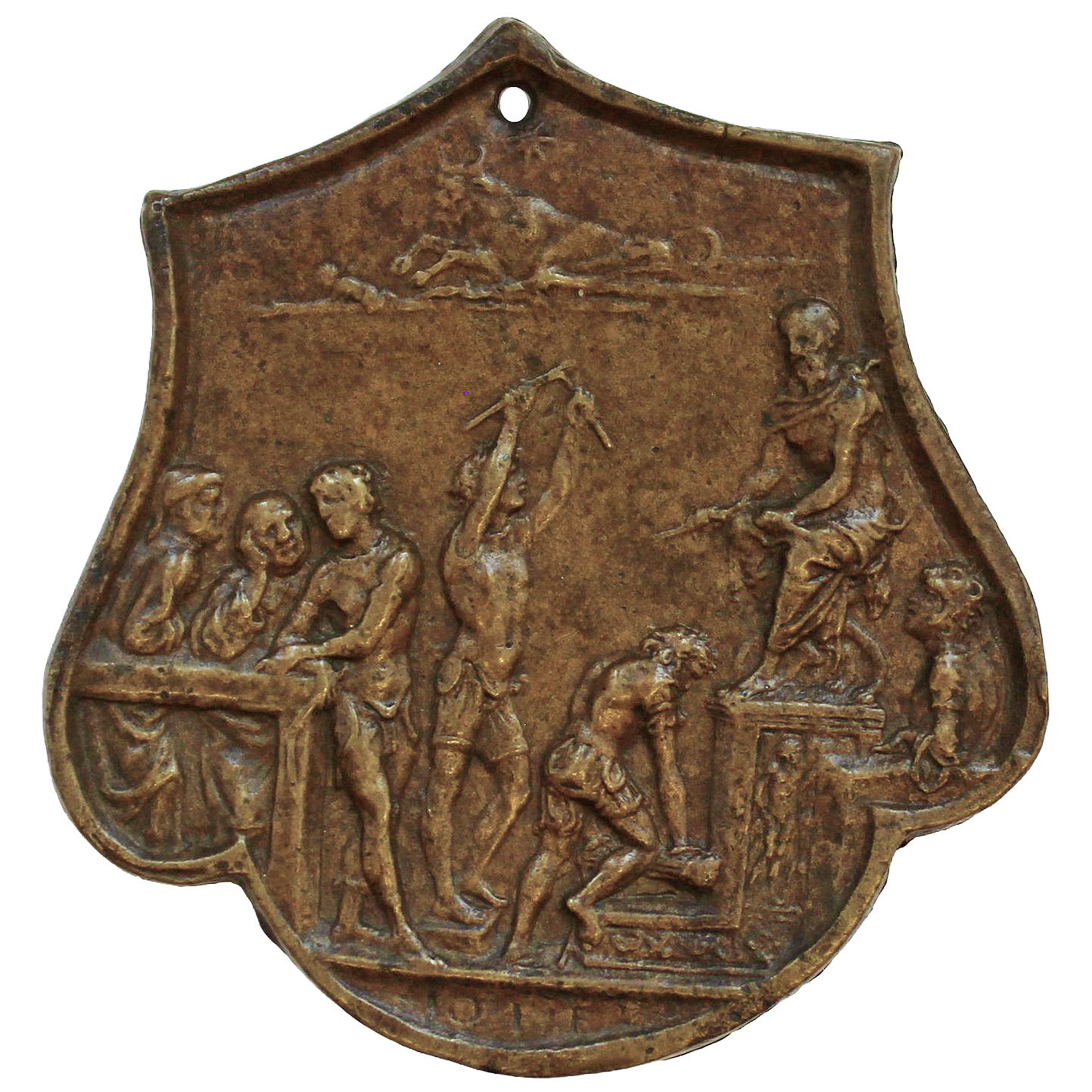
Fig. 10: Bronze plaquette portraying The Revolt of Volero Publilius, ca. 1502, by Giovanni Francesco Furnio (British Museum, inv. 1915,1216.99)
Complementing this were his other late, Livian works: the Trial of Mucius Scaevola, depicting ultimate Roman defiance; the Death of Marcus Curtius, illustrating supreme self-sacrifice; and Horatius Cocles Defending the Bridge (fig. 11). While the feature of three distinct stars in the upper register of the latter relief have often been delegated to mere decorative staffage, the present author alternatively suggests they function as an intentional layered emblem: a cosmic guarantee of victory that simultaneously reminds the Renaissance swordsman that his disciplined violence is meant to protect the three indispensable pillars of Bolognese life—the Church, the Commune, and the University.
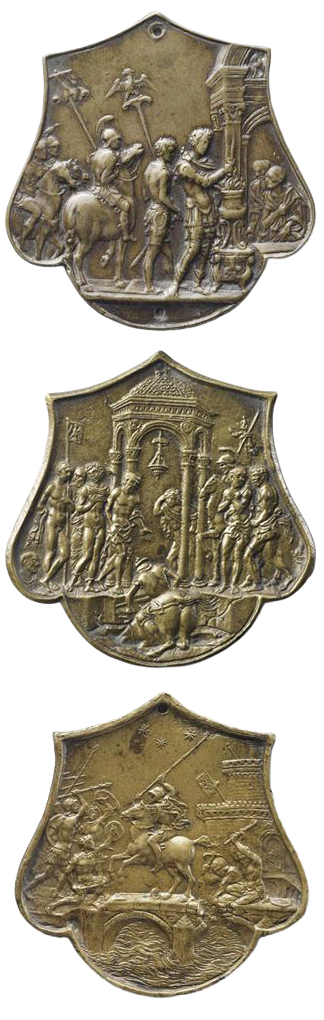
Fig. 11: Bronze plaquettes depicting (from top-to-bottom), the Trial of Mucius Scaevola, the Death of Marcus Curtius, and Horatius Cocles Defending the Bridge by Giovanni Francesco Furnio, ca. 1502-06 (Louvre, invs. OA 2852, OA 9257, and OA 9255)
A singular relief preserved at the Museo Correr (fig. 12) represents a notable break from Fulton’s established structural criteria for IO.F.F.’s workshop. While Fulton observed that Furnio’s shield-shaped cartouches were exclusively reserved for male-dominated scenes of Roman virtus, this unique plaquette depicts the Livian episode of the Continence of Scipio, prominently featuring female figures. The narrative is clearly evidenced by the victorious general Scipio Africanus (marked by the “S.A.” standard), the reunited captive maiden and her betrothed, and the bestowed ransom gold. By making this formatting exception, Furnio provided the Bolognese swordsman with the ultimate martial manifesto—a stoic visual declaration that true, classically sanctioned power lies not simply in physical conquest or violence, but in clemency, absolute self-mastery, and the noble restraint of base passions. Unusually, this relief did not achieve the widespread commercial success evinced by the numerous surviving casts of his other compositions.
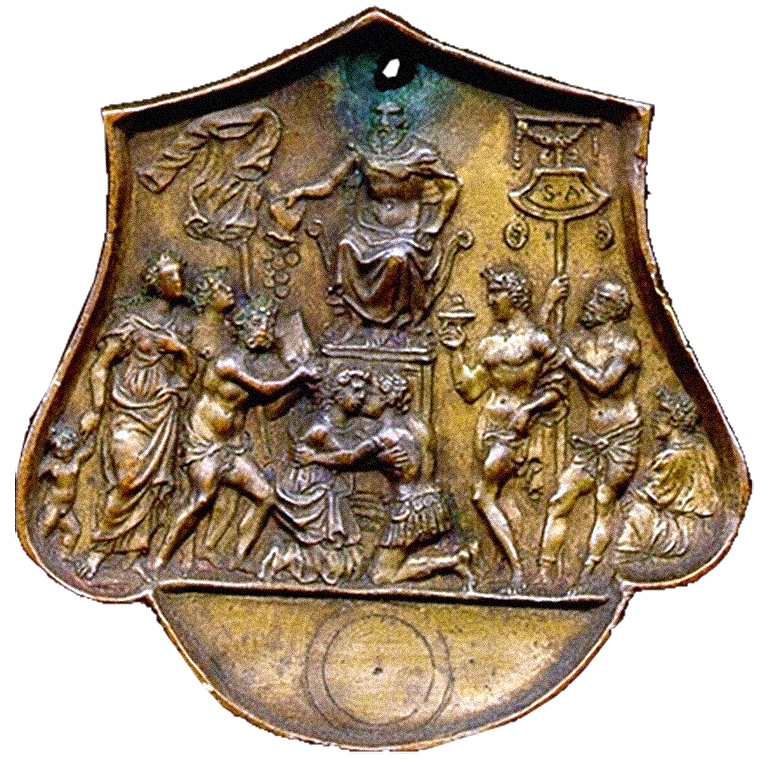
Fig. 12: Bronze plaquette portraying the Continence of Scipio, ca. 1502-06, by Giovanni Francesco Furnio (Museo Correr, inv. Cl. XI n. 0060)
To explicitly codify the anti-tyrannical subjects observed in the previously discussed plaquettes, IO.F.F. also produced stoic, martial allegories. A paramount example of this is the earlier discussed Allegory of Constancy as an emblem of fortitude against the impending threat posed by the Papal States. Another emblematic plaquette of similar thematic import is a scene of Theseus Overcoming Antiope, properly identified by Bange but often misidentified as the Sacrifice of Iphigenia (fig. 13). When viewed as a scene depicting Theseus Overcoming Antiope, the plaquette becomes a highly appropriate martial manifesto for the Bolognese swordsman. The composition frames the sword-wielding Theseus and the attendant bearing the spoils of the Amazons as a triumphant display of reason and order. By adorning a weapon with this specific scene, the owner carried a visual guarantee that his own violence was justified through a mythological allegory celebrating the victory of civilized, disciplined martial virtue over wild, untamed, and chaotic forces.
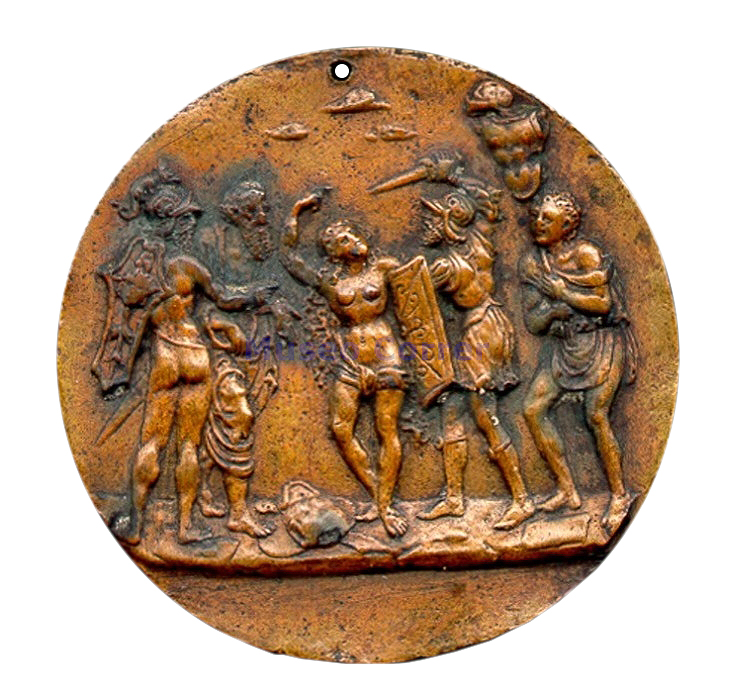
Fig. 13: Bronze plaquette portraying Theseus Overcoming Antiope, ca. 1500-1506, by Giovanni Francesco Furnio (Museo Correr)
Although possibly not by IO.F.F., a more direct contemporaneous example of this theme is observed in an Allegory of Fidelity depicting a naked youth steadfastly enduring an attack by lions, accompanied by the profound Latin legend: ET SI CORPUS NON FIDES MACULABITUR (“Even if the body is destroyed, faith/fidelity shall not be spotted”) (fig. 14). This inscription provides direct, textual evidence (on the bronze itself) that these weapons were used to project an intellectualized, sacrificial masculinity.56 By carrying a weapon adorned with these specific pommels, the Bolognese patrician bore a defiant martial manifesto, broadcasting their readiness to defend Bolognese libertas against tyrannical encroachment.
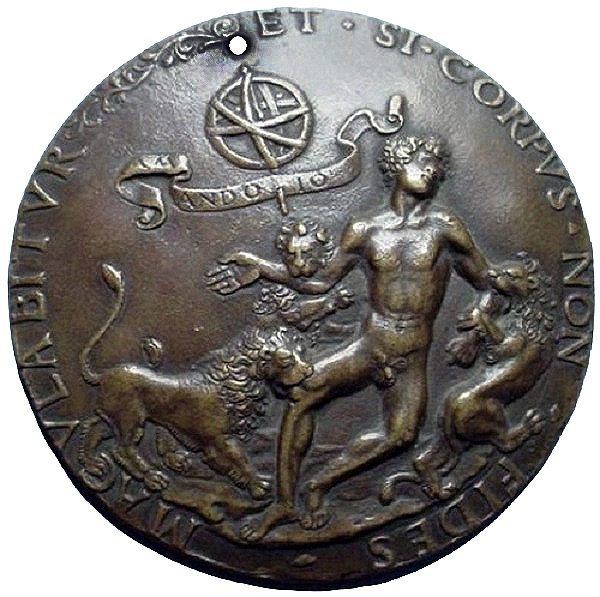
Fig. 14: Bronze plaquette depicting an Allegory of Fidelity, ca. 1500-06, follower of Giovanni Francesco Furnio (?) (ex-Max Falk collection)
Ultimately, the highly lucrative market that Master IO.F.F. had monopolized was extinguished not by his artistic rivals, but by the tactical revolution of gunpowder. As Spanish arquebusiers repeatedly decimated traditional cavalry in the early sixteenth century—culminating in the military adventures of the “Great Captain,” Gonzalo Fernández de Córdoba—the heavy, wide-bladed cut-and-thrust sword rapidly lost its martial prestige.57 Gentlemen swiftly adopted the lighter, slender rapier as their weapon of choice, suddenly rendering the heavy bronze canvas of the Bolognese pommel obsolete.58 Yet, the enduring success of IO.F.F.’s aesthetic branding is evidenced by the incredible international “afterlife” of his designs which transcended the Bolognese Quattro Arti and continued to be reproduced long after the artist ceased production. His designs were appropriated for elite contexts across Europe: casts of his reliefs were utilized in the decoration of the luxurious leather bookbindings of the famous bibliophile Jean Grolier, and in England, a boss from a gun shield commissioned for the bodyguard of King Henry VIII in the 1540s features a faithful, engraved copy of IO.F.F.’s Trial of Mucius Scaevola.59
Furthermore, his most popular compositions spawned later aftercast variants produced by provincial workshops. These later casts were sometimes modified to include added inscriptions that explicitly elaborated on the philosophical weight of the scenes. Two such variants of the Judgment of Paris feature profound humanist maxims: like the previously noted: IVDICIO PARIDIS INCLITA TROIA IACET (“By the judgment of Paris, famous Troy lies in ruins”) and another inscribed PVLCHRAE OPES ET ARMA SED MORS PVLCHRIOR (“Beautiful are Riches and Arms, but Death is More Beautiful”).60
Far from being a subordinate to the ‘School of Francia,’ Master IO.F.F. stands revealed as the highly strategic Giovanni Francesco Furnio. This identification transcends circumstantial conjecture, satisfying the most rigorous modern attributional frameworks by meeting strict demands for documentary exclusion, chronological alignment, and material excellence. Furnio thus emerges as an artist whose ‘reliefs in circular form and in medium and low relief’ were unique visual inventions which continued to serve as potent vehicles of moral and martial reflection across Europe well into the sixteenth century and beyond.61
Endnotes:
1 For the standard cataloging of this specific composition, see John Pope-Hennessy, Renaissance Bronzes from the Samuel H. Kress Collection: Reliefs, plaquettes, statuettes, utensils and mortars (London: Phaidon Press, 1965), 36, No. 110. The plaquette also appears on the reverse of a 1524 medal by Christoph Weiditz, demonstrating the wide resonance of the design.
2 For over a century, the identity of the Master IO.F.F. was the subject of intense scholarly speculation, resulting in several proposed—and subsequently rejected—identifications. Early critics, such as Émile Molinier, mistakenly identified the artist as Giovanni di Lorenzo di Pietro delle Opere (known as Giovanni delle Corniole), a Florentine gem engraver whose work bears no stylistic similarity to the plaquettes. J.C. Robinson and C.D.E. Fortnum privately entertained the idea that the monogram belonged to Giacomo Francia, the son of Francesco Francia, given the artist’s obvious debt to the Bolognese niello tradition; however, Giacomo’s later career does not align with the dating of the plaquettes. An associaton with Giovanni Fonduli of Crema was proposed by Winifred Terni de Gregory in 1950 but the artist’s emergent style in subsequent studies have since dissuaded this idea. Other discarded candidates include the Mantuan bronze caster and medalist Giovanni Francesco Ruberti, the gem engraver Giovanni Bernardi (whose documented activity postdates the core period of IO.F.F.’s production), and a certain Gian Francesco di Boggio, who was active too late (1538). For a comprehensive summary of these early attributional histories, see Christopher Fulton, The Master IO.F.F. and the Function of Plaquettes, in Studies in The History of Art, vol. 22, (National Gallery of Art, Washington, DC., 1989), p. 156, note 3.
3 Ibid., Fulton (1989); and Marco Collareta, Sul “Maestro IO.F.F.” e sulla posizione dell’oreficeria nell’arte italiana intorno all’anno 1500, in Prospettiva, nos. 87–8 (July–October 1997), 137–139.
4 Jeremy Warren, Medieval and Renaissance Sculpture in the Ashmolean Museum, Vol. 3: Plaquettes, (Ashmolean Museum Publications, UK, 2014), p. 818. The literary endorsement is found in Giovanni Filoteo Achillini, Il Viridario (Bologna: per Hieronymo di Plato, 1513). Rossi’s recent catalog of the Scaglia collection likewise follows this hypothesis of Furnio as the identity behind IO.F.F., in Francesco Rossi, La Collezione Mario Scaglia – Placchette, Vols. I-III. (Lubrina Editore, Bergamo, 2011), p. 260. The present author also agrees with the identification of Giovanni Francesco Furnio as IO.F.F. This idea may be further bolstered by a unique plaquette of the Judgment of Paris discussed by Toderi-Vannel which bears the alternative epigram IO.F.FVI. IO.F.FVI This unique signature may represent an extended Latin abbreviation of his surname, Iohannes Franciscus FVI[rnius]; alternatively, it could reflect the humanist convention of utilizing the perfect tense fui (“I was”) as a declarative mark of authorship. However, it is perhaps most probable that “FVI” is simply a modern transcription error. Furnio’s standard epigram, IO.F.F., is frequently followed by a decorative sprig of foliage. A worn cast or damaged edge could easily cause this final “F” and leaf motif to be visually misinterpreted by catalogers as the letters “FVI” (not unlike historical misreadings of his signature as “JOLI F”).
5 Fulton, “The Master IO.F.F.,” 145.
6 Ernst Bange, Die Italienischen Bronzen der Renaissance und des Barock. Zweiter Teil: Reliefs und Plaketten. (Vereinigung Wissenschaftlicher,, Verleger Walter de Gruyter & Co., Berlin and Leipzig, Germany, 1922), no. 646, inv. 1240.
7 From the Ciechanowiecki Collection, and before him, with Stefano Bardini. See Fulton, “The Master IO.F.F.,” 158, note 5.
8 Email communication, February 2026 (formerly with the collection of Neil Goodman). Warren likewise owns a rare example of the “rectangular” plaquette by IO.F.F. for Grimani.
9 Fulton, “The Master IO.F.F.,” 146. Fulton conflated the unsigned rectangular composition with the signed arched composition. Woops, no biggie (that Bange catalog is uber-huge!).
10 Bange (1922), no. 647, inv. 1241.
11 From the collection of Roger Arvid Anderson and before him with Dr. Eduard Simon in Berlin.
12 Inv. Pl.30.
13 Èmile Molinier, Les Bronzes de la Renaissance. Les plaquettes, (Paris, 1886), no. 125.
14 Wilhelm von Bode, Beschreibung der Bildwerke der Christlichen Epochen: Die Italienischen Bronzen, (Berlin, Germany: Konigliche Museen zu Berlin, 1904), no. 647.
15 Bange (1922), no. 647.
16 Davide Banzato, Maria Beltramini and Davide Gasporotto, Placchette, bronzetti e cristalli incisi dei Musei Civici di Vicenza. Secoli XV- XVIII, (Vicenza, Palazzo Chiericati, 1997), no. 27, pp. 63-64.
17 See Molinier (1886), nos. 124 and 125; and Bange (1922), nos. 646 and 647. For the Cividale Grimani pax see also Thomas Richter, Paxtafeln und Pacificalia: Studien zu Form, Ikonographie und liturgischem Gebrauch. Verlag und Datenbank für Geisteswissenschaften (Weimar, 2003) and Paolo Goi, Vero, dipinto, donato, perduto. Percorso alternativo attraverso i metalli preziosi del Friuli-Venezia Giulia in Ori e tesori d’Europa. Atti del convegno di studio, (Udine, 1992).
18 The Crucible of Renaissance Craft: Archival Perspectives on Bolognese Goldsmiths, 1490–1510, 2-4. The foundational archival work of Mario Fanti in reorganizing the Libri di Spesa and Mandati di Pagamento of the Fabbriceria di San Petronio has been instrumental in detailing the reliance on rotti (recycled metals) due to bullion scarcity during this period.
19 The Golden Age of the Bolognese Artisan: An Archival Reconstruction of the Goldsmiths’ Guild and Judicial Landscape (1490–1510), 3-4.
20 For Peregrino da Cesena’s activity within the circle of Francesco Francia and the Bologna Mint, see Franco Spazzoli, Peregrino da Cesena, Misterioso e geniale maestro nell’arte incisoria del niello (cesenadiunavolta.it, 2020, accessed February 2026). See also, anon., The Shadow and the Die: Peregrino da Cesena and the Intersection of Niello Artistry, Goldsmithing, and the Numismatic Evolution of the Bologna Mint (2022).
21 Ibid. Peregrino’s work acted as a “bridge” (testimonianza ponte) between the artisanal world of the orefice (goldsmith) and the intellectual world of the printmaker.
22 Ibid.; see also Spazzoli (2020). Both authors cite the models for knife handles attributed to Stefano Pellegrini, preserved in the Raccolte Grafiche e Fotografiche of the Castello Sforzesco in Milan.
23 Fulton, “The Master IO.F.F.,” 150-151.
24 The translation of the two-dimensional niello line into three-dimensional high-relief plasticity confirms that goldsmiths in this circle did not view designs passively. See Michael Riddick, Bizarre Silver, Aspertini, Peregrino, and a Pair of Bolognese Paxes (2026, Renbronze.com, manuscript February 2026).
25 Fulton, “The Master IO.F.F.,” 150-151. Fulton specifically notes the structural congruence between the Bacchanale niello in the British Museum and the contraposto movements in IO.F.F.’s Ariadne on Naxos. We may also note a related Trial of Mucius Scaevola niello by Peregrino or the Bolognese school, brought to our attention by Fulton, which is reproduced in Arthur M. Hind, Nielli, chiefly Italian of the XV century: plates, sulphur casts and prints preserved in the British Museum, London: Printed by order of the Trustees, 1936, p. 53, no. 225.
26 On Peregrino da Cesena’s role as a graphic distributor and bridge within the Quattro Arti, see The Shadow and the Die: Peregrino da Cesena (2022).
27 Fulton, “The Master IO.F.F.,” 148.
28 Ibid., 149-150.
29 Ibid. Fulton notes the observations of Ulrich Middeldorf regarding the stylistic congruencies between IO.F.F.’s plaquettes and the Borgia scabbard preserved in the Victoria and Albert Museum.
30 Ibid., 147-151.
31 Michael Riddick, Three Plaquettes by Francesco Francia or His Circle – Proposing an Identity for Pseudo-Fra Antonio da Brescia, (Renbronze.com, 2017, accessed February 2026).
32 Archivio di Stato di Bologna (ASBo), Società degli Orefici. See also The Crucible of Renaissance Craft: Archival Perspectives on Bolognese Goldsmiths, 1490–1510.
33 For the presence of sword and buckler instruction in early sixteenth-century Bolognese poetry and its relation to the Dardi school terminology, see The Bolognese Tradition: Ancient Tradition, 2-12. Achillini’s Viridario (1504) significantly predates the publication of the traditional Bolognese fencing masters, illustrating the deep entanglement of humanist letters and martial practice.
34 For Bologna as an epicenter of Renaissance martial arts and the Dardi school, see Bolognese Swordsmanship: The Dardi School (published online by the Chicago Swordplay Guild).
35 Filippo Beroaldo, Commentarii a Philippo Beroaldo conditi in Asinum aureum Lucii Apuleii (Bologna: Benedictus Hectoris Faelli, November 1500). For the context of Beroaldo’s printing and its impact, see also Andrea Severi, Filippo Beroaldo il Vecchio, un maestro per l’Europa (Bologna: Il Mulino, 2015).
36 Warren (2014), 877–879.
37 For the classical literary source of the Nessus and Deianira myth—a cautionary narrative regarding lust that was highly popular in the Renaissance and frequently depicted in contemporary plaquettes by artists such as Moderno—see Ovid, Metamorphoses, 9.101–133.
38 Fulton, “The Master IO.F.F.,” 146-147.
39 Luke Syson and Dora Thornton, Objects of Virtue: Art in Renaissance Italy (Los Angeles: J. Paul Getty Museum, 2001), 24-25.
40 Ibid., 135-136.
41 Fulton, “The Master IO.F.F.,” 143. Fulton cites Sir George Francis Hill’s classification of plaquettes cast directly from engraved gems of classical or Renaissance origin as a “bastard breed.”
42 For a discussion of the elite patron’s demand for the artist’s ingegno (genius) in reproducing and restoring antiquities, see Luke Syson and Dora Thornton (2001), 108.
43 Colin Rose, Violence and the Centralization of Criminal Justice in Early Modern Bologna, in A Companion to Medieval and Renaissance Bologna, ed. Sarah Rubin Blanshei (Leiden: Brill, 2018). For the broader context of masculinity and public violence, see also J. M. Hunt, Carriages, Violence and Masculinity in Early Modern Rome, in I Tatti Studies in the Italian Renaissance 17, no. 1 (2014): 175-196.
44 Catherine Kovesi Killerby, “Practical Problems in the Enforcement of Italian Sumptuary Law, 1200-1500, in Crime, Society and the Law in Renaissance Italy, eds. T. Dean and K. Lowe (Cambridge: Cambridge University Press, 1994), 251-261. On the value of bronze over gold based on the artist’s ingegno, see Luke Syson and Dora Thornton (2001), 135-136.
45 Syson and Thornton, Objects of Virtue, 84-85.
46 Tobias Capwell, Sharp Dressing: A Dress Sword of the Italian Renaissance, in Apollo (February 2013): 34-35.
47 Stephen Fratus, trans., Anonimo Bolognese (Unpublished Translation), sec. 1.
48 Capwell (2013), 36.
49 Fulton, “The Master IO.F.F.,” 146.
50 Sarah Rubin Blanshei, ed., A Companion to Medieval and Renaissance Bologna (Leiden: Brill, 2018).
51 David J. Drogin, Art, Patronage and Civic Identities in Renaissance Bologna, in A Companion to Medieval and Renaissance Bologna, ed. Sarah Rubin Blanshei (Leiden: Brill, 2018), 246-248. See also Angela De Benedictis, Popular Government, Government of the Ottimati, and the Languages of Politics: Concord and Discord (1377-1559), in the same volume, 290-291.
52 Louis Waldman, A Livian Plaquette by Master IO.F.F., The Medal, No. 21 (1992), pp.16-19.
53 Fulton, “The Master IO.F.F.,” 146-147.
54 Lorenzo Spirito, Libro della Ventura [also known as Il Libro delle Sorti] (Bologna: Caligola Bazalieri, c. 1498). For a comprehensive study on the iconography and circulation of Spirito’s work, see Silvia Urbini, Il Libro delle Sorti di Lorenzo Spirito Gualtieri (Modena: Franco Cosimo Panini, 2006). The intellectual climate of the Bolognese Quattro Arti was heavily influenced by the local printing presses, which also produced fundamental geographic and astrological texts such as the first printed edition of Claudius Ptolemy’s Cosmographia (Bologna: Domenico de’ Lapi, 1477).
55 Guido Bonatti, a highly influential 13th-century astrologer active in the Romagna, detailed his astrological theories in his Liber Astronomiae (later printed widely as Decem tractatus astronomiae). For the historical account of Bonatti’s use of astrological bronzes as protective civic talismans, see Jacob Burckhardt, The Civilisation of the Renaissance in Italy, trans. S. G. C. Middlemore (New York: Harper & Row, 1960). For the broader Renaissance practice of wearing esoteric or cryptographic symbols as personal or defensive talismans, see also Lorenzo Bonoldi and Monica Centanni, Catena d’onore, catena d’amore: Baldassarre Castiglione, Elisabetta Gonzaga e il gioco della ‘S’, in La Rivista di Engramma (engramma.it, accessed February 2026).
56 For the identification of this plaquette as Rectitude or Fidelity, see John Pope-Hennessy, “The Italian Plaquette,” Proceedings of the British Academy, 50 (1964), 64. For further discussion on the iconography of stoic endurance in Renaissance bronzes and the Allegory of Fidelity, see Attilio Troncavini, “Placchetta in bronzo con uomo nudo incatenato su pira ardente,” Antiqua Nuova Serie (www.antiquanuovaserie.it).
57 Fulton, “The Master IO.F.F.,” 156.
58 Ibid.
59 Waldman (1992), 18.
60 Fulton, “The Master IO.F.F.,” 147.
61 The enduring physical legacy of IO.F.F.’s work is occasionally brought to light through modern, informal recovery. A gilt example of the Allegory with a Woman on a Dragon, formerly in the author’s collection, was discovered circa 1928 by a local youth, Armando Angeli, within an unexcavated subterranean path at the ruined fortress of Verruca. This fortress served as a highly contested stronghold during the Florentine-Pisan wars of the early sixteenth century. Pierced in three places, the relief may have functioned as a hat badge or perhaps as an ornamental mount for a sword hilt—a fitting accessory given the site’s history of Renaissance melee. The object was later examined and its identity corroborated by directors at the Museo Nazionale del Bargello. (For the Bargello’s cataloged specimens of this relief, see Giuseppe Toderi and Fiorenza Vannel Toderi, Placchette: secoli XV-XVIII nel Museo Nazionale del Bargello [Florence: S.P.E.S., 1996]). Such provenances provide a rare, tangible link between IO.F.F.’s secular production and the physical battlegrounds of the Italian Renaissance.
 Renaissance Bronze
Leave a comment