by Michael Riddick
Preview / download PDF in High Resolution
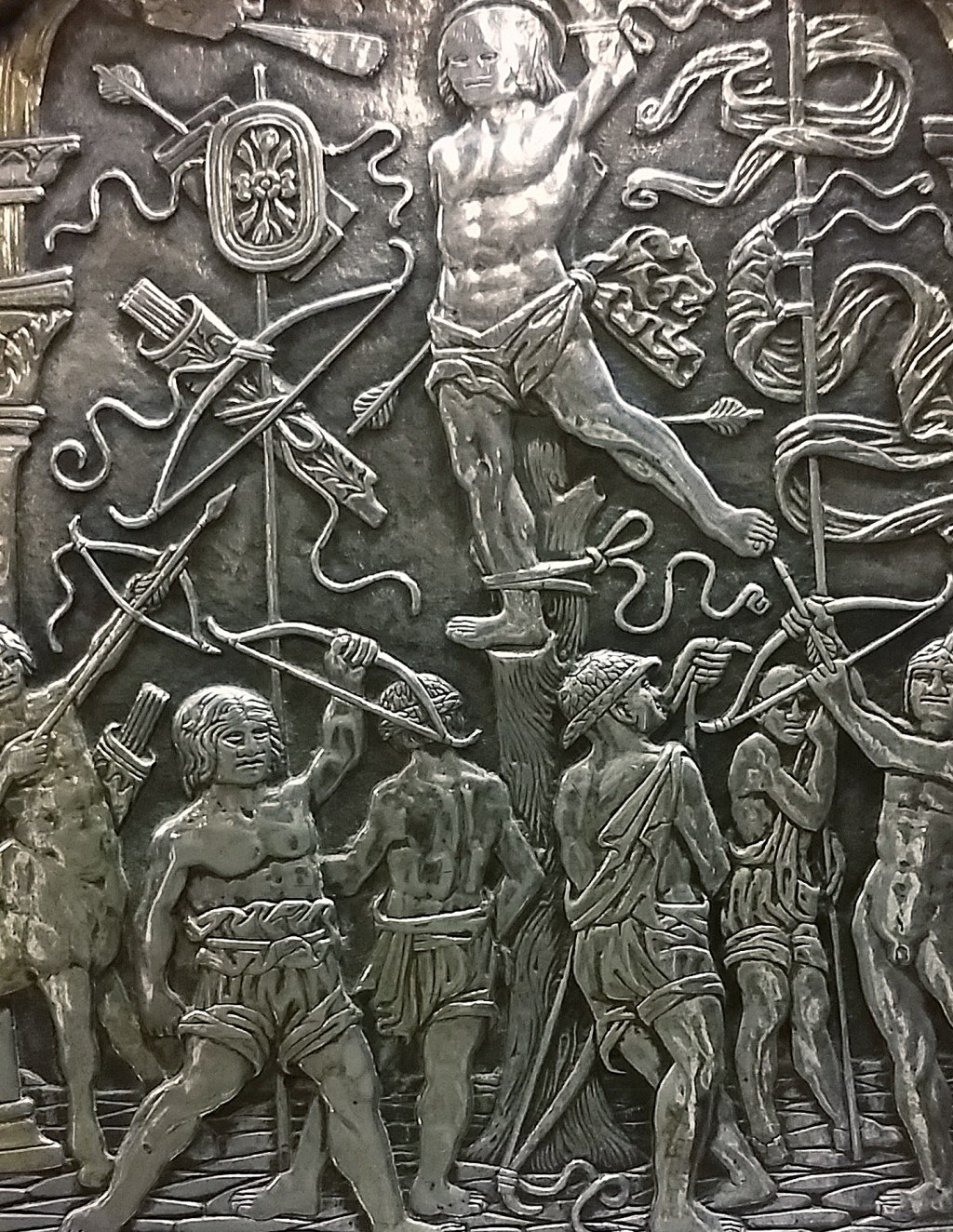
The historiography of Bolognese Renaissance goldsmithing has traditionally been viewed through the narrow lens of the officina of Francesco Francia. While Francia’s dual signature as aurifex and pictor underscores the fluidity between the arts in the Emilian capital, a pair of high-prestige silver devotional paxes—the Martyrdom of Saint Sebastian in the Basilica of San Petronio (inv. 62) and a lost Crucifixion formerly in the treasury of San Martino Maggiore—presents a stylistic rupture with the prevailing Raibolini aesthetic (fig. 1). These objects, whose reliefs are characterized by a “blocky,” Mantegnesque plasticity and a restless “archaeological” iconographic program, have long defied precise attribution. While scholars like Montefusco Bignozzi and Bergamini correctly identified the unique plasticity of the Sebastian relief as a departure from the Raibolini manner, the identity of the master has remained elusive.1
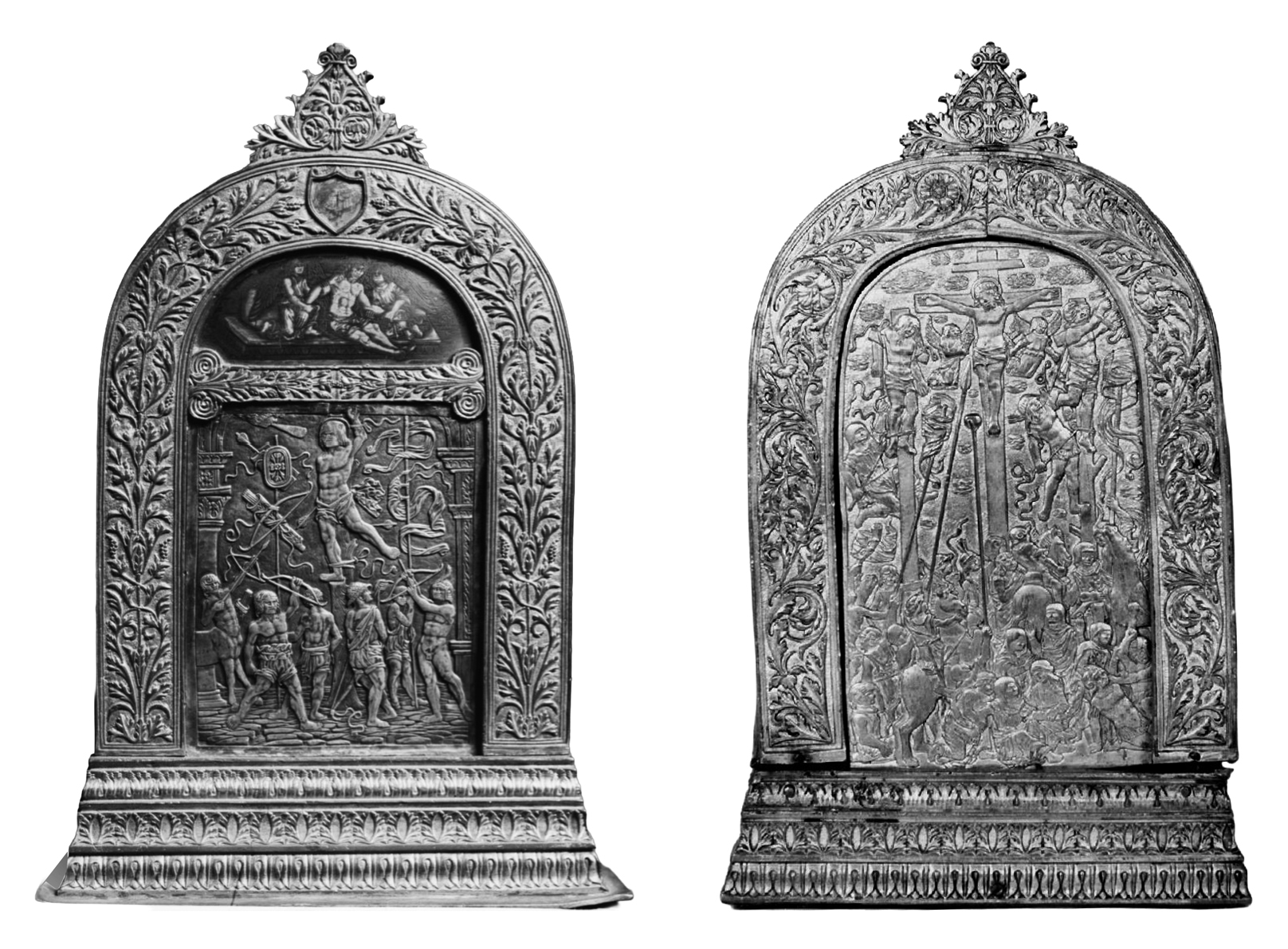
Fig. 1: Silver and parcel gilt pax depicting the Martyrdom of Saint Sebastian with a niello lunette of Christ at the Tomb, probably 1490s (left; Treasury of the Basilica of San Petronio, Bologna); silver and parcel gilt pax of the Crucifixion, probably 1490s (right; formerly at San Martino Maggiore, Bologna)
The critical reception of the Sebastian relief has undergone significant revision. Early literature struggled to place the object’s eccentric style, initially proposing a rejected attribution to Antonio Pollaiuolo. Subsequently, 19th-century scholarship, led by Eugène Piot and Émile Molinier, categorized the relief as Milanese, likely stimulated by the object’s virtuoso technical finish which recalled the Lombard enamels of the period. Piot went so far as to suggest the hand of the Milanese enameller Daniele Arzoni or the master Caradosso.2 This classification persisted through the catalogues of Seymour de Ricci and Perry B. Cott, who assigned the relief to an anonymous Milanese master active around 1490.3 However, modern scholarship pivoted toward an Emilian origin when John Pope-Hennessy, in his definitive cataloging of the Kress collection, noted that the figure style “recalls the work of Aspertini” and proposed that the plaquette was likely Bolognese.4 This shift recognized that the all’antica vocabulary of the relief—specifically the splayed stance of the Saint and the inclusion of the centaur within its visual program—aligned more closely with the restless archaeological inquiry of the Bolognese school than with the Lombard aesthetic.
The silver relief of the Sebastian pax in San Petronio finds its most significant material parallel in the lost and nominally discussed Crucifixion of San Martino. Both objects display a figure style characterized by squat, muscular proportions, tendon-centric styling of the limbs and a distinct articulation of the joints that suggests a deliberate rejection of the lyrical grace associated with the Francia-Costa tradition. The material qualities of this “hard” style are best preserved and observed in a singularly fine bronze cast of the Sebastian relief now housed at the National Gallery of Art in Washington (fig. 2). Described by Émile Molinier as “perhaps the finest plaquette known,” this bronze preserves the remarkably crisp chasing that characterizes the silver original.5 Technical examination of the Washington cast reveals a stippled ground—a treatment typically intended to provide a key for enamel, as one might presume in the work of contemporary Bolognese masters. However, this stippling may simply represent a cosmetic modification intended to differentiate the exceptionally low-relief imagery from the field, preventing the figures from becoming lost in the darker, less reflective medium of bronze. This treatment was left smooth on the silver Sebastian relief, where the natural brilliance of the precious metal provided sufficient tonal separation.
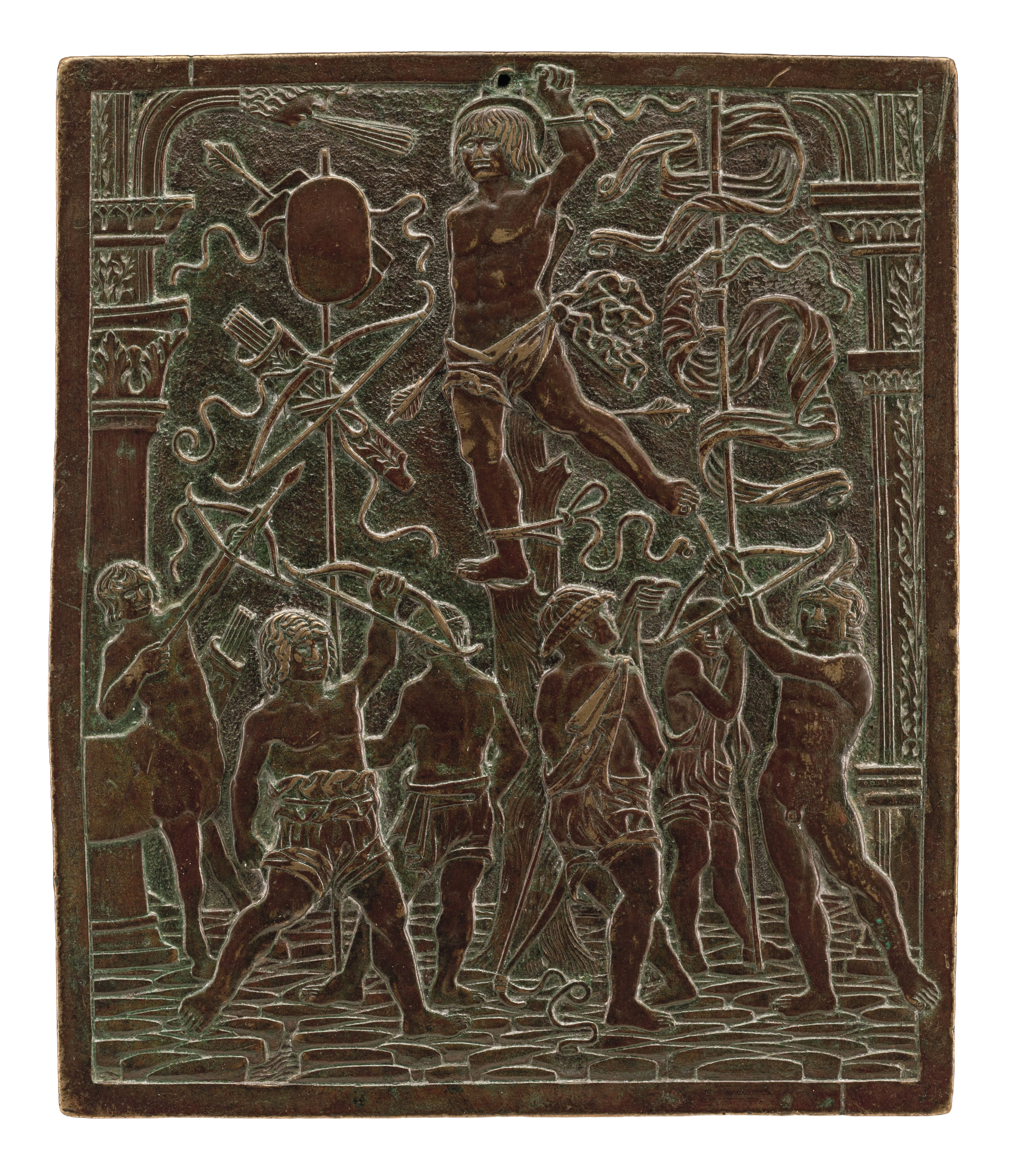
Fig. 2: Bronze plaquette reproducing the Martyrdom of Saint Sebastian (National Gallery of Art, DC, inv. 1957.14.215)
This high-finish quality and crystalline definition serve as a material link between the documented silver pax and the broader circle of the Bolognese Zecca. It points to an artisan trained not in the additive process of casting, but in the subtractive, rigorous arts of the die-cutter (intagliatore di conii) or niellist. The technical requirements for cutting steel dies for coinage were identical to those for niello, utilizing the burin on hard metal to create negative relief. This technical convergence suggests the “Anonymous Master” of these paxes operated within the environment of the Bolognese Mint, where the boundaries between the niellatore, the intagliatore, and the goldsmith were porous.6
The visual language of these reliefs maintains a profound dialogue with the graphic output of Peregrino da Cesena, the Mint’s leading niellist, suggesting the artist responsible for these paxes may have even worked alongside him.7 Peregrino is explicitly identified in the sources as a goldsmith and engraver active in the Bolognese orbit between 1490 and 1520.8 The intentionality of this borrowing is evidenced by the right-most archer in the Sebastian relief, which appears to directly imitate a figure of Mars found in a niello print by Peregrino and presumably working from the shared visual models of Francia’s atelier (fig. 3). Notably, on the reliefs, the archer’s proper left foot breaks the compositional margin—extending into the flange—precisely mirroring how Peregrino’s character of Mars disrupts the border of his own print.9 This suggests a dialogue between the relief and the niello plate, where the two media borrow from the same aforenoted visual repertoire.
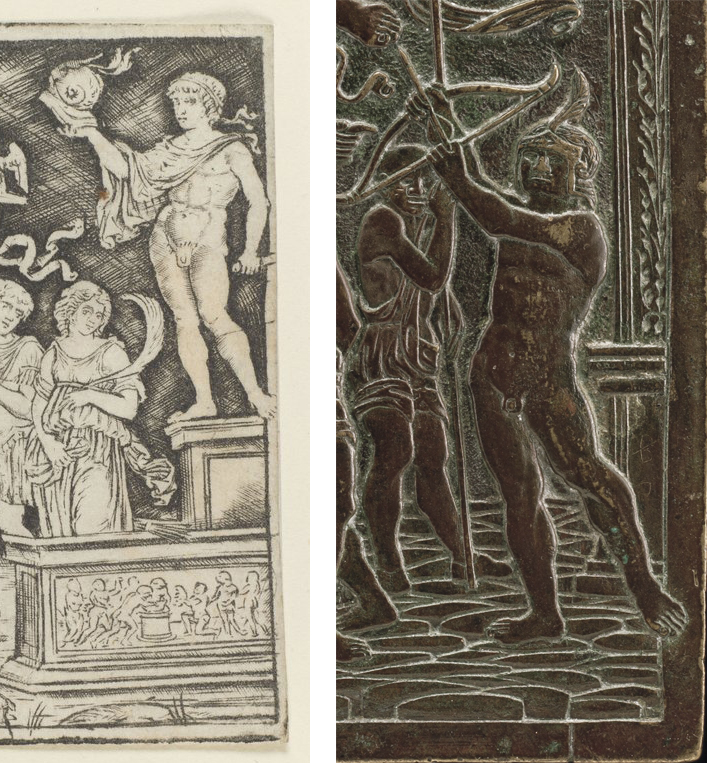
Fig. 3: Detail of A Sacrifice to Mars print in the niello manner by Peregrino da Cesena, ca. 1490-1520 (left; Louvre, inv. 52 ni); detail of figure 2 (right; NGA)
Furthermore, the iconographic program of the Sebastian pax includes features highly unusual for Bolognese devotional silver, such as the anthropomorphic personification of the wind (Boreas) in the upper corner. This figure, characterized by radiating lines, finds a further graphic parallel in the niello print of an Allegory of Adversity by Peregrino (fig. 4, top).10 Likewise, the anonymous master’s articulation of billowing drapery closely follows that observed in Peregrino’s niello print of the Triumph of Neptune (fig. 4, bottom). The presence of this highly specific graphic vocabulary—particularly the radiating, anthropomorphic wind-head—can be directly traced to the landmark 1477 Bologna publication of Claudius Ptolemy’s Cosmographia.11 As the first printed atlas to utilize copperplate engravings rather than woodcuts, its production relied heavily on the city’s goldsmiths, who readily applied their metalworking skills to the new technology of printmaking. The maps of this pioneering edition were explicitly embellished with engraved vignettes of blowing wind-heads.
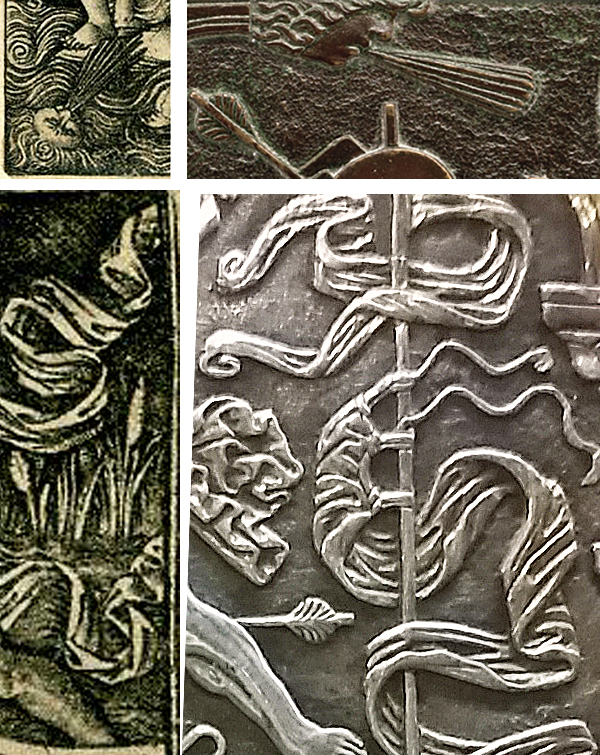
Fig. 4: Detail of an allegorical print (of Adversity?) in the niello manner by Peregrino da Cesena, ca. 1490-1520 (top left; British Museum, inv. 1895,0915.150); detail of figure 2 (top right; NGA); detail of a print of the Triumph of Neptune by Peregrino da Cesena, ca. 1490-1520 (bottom left; British Museum, inv. 1884,0726.32); detail of a silver relief of the Martyrdom of Saint Sebastian (bottom right; Treasury of the Basilica of San Petronio, Bologna)
Operating within the collaborative crucible of the Bolognese Mint (Zecca) and the Quattro Arti, both Peregrino and the anonymous pax master actively absorbed these cosmographic motifs. The appearance of Boreas on the Sebastian pax thus represents a direct, tactile translation of the city’s avant-garde printed cartography into three-dimensional devotional silver, further confirming the porous boundaries between Bolognese engravers and goldsmiths.
The blocky, anti-classical aesthetic of the Sebastian and Crucifixion reliefs align with what has been identified in the graphic work of Peregrino as a rude forza espressiva (rough expressive force)—a deliberate characteristic of the Po Valley (padana) lineage that favored restless chiaroscuro over balanced classicism.12 Furthermore, the anatomical rigor of the figures, with their hyper-articulated joints, finds its conceptual source in Amico Aspertini’s intellectual circle. Aspertini’s eccentric hypernaturalism, to be further discussed, was heavily influenced by his close association with the Achillini brothers: while Giovanni Filoteo provided antiquarian inspiration, Alessandro Achillini, a renowned philosopher and anatomist at the Bolognese Studium, informed the underlying structural intensity of Aspertini’s disegno.13
While Thomas Richter has emphasized the additive character of the San Petronio pax, arguing that the niello lunette of the Christ at the Tomb falls short of the virtuosity observed in the main Sebastian relief and must therefore be the work of a different hand,14 a closer inspection challenges this strict separation. The distinct “knobby” and sinuous anatomical definition of the Christ in the lunette mirrors the rugged articulation of the executioners in the Sebastian scene below, implying that even if the specific hands may differ, the figures emerged from the same immediate stylistic milieu. Furthermore, Richter’s hypothesis that the frame originated from a separate workshop must be reconsidered in light of the related Crucifixion pax of San Martino; both objects are surmounted by an identical gilt-silver applique, indicating a unified production source (fig. 1). The chasing of the low-relief foliates along the borders—reminiscent of the vine-scroll and grape motifs in Peregrino’s niello work13—is executed with a mastery equal to that of the reliefs themselves. Nevertheless, the Sebastian pax does retain a composite quality: the presence of integral flanking columns within the main relief—a redundant feature within an architectural pax frame—strongly suggests that the silver plate was originally conceived for a different context before its integration into this instrumentum pacis.
While the execution of the Sebastian and Crucifixion paxes points to a Mint master, the invention of its disegno possibly belongs to Amico Aspertini or his influence. The compositional daring of the Crucifixion pax necessitates a design source beyond the immediate circle of the Mint. The dramatic intensity of the scene, particularly the contorted thieves and the fainting Virgin, reflects the lingering shadow of Ercole de’ Roberti’s lost frescoes for the Garganelli Chapel in San Pietro. Completed in the 1480s, the Garganelli Crucifixion was renowned for its expression of “passionate grief,” a quality Vasari noted as being “scarcely to be conceived.”16 The pax relief appears to filter this Ferrarese emotionalism through a more specific, local lens: that of the Aspertini family. The composition may echo the lost fresco of the Crucifixion painted by Amico’s older brother, Guido Aspertini between 1486 and 1491, and once featured beneath the portico of San Pietro.17 The composition certainly relates to the sketch of a Crucifixion by Amico Aspertini preserved in the Morgan Library & Museum (fig. 5).
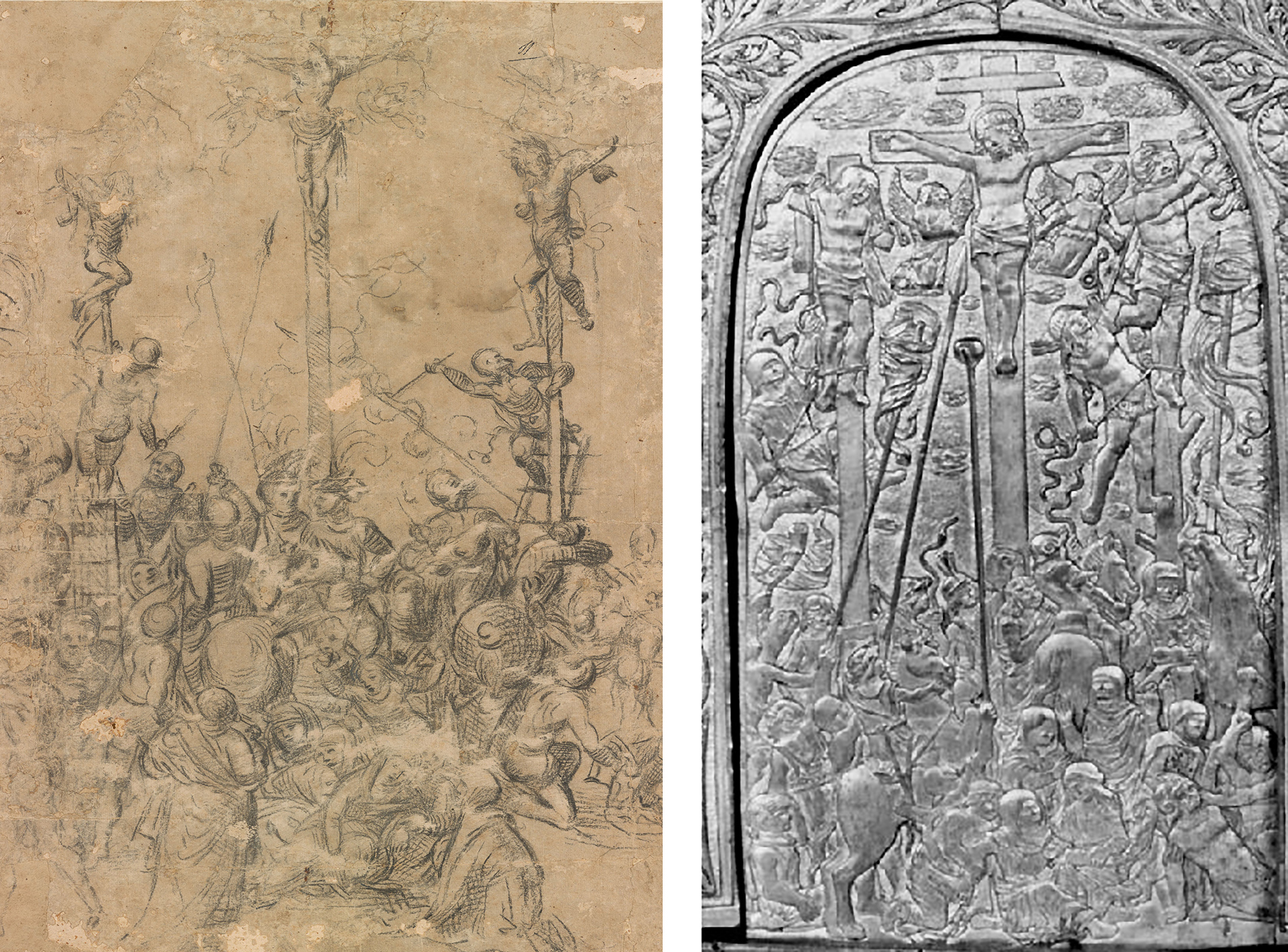
Fig. 5: Black chalk sketch of the Crucifixion attributed to Amico Aspertini, ca. 1500 (left; Morgan Library & Museum, inv. 1981.18); detail of a silver pax of the Crucifixion (right; formerly at San Martino Maggiore, Bologna)
Furthermore, the bizarre and expressive qualities of the figures align with the developing style of the young Amico Aspertini, whose fascination with German prints (such as those by Dürer and Schongauer) introduced a ferociously expressive aspect to Bolognese art that is clearly mirrored in the rugged anatomy of the silver figures.18 The emergence of this “blocky” and restless style observed in the reliefs derives from the intellectual climate of the University of Bologna and the court of Giovanni II Bentivoglio. In the Sebastian pax, the saint’s anatomy is treated with a rigor that borders on the grotesque; the widely splayed stance of the proper right leg and the physical tension of the archers evoke the Roman relief style of the Trajan Column, which Aspertini studied obsessively in his Roman sketchbooks
(fig. 6).19
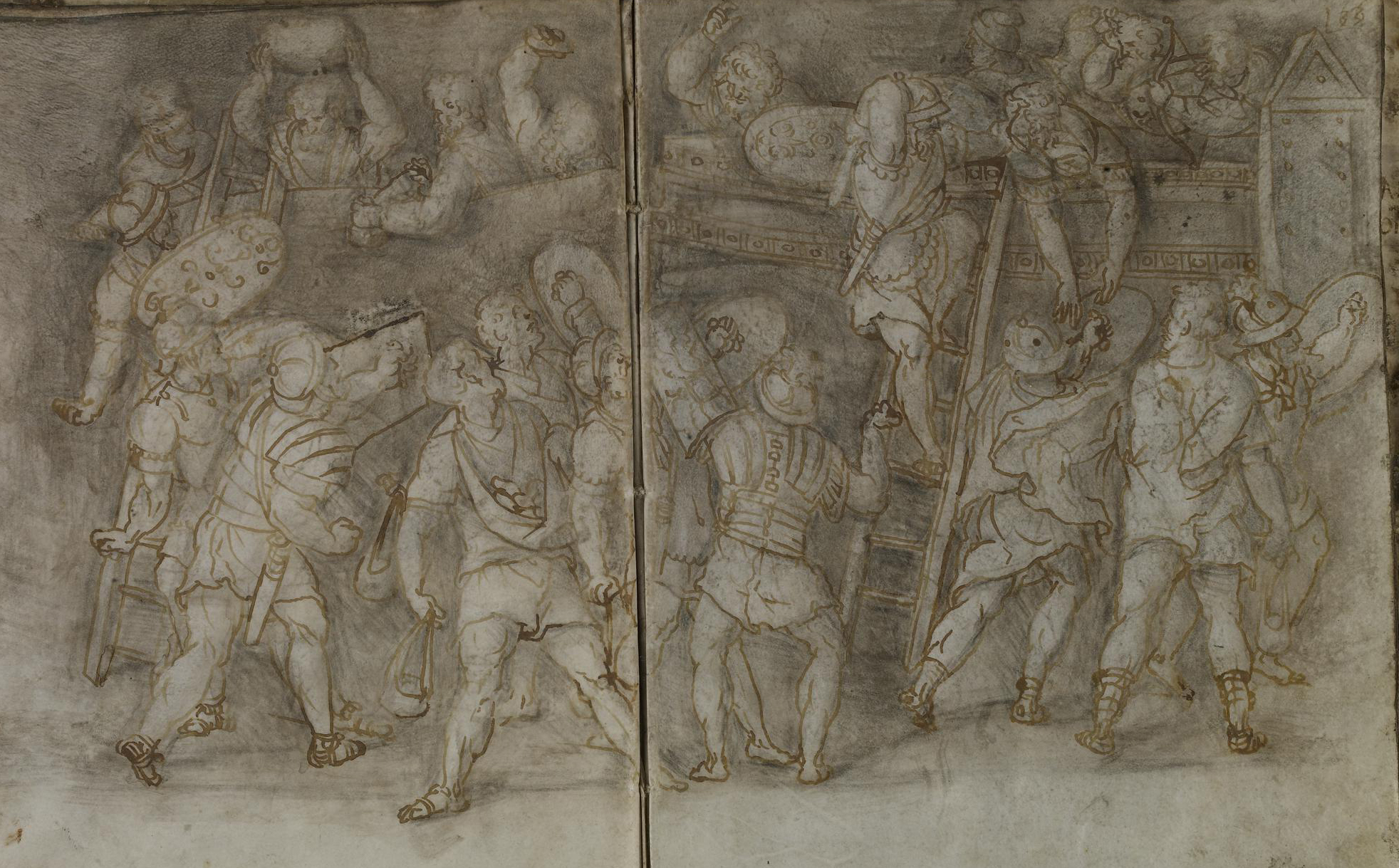
Fig. 3: Pen and brown ink over black chalk drawing of a scene from the Trajan Column from the sketchbook of Amico Aspertini, ca. 1532-35 (British Museum, inv. 1898,1123.3.32)
The iconographic program of the Sebastian pax functions as a specific liturgical response to the site of its display, the Vaselli Chapel in San Petronio. Canon Donato Vaselli, who renovated the chapel in the late 15th century, dedicated the space to Saint Sebastian specifically as a protector against the plague, having himself survived the epidemic of 1468.20 The relief features “archaeological” details that transcend mere decoration, functioning instead as humanist hieroglyphs. The unusual centaur incorporated into the relief scene and the personification of the wind god Boreas—motifs found in Aspertini’s sketchbooks19 and Peregrino’s prints22—likely symbolize the chaotic, miasmic forces of the epidemic which the saint overcomes. In this context, the pax was not a static object but an active instrumentum pacis. During the Mass, the pax-brede was kissed by the celebrant and then offered to the congregation as a substitute for the direct embrace, transmitting the sacred peace of the altar to the laity.23
Similarly, the Crucifixion pax of San Martino was viewed within a church deeply invested in the visual culture of the Passion. The Carmelite church of San Martino Maggiore was a site of significant artistic intervention in this period, housing works by Aspertini himself, such as the Madonna Enthroned with Saints (c. 1515).24 The presence of a silver pax exhibiting the same “hard” anti-classical style as the San Petronio example suggests a common workshop supplying the city’s major religious houses and one that seems to have followed in close proximity with Amici. In the context of San Martino Maggiore the Crucifixion relief, with its dense crowding of figures and acute attention to the physical suffering of Christ, would have served to focus the devotee’s gaze on the Eucharistic sacrifice, reinforcing the dogma of the Real Presence at the moment of the Osculum pacis.
The paxes of San Petronio and San Martino represent a distinct moment in Bolognese goldsmithing. They are the product of a collaborative hierarchy where the invenzione of the Aspertini circle—rich in antiquarian and Northern references—was translated into silver by a master trained in the rigors of the Mint. This connection is further reinforced by the bronze plaquette of the Resurrection signed I.F.P. (interpreted as Invenit Fecit Peregrino).25 The existence of the Resurrection as both a print and a relief plaquette demonstrates that Peregrino and his circle conceived of their designs as three-dimensional metalwork (fig. 7).26
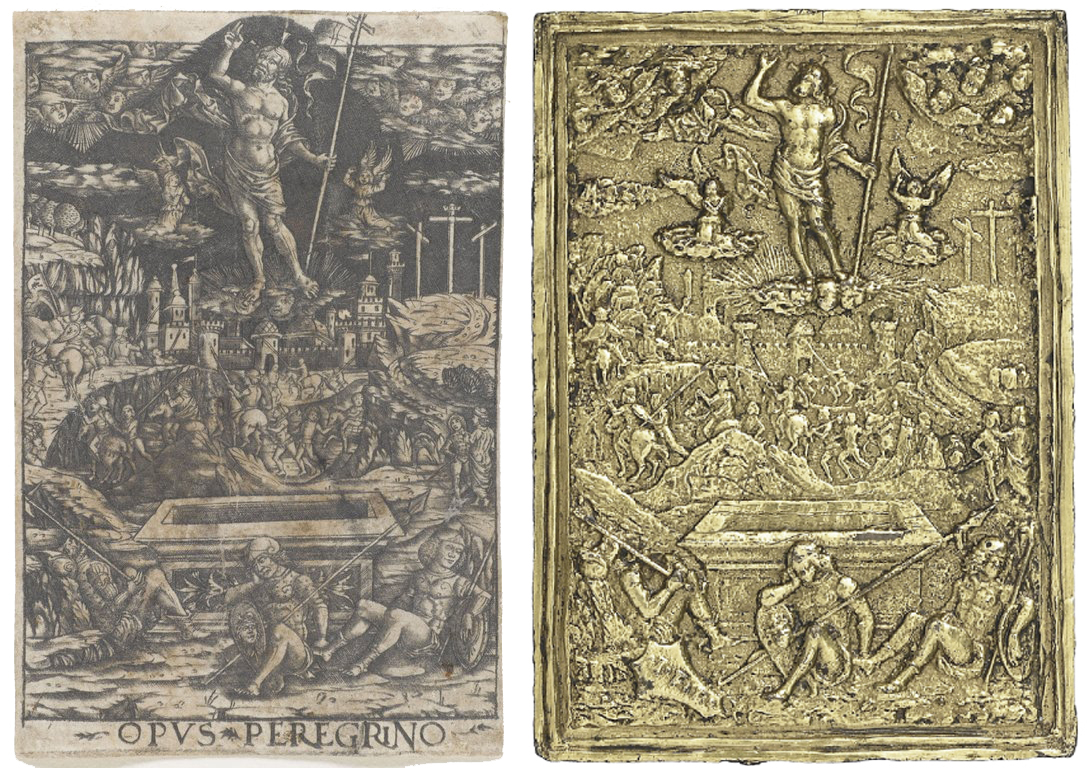
Fig. 7: Niello print of the Resurrection of Christ by Peregrino da Cesena, ca. 1500 (left; Louvre, inv. 22 Ni); bronze plaquette of the Resurrection of Christ probably by Peregrino da Cesena, ca. 1500 (right; collection of Mario Scaglia)
If we seek a historical name for the “Anonymous Master,” of the Sebastian and Crucifixion designs, the matriculation lists of the Società delle Quattro Arti offer two compelling candidates. Two masters enrolled during the critical window of the 1490s stand out: Guglielmo di Simone (enrolled 1490)27 and Francesco di Giorgio dal Caseduro (enrolled 1492).28 While their specific oeuvres remain to be reconstructed, their presence in the archives alongside Francia makes them viable candidates for the authorship of these masterpieces.
Endnotes:
1 P. Montefusco Bignozzi and W. Bergamini, L’arredo sacro e le oreficerie, in La Basilica di San Petronio in Bologna, Vol. II (Bologna, 1984), 156–158.
2 E. Piot, L’Art ancien à l’exposition de 1878, p. 414; E. Molinier, Les Plaquettes (Paris, 1886), No. 451.
3 S. Ricci, The Gustave Dreyfus Collection: Renaissance Bronzes (Oxford, 1931), ii, p. 68, No. 91; P. B. Cott, Renaissance Bronzes from the Kress Collection (Washington, 1951), p. 145.
4 J. Pope-Hennessy, Renaissance Bronzes from the Samuel H. Kress Collection: Reliefs, Plaquettes, Statuettes, Utensils and Mortars (London, 1965), p. 85, No. 297.
5 E. Molinier (1886). Molinier describes the plaquette as ‘peut-être la plaquette la plus fine que l’on connaisse.’
6 Michele Chimienti, Monete della Zecca di Bologna: catalogo generale (Bologna: Editrice Compositori, 2009), 205–224; see also the discussion on the shared toolset of the intagliatore di conii and the niellist in anon. The Shadow and the Die: Peregrino da Cesena and the Bolognese Mint (2022).
7 The present author suggests certain anonymous Bolognese nielli could be the work of this master. See for example British Museum invs: 1845,0825.133; 1845,0825.124; 1895,0915.157, 1837,0616.374, et al. See also A. M. Hind, Nielli. Chiefly Italian of the XV. Century Plates, Sulphur Casts and Prints preserved in the British Museum (London, UK, 1936), nos. 133, 167, 184, and 216.
8 Peregrino is identified as a “goldsmith, engraver, and worker in niello” active in the late 15th and early 16th centuries. Peregrini Da Cesena, or Pellegrini Da Cesio – McClintock and Strong Biblical Cyclopedia; see also Marzia Faietti, “Stampe a niello bolognesi ed emiliane,” in Bologna e l’umanesimo, 1490-1510, exh. cat. (Bologna: Nuova Alfa, 1988), 323–40.
9 For the comparison between the archer and Peregrino’s Mars, see A. M. Hind (1936), p. 13.
10 For Peregrino’s graphic parallel to the wind god Boreas, see A.M. Hind 1936), no. 211.
11 Edward Lynam, The First Engraved Atlas of the World: The Cosmographia of Claudius Ptolemaeus, Bologna, 1477 (Jenkintown, PA: G. H. Beans Library, 1941). In the late fifteenth century, Bolognese goldsmiths frequently transitioned their skills from engraving metal plates for jewelry and niello to cutting punches and plates for the printing press, operating in close proximity to the book trade. See The Golden Age of the Bolognese Artisan: An Archival Reconstruction of the Goldsmiths’ Guild and Judicial Landscape (1490–1510).
12 Franco Spazzoli, Peregrino da Cesena, misterioso e geniale maestro nell’arte incisoria del niello, in Le Vite dei Cesenati, 13 (2020): 18-19.
13 Marzia Faietti and Daniela Scaglietti Kelescian, Amico Aspertini (Modena: Artioli, 1995); for the influence of the Achillini brothers on Aspertini’s hypernaturalism, see also Marzia Faietti, Variety and Metamorphosis: Form and Meaning in the Ornament of Amico Aspertini in The Art of the Eclectic, trans. Cara Rachele, 384 n. 3, p. 211.
14 Thomas Richter, Paxtafeln und Pacificalia: Studien zu Form, Ikonographie und liturgischem Gebrauch (Weimar: VDG, 2003), 245. Richter identifies the niello lunette as an Engelpietà and notes it “falls off strongly in layout and execution compared to the main image and was created by another hand.”
15 See A. Hind (1936), no. 256, or British Museum inv. 1845,0825.168, for example.
16 Luigi Lanzi, The History of Painting in Italy, Vol. V (London: Henry G. Bohn, 1847), 50–51. Lanzi cites Vasari’s description of the Garganelli frescoes, noting the “expression of passionate grief, such as can scarcely be conceived.”
17 For the lost Crucifixion by Guido Aspertini (and his father Giovanni Antonio) in San Pietro, see Marzia Faietti, “Variety and Metamorphosis”; see also Daniele Benati, “Gli altri Aspertini: Il padre Giovanni Antonio e il fratello Guido,” in Amico Aspertini 1474-1552, exh. cat. (Cinisello Balsamo: Silvana Editoriale, 2008), 717–37.
18 Marzia Faietti, “Variety and Metamorphosis,” 204–212. Faietti discusses Aspertini’s “bizarre” anti-classicism and his specific engagement with German prints, noting his style was often described as “ferociously expressive” (p. 210).
19 Phyllis Pray Bober, Drawings after the Antique by Amico Aspertini: Sketchbooks in the British Museum (London: Warburg Institute, 1957); see also Phyllis Pray Bober and Ruth Rubinstein, Renaissance Artists and Antique Sculpture: A Handbook of Sources, 2nd ed. (London: Harvey Miller, 2010); see also Gunter Schweikhart, Der Wolfegg Codex: Zeichnungen nach der Antike von Amico Aspertini (1986).
20 Alessandro Serrani, “Donato Vaselli: un ambizioso ecclesiastico ai tempi di Giovanni II Bentivoglio,” in Strenna storica bolognese, LXX (2020), 313–324.
21 P. Bober (1957, 2010).
22 See note 8 regarding Peregrino’s prints.
23 Thomas Richter (2013), p. 15. Richter discusses the Philema hagion and the transmission of the “sacred peace” through the instrumentum.
24 For Aspertini’s Madonna Enthroned with Saints (c. 1515) in San Martino Maggiore and his broader activity in Bolognese churches, see Amico Aspertini (Wikipedia, s.v. “Anthology of works”); and Marzia Faietti and Daniela Scaglietti Kelescian, Amico Aspertini (Modena: Artioli, 1995).
25 For the interpretation of the monogram I.F.P. as Invenit Fecit Peregrino and the relationship between the printed design and the relief, see J. Pope-Hennessy (1965), no. 96, p. 32.
26 While Pope-Hennessy (1965) didn’t see any reason to suggest a single author between the niello and relief versions of this composition the present author follows Francesco Rossi’s most recent analysis of this plaquette, judging that Peregrino was the likely author of both the niello and the plaquette. Francesco Rossi (2011): La Collezione Mario Scaglia – Placchette, Vols. I-III. Lubrina Editore, Bergamo, no. VI.4, pp. 256-257; see also Attilio Troncavini (2018), Nielli e placchette in bronzo – AntiquaNuovaSerie.it (accessed February 2026).
27 Francesco Malaguzzi Valeri, “L’arte degli orefici a Bologna,” in Archivio storico dell’arte (1894), 37–56. The matriculation entry reads: “…nel 1490 Guglielmo di Simone…”.
28 Ibid. The entry records Caseduro’s matriculation in the Società delle Quattro Arti in 1492. The Società delle Quattro Arti (Society of the Four Arts) was a composite guild in Bologna that united artisans involved in the production of arms and military equipment: sword-makers (spadai), sheath-makers (guainai), saddlers (sellai), and shield-makers (scudai). Painters (pittori) were incorporated into this specific guild—rather than an independent guild of St. Luke—due to their practical role in decorating shields and armor. Francesco Francia is documented as matriculating into the Quattro Arti on December 23, 1503, a significant date that followed his earlier matriculation into the Goldsmiths’ guild (Orefici) in 1482; this dual membership reflects the fluidity of his practice between painting and metalwork. Amico Aspertini operated within this same corporate structure, as painters remained united with the swordsmiths and saddlers. For details on this organization see Marzia Faietti, “Printmaking in Renaissance Bologna,” in Print Quarterly, XXXVI, no. 2 (June 2019), 178 and Luigi Lanzi (1847), 163.
 Renaissance Bronze
Leave a comment