
by Michael Riddick
Download / Preview High-Resolution PDF
The Origins of the all’Antica Plaquette
The genesis of Renaissance bronze plaquettes is indebted to the revival of glyptic art in Italy, encouraged by the patronage and collecting fervor of popes, cardinals, and Humanist nobles, as well as to the admiration and study of ancient gems by contemporary artists who incorporated them as models in their work.
In particular, the eccentric antiquarian, Cardinal Pietro Barbo—who became Pope Paul II in 1464—was lauded for his passion of antiquity and amassed one of the largest collections of its type during his lifetime. His inventory, begun in 1457, describes his vast collection of ancient coins, cameos, and engraved gems; organizing them into categories of portrait busts, full-length figures, emperors, empresses, and persons of renown.1 It is under his probable patronage that plaquettes—small reliefs produced in bronze—was conceived.
Precious classical gems were esteemed among avid collectors and artists who desired to portray Italy’s ancient golden age in the epoch of the new Renaissance. While most gem collections remained the private property of their owners—shared on special occasion with guests or other erudite collectors—Paul II was rather different in the treatment of his collection, unabashed in sharing with others the prizes he so personally admired while leveraging them to communicate a contemporary image of himself through the lens of a classical ethos.
During the Renaissance, the earliest and most common diffusion of these gems came by way of gesso or wax impressions of them. Gem impressions could be made and delivered with the intent to sell or share examples among collectors. This is attested in several sources, like Filarete’s ownership of a plaster impression of a precious cameo preserved in the basilica of St. Sernin in Toulouse,2 an example of which Paul II must have likewise owned, as he voraciously pursued in vain to purchase the original.3 Lorenzo de’ Medici’s receipt of a plaster cast intaglio of Phaethon,4 owned by Giovanni Ciampolini,5 as well Lorenzo’s request for casts of cameos belonging to Cosimo Sassetti’s collection, are further examples of this practice.6 Wax impressions were also used, such as Luigi da Barberino’s wax impression of a gem on a letter he sent to Nicolò Michelozzi, to offer ‘an impression’ of what it looked like.7
The earliest documented example of a gem impression cast in metal is a lead image of Scylla, reproduced from an antique gem owned by Cyriac of Ancona, of which he gave examples to Teodoro Gaza and Angelo de’ Grassi, the bishop of Ariano Irpino, in 1442.8 It is to be wondered if Paul II, during his earlier years as a Cardinal in service to his uncle, Pope Eugene IV, may have been aware of this practice of Cyriac, as Eugene IV was a great patron of Cyriac during his pontifical tenure. While no documentation has surfaced concerning the reproduction of Paul II’s gems in bronze, there are several points of evidence, discussed in previous scholarship, that encourages this notion. Chief among these are the renovation projects instituted by Paul II at his Palazzo di San Marco residence in Rome (now the Palazzo Venezia), begun while he was still a Cardinal in 1455.9
One of the earliest known portrait medals cast in Rome, presumably made sometime just before 30 August 1464—and the earliest of many to be commissioned and cast for the Cardinal and future Pope—is one profile portrait medal depicting Barbo as a Cardinal with his armorial on the reverse. As noted by George Francis Hill, a subsequent edition of this medal, with an alternative verso, was made portraying the newly planned façade of the Palazzo di San Marco, dated 1464,10 and coinciding with the enlarged building plans for the palace that were drafted upon Barbo’s election to the papacy that year. A slightly later modification to this aforenoted medal’s reverse, bearing the year 1465, and featuring an altogether newly modeled profile portrait of the elected Pope on its obverse, was serially produced in that year (fig. 1) and intended for distribution and internment in the foundation of the new additions being made to the palace, a practice executed by Paul II in true all’antica tradition.11
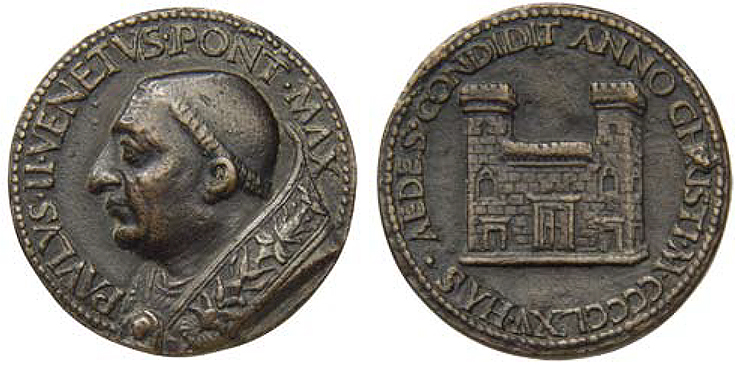
Fig. 1: Bronze portrait medal of Pope Paul II (obverse), attributed to Cristoforo di Geremia, 1465, with the facade of the Palazzo di San Marco (reverse) (Münzkabinett, Dresden, Germany)
On stylistic grounds, this latter medal is attributed to the Mantuan goldsmith and metal-worker, Cristoforo di Geremia, who was active in Rome under the earlier patronage of the prelate Ludovico Trevisan, another avid collector of gems and antiquities.12 Cristoforo is believed to have entered Paul II’s service not long after the death of Trevisan on 22 March 1465.13
As part of Paul II’s enlargement of the Palazzo di San Marco, begun in 1465, a new roof was added and completed by the year 1467. The roof was made with gilt lead tiles, examples of which incorporated an impression of a medal by Pisanello and another which reproduced the aforenoted portrait medal of 1465, attributed to Cristoforo.14 A vast quantity of these latter medals must have been produced, not only for private distribution by Paul II to his peers, but also for burying in the foundations of the enlarged palace. The medals were coated in wax as a protective seal and inserted in groups of two, three or five into individual dindaroli or terracotta containers (fig. 2), and buried approximately 10 feet apart along its foundation, around doorways and beneath staircases. An archival document from 1466 cites payments for 129 containers,15 thus suggesting a great quantity of medals must have been cast for the purposes of internment alone.
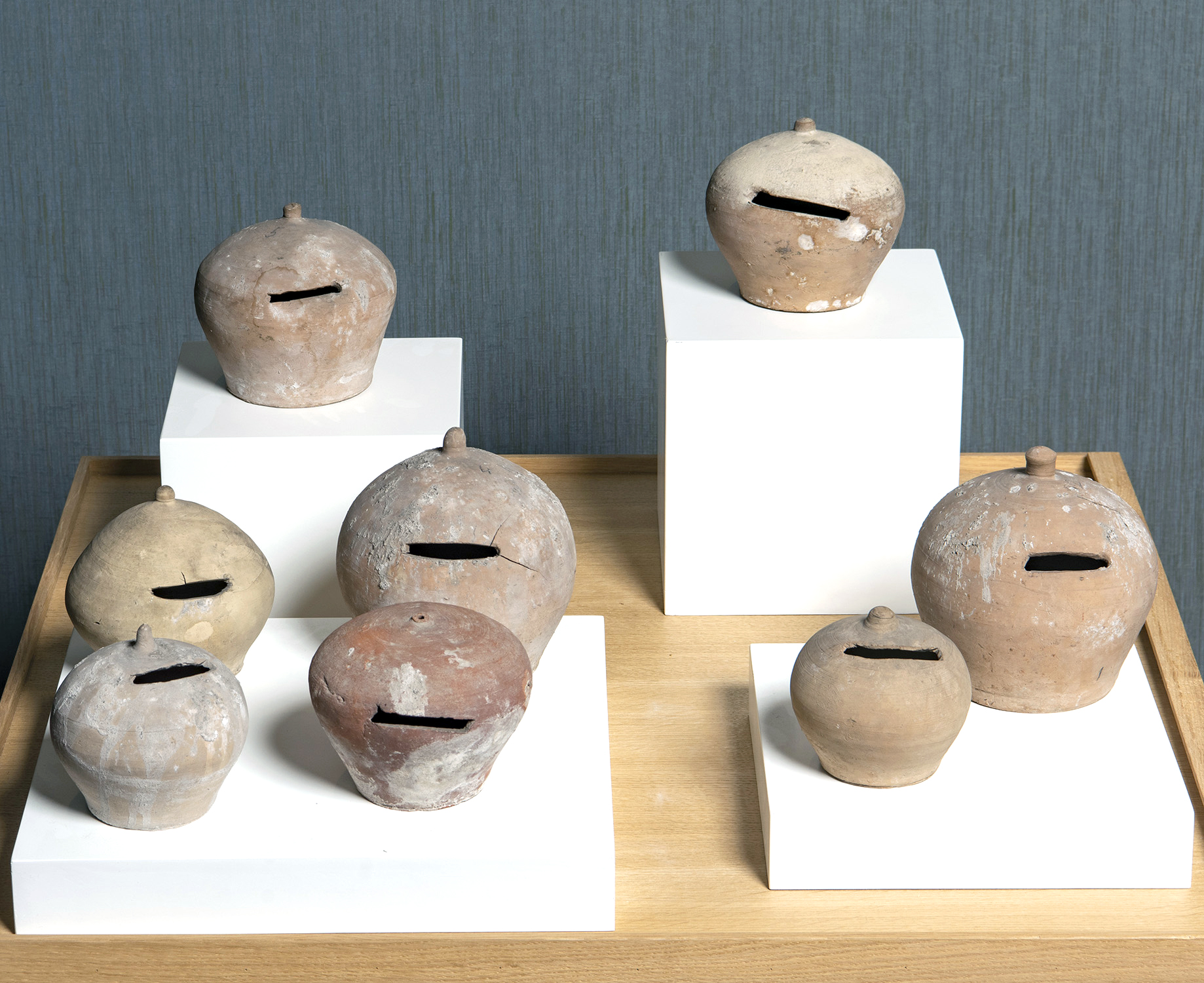
Fig. 2: A collection of 15th century dindaroli discovered at the Palazzo di San Marco (Palazzo Venezia, Rome)
It is due to this prolific production that bronze casts reproducing gems from Paul II’s collection are thought to have emerged from this activity—and as suggested by Luke Syson and Dora Thornton—possibly under the supervision of Cristoforo Geremia.16 This seems possible given Cristoforo’s antiquarian expertise and Paul II’s commission to have Cristoforo restore the historic equestrian monument of Marcus Aurelius in 1466-68.17 However, other bronze founders like Andrea Guacialoti, possibly responsible for Paul II’s medal celebrating his ascension as Pope in 1464, should not be ruled out.18
Cristoforo’s former proximity with Trevisan—a vocal opponent of Paul II19—and his familiarity with that prelate’s possessions—aside from being an antiquaire himself20—must have interested Paul II. It is to be wondered if Cristoforo could have had some role in facilitating or valuing the distribution of antiquities from Trevisan’s estate, perhaps related to Paul II’s almost immediate acquisition of important gems from Trevisan’s collection like the prized Augustan convex carnelian intaglio of Apollo, Marsyas and Olympus,21 often dubbed the ‘Seal of Nero (fig. 3).’22 However, the Pope himself may have simply exercised his newfound power to conveniently acquire such important works from that estate.23
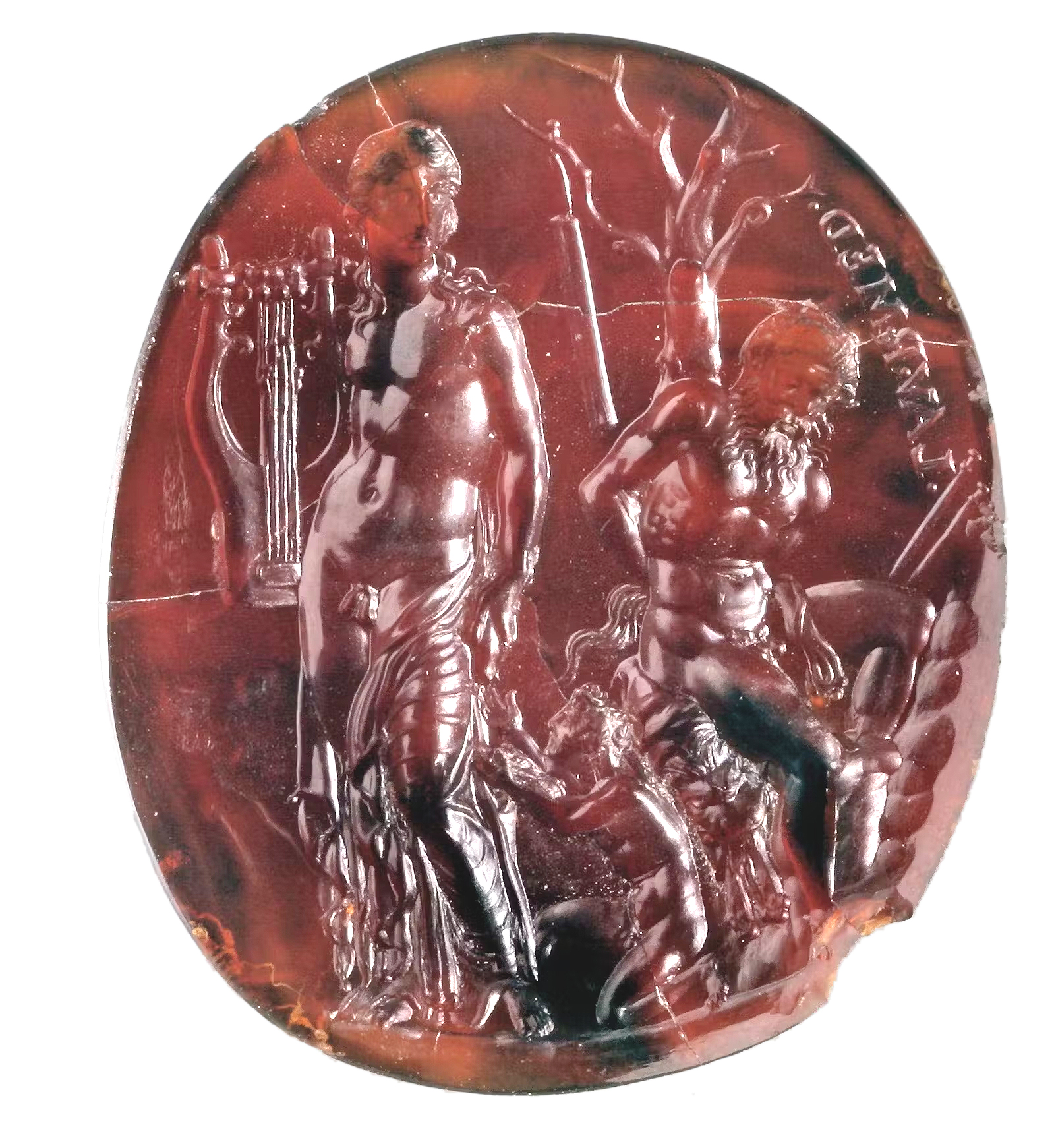
Fig. 3: Carnelian intaglio of Apollo, Marsyas and Olympus, often called the ‘Seal of Nero’ (Museo Archeologico Nazionale di Napoli, inv. 26051)
Plaquette casts of one of Paul II’s gems, and possibly two others, may predate this prolific activity of the casting for the Palazzo di San Marco construction efforts of 1465-67, thought to have been produced in a foundry tentatively dubbed the ‘Officine di San Marco.’24 For example, Paul II’s bronze portrait medal, executed by an unknown hand while still a Cardinal and made sometime before the end of August 1464, is evidence that Paul II already had use of an unidentified bronze founder in service to him. The first plaquette, certain to date probably before September of 1464, is that reproducing Paul II’s white amethyst intaglio portraying Abundance and featuring its original precious mount commissioned by the then Cardinal with his armorial depicted along its lower margin (fig. 4, right). In 1457, the Abundance amethyst was Paul II’s most valuable gem, as recorded in his inventory.25
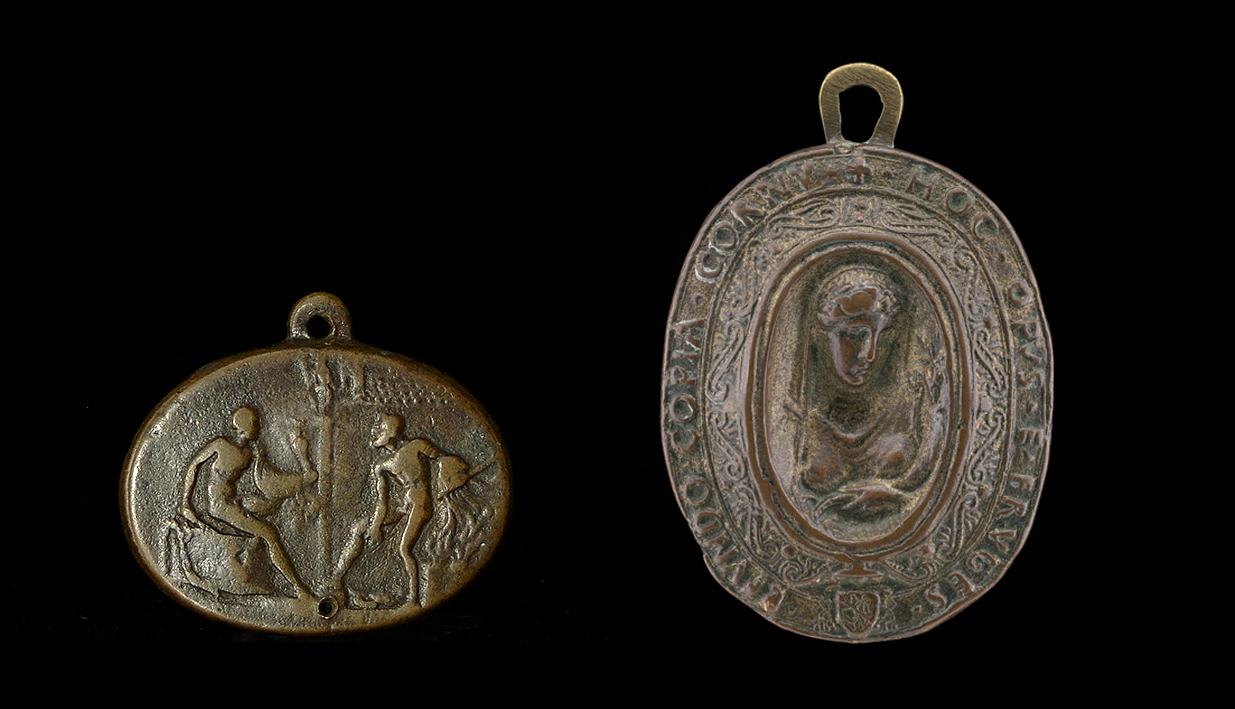
Fig. 4: Bronze cast after the ‘Felix Gem,’ cast in Rome probably before September 1464 (left; Ashmolean Museum, inv. WA2020.17); bronze cast after an amethyst with an allegorical figure of Abundance with the precious mount of Cardinal Pietro Barbo, probably cast in Rome before September 1464 (right; National Gallery of Art, DC, inv. 1957.14.169)
Another early production could involve bronze plaquette copies of another prized gem: Paul II’s sardonyx cameo of Odysseus and Diomedes with the Palladium, signed by a certain Felix, and later dubbed the ‘Felix Gem.’26 The impression of the gem’s composition is weakly reproduced on these plaquettes and could infer an early experimentation in reproducing the most precious objects from his collection (fig. 4, left).27
Among the surviving casts representing antique gems from Paul II’s collection, the two aforenoted plaquettes are exceedingly rare and approximately half of the known surviving examples of each of them uniquely feature an integrally cast suspension loop, suggesting they may have been cast in proximity of one another and intended to be prized and worn as pendants,28 perhaps allowing the Pope to travel with examples of his favorite objects, or as Francesco Rossi suggests, offered as New Years gifts to his closest confidants and friends,29 like his cousin and fellow antiquaire, Cardinal Marco Barbo, also a resident with him at the Palazzo di San Marco.
That Paul II probably distributed casts of gems to others is inferred by the presence of several plaquettes which appear in relief as spandrels on a colonnade depicted on the interior silver lining of the Shrine of Saint Simeon in Zadar, executed by Tommaso di Martino of Zara, and completed by 30 April 1497 (fig. 5).30 The reliefs are executed with such fidelity to presume the silversmith, Tommaso, was operating with very good contemporary casts of these reliefs, whether in gesso or bronze.
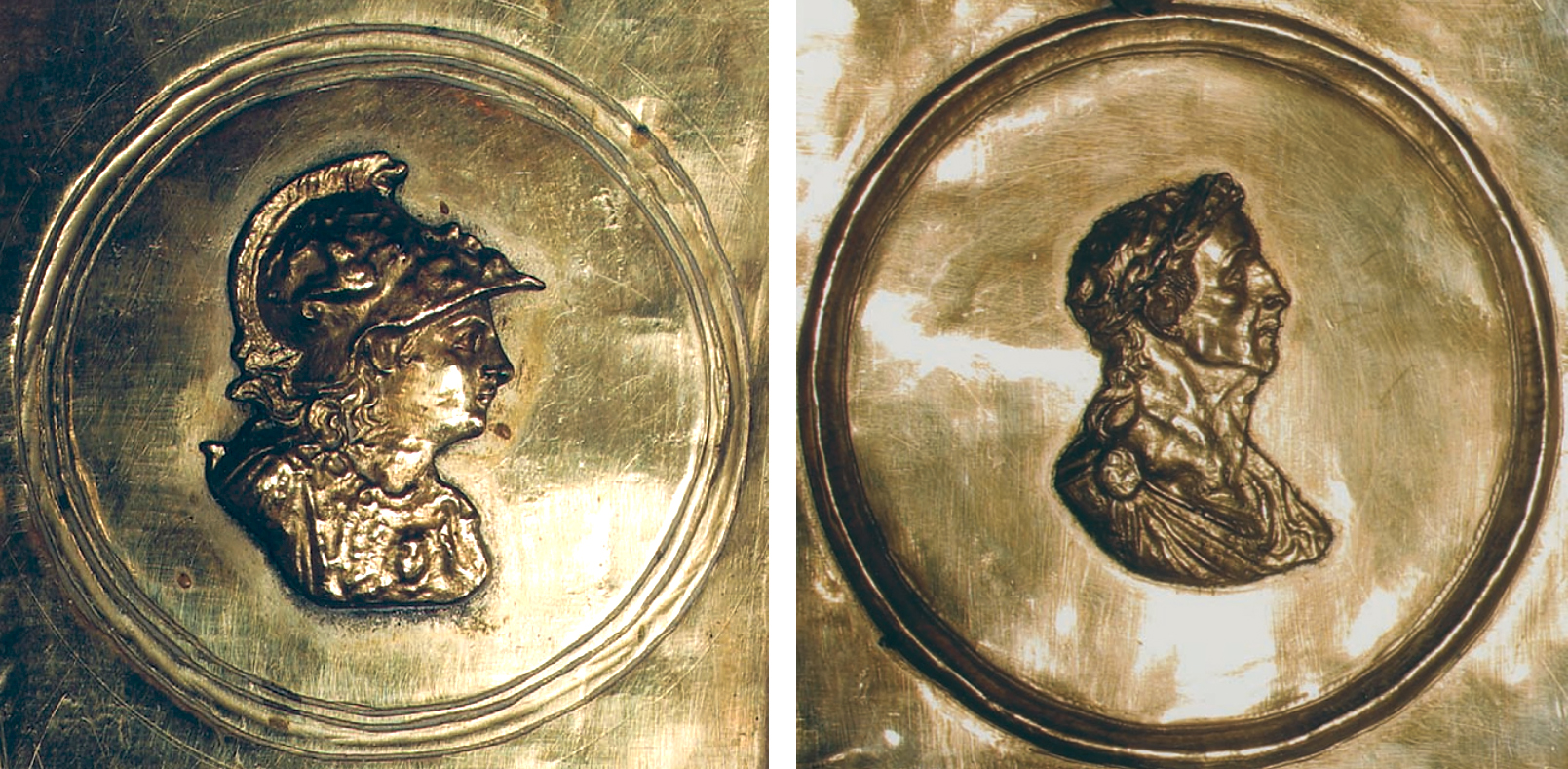
Fig. 5: Details of the gilt silver interior lining of the Shrine of St. Simeon in Zadar by Tommaso di Martino of Zara, 1497, reproducing plaquettes of a Head of Minerva (left) and Julius Caesar (right) (Church of St. Simeon, Zadar, Croatia)
Documents from the 1450s indicate the archbishop of Zadar, Maffeo Vallaresso, was in pursuit of all’antica motifs for a variety of projects he was commissioning in that city. His intent was to provide such resources to local craftsman in the execution of various projects, a tradition established and preserved in the updates made to the Shrine of Saint Simeon by the end of the 15th century. Notably, Vallaresso’s brother, Giacomo, was a Roman member of Paul II’s circle, and Maffeo himself made occasional stays at the Pope’s Palazzo di San Marco, visiting there while the Pope was still a Cardinal and later, in 1466 and 1468.31 Also worth noting is that Paul II was still a Cardinal, when assigned as abbot-commendatore of the Benedictine monastery of St. Krsevana in Zadar in 1447, sending his older brother, Paolo and the cleric, Nicola de Nai of Padua, to fulfill various of those responsibilities on his behalf. The Barbo influence in Dalmatia is further emphasized by Paul II’s other brother’s role of the same kind at the monastery of St. John the Baptist in Trogir beginning in 1468 and had at least four other abbeys under his influence during this period.32 The presence of these plaquettes featured on the shrine of St. Simeon point to a confident origin within Paul II’s sphere and notably involve plaquettes depicting Julius Caesar (fig. 5, right), a Bust of a Classical Youth, Head of Minerva (fig. 5, left), Bust of Diana, and a freehand copy of Apollo, Marsyas and Olympus executed by Cristoforo Geremia, to be discussed.
A third plaquette that may have emerged prior to the prolific casting efforts for the Palazzo di San Marco construction projects are those reproducing the Apollo, Marsyas and Olympus gem, or so-called ‘Seal of Nero,’ featuring its integral mount made by Lorenzo Ghiberti in 1428 (fig. 6, left).33 As noted by Douglas Lewis, these casts represent the gem and its setting while it was still in the possession of Trevisan. Their lackluster quality appears to be due to Lewis’ observation that the casts are “pirated from a crudely overlapped (partially doubled) seal impression—presumably on the basis of a carelessly executed wax seal”34 and that the plaquettes utilized this wax impression as a model for their casting. Lewis further suggests that the casts, perhaps made during the 1450s, may be due to Paul II’s ambitions, being unable to directly access the original gem on account of tensions at-that-time with Trevisan, yet desirous of an example of the gem for his own purposes.
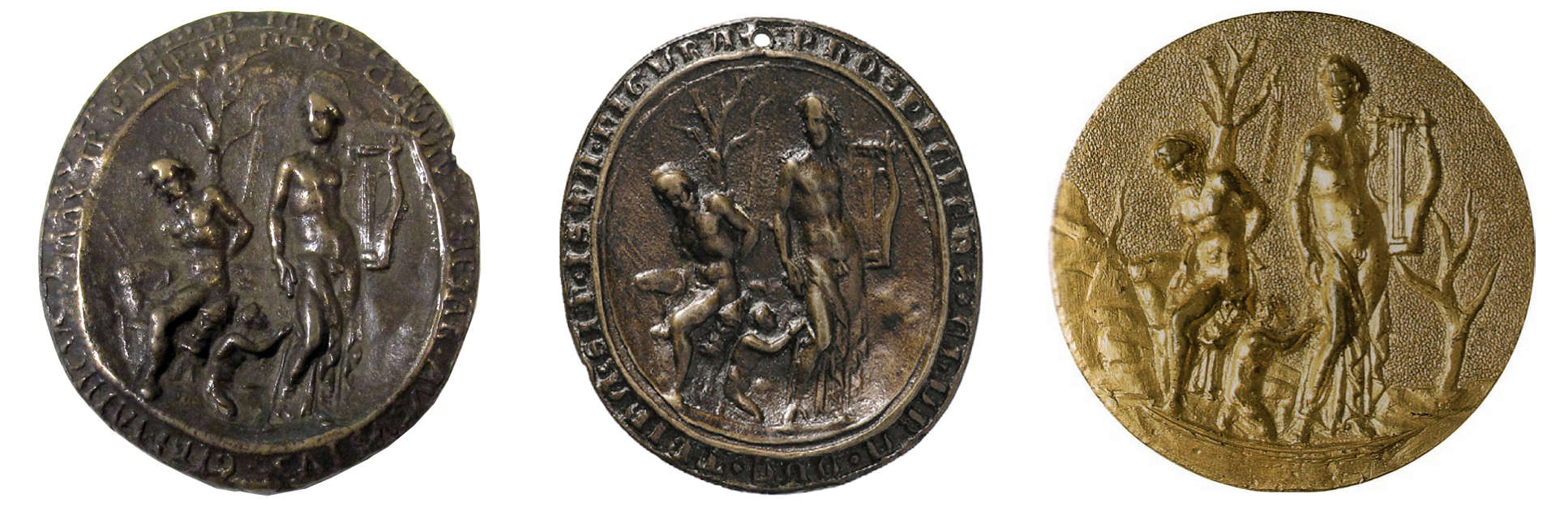
Fig. 6: Bronze plaquette of the ‘Seal of Nero,’ probably cast in Rome after a wax seal impression before 1465 (left; Cabinet des Medailles, Bibliothèque Nationale, inv. 442); bronze plaquette after a carnelian of Apollo, Marsyas, and Olympus with later mount, cast probably in 1468 (center; Mario Scaglia collection); gilt bronze medallic reverse of a medal, based upon the ‘Seal of Nero,’ by Cristoforo Geremia, 1468, Rome (right; Palazzo Venezia)
Indeed, upon acquiring the famed carnelian from Trevisan’s estate, Paul II subsequently launched a campaign in celebration of his peace proclamation of 25 April 1468 which employed a multi-faceted use of the gem and its iconography. In close proximity with this event, he appears to have recontextualized the gem by removing its former Florentine-themed setting by Ghiberti and introducing a new band setting relative to his peace proclamation.35 This new setting is reproduced in a very rare variant of plaquette casts of the gem (fig. 6, center).36 On this occasion, Paul II also tasked Cristoforo Geremia with the creation of a portrait medal to memorialize the event.37 In this effort, Cristoforo created a revised portrait of the Pope and a medallic reverse featuring a newly modeled freehand copy of the Apollo, Marsyas and Olympus gem (fig. 6, right).
These events inform us of two noteworthy practices of Paul II: first, that he was possibly inclined to copy in bronze an important object he was unable to obtain; and secondly, that he authorized a bronze contemporary copy of a prized antique gem in his possession.
Giuliano di Scipio
This brings our discussion to a gem-cutter of which there is little known but who was situated in the environment of activity surrounding Paul II, Cristoforo Geremia and a host of other noteworthy patrons, collectors, and artists. Of especial note is his presence at the intersection of Rome and Mantua and his role, whether active or passive, in the realization of one of the masterpieces of Renaissance bronze relief work: the Martelli Mirror.38
On 17 April 1470, and just two years after Paul II’s campaign promoting his peace proclamation, he instituted a papal bull establishing a new pattern for the jubilee cycle. To celebrate he commissioned the gem-engraver, Giuliano di Scipione Amici, to execute a carnelian intaglio portrait commemorating the event (fig. 7). The carnelian is the only known documented work of Giuliano, recognized in 1929 by Ernst Kris,39 and following upon earlier published records of the Papal Treasury discovered by Eugène Müntz.40 The carnelian is inscribed, ANNO PUBLICATIONIS JUBILEI, referring to the jubilee, and thus informing that Giuliano’s carnelian intaglio portrait of the Pope must have been completed between mid-April 1470 and the end of that year. Approximately four months after the Pope’s unexpected death, in 1471, Giuliano petitioned to the Apostolic Chamberlain of the Papal Treasury for payment concerning the carnelian portrait as well as payment for other items he had either gifted or worked-on for the Pope.41

Fig. 7: Carnelian intaglio portrait of Pope Paul II by Giuliano di Scipio, 1470, Rome (Palazzo Pitti, Museo degli Argenti, inv. Gemme no. 323)
Paul II was without hesitation in having bronze casts produced after Giuliano’s contemporary gem (fig. 8).42 Such casts inform us of Paul II’s continued interests in the seriality of bronze as a prestigious medium through which to convey not only his interests in antiquity but also the continuing promulgation of his public image and legacy. The plaquette copies were likely made in conjunction with the jubilee and before the death of the pope on 26 July 1471.43 These bronze casts also reproduce the carnelian’s original setting and this too is quite possibly Giuliano’s invention.

Fig. 8: Bronze plaquette, 1470, after a carnelian intaglio portrait of Pope Paul II by Giuliano di Scipio, Rome (private collection)
It ought to be recognized that gem-engraving frequently belonged to the realm of the goldsmith and that while Giuliano’s expertise may predominantly have involved the working of hardstones, he probably also worked with other precious materials and may have likewise had some involvement, even if only administrative, in the bronze casts that reproduce his masterful carnelian intaglio of the Pope. One detail that may attest to Giuliano’s powers as a goldsmith is the uniquely preserved and rare example of two entirely gold casts of Giuliano’s intaglio which survive in the Vatican Medagliere in Rome and at the Museo Correr in Venice.44
In the sparse art historical discourse available concerning Giuliano he is frequently cited as only a gem-engraver and dealer of antiquities. However, the accounts of his petition to the Apostolic Chamberlain seem to have been somewhat misread in contemporary scholarship. Modern literature suggests that Giuliano had something to do with the dispersal and sale of Paul II’s collection of gems from the Papal Treasury following Paul II’s death and while Giuliano may very well have been appointed such a role from the incumbent Pope Sixtus IV, there is more to be observed in the notes concerning the record of his requests.
On 30 November 1471, during the settlement of debts owed to Giuliano from the Papal Treasury, he described several carved-gems he sought payment for from Paul II’s estate, noting that four of them were already in Cardinal Francesco Gonzaga’s possession and that the carnelian portrait he had made of Paul II was in Domenico di Piero’s possession.45
We can presume Domenico, a successful Venetian merchant and dealer of hardstones and other antiquities, probably reserved Giuliano’s intaglio for his own commercial or personal interests, seeing that he was likely fond of the prominent Venetian pope and fellow native. Domenico was often on the forefront of events concerning the exchange and acquisition of precious carved-gems throughout Italy and was probably able to reserve and secure Giuliano’s carnelian portrait of the Pope, among various other of Paul II’s antiquarian collection, quite soon after Paul II’s death. Over a duration of time Domenico had sold a number of antique gems to Paul II46 and may have been able to secure Giuliano’s carnelian and other gems, inclusive of the prized Apollo, Marysas and Olympus,47 on probable outstanding debts due to him from Paul II, and thus the Papal Treasury.
Confounding, however, is how or why Cardinal Francesco Gonzaga was in possession of four of these gems from Paul II’s collection in November of 1471. Had Paul II earlier given or loaned these to the Cardinal before he died?48 This seems unlikely despite their good terms. Rather, the answer is simpler given some further context and a bit more data.
Foremost is the realization that these gems were not antique, as has often been assumed. It is noted in the records of Giuliano’s petition to the Apostolic Chamber, that these four gems in Cardinal Gonzaga’s possession were gifts he had given to the Pope, apparently his own creations, which explains why, at the beginning of his petition, he had to give valuations of them based upon what other patrons had offered him for them. It also explains why he willingly suggests not receiving a payment for them and to have them returned to him while receiving payment only for the works he had been contracted to do for Paul II. That is, payment for the carnelian intaglio portrait he had executed for the jubilee as well as payment for a cameo he had worked on for five months whose stone had been imported from France. This latter object is probably the cameo portrait of Paul II which is recorded in Cardinal Francesco Gonzaga’s posthumous inventory of 1483, which Clifford Brown had originally suggested might be a work made by Giuliano.49
The reason Cardinal Gonzaga would have been in possession of these gifts made by Giuliano for Paul II, is because the Cardinal not only had an interest in them for himself, but was also, during this period, quite likely to have been a regular patron of Giuliano’s, as he is documented to have certainly been in the Cardinal’s service a decade later during the early 1480s.50
Cardinal Francesco Gonzaga was one of the few Cardinals Paul II elevated to an influential role within the Curia,51 appointing him the Papal legate to Bologna on 18 February 1471. In addition to this, the Cardinal was also on good terms with Paul II’s loyal cousin, Cardinal Marco Barbo. Both Barbo and Gonzaga together welcomed Borso d’Este on his visit to Rome to receive Paul II’s blessing in becoming the Duke of Ferrara on 12 April 1471, for example. The Pope had unexpectedly died after the Cardinal had just left for his new appointment in Bologna and did not return to Rome until 4 August 1471. We are thus to presume that between this date and the end of November, the Cardinal was able to secure Giuliano’s engraved-gems from the Papal Treasury and this is indeed a probability given that upon his return, Cardinal Gonzaga, along with Cardinals Bessarion and Giovanni Battista Capranica, were tasked by Pope Sixtus IV to draft an inventory of Paul II’s assets.52 It is presumably at this time that Cardinal Gonzaga secured these gems, knowing that he could either later purchase them from Giuliano or return them to him on his behalf. One or more of these gems likely form part of Cardinal Gonzaga’s posthumous inventory: that of a chalcedony Head of Alexander the Great and a large cameo of a cloaked Faustina, also in chalcedony.53
In Giuliano’s carnelian portrait of Paul II, we observe an already accomplished master which must suggest an earlier unidentified repertoire of work, presumably also under Paul II’s patronage and probably also that of Cardinal Francesco Gonzaga, the latter of which is attested by an offer Giuliano had received for one of his gems before 1471 from a certain Galeatio Agnello, whom we identify as a member of Cardinal Gonzaga’s household as late as 1483.54 Of especial note is a signet ring of Paul II from 1464-71, probably used to seal official correspondence (fig. 9). The underside of the ring is inscribed in-relief with the Pope’s title and clearly identifies his ownership of it.55 The surface of the ring depicts facing profiles of Saints Peter and Paul, inspired by early Christian intaglios of the 4th and 5th century and following the tradition of lead seals from the 11th century onward.56 Diana Scarisbrick notes the intaglio on Paul II’s ring was “executed by an artist whose style rivalled that of the best engravers of the age of Augustus, the dignified portraits are lively, combining classical idealization with Christian piety.”57 This achieved naturalism is tantamount to the quality perceived in Giuliano’s portrait of Paul II as well as that of other works, to be discussed.

Fig. 9: Intaglio signet ring of Pope Paul II, probably 1464, possibly by Giuliano di Scipio, Rome (private collection)
In the small effigy of St. Peter, we perceive a precursor to the larger intaglio of Pan (fig. 24)—to be discussed—whose portrait similarly boasts high and narrow cheeks, a thickly protruding upper brow line and wild beard. It could be speculated that this signet ring is the work of Giuliano executed several years before the carnelian portrait of the Pope, and at much smaller scale. Its dependency on antique sources and classical modalities is entirely in line with what would have been Giuliano’s expertise and knowledge.
It should be noted that Giuliano’s petition to the Apostolic Chamber also involved the Chamberlain’s request to have Giuliano update a ‘carnelian of the kingdom,’ possibly for a signet ring, with the new Pope Sixtus IV’s title, as well as a request to ‘redo’ an inscription on a sapphire vessel originally ordered by Paul II, so that it might reflect instead the name of the new Pope.58 Müntz notes that when the body of Sixtus IV was moved in 1610, the papal ring on his finger still had a dedicatory inscription belonging to Paul II: Paulus Venetus Papa Secundus.59 It would seem the former Pope’s successor never completed the task in updating various works earlier commissioned and produced under Paul II’s papacy. Indeed, judging by the sums paid to Giuliano, he does not appear to have fulfilled these requests on behalf of Sixtus IV, at least not in 1471.
Nonetheless, Giuliano’s presumed earlier artistic service to Paul II, could suggest a trusted tenure and relationship characterized by patronage and a shared appreciation for antiquity. Their relationship appears to have been on respectable terms considering the gift of four engraved-gems the Pope had already received from Giuliano. We may also note here the rather informal relationship Giuliano maintained with Cardinal Francesco Gonzaga a decade later, to the degree in which work was completed without any formal contracts,60 and probably also one reason so little documentation survives about this incredibly talented artist.
Paul II’s later commission and reproduction of Giuliano’s intaglio portrait of him informs us of a third important point: that Paul II sponsored the cutting and engraving of modern gems and he took an interest in not only reproducing antique gems from his collection in bronze, but also a contemporaneously made gem, and notably, one made by Giuliano.
This last observation may help resolve questions in plaquette scholarship which have long noted that some all’antica plaquettes derive from legitimate classical gems while others appear to be cast after Renaissance inventions inspired by the antique. It is the present author’s suggestion that Giuliano had an instrumental role in this period of early plaquette production. An immediate observation is that Paul II’s carnelian portrait was made already with the intention of it serving as a model for reproduction in bronze61 or as a seal,62 as the legend on the intaglio is engraved in reverse. It could be presumed that this was not the first time Giuliano had executed a work of this kind, and it is the present author’s suggestion that he is the potential author of one of the most widely diffused and early plaquettes of the 15th century: that reproducing the effigy of the Divine Julius Caesar (fig. 10), to be discussed.63
Giuliano’s feasible exposure to Paul II’s vast collection of antique numismatic objects and more than 821 gems64 would have served as a prime resource for producing contemporary gems inspired by antique glyptics and coins.65 Such an awareness would have provided Sixtus IV the impetus to assign Giuliano the role of assisting in the liquidation of Paul II’s assets in the Papal Treasury. However, it is Paul II’s patronizing of Giuliano which also exemplifies his support for the greatest contemporary artists of his era.
It is possible Cristoforo Geremia may have been witting of Giuliano’s early talents, and possibly during a period before they both fell under the patronage of Paul II. In 1462, Cristoforo cautioned the Marquis of Mantua, Ludovico III Gonzaga, about ‘an excellent craftsman’ making antique cameos in Rome that were counterfeit.66 Whether Giuliano may have been intentional in such a practice during his early career cannot be ascertained67 but if Cristoforo’s comment refers to him, he certainly recognized his capability, and perhaps came to respect his accomplishments when both artists came into the service of the same patron, perhaps even collaboratively. The proposal of Giuliano’s talents in producing convincingly antiquated designs may account for the more than century-long debate concerning the authenticity and age of various all’antica plaquettes discussed in literature on the subject.
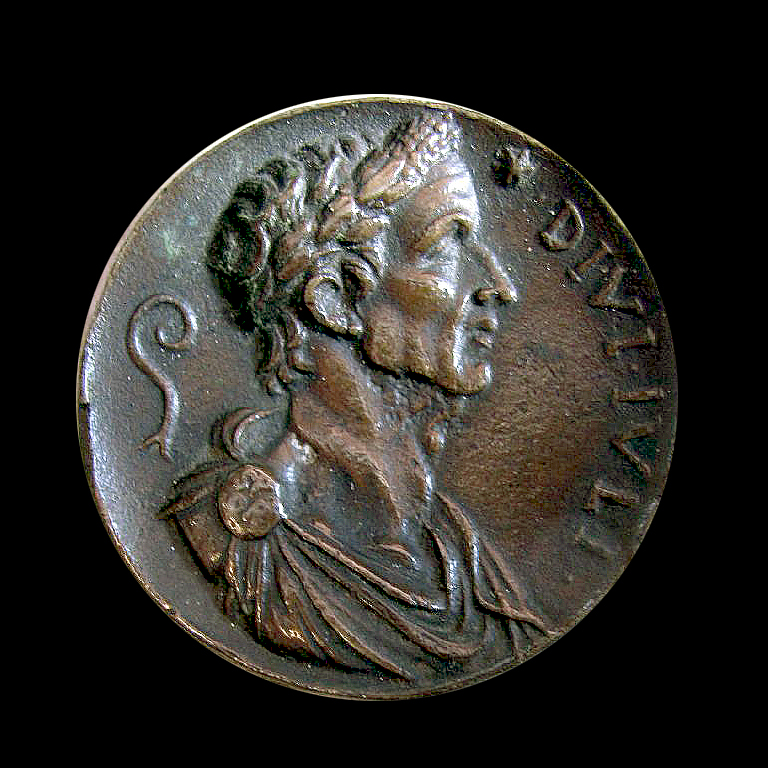
Fig. 10: Bronze plaquette of Julius Caesar after a carnelian intaglio here attributed to Giuliano di Scipio, ca. 1466-67 (Palazzo Madama, inv. 1120B)
One of the most influential and widespread all’antica plaquettes is that representing Julius Caesar, previously noted (fig. 10). As with a quantity of other all’antica plaquettes, some scholars have suggested the plaquette representing a profiled bust of Julius Caesar was cast after a classical gem while others have suggested it to be a Renaissance invention inspired by antique models. This latter perspective has received the widest acceptance, especially in recent scholarship.68 The plaquette’s composition appears to derive from a unique blend of both glyptic and numismatic sources, notably a putative portrait of Julius Caesar from the late Augustan era or thereafter, as featured on examples like an amethyst intaglio at the Museo Nazionale in Siracusa69 or a lost carnelian intaglio portrait formerly in the collection of Pierre Louis Jean Casimir, Duke of Blacas (fig. 11).70 71 The unusual modeling of Caesar’s neck particularly seems to derive from such antique glyptic prototypes while the general format of the portrait with Caesar’s cloak, wreath, star and lituus may relate to the Roman portrait coins of the emperor from the 40s BC.72

Fig. 11: Plaster impression after a carnelian intaglio of Julius Caesar, reproduced in 1843 in Trésor de numismatique et de glyptique, formerly in the collection of the Duke of Blacas, and possibly formerly with Cardinal Pietro Barbo (Pope Paul II), before 1471
A majority of plaquette scholars have associated the plaquette with a gem described in Paul II’s inventory as ‘a small head of Julius Caesar in carnelian worth four ducats.’73 Some scholars have further linked this carnelian in Paul II’s collection with one also in Cardinal Francesco Gonzaga’s posthumous 1483 inventory describing a carnelian intaglio of Julius Caesar with the inscription, DIVI JULI, identifying him as the ‘Divine Julius,’74 and clearly related to the plaquette here discussed.75
Scholars have often thought these two carnelians of Julius Caesar to be one-and-the-same on account of Cardinal Gonzaga’s acquisition of a quantity of Paul II’s gems, besides those noted here to be executed by Giuliano, such as antique works like the so-called ‘Felix Gem.’76
However, these two inventory accounts of a carnelian portraying Julius Caesar are possibly two entirely different objects. Namely, the Paul II carnelian is described as ‘small’ and is only given the value of 4 ducats and the inscription, DIVI JULI, is not noted. Cardinal Gonzaga’s carnelian is also valued—at-a-later-date—to be worth 10,000 ducats, to be discussed. Of some note, however, is that the carnelian of Julius Caesar in Cardinal Gonzaga’s inventory is recorded in-between the first listed gem of his inventory: that of the cameo of Paul II, here noted as a possible work by Giuliano, already discussed; and the third gem of his inventory, being that of a chalcedony cameo of Faustina, which we have earlier noted was one of the gems Giuliano originally made as a gift for Paul II and was already in the Cardinal’s possession soon after the Pope’s death. It could stand to reason that the carnelian of Julius Caesar, listed in-between two gems made by Giuliano may inform that it too is a work of Giuliano’s and probably also mounted by him in the gilt silver setting described in the inventory.
If the carnelian of Julius Caesar is Giuliano’s invention, we can stylistically appoint it to an earlier period in his career, sometime before his production of the carnelian portrait of Paul II. Such a production may have been initiated in 1466 when we find in that year, Cardinal Francesco Gonzaga sending a plea to his father in Mantua to borrow a manuscript of Aelius Spartianus so that the text and representations of ancient medals of the Caesars can be referenced because ‘their iconography could not be found in Rome.’77 The Cardinal’s request for this work was intended for use by his court illuminator, Gaspare da Padua, who also happened to be Giuliano’s intermediary for commissions he received from the Cardinal.78 The receipt of this manuscript into the Cardinal’s household is indicative of the interest in such portraits at this date and could place the commission for Giuliano’s Julius Caesar to around 1466-67, a period in which we can assume he had already achieved the graces of both the Pope, and Cardinal Gonzaga.79
It remains uncertain if such a commission would have been executed at the Cardinal’s request or that of Paul II’s.80 Irrespective of this, its possible completion by 1467 would have placed it during the prolific casting activities associated with Paul II’s ‘Officine di San Marco,’ thus encouraging its diffusion through reproductions of it in bronze and probably gesso as well. This idea also foments the notion that the development of plaquettes, with its origins in the reproduction of classical gems and coins—for the sake of preservation and celebration for the antique—emerged with its first contemporary inventions inspired by those same antique sources.81
The diffusion of the Julius Caesar carnelian’s design
A testament to the success of the Julius Caesar carnelian is preserved in the many ways its diffusion served to encapsulate the revival for the antique during the later 15th century and first quarter of the 16th century over a variety of media. The motif’s earliest identified appearance features on an illuminated manuscript produced as early as 1485, to be discussed. However, from this period and into the early part of the next century, it appears as an embossed leather motif on the covers of as many as twenty book bindings executed over a span of several decades in five different locations throughout Italy.82 The motif also appears as a marble tondo at the Casa Botta in Milan, featured on the façade of the courtyard and located just above its entrance.83 As earlier noted, the portrait of Julius Caesar also appears on the interior silver lining of the Shrine of St. Simeon in Zadar, completed in 1497 by the silversmith, Tommaso di Martino (fig. 5, right). A superb gesso or bronze cast of the composition may have passed to that silversmith by way of the shrine’s patron, Maffeo Vallaresso, who visited and stayed with Paul II at the Palazzo di San Marco in 1468, a year after we propose Giuliano completed this work. In 1517 the motif was used in reverse profile, for a woodcut portrait of Julius Caesar depicted in Andrea Fulvio’s Illustrium Imagines, published in Rome.84
Not yet noted in plaquette literature is the feature of the Julius Caesar portrait on a stucco medallion along the lower west wall of an outdoor ambulatory at Horton Hall in England.85 The ambulatory was built for William Knight, ca. 1527-29,86 who was Prothonotary to the Holy See, and later Bishop of Bath and Wells. He visited Rome on numerous occasions, studying at the University in Ferrara and serving as an emissary for the King of England on numerous visits, most notably in 1527 to petition the Pope’s approval for King Henry VIII’s divorce from Catherine of Aragon.87 It is one of the earliest referential uses of a plaquette composition in England with exception of the feature of Master IO.F.F.’s Judgment of Paris inspiring a portion of a frieze along the wood carved mantle of the Great Parlour in Wingfield House, Ipswich, probably made in 1516.88
Also, not well-noted in literature, is the feature of the Julius Caesar plaquette on bronze mortars produced in France, where it appears on at least seven examples datable to the 17th century (fig. 12).89 Other plaquettes descendant of Paul II’s sphere are likewise featured on mortars from this period and Bertrand Bergbauer hypothesizes these models must have initially reached France through Paris during the mid-16th century. This is evinced in part by the presence of terracotta models of these plaquettes which were used as moulds in the pottery workshop of Bernard Palissy, ca. 1510-90, including a mould of the Julius Caesar plaquette.90 91 The interest in incorporating these classical motifs on mortars appears to remain in Southern France throughout the 17th century, where we observe the Julius Caesar plaquette reproduced on mortars made in the workshops of the Master of 1603—active in or around Lyon—and the Master of Provins.92 An interest in the Julius Caesar plaquette a few decades earlier in Lyons, is also observed by a bookbinder who produced a selection of books with this motif on their cover for the library of Marcus Fugger.93

Fig. 12: Bronze mortar with later wooden base, reproducing a plaquette of Julius Caesar, France, 17th century (private collection)
Lastly, Douglas Lewis’ unpublished survey of this plaquette points out its feature on an illuminated miniature equestrian portrait of King Louis XII of France, datable ca. 1498-1503, and featured as one of numerous fictive medallions portraying military heroes along its margins.94 He also notes the motif’s feature on the Ace of Coins from a tarot deck formerly in the collection of Leopold Cicognara, datable to the first decade of the 16th century.95
It is due to this widespread diffusion that the carnelian—sometime after the deaths of Cardinal Gonzaga and Giuliano—that it was apparently mistaken as ancient, as well as remarkably important, and thus valued to be worth 10,000 ducats.96
Proposed origins for the diffusion
of Giuliano di Scipio’s all’antica inventions
While it is apparent Giuliano’s herewith proposed depiction of Julius Caesar was well diffused, this may not have been an arbitrary occurrence, but rather indebted to the immediate Roman environment within which he operated during the 1460s thru to the 1480s and especially by way of his activity surrounding Cardinal Francesco Gonzaga and the retinue of his household, those individuals that were ‘familiares et continui commensals,’97 and who David Chambers notes: “determined the cultural tone of the cardinal’s household in his later years.”98
In beginning this hypothesis, we may follow the subsequent path of the carnelian’s journey. After Cardinal Francesco Gonzaga’s death in 1483, the carnelian was transferred to settle outstanding debts with Francesco’s friend, Alfonso II of Aragon in Naples.99 From this transfer to a Neapolitan environment, we may subsequently note its early reproduction on illuminations tied to that court. Cardinal Francesco Gonzaga’s rapport with Alfonso appears to have borne some influence with his patronized artists in Rome into the Neapolitan environment, most apparent through the previously noted illuminator-miniaturist and antiquaire, Gaspare da Padua, who lived in the Cardinal’s home in Rome and was surely familiar with the carnelian of Julius Caesar.100
In 1485, two years after the Cardinal’s death, Gaspare moved to Naples and entered the service of Cardinal Giovanni of Aragon.101 We may note that as early as 1471, Giuliano also appeared to have had notable ties to Naples, evident by Neapolitans who attempted to purchase his engraved-gems,102 and this could be due to the bonds he shared with his Gonzagan patron and his apparent rapport with Gaspare da Padua. Giuliano’s association with Gaspare is evident in the Cardinal’s requests of Gaspare to commission from Giuliano various works-of-art103 and suggesting that the Cardinal regularly and informally relied upon Gaspare to solicit works from Giuliano which assumes the two of them shared a pre-established acquaintance and working relationship. Gaspare had been in service to the Cardinal since 1466 and is believed to have been trained in the studio of Andrea Mantegna.104 Such camaraderie between Giuliano and Gaspare could be expected as illuminators were often closely linked to goldsmiths, frequently referring to their precious artworks as source material for their elaborate painted border treatments. In 1483, Cardinal Francesco Gonzaga enlisted both Giuliano and Gaspare to help him find antiquities shortly before he died.105
The earliest identified reproduction of the Julius Caesar plaquette is its ornamental feature on the frontispiece of a manuscript of Plutarch compiled by Giovanni Albino and illuminated by Cristoforo de Majoranna in Naples ca. 1485.106 The portrait of Julius Caesar is also reprised in another later Neapolitan work compiled also by Albino alongside Giovanni Marco Cinico in 1494 for Alfonso II of Aragon.107 This latter manuscript’s feature of the Julius Caesar plaquette motif has gone unrecorded in plaquette literature and is attributed to the Neapolitan illuminator Giovanni Todeschino, who worked alongside Cristoforo de Majoranna in the scriptorium of the Neapolitan royal library and workshop (fig. 13, left). More importantly, Todeschino is thought to have been trained by Gaspare da Padua in Rome,108 and could be one further impetus for Gaspare’s eventual departure to Naples in 1485, notwithstanding his probably frustrated pursuit in receiving monies due to him after his Gonzagan patron’s death.109

Fig. 13: Detail reproducing a plaquette of Julius Caesar on an illuminated sheet of Livy’s Decades by Giovanni Todeschino, 1494, Naples (left; US Library of Congress, inv. 2021667740); detail reproducing a plaquette of Diana on an illuminated frontispiece of De evitandis venenis… by Giovanni Todeschino, 1480s, Naples (right; Biblioteca Casanatense, Rome, Ms.125)
Also not formerly noted in previous plaquette literature is Todeschino’s portrayal of the Diana plaquette, to be discussed, which is featured on his frontispiece of a manuscript by Giovanni Matteo Ferrari, De evitandis venenis et eorum remediis, produced in Naples during the 1480s (fig. 13, right).110 It could be surmised that Todeschino could have encountered or acquired gesso or plaquette casts of these compositions during his training in Rome under Gaspare da Padua or could have received examples upon Gaspare’s arrival to Naples in 1485. However, Todeschino would certainly have known the Julius Caesar carnelian after its arrival in Naples in 1483.
Giuliano’s relationship with Gaspare da Padua may, by consequence, also have placed him in the ambit of another Gonzagan resident illuminator and scribe: Bartolomeo Sanvito, with whom Gaspare would frequently collaborate.111 However, Giuliano could have earlier encountered Sanvito during that scribe’s tenure under Paul II between 1464-65.112 While its Roman binding is of a later date, ca. 1515-25, a manuscript of Petrach’s Sonnets and Triumphs,113 scribed by Sanvito, features on its back cover binding, an embossed impression of the Diana plaquette—previously noted and to be discussed.114
Between 1469-71, both Bartolomeo Sanvito and Gaspare da Padua worked closely with the Humanist and antiquaire Julius Pomponius Laetus on the execution of an illuminated manuscript of C. Suetonii Tranquilli duodecim Caesares, probably made for Cardinal Francesco Gonzaga.115 The manuscript exhibits an unusually accurate portrayal of ancient coins and their subjects, representative of the advancement in numismatic knowledge occurring in Rome during this period.116
Pomponius Laetus was one of the most erudite teachers and Humanists in Rome during this period as well as one of the earliest collectors of antiquities in the city. His home on the Quirinal was filled with displays of his coins, statuary, inscriptions, and other antiquities117 and served as a place where ‘unanimes perscrutatores antiquitatis,’118 could gather, learn, and practice living out a lifestyle inspired by the ancient classical past. These gatherings formed what was called the Accademia Romana, engaging in specialized interests revitalizing classical ideals through poetry, literature, food, clothing, and the adoption of classicized names for its principal members.
It is precisely this audience to which Giuliano’s classically inspired designs would have appealed. It could even be assumed he may have been a casual member given his expertise and work. He may have known Laetus directly, but would have likely known others belonging to his circle and academy. For example, we are aware that prior to Cardinal Francesco Gonzaga’s possession of Giuliano’s calcedony of Faustina, it was earlier in the possession of Cardinal Pietro Riaro119 who was a great patron of arts and a friend of Laetus. His uncle was Pope Sixtus IV, whom Giuliano may have served. Riaro’s other uncle was Cardinal Domenico della Rovere, the brother of Sixtus IV, who was made guardian of the Accademia after its reinstatement by Sixtus IV in 1479.120 Another avenue of introduction may have come through Giuliano Marasca who was a pupil of Laetus and the nephew of Bartolomeo Marasca who had served as the household steward for Cardinal Francesco Gonzaga in 1468-69 and had likewise served as the ‘Maiordomus’ for Paul II.121 However, the most direct link would have come by way of another long-time member of Cardinal Gonzaga’s household: Bartolomeo Sacchi, called il Platina, who had been the Cardinal’s tutor during his youth and was one of the core members of the Accademia Romana. He certainly would have seen Giuliano’s creations while in the Cardinal’s possession.
However, there is one further notable member of Cardinal Gonzaga’s household who was likewise a participant in the Accademia Romana, namely Cristoforo Geremia’s nephew: the poet, bronzista and architect, Hermes Flavius de Bonis, also called ‘Lysippus the Younger,’ according to the epithet given him by the Accademia.122 Hermes’ epithet—inspired by the famous 4th century BC bronze worker of antiquity—reflected his prowess in bronze work, a discipline he certainly refined under the tutelage of his uncle, Cristoforo.
It is believed Hermes arrived in Rome as early as 1468 and certainly before the end of 1471, when he executed the first papal coronation medal for the ascension of Pope Sixtus IV.123 Hermes was still an adolescent when he was commissioned to create this work and we are to imagine that he was involved in refining and learning his trade through the prolific bronze casting activities commissioned by Paul II during and leading up to this period.
It could be suggested that the young Hermes may have practiced this art through the casting of uniface plaquettes, involving a simpler process than those required in the production of two-sided medals which he would later prove to be most capable. We may also consider that the young Hermes would have also witnessed or even collaborated with Giuliano in the production of casts made after his carnelian of Paul II while his uncle and mentor, Cristoforo, was also in service to that Pope. Such preliminary experience may additionally have landed Hermes the opportunity to produce Sixtus IV’s medal of 1471, notwithstanding the probable influence of his uncle in obtaining such a commission.124
It is reasonable to suggest that the production of plaquettes in Rome, initiated by the zeal of Paul II, may have continued after his death, sustained in the sphere of Giuliano, Cristoforo Geremia, and by extension, Hermes Flavius de Bonis as well as the overarching interest of Roman Humanists who continued celebrating the classical past. It is worth noting Hermes’ primary patrons were bibliophiles and this may have created an avenue through which Giuliano’s creations spread to other Italian illuminators and bookbinders. Hermes’ primary patron in Rome was the book producer, Giovanni Alvise Toscani and his later Mantuan patron was Cardinal Gonzaga’s brother, Bishop Ludovico Gonzaga, also a bibliophile.125
The last known document we have concerning Giuliano involves his request of the Gonzagan Marquis of Mantua, in 1484, asking for a remaining balance due to him from the late, Cardinal Francesco Gonzaga, for precious jewels and ‘medaglie’ he had sold to him.126 The term ‘medaglie’ during this period is ephemeral and could either refer to coins, medals or plaquettes. This letter from Giuliano also appears to relate to one Gaspare da Padua, had earlier sent to the Marquis mentioning that he had sent silver and bronze ‘medaglie’ to Ferrara and had been instructed to send gems as well. It is presumed these were possible items procured by Gaspare from Giuliano and it remains to be understood if they may refer to medals, plaquettes or coins, yet they suggest the possibility Giuliano may have produced copies of his own works, and if not executed by himself, he may have sourced them to a talent like Hermes who excelled with bronze work and operated among the circle of Humanists probably most prone to appreciate and patronize Giuliano’s work.
Plaquette Bindings
Further suggestive of this idea is the way Giuliano’s inventions were employed regarding their feature in illuminated manuscripts and their use as decorative motifs on the covers of book bindings. A corollary antecedent to this type of diffusion is realized in the work of Hermes whose 1473 portrait medal of Sixtus IV, commemorating the commission for the restoration of the Ponte Sisto bridge, is reproduced, ca. 1475, in a manuscript of the Vitae Pontificum, dedicated to the Pope, illuminated by Gaspare da Padua, scribed by Bartolomeo Sanvito, and written by Platina, thus involving all members of the Gonzagan household. This same medal is reprised by these artists on the frontispiece of Aristotle’s De animalibus,127 ca. 1473-75, and again on a presentation copy of Plutarch and Seneca copied by Sanvito in 1477.128 This same medal by Hermes also represents the earliest feature of a Renaissance medal on a book binding: embossed in leather on a Roman binding, ca. 1475-78, of St. John Chrysostom’s sermons by Andrea Brenta, and scribed by Sanvito (fig. 14),129 who himself may have been responsible for inventing this binding.130
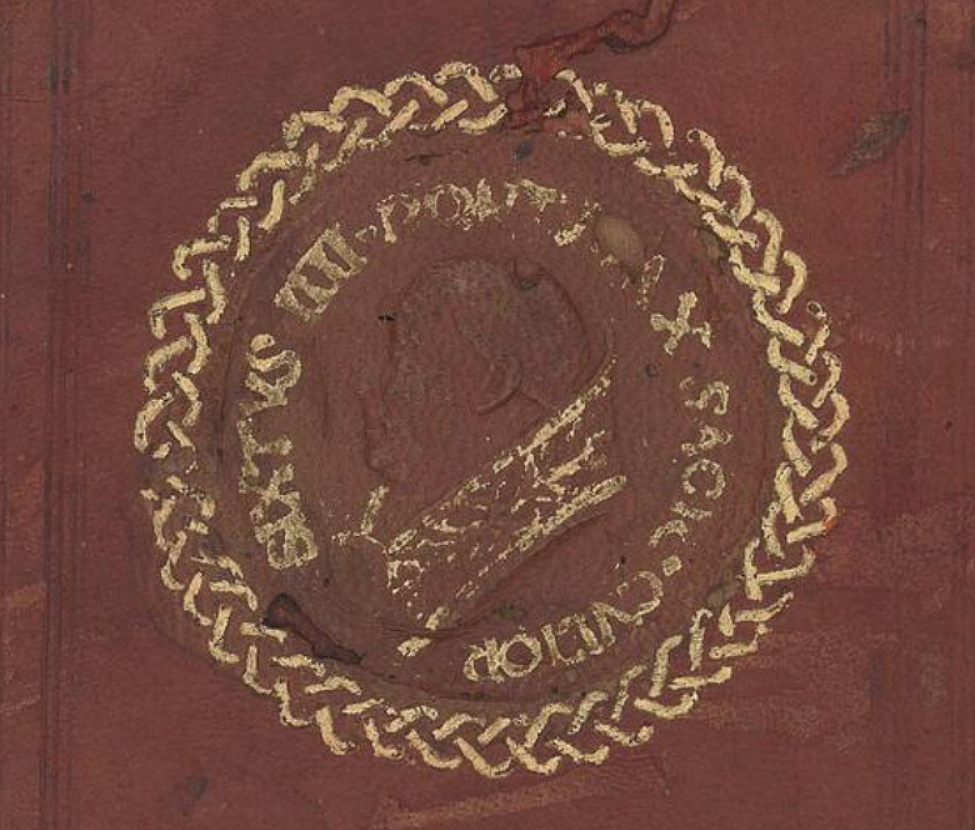
Fig. 14: Stamped leather bookbinding of St. John Chrysostom’s sermons, probably bound by Bartolomeo Sanvito, ca. 1475-78, after a portrait medal of Pope Sixtus IV made by Hermes Flavius di Bonus in 1473 (Vatican Library, vat. lat. 3575)
We may thus observe that this circle of artists tied to Cardinal Gonzaga, were the first to deploy the copying and reproduction of contemporaneously made all’antica devices within the Humanistic milieu of Rome beginning from the mid-1470s and among those connected loosely or intimately with the Accademia Romana. A testament to the collecting activities of these individuals is already noted briefly in the habits of individuals like Laetus and Cardinal Gonzaga but is also attested in Sanvito’s own lost Memoriale which described him as a ‘cultivated amateur,’ whose cabinet was filled with ‘jewels, cameos, gold and silversmiths works, coins and medals.’131 We may thus observe Giuliano’s proximity with these events, his connection with the Gonzagan household, and the subsequent appearance of his own all’antica devices finding their way onto bindings and illuminated representations in manuscripts.
Giuliano’s inscriptions
Another event closely tied to the literate sphere of the Accademia Romana is the advent of the first printing press in Rome. The immense influence of the Accademia Romana on the editing and publishing of books in late 15th century Rome is already thoroughly outlined by Maria Grazia Blasio,132 however, we may note, for example, the influence of members like Giovanni Antonio Campani, and also members of the Papal Curia like Cardinal Bessarion and the Pope’s cousin, Cardinal Marco Barbo, who advocated for the introduction of the printing press with much controversy.133 The literate sphere of the Accademia is further emphasized in the Cardinal’s former house-guest, Platina, who was later appointed as Papal Librarian by Pope Sixtus IV, a role that was to be even later assumed by another of Cardinal Francesco Gonzaga’s friends: Pietro Demetrio Guazzelli da Lucca.
When the German monks, Arnold Pannartz and Konrad Sweynheim, arrived just outside of Rome to establish the first printing press at the Monastery of St. Scholastica in Subacio, they produced the first books in a half Roman type to meet the demands and interests of the Humanists involved in sponsoring this effort. In 1467, they relocated their operation inside of Rome at the Palazzo Massimo.
The introduction of movable type in Rome required that cutting punches, striking matrices, and moulds for casting type were needed. This work, during this period in history, was allocated to the realm of goldsmiths, and particularly those experienced with the production of coins or medals. While such type could have been executed by other Germans emigrating to the region to work for the new print industry of Italy, the expertise required to understand the foreign Humanist script would have been arduous for those acclimated to the blackletter types of the north. Rather, more accessible artists among Rome’s goldsmiths may have been a better solution, and this indeed appears to be the case. Riccardo Olocco’s novel research on this subject has brought to attention a company formed in Rome during the late 1460s which included four unidentified Roman goldsmiths ‘to compose and produce books with [letter] forms.’134 The company was to last for a term of five years and we may readily associate this with Rome’s first press within the city, which was begun in 1467, yet had come to an end by 1472. We could wonder if Giuliano may have been one of the four goldsmiths involved in this enterprise given his proximity with those active in-and-around the Cardinal Gonzaga’s retinue as well those attached to the Accademia Romana.
Giuliano’s proximity with Gaspare da Padua, and by consequence, his collaborator, Bartolomeo Sanvito, would have made him readily familiar with the contemporary use of the Humanist scripts being employed in Rome at this time. His requests to execute inscriptions on hardstone may also have been impetus to get involved in such an enterprise. Notably, Sanvito’s script closely followed that of Laetus’ own personal script and the amalgam of their styles appear to have greatly influenced the first letter types used on Rome’s printing press.135
The inscribed text observed on Giuliano’s carnelian portrait of Paul II as well as that featured on the plaquette casts of the carnelian of Julius Caesar, here attributed to him, use the Humanist minuscule form script, dubbed in that period as the ‘litterae antiquae’ manner. This type was espoused by Giovanni Andrea Bussi, the first Papal Librarian appointed by Paul II and a close friend of Cardinal Bessarion. He was the lead print editor for this first printing press set-up in Rome in 1467. The detail to which Giuliano gives to his inscriptions is tantamount to these practices occurring in the academic environment within Rome and suggestive of his presence in the midst of it all.
We may note here the various matrices which faithfully reproduce the intaglios and cameos ascribed herein to Giuliano, which were possibly made with the intention of stamping leather for the bindings of books (fig. 15). The concept of this production is generally related to the processes involved in producing typecasts for the printing press. However, they may also have been used to produce multiples in gesso to sell or distribute among collectors. It cannot be determined whether such matrices may have been produced by Giuliano, insofar as their use on bindings might be concerned, as most survivals of these bindings date to the first quarter of the 16th century, and we are to presume, by that time, Giuliano had passed-away. Nonetheless, it would appear, at a minimum, that superb examples of Giuliano’s compositions must have survived among book processing workshops to allow such quality matrices to be produced or to have survived beyond Giuliano’s lifetime.
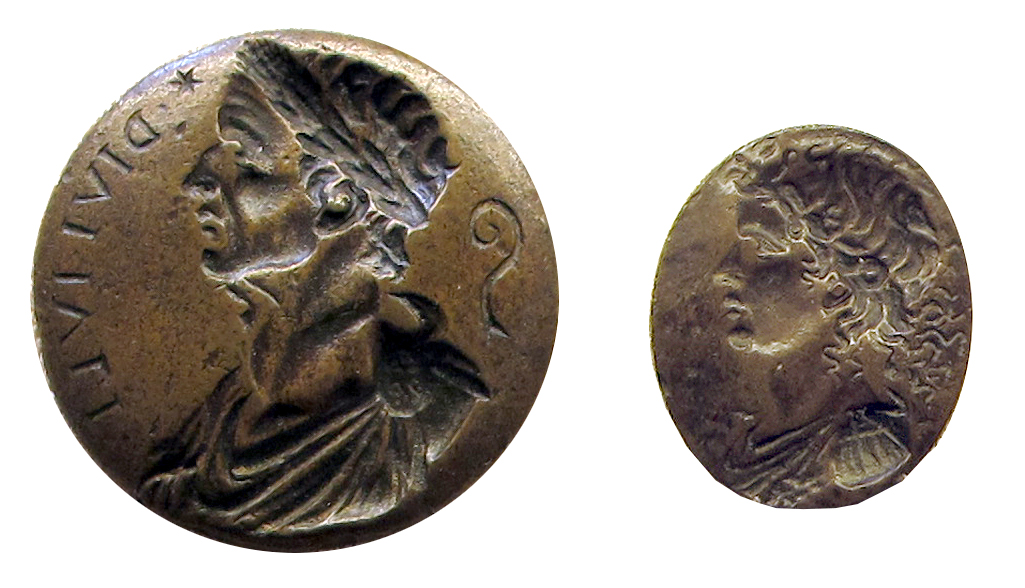
Fig. 15: Bronze plaquette matrices of Julius Caesar (left) and a Bust of a Classical Youth (right) used for stamping leather bindings for book covers (Museo Nazionale del Bargello, invs. 621B and 153B)
Giuliano’s proposed activity in the sphere of the Accademia Romana may have been a tangible avenue through which his all’antica designs spread among Italy’s Humanist audiences and encouraged their continued life in other media and especially those regarding the dissemination of literature.
Other works by Giuliano in Rome
In addition to the plaquette of Julius Caesar, there are various others within the category of all’antica plaquettes, believed made during the Renaissance, which may stylistically—and to some degree, contextually—be associated with Giuliano.
A rare plaquette depicting a Bust of a Classical Youth (fig. 16, left) is the earliest plaquette design identified on a book binding. The design is incorporated on the cover of the Codex Lippomano (fig. fig. 16, right), a collection of Latin epigrams and poetic verses dedicated to its recipient, Niccolò Lippomano, and composed by Jacopo Tiraboschi, which he presented to his classmate to preserve the memory of their academic experiences in Padua. The manuscript was originally presumed to have been bound not long after 1471,136 however, it has been more recently suggested that the poems Jacopo prepared in this volume may not have been written until a later date, ca. 1478-80, as some of them are addressed to students at the University who were not present there until this later period.137 Nonetheless, its binding follows not long after that observed of Hermes’ feature of his medal on the manuscript of St. John Chrysostom’s sermons, previously discussed (fig. 14). The execution of the Lippomano manuscript is attributed to Felice Feliciano,138 who was also responsible for its binding, as typical of scribes from this period. Plaquette bindings may indeed have derived from the recruitment of goldsmiths who would have furnished the accessories for a binding, namely the clasps, catches, corner pieces and central medallions applied to their covers. Such objects were, during these early dates, the commission of scribes and manuscript illuminators who would bind their own works.
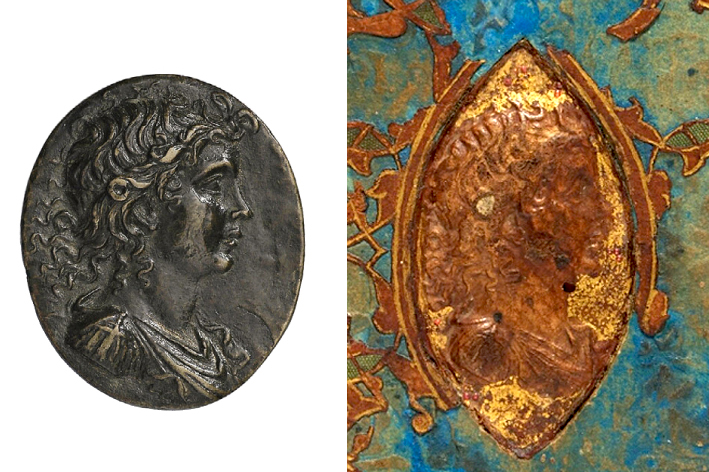
Fig. 16: Bronze plaquette Bust of a Classical Youth (Antoninus or Caracalla?), after a gem here attributed to Giuliano di Scipio, before 1471 (left; Mario Scaglia collection); and a detail of the cover binding of the Codex Lippomano, reproducing a Bust of a Classical Youth (right; Morgan Library, inv.199044)
The Lippomano binding is unique from other plaquette bindings in that it incorporates a gesso cast of the plaquette inset beneath its leather cover. The binding was recently subjected to scientific tests and a hypothetical recreation by Yungjin Shin of the Thaw Conservation Center. His analysis noted that a metal or wood plate would have also been used to assist in stamping the plaquette’s design onto the leather binding in addition to incorporating the gesso inset,139 being in-keeping with the various other plaquette bindings that do not incorporate a gesso inset but rely rather on stamping the leather with an impression. Shin also observed the use of trace red beads of resin or glass that were once patterned over the brushed gold ground surrounding the plaquette motif which, in its original state, likely filled the entire negative space surrounding the relief, creating a beautiful glowing red texture atop the gold ground. This same technique was employed on other bindings by Feliciano and would suggest further evidence for Hobson’s attribution of the binding to that maker.140 The plaquette appears on at least six additional bindings141 made in Padua, Rome and Naples, the latter of which is the latest, ca. 1515-35, and corresponds with a later circular variant of the relief.142 One example of a matrix used for stamping this relief into the leather covers for bindings is preserved at the Museo Nazionale del Bargello (fig. 15, right).143
There are several means by which this early plaquette, here attributed to Giuliano, may have reached Feliciano. Feliciano had been in Rome in 1478, just prior to the execution of the manuscript and its binding, and furthermore, Feliciano was a friend of Cristoforo di Geremia during their youthful years in Verona. He wrote two sonnets of praise to Cristoforo during the 1450s, for example.144 It could be presumed he acquired this gesso example of Giuliano’s composition while in Rome and may also have learned about or observed the feature of Hermes’ medal of Sixtus IV embossed on the cover of the manuscript of St. John Chrysostom’s sermons.
That Cristoforo Geremia was a friend of Feliciano’s led Anthony Hobson to suggest the Bust of a Classical Youth may have been his work.145 However, this seems unlikely since Cristoforo is not securely known to have produced any plaquettes,146 although we here retain the notion that Cristoforo may have been involved in producing casts of it on account of his proximity with Giuliano. The bust has also been thought to portray Antinous among others,147 and could possibly relate to a chromium chalcedony belonging to Cardinal Francesco Gonzaga as noted in his posthumous inventory.148 However, due to its feature on a Florentine manuscript of Ptolemy’s Geografia, ca. 1476-90, by Attavante degli Attavanti or Boccardino il Vecchio (fig. 17, left),149 it is thought the composition could equally relate to a gem of Caracalla owned by Lorenzo de’ Medici. The manuscript’s frontispiece upon which this design is featured likewise includes other cameos certain to have been in Lorenzo’s collection.150 However, this gem may have been part of one or two groups of Cardinal Francesco Gonzaga’s gems that travelled to Florence twice in 1484: in March and October, respectively, while Lorenzo was contemplating purchasing items from the Cardinal’s estate to settle debts owed to the Medici bank in Rome.151 At this time, Lorenzo may have commissioned plaster casts of several of these gems to keep for the purposes of decision-making concerning their purchase. However, the last group of gems, delivered in October, seem to have remained in Florence for almost four years, until being sent back to Rome in 1488. This provided plenty of time for Florentine illuminators to become familiar with various of Cardinal Gonzaga’s gems, possibly incorporating them into their manuscripts datable to this period.152 However, this plaquette’s feature on these manuscripts, dependent on when they were made, may also indicate it was one of the objects from Paul II’s collection which Lorenzo may have acquired in 1471 and could also attest to its Florentine presence, if unrelated to the Antinous gem listed in Cardinal Gonzaga’s inventory.

Fig. 17: Details of a frontispiece of Ptolemy’s Geografia depicting illuminations by Attavante degli Attavanti or Boccardino il Vecchio, ca. 1476-90, after plaquettes of a Bust of a Classical Youth (left) and Head of Minerva (right) (Bibliothèque Nationale, MS. lat. 8834, fol. 1)
Christopher Fulton thought the Bust of a Classical Youth may have been inspired by numismatic and glyptic portraits of Mithridates VI Eupator, king of Pontus (120–63 B.C.).153 and Lewis compares it to the chalcedony intaglio profile of the ‘Strozzi Medusa’ executed in the 1st BC by Solon.154 This amalgam of various prototypes speaks to Giuliano’s working methods in creating fictive portraits in all’antica manner.
To recall that Giuliano may have conceived Paul II’s carnelian portrait with the intent to also reproduce bronze examples is furthered in Douglas Lewis’ comment of the Bust of the Classical Youth which he notes is: “so unusually crisply rendered, it may well be possible that this plaquette design was originated directly by a Renaissance artist accustomed to bronze casting.”155
In 1989 Francesco Rossi noted technical similarities between the aforenoted Bust of a Classical Youth and a plaquette depicting Athena or Minerva (fig. 18, left).156 The latter may have been one of two busts of Athena listed in Lorenzo de’ Medici’s posthumous inventory, considered lost.157 One ancient example from Lorenzo’s collection—of Hellenistic or early Augustan import—survives in the Museo Archeologico in Florence.158 Suggesting that the plaquette may preserve the other lost example in Lorenzo’s inventory is reinforced by its feature on Florentine manuscripts, namely the previously discussed copy of Ptolemy’s Geografia of 1476-90 (fig. 17, right), and more particularly on a Missal of Thomas James illuminated by Attavante which offers a secure date of 1483 and precedes the period in which Cardinal Gonzaga’s gems were in Florence.159 The plaquette also appears on bindings, the earliest being attributable ca. 1505-15,160 and appears also on the interior silver lining of the Shrine of St. Simeon in Zadar, previously discussed (fig. 5, left). If owned by Lorenzo, it could be concluded he had acquired it from Paul II’s collection in 1471.

Fig. 18: Bronze plaquette of a Head of Minerva, after a gem here attributed to Giuliano di Scipio, before 1471 (left; Grassimuseum, lost in WWII) and a bronze plaquette of Julius Caesar, possibly after a gem by Giuliano di Scipio, probably before 1466 (Museo Nazionale del Bargello, inv. Dep. p.10.)
Lorenzo’s acquisition of gems from Paul II’s estate is inferred by a document from Lorenzo’s Ricordi of September 1471 and correlates with his visit to Rome while establishing Medici banking relations with the newly installed Pope Sixtus IV.161 This is precisely the period in which Giuliano may have been actively brokering or advising in the sale of Paul II’s gems in Rome and Laurie Fusco and Gino Corti equally suggest Giuliano’s possible involvement in Lorenzo’s acquisition of various of the Pope’s gems.162 Such an occasion may have also introduced Lorenzo to Giuliano’s talents, to be discussed, and particularly after having recently executed the successful carnelian portrait of Paul II.
On a tertiary note, Jeremy Warren has made an interesting observation concerning a rare plaquette of Julius Caesar that may relate to the Minerva plaquette (fig. 18). They share the same style of cuirass and a similar scale. However, the bronze casts which preserve the memory of this composition seem to be a later production probably after the 15th century (fig. 18, right). They feature a crudely articulated inscription: IVLIVS CAESAR DICTATOR, which has been added to an impression of what was an originally blank ground. Remarkably, the collection of gesso casts taken by Tomasso Cades in the early 19th century reproduce what must be the now lost gem (fig. 19). This could represent another production by Giuliano as its character closely relates to the inscribed carnelian of Julius Caesar and is possibly a precursor to it. However, it almost certainly uses the carnelian intaglio of Julius Caesar formerly in the Duke of Blacas’ collection as its point-of-reference (fig. 11), inclusive of the cuirass, which would encourage one to suggest that the Blacas carnelian of Julius Caesar may have been the example once owned by Paul II and described in his inventory, and thus also immediately familiar to Giuliano.

Fig. 19: Tomasso Cades’ early 19th century plaster impression of a lost gem of Julius Caesar, possibly by Giuliano di Scipio, before 1466, based upon a carnelian possibly once in Paul II’s collection (see fig. 11)
Giuliano appears to later evolve his composition of Minerva into a larger fictive portrayal of Alexander the Great. This idea is reinforced by the inscription: ALISANDRO (fig. 20, left) featured on a majority of known casts.163 However, this inscription is quite likely a later addition to one of the moulds taken from the original gem. A ‘first state’ of this plaquette, not very well known since the majority of them are in private collections (fig. 20, right), lacks the inscription and more faithfully reproduces the original gem. The Alexander the Great plaquette retains the same styled cuirass, facial type, and near-similar helmet to that of the aforenoted Head of Minerva although exchanges the helmet’s portrayal of a triton blowing a conch with an alternative scene of a contest between a centaur and lapith. Just as the plaquette of Julius Caesar, this example of Alexander the Great also served as the model for the portrait of Alexander the Great featured in Andrea Fulvio’s Illustrium Imagines, published in 1517 (fig. 21).

Fig. 20: Bronze plaquette of Alexander the Great with inscription (left; National Gallery of Art, DC, inv. 1942.9.202) and a bronze plaquette of Alexander the Great, without an inscription (right; Mario Scaglia collection), after a presumably lost white chalcedony engraved-gem here attributed to Giuliano di Scipio, before 1471.

Fig. 21: Detail of a woodcut from Andrea Fulvio’s Illustrium Imagines, 1517, after a composition here attributed to Giuliano di Scipio
Not yet noted in plaquette literature is the partial portrayal of this composition as an illuminated miniature double-portrait featured in a copy of Petrarch’s Triumphs scribed and illuminated around 1480 by Bartolomeo Sanvito and Gaspare da Padua.164 While the cuirass on the illuminated portrayal of Alexander is different from that of the plaquette, the face, hair and especially the helmet—which depicts the previously noted contest between a centaur and a lapith—is an exact copy (fig. 22). It would also appear that this double-portrait of Alexander has been superimposed over a second portrait of what looks like a profile of Cardinal Francesco Gonzaga, presumably associating him with the prestige and accomplishment of the ancient hero and perhaps related to his role as legate during the War of Ferrara in 1482-83.165 It is notable the Cardinal’s own armor, or cuirass, related to this event, formed part of his belongings after his death166 and we are to wonder if this miniature might depict it. This large plaquette of Alexander the Great may very likely reproduce the ‘chalcedony head of Alexander’ Giuliano originally gave to Paul II as a gift and was subsequently kept in Cardinal Gonzaga’s possession after the Pope’s death and consequently owned by the Cardinal, described in his posthumous inventory as: ‘Alexandro Magno in calcedonio biancho ligato ut supra cum cadenella.’167 This would also explain its partial feature on the aforenoted manuscript, as both Gaspare and Sanvito would have seen the chalcedony of Alexander the Great in the Cardinal’s household, thus using it as a reference for the miniature double-portrait.
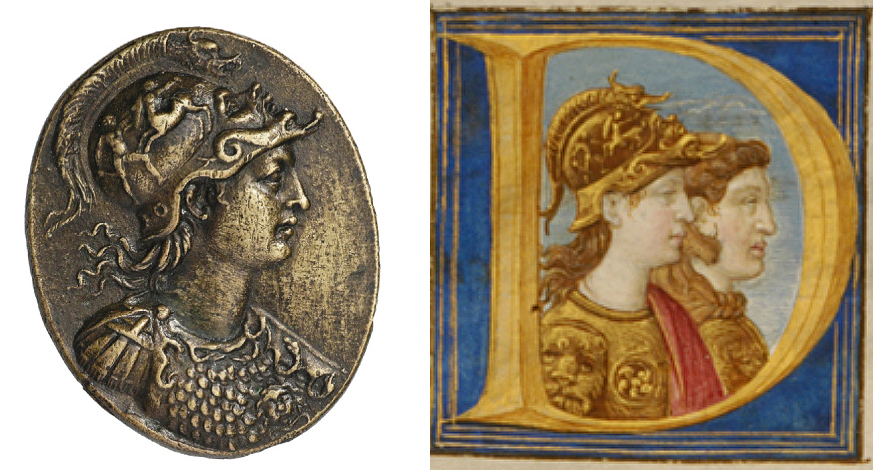
Fig. 22: Bronze plaquette of Alexander the Great, after a lost chalcedony here attributed to Giuliano di Scipio (left; Mario Scaglia collection); detail of an illuminated sheet from Petrach’s Triumphs by Gaspare da Padua and Bartolomeo Sanvito, ca. 1480-83, presumably a double-portrait of Alexander the Great and Cardinal Francesco Gonzaga (right; Walters Art Museum, inv. W755)
The Alexander the Great composition also appears on four surviving book bindings, all noting the subject of the portrait: two with the text, ALESANDRO and two with the Greek spelling of the hero’s name.168 It is perhaps due to the association of the plaquette with these bindings that a later workshop decided to add the inscription ALISANDRO to subsequent casts of the plaquette (fig. 20, left).
One further plaquette emerging from Paul II’s orbit, also featured on the previously discussed shrine in Zadar, is one depicting Diana (fig. 23, left). Although traditional plaquette literature has placed its origin around the year 1500, Jeremy Warren has recently noted it served as a reference for a right-facing portrait profile on the wheel of a chariot in a stone relief dating from the 1480s, and executed by a sculptor active in Cremona.169

Fig. 23: Bronze plaquette of a Bust of Diana (left; AD & A Museum, inv. 1964.524); detail of a stamped leather Roman binding after a plaquette of Diana, ca. 1510-20 for a copy of a Greek Psalterion (right; private collection)
Further suggesting an earlier origin is the appearance of this plaquette on a bookbinding for a copy of Asconius Pedianus’ Commentarii in orationes Ciceronis, printed in Venice sometime after 2 June 1477, and probably bound ca. 1480-95, as adjudged by Anthony Hobson.170 The Diana plaquette is likewise reproduced on seven additional bindings produced in Florence, Rome (fig. 23, right), and Milan between ca. 1497 and ca. 1525,171 and three matrices of the plaquette survive in various collections. Its success is likewise proved by the quantity of casts which survive in numerious private and public collections.172
Not noted in previous plaquette literature is Neil Goodman’s observation that this motif appears in a tromp l’oeil stone tondo forming part of the wall frescos in the Abbazia-Lazzari Chapel at Verona Cathedral attributed to Antonio Badile II during the late 15th century.173 An additional early portrayal, also not yet noted, is its feature on the frontispiece of a manuscript by Giovanni Matteo Ferrari, De evitandis venenis et eorum remediis, copied in Naples in the 1480s by the previously noted illuminator Giovanni Todeschino (fig. 13, right),174 a presumed pupil of Gaspare da Padua.
Rather than borrowing from classical gems, the bust of Diana instead appears to depend on ancient coins of Greek and Hellenistic origin. Lewis suggests its closest parallel to be that of a hundred litrai coin struck for Agathocles of Syracuse, in Sicily around 300 BC.175 Paul II’s collection of coins would have been an adequate source from which to have developed this composition which Lewis notes is an “impressively resolved design which may well have been an original creation, based on a variety of antique numismatic and/or glyptic inspirations, by a remarkably accomplished artist of the 1460s or early 1470s.”
Other works by Giuliano in Florence
As previously noted, the gem of Minerva and possibly that of the Bust of a Classical Youth, here ascribed to Giuliano, appear to have reached Florence possibly as part of Lorenzo de’ Medici’s acquisitions from Paul II’s estate in 1471 or alternatively acquired from Cardinal Gonzaga’s estate in 1484.176 Encouraging this idea is their tandem appearance on the previously discussed frontispiece of Pliny’s Geografia (fig. 17). However, it is unclear if Lorenzo would have understood these to be contemporary inventions or antique. We may note that in 1489, when the goldsmith Caradosso Foppa visited Florence and saw Lorenzo’s collection, he noted one gem—believed to be antique—was judged by him to be modern.177
It remains evident, however, that Lorenzo did commission contemporary works, as observed by several surviving gems from his collection now at the Archeological Museum of Naples, inclusive of a Maenad, to be discussed. His interest in both antique and contemporary glyptic art may also have been encouraged by his loyal secretary, Niccolò Michelozzi, who also collected both antique and modern gems. Giorgio Vasari also paints for us the image of Lorenzo as a revivalist of glyptic art in Florence.178 In 1477, the medallist Pietro de’ Neri Razzanti may have arrived in Florence to teach gem engraving but it remains questionable whether this was at Lorenzo’s request.179 Nonetheless, we are aware of Giovanni delle Corniuole and Pier Maria Serbaldi da Pescia, who were together tasked to evaluate the Medici gems after Lorenzo’s death in 1492,180 and who must have had an early start to their careers in Florence, probably on account of Lorenzo’s patronage. Certainly, the cameo portrait of Lorenzo attributed variably to the aforenoted Giovanni or to Domenico de’ Cammei is an example of his sponsorship of this art.181
While no documentary evidence has come to light concerning Lorenzo’s patronage of gem-engravers, the earlier occasion of Lorenzo’s sojourn to Rome in 1471 may have introduced Lorenzo to Giuliano’s talents in this field while acquiring objects from Paul II’s collection. It should also be noted that Giuliano, if operating in the circle of the Accademia Romana, may have also had convenient ties to Florence through members of the academy like Cardinal Giacomo Ammannati and Agostino Campano Settimuleio, both of whom were important Humanist contacts between Rome and Florence and friends with Gentile Becchi, who had served as the private tutor of Lorenzo during his youth.182 It is also worth noting that Bartolomeo Sanvito, in 1474, produced a revised manuscript of De optimo cive which was presented to Lorenzo in that year.183
We know nothing of Giuliano after 1471 until he reappears, still in service to Cardinal Francesco Gonzaga, in Rome, in 1483. If Giuliano did spend a brief period in Florence, he may have been drawn there not long after Cristoforo Geremia’s death in 1476 or perhaps sought to extend his patronage to an important collector like Lorenzo.
As a patron of artists, Lorenzo embellished his gem collection with contemporary examples relative to his interests and the present author has previously suggested an intaglio rock crystal depicting the Head of Pan could be Giuliano’s invention (fig. 24).184

Fig. 24: Rock crystal intaglio of a Head of Pan, here attributed to Giuliano di Scipio, ca. 1480 (private collection)
The intaglio of Pan shares several similarities with Giuliano’s portrait of Paul II beyond their left-facing profile busts and shared widths; like the small tuft of hair peeking from the base of Barbo’s crown, rendered in a manner close to Pan’s as well as the curved strokes delineating the eyebrows on each gem, both engraved in alike manner. Additionally, the smoothly curved contours along the edge of the noses and the modeling of the faces share a similar gelatinous-like luminous distinction. The pupils on both are carefully drilled just slightly beyond the orb of the eye and the palmettes extending from Barbo’s triple crown papal tiara terminate in sharply chiseled, angular hooks in the same manner as the wild hair protruding from Pan’s forehead (fig. 25).

Fig. 25: Detail of a rock crystal intaglio of a Head of Pan, here attributed to Giuliano di Scipio, ca. 1480 (left; private collection) and detail of a carnelian intaglio portrait of Pope Paul II by Giuliano di Scipio, 1470, Rome (Palazzo Pitti, Museo degli Argenti, inv. Gemme no. 323)
There are also shared correspondences between the intaglio of Pan and that of the Julius Caesar composition (fig. 41). Foremost is their alike format, having been carved in intaglio atop a convex surface and thus prompting their bronze reproductions as plaquettes to be incuse on casts of the finest examples. The similar depth of modeling and alike convex character is observed in placing examples of these plaquettes side-by-side (fig. 26).
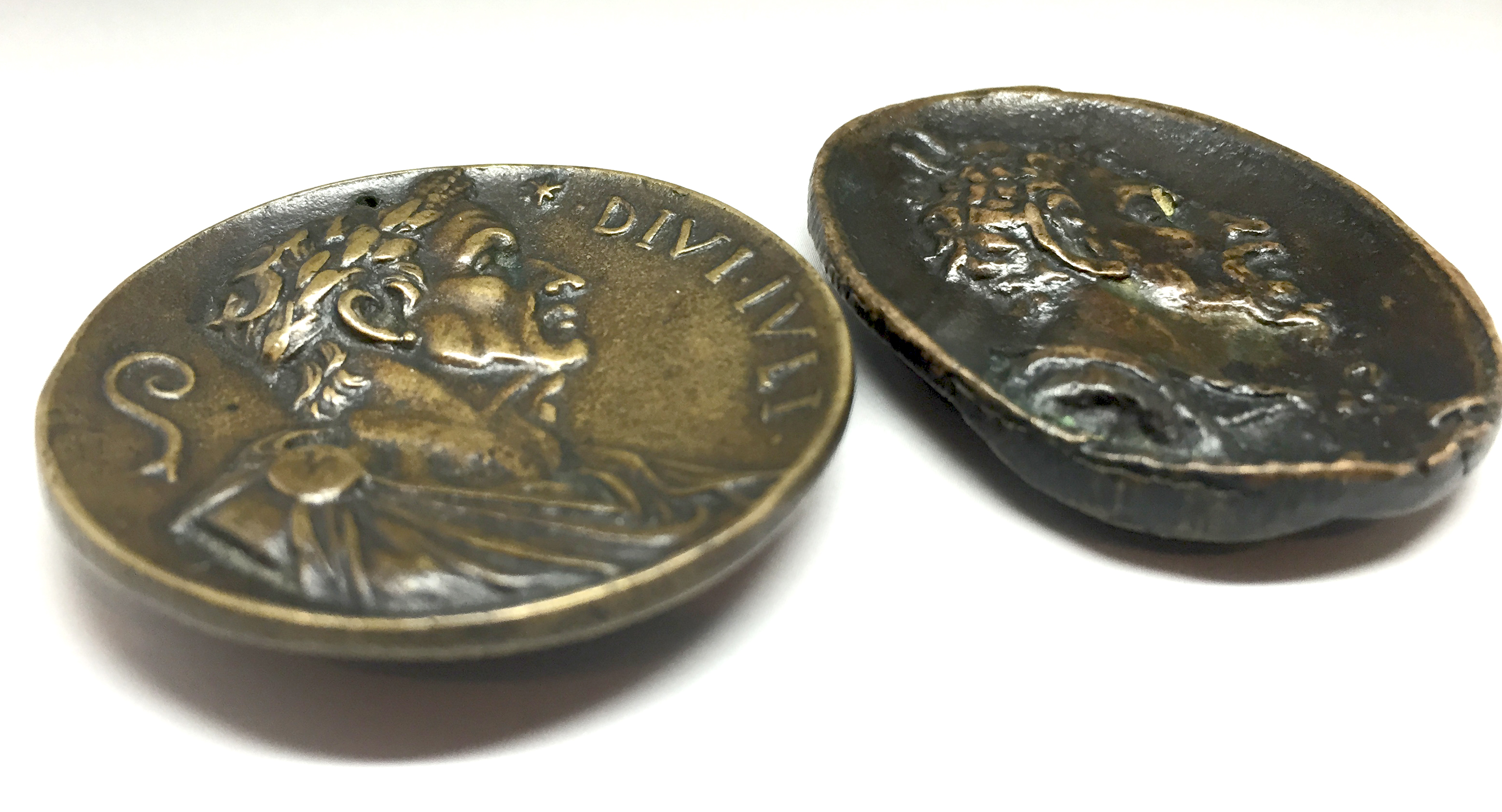
Fig. 26: Bronze plaquette of Julius Caesar (left; private collection) after a carnelian intaglio here attributed to Giuliano di Scipio, ca. 1466-67 and a bronze plaquette of Pan (right; Ashmolean Museum, inv. WA2021.7) after a rock crystal intaglio here attributed to Giuliano di Scipio, ca. 1480
The present author’s previous discussion of the Head of Pan intaglio suggested it was a work commissioned by Lorenzo,185 probably in or around 1480 when his Pan-centric role at the Medici Villa Careggi and lifelong esteem for the mythical figure was at its peak.186 A reasonable impetus for such a commission may have been the 1480 Saturnalia he organized at the villa while he and his friends increased their visits there to engage in Pan-centric poetry and the idyllic pleasures of the pastoral life.187
An additional connection between this intaglio and Lorenzo’s collection is noted in a sketch of the crystal executed by Lorenzo’s young protégé, Michelangelo Buonarotti, preserved on an early sheet of his in the British Museum (fig. 27).188 The intimacy of Michelangelo’s familiarity with Lorenzo’s collection is noted in Baccio Bandinelli’s comment that Michelangelo was the custodian of Lorenzo’ s collection,189 and Asciano Condivi’s comment that Lorenzo “many times a day had him (Michelangelo) called, showing him his jewels, carnelians, coins and similar objects of great value.”190

Fig. 27: Detail of a Head of a Satyr in pen and brown and grey-brown ink by Michelangelo Buonarroti, ca. 1501-03, Florence (left; British Museum, inv. 1895,0915.495) ; detail of a rock crystal intaglio of a Head of Pan, here attributed to Giuliano di Scipio, ca. 1480 (right; private collection)
Another intaglio, preserved in the Naples Archeological Museum191 and once forming part of Lorenzo’s collection—as adjudged by the inscribed LAV.R.MED192—may likewise be suggestive of Giuliano’s workmanship (fig. 28). Like the Head of Pan, the intaglio depicting a Maenad also correlates with Lorenzo’s secular interests of the 1470s and 80s.193 That Lorenzo would have had his epigram inscribed on a contemporary work rather than an antique gem is also not unusual, as we observe his epigram on near-contemporary or contemporary vases194 as well as his initials on at least two other contemporary cameos inspired by antique gems in his collection like a Centaur195 and Mercury and Marsyas.196

Fig. 28: 15th century glass intaglio of a Maenad, possibly by Giuliano di Scipio, ca. 1480 (Museo Archeologico di Napoli, inv. 1534)
In observing the letterform of the inscribed Maenad, we may assume Giuliano was responsible for this ownership mark on Lorenzo’s intaglio. The letterform of the LAV.R.MED inscription on the Maenad is commensurate with that featured on the Julius Caesar and Paul II carnelian inscriptions, being of the Humanist minuscule form or ‘litterae antiquae’ previously discussed. One particularly shared stylistic preference is the choice break along the leg of the letter “L,” rendered somewhat exaggerated like the hooks of the terminating strands of hair in his compositions. Comparable to the intaglios of Pan and Julius Caesar are the striated and contouring tufts of hair (fig. 29) which flair out at certain points as well as the deeply-set eye sockets. The Julius Caesar and Maenad designs also share an alike depth and articulation of the ear. However, unlike the gnarly configuration of the Pan intaglio, the Maenad rather portrays a very clean classical character recalling the Bust of a Classical Youth, Alexander the Great, Minerva, and Diana compositions previously discussed. However, among all these features is the immense—almost monumental—naturalism expressed in such a diminutive scale.
Fig. 29: Details of the hair on a rock crystal intaglio of the Head of Pan (left; private collection) and a glass intaglio of a Maenad (Museo Archeologico di Napoli, inv. 1534)
It is to be wondered if Lorenzo’s desire to obtain the Julius Caesar carnelian in 1483 was due to his recent familiarity with Giuliano’s work.197 He may have at least known and possibly owned bronze plaquettes of it, perhaps indicated by a ‘medallion’ of Julius Caesar he sent as a gift to Giovanni Sforza in February 1484.198
Although speculative, it could also be wondered if Giuliano’s talents in executing inscriptions may have resulted in Lorenzo’s possible request to have him variably inscribe his epigram on other possible objects in his collection such as additional gems or his hardstone vases (fig. 30). It is notable that Lorenzo’s epigram on these various objects is not uniform and was executed by a variety of different hands over an extended period-of-time. Pope Sixtus IV’s request to have Giuliano execute an inscription on an emerald vessel would speak to his talents in this area and his work in porphyry would also have been of potential interest to Lorenzo, in addition to his probable knowledge of ancient coins.199

Fig. 30: Vase with a lid and two handles, gilt silver, enamel and jasper, 14th or 15th century, from the collection of Lorenzo de’ Medici (Museo degli Argenti, Florence)
Like Giuliano’s carnelian portrait of Paul II, the Maenad is cut from beneath, allowing for a smooth surface through which to perceive the design. Francesco Rossi rightly associates this intaglio with another Maenad with a Thyrsus that is produced in plaquette form, albeit rare.200 He also tentatively associates this object within the sphere of Lorenzo de’ Medici. The very rare plaquettes reproducing the Maenad with a Thyrsus are predominantly redacted examples in narrow ovular or circular variants. However, the original carnelian appears to survive at the Mauritshuis in The Hague, and a copy in plaster is reproduced in Adolf Furtwängler’s Die Antiken Gemmen (fig. 31).201 This Maenad with a Thyrsus follows rather closely with the Naples Maenad in its feature and execution of the panther fur mantel worn by the protagonist. This repetition of attire follows also the habit of Giuliano that we observe between his Minerva and related Julius Caesar (fig. 18), as well as the larger Alexander the Great composition (fig. 20) which variably feature almost the same outfit. We may also observe in this Maenad with a Thyrsus a precursor to the very similar facial profile and thyrsus of a Bacchante, to be discussed.
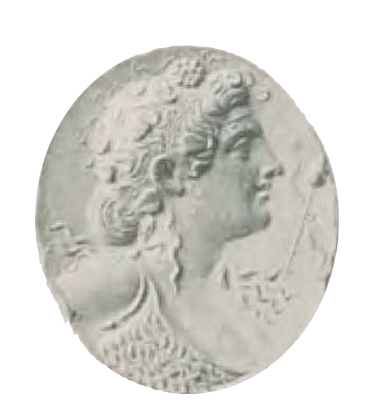
Fig. 31: Plaster impression of a Maenad with a Thyrsus, ca. 1900, reproduced from Adolf Furtwängler’s Die Antiken Gemmen after a carnelian intaglio (Mauritshuis, The Hague) possibly by Giuliano di Scipio, ca. 1480
The Maenad in Naples appears to be engraved in glass and it is to be wondered if the Head of Pan may also have been engraved in glass rather than rock crystal. While Venice was chiefly prized for its glass production, Florence appears to have had a very special concentration in fine glass production from the mid-15th century, particularly in the production of monocles and spectacles of both convex and concave lenses.202 Such a specialized production might have appealed to Giuliano who would have appreciated the unique ways in which the curvature of glass could project his engravings through their refined surfaces.
An example of the Diana plaquette in the Ashmolean Museum features an unusual negative impression on its reverse. Its incuse contours along the reverse almost precisely parallel the raised relief of its obverse. Warren relates it to a few other rare survivals of this kind203 which Graham Pollard had suggested may have been employed for the purpose of making plaster, clay, or glass reproductions of a composition.204 The most well-known example of this practice is observed in Donatello’s Chellini Madonna: a bronze matrix intended for reproducing glass copies.205 A 1508 inventory of the Dragani family’s Venetian glasshouse lists seven bronze moulds206 used for this kind of purpose, although there is very little evidence elsewhere to suggest this practice, save for two additional glass casts after plaquettes that could be of an early period.207
Giuliano’s Manner
From this suite of related plaquettes and gems may be gathered a sense of Giuliano’s style, an idea subtly recognized earlier by Rossi when observing the technical attributes shared between the Bust of a Classical Youth and plaquette of Minerva.208 In observing some of the finest examples of these plaquettes, and where available, the actual gems themselves, certain features of Giuliano’s style emerge.
Most notable is the suave articulation of facial features that reward each work with a highly naturalistic demeanor evinced through contours like the subtle way in which the fine and diverse execution of noses rise from the ground of the relief into their three-dimensional forms as well as the very natural way Giuliano articulates the height of the cheeks contrasted against their hollows as they sink down the contours of the face (fig. 25).
Certain characteristics are occasionally redundant like the similar articulation of necks and distinctively aquiline noses featured on the Julius Caesar and Head of Pan designs, both of which were cut in intaglio on convex surfaces (fig. 41). The coiling tendrils of hair are a frequent and distinguishing factor in various works and particularly the way in which they terminate subtly into the ground of their surfaces (fig. 32). A drilled hole of modest depth just along the margin of the orb of the eye delineates the pupils on all adjudged works by Giuliano, a feature not as apparent in most bronze reproductions, however.

Fig. 32: Detail of a bronze matrix of a Bust of a Classical Youth (left; Museo Nazionale del Bargello, inv. 153B); detail of a rock crystal intaglio Head of Pan (center; private collection); detail of a bronze plaquette of Minerva (right; Mario Scaglia collection)
When desired, Giuliano exchanges rich contours for a very pure and well-leveled portrayal of portraits with classical import. Their height of relief is more subtle and cameo-like and the articulation of the eyes and their sockets are frequently commensurate (fig. 33).
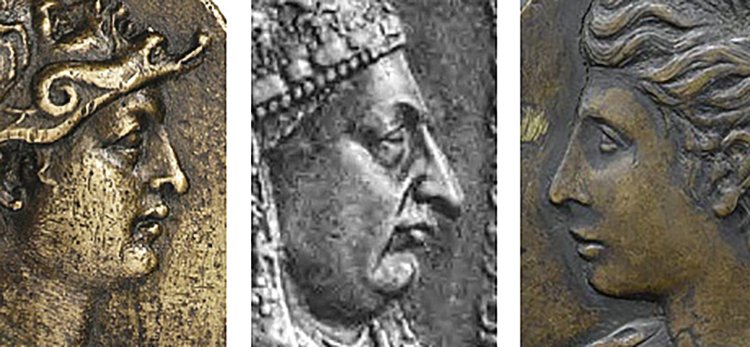
Fig. 33: Detail of a bronze plaquette of Minerva (left; Mario Scaglia collection); detail of a bronze plaquette after Giuliano di Scipio’s intaglio portrait of Paul II (center; Berlin Museums, inv. 5301); detail of a bronze plaquette Bust of Diana (right; Chateau d’Ecouen, inv. OA2433)
There are also general comparisons with the manner of inscriptions presented on the Julius Caesar, portrait of Paul II and Maenad intaglios, notably the same employ of Humanist script, already discussed, as well as an alike portrayal of stars and the use of centered dots as stops.
There are possible other works that fall into the category and manner as those ascribed here to Giuliano and are probably deserving of further study. These include a rare plaquette of the Goddess Roma;209 a plaquette of one of the Furies, known only by a single example at the Museo Nazionale del Bargello;210 a Head of a Satyr, of which at least one matrix example is known,211 as well as its feature on a binding from Urbino datable ca. 1486-88;212 a Bust of Alexander the Great as Jupiter Ammon;213 and a female bust sometimes identified as Cleopatra.214 Such a quantity of works suggests a prolific activity and one confidently tied to artists also working in bronze given the many various examples which survive, even if only known in very scarce quantities. There are more that could be added to this list, but are yet too questionable to entertain with any high degree of confidence.
The Martelli Mirror
There are, however, two final artworks the present author would like to ascribe to Giuliano. These involve works probably representative of his greatest maturity and are indicative of a talented master who has reached the zenith of his powers in working engraved gems. These involve a Bacchante and a Satyr known by the various bronze plaquettes that preserve their compositions (fig. 34) and more famously known for their collective portrayal on one of the most impressive bronze reliefs of the Renaissance: the Martelli Mirror (fig. 35).
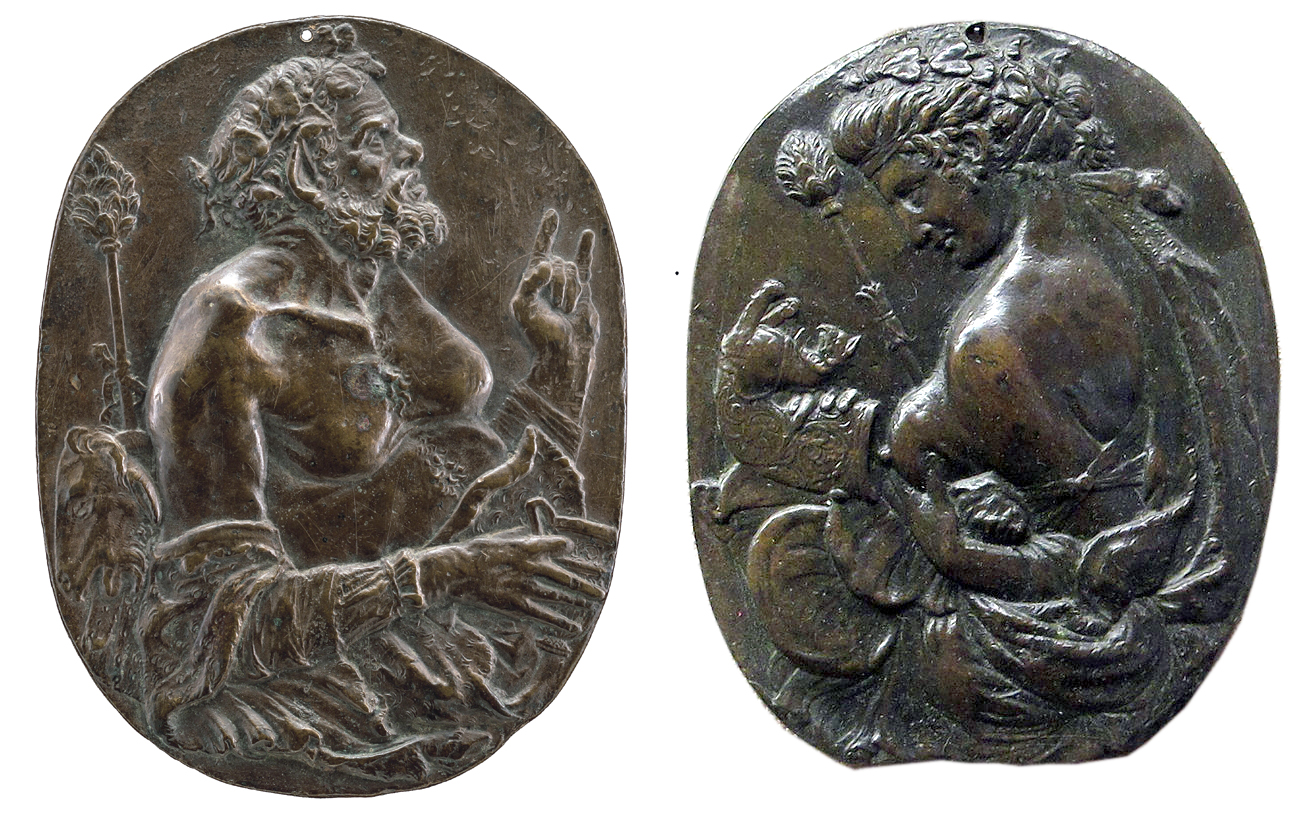
Fig. 34: Bronze plaquettes of a Satyr (left; National Gallery of Art, DC, inv. 1957.14.128) and a Bacchante (right; Museo Nazionale del Bargello, inv. 174B) after engraved glass or gem intaglios here attributed to Giuliano di Scipio, ca. 1480s
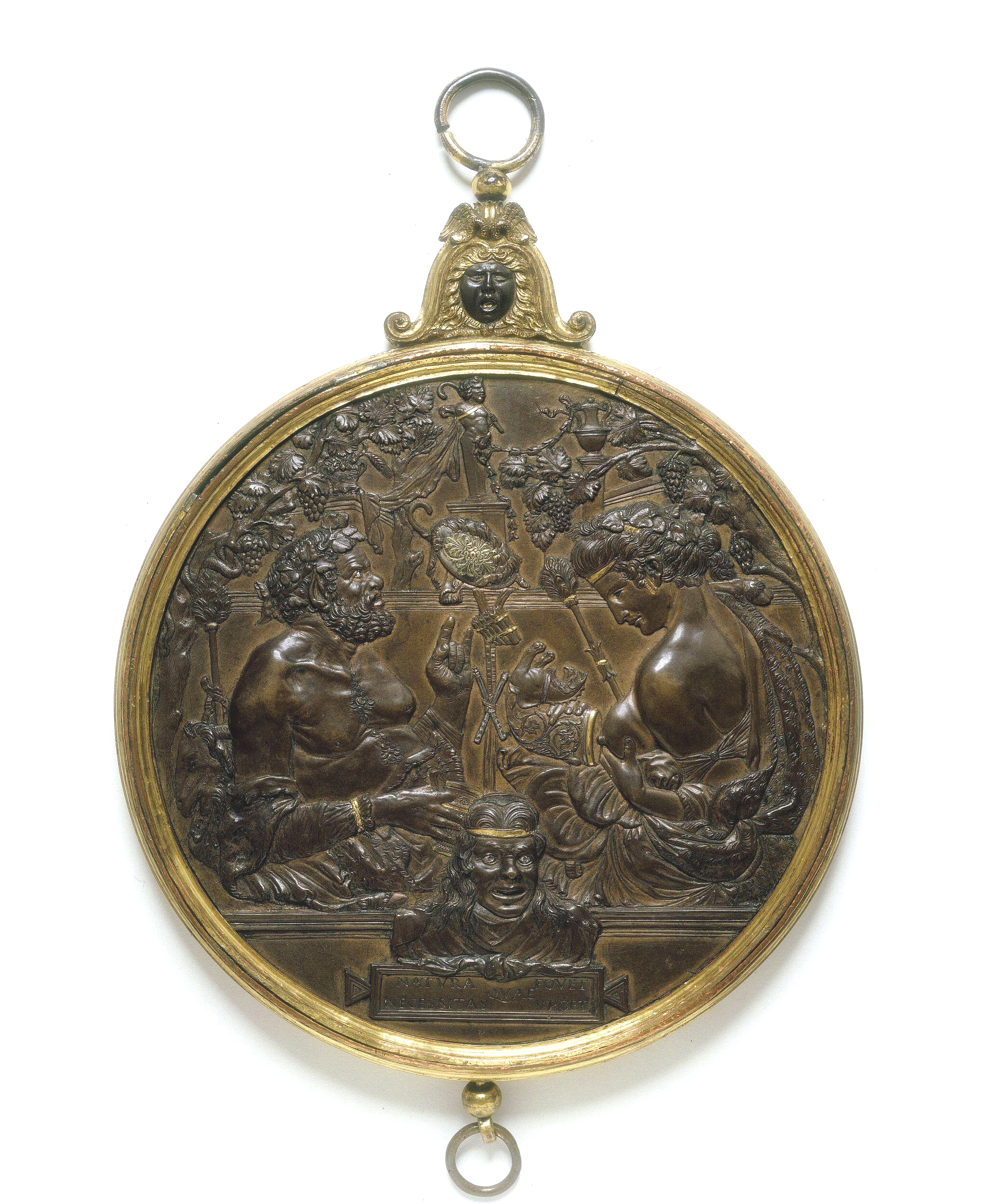
Fig. 35: Bronze and partially gilt silver and gold relief of an Allegory of Reproduction here suggested as a Mantuan production cast by Gian Marco Cavalli, 1489 (?) after earlier engraved glass or crystal intaglios of a Bacchante and Satyr here attributed to Giuliano di Scipio (Victoria & Albert Museum, inv. 8717.1863)
It is frequently accepted in plaquette literature that the individual plaquettes depicting the Bacchante and Satyr were ‘taken from’ the Martelli Mirror. However, this would have required those responsible for producing these plaquettes to have excised the main figures from their elaborate background, place them on newly prepared plain grounds, and have completed certain details like the tips of the Satyr’s fingers or the terminating curvature of the Bacchante’s gown. The more likely possibility is that the Bacchante and Satyr were originally individual works, assembled by the enterprising genius of another artist who brought them together in the newly inspired context of the Martelli Mirror.
This idea is also suggested as a possibility by Douglas Lewis in his unpublished survey on the subject.215 Lewis furthers this idea by noting that the independent plaquette compositions and their cropped margins are faithful to their much smaller glyptic prototypes, to be discussed. The present author observes additional details that suggest the Martelli Mirror was ‘built-around’ these two independent reliefs, noted by the central ribbon suspended from the edge of the wall behind the two figures, which makes a sudden left-leaning turn to accommodate the pre-made drapery of the Bacchante (fig. 36, left); and the previously noted semi-circular drapery of the Bacchante being interrupted by the feature of the bust along the lower register of the relief, as well as the tips of the Satyr’s extended fingers being cropped. The tree behind the Satyr’s thyrsus conveniently lowers-in-relief to allow the higher relief bulb of the thyrsus to be incorporated and a small band of ribbon is added beneath the Bacchante’s curving drapery (fig. 36, center). Additionally, the lower-left drapery of the Satyr does not fall horizontally along the edge of the exergue but unnaturally rises above it (fig. 36, right), indicating the background was invented around these pre-existing reliefs. The pair of reliefs have been framed by the linear moulding of the exergue and the cornice of the wall behind the two figures, defining their facing stature and fusing them together in a roundel made to feel visually natural through the various antiquated embellishments added to the composition. The ‘unconfident’ striated lines defining the cornice along wall the behind the two figures is challenged by the various interrupting components of the design, which suggests it may have been slightly widened as an afterthought when observing the final model or embellished through difficult chasing while cold working the finished bronze.

Fig. 36: Details of a bronze and partially gilt and silvered relief of an Allegory of Reproduction, called the Martelli Mirror (Victoria & Albert Museum, inv. 8717.1863)
Further suggestive of this ‘assembled’ composition is the stylistic inconsistency between the suave and masterful naturalism of the chief protagonists versus that of the three-quarters perspective bust featured along the lower register of the relief and the almost naive quality of the face of Priapus depicted on the ancient statue portrayed at the top.
There are two general variants of both the Bacchante and Satyr plaquette reliefs. While their relief compositions are alike in scale, one group of casts have a larger ground with margins approximately half-a-centimeter wider and lengthier than the more finely cast examples which have a slightly smaller ground. The larger and coarser cast examples of the Bacchante uniquely feature a plain rhyton and lack the ornamental foliate decoration observed on the Martelli Mirror and other casts of the plaquette (fig. 37). Such casts may indicate an earlier state of the Bacchante or more probably was edited on the wax or gesso model that served as the master for casting this variant. The evidently poor-quality master model employed for these casts probably insufficiently reproduced the ornate program on the rhyton, prompting the choice to excise that part of the original design.

Fig. 37: Bronze plaquette of a Bacchante, embellished, after an engraved glass or crystal intaglio here attributed to Giuliano di Scipio (Louvre, Paris, inv. OA7341)
There is an additional difference observed on the plaquette casts of the Bacchante which distinguish it from her feature on the Martelli Mirror. There is a slightly more prominent lower eyelid and a slight curvature of the brow line which is more natural on the plaquettes than the rather linear fold of the upper lid as featured on the Martelli Mirror. While it might be tempting to suggest that the subsequently finer casts of the Bacchante may have been taken from the mirror, this would appear incorrect, as the plaquette casts, although featuring the foliated texture of the rhyton, maintain the more natural eye of the Bacchante and do not reproduce the added band of ribbon featured beneath the contour of her robe as exhibited on the Martelli Mirror (fig. 36, center). It thus becomes evident that the plaquettes most likely were not ‘taken from’ the mirror’s composition, but rather, alternatively formed its basis.
While most examples of these plaquettes were probably cast in a Mantuan environment,216 near to that of the mirror, to be discussed, at least one pair of possible Roman casts exist with the uniquely integral feature of the della Rovere Papal arms on their reverse. This involves a cast of the Satyr in the British Museum and a cast of the Bacchante, formerly cited in literature as belonging to a private collection, but now at the Musée des Beaux-Arts in Angers.217 While the arms of the Pope on the reverse of these plaquettes is reproduced with great quality—perhaps taken from the impression of a papal ring—their obverse depictions of the Bacchante and Satyr are unusually crude and weak copies and very evidently bad aftercasts.218 Nonetheless, in literature, the feature of the papal arms on the reverse of these examples have long provided a terminus ante quem for the reliefs as well as for the Martelli Mirror, being dated sometime before 1471-1513, being those years of the pontificate of the della Rovere Popes Sixtus IV (Francesco della Rovere) and Julius II (Giuliano della Rovere), respectively.
Like the Head of Pan or Maenad earlier discussed, the present author suggests these two compositions may have originally been executed in intaglio on glass or rock crystal and smoothed to a modestly incuse surface. This idea was first posited by Emile Molinier while challenging their misunderstood early association with Donatello during the late 19th century.219 As late works by Giuliano they may have been made sometime during the 1480s.
It has often been noted that the Martelli Mirror’s inventor appears to have depended on an awareness of Lorenzo de Medici’s collection of gems despite the mirror having an unlikely origin in Florence.220 Laurie Fusco and Gino Corti have drawn interesting analogies between the mirror and the Tazza Farnese and have also suggested the artist may have been aware of Lorenzo’s antique statue of Priapus who features at the top of the mirror’s composition.221 However, Giuliano would have acquainted himself with the Tazza Farnese while belonging to Paul II’s collection.
Literature has often cited a now lost intaglio ‘Nymph Hippa’ in relation to the Bacchante which depicts a draped nymph squeezing her breast into a rhyton as reproduced in Antonio Francesco Gori’s 1731 publication of the Gemmae Antiquae (fig. 38, right). The ‘Nymph Hippa’ in Gori’s publication is frequently compared against a cameo of similar composition that was set into a gold ring belonging to Lorenzo de’ Medici’s collection described in his posthumous inventory as a ‘cameo mounted in a gold ring, on which is carved in relief a woman shown to her waist, with a cloth slung over her shoulder, and she squeezes her milk into a horn.’222 However, not well noted is that Lorenzo only owned this cameo for less than a year before his death, as it had formerly been in Rome, acquired by Lorenzo’s Roman banker and agent, Nofri Tornabuoni, who had procured it for Lorenzo in June of 1491.223 It cannot be said if such a work was antique or contemporary but it remains apparent that the iconography of the composition was known in Rome before 1491.
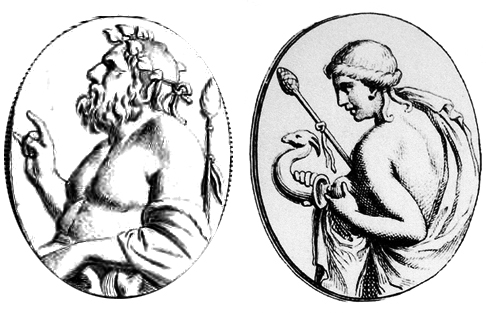
Fig. 38: Engravings of a Satyr intaglio (left) and Nymph Hippa intaglio (right) from Francesco Gori’s publication, Gemmae Antiquae, in 1731
While it is presumed Lorenzo’s cameo ring of this subject may have appeared like the intaglio portrayed in Gori’s publication, it has also been noted that there are characteristics which distinguish it from the Bacchante, namely that her hairstyle is entirely dissimilar and her classical drapery is exchanged for a goat’s pelt. The rhyton also terminates with a goat’s head rather than a griffin. However, as with other of Giuliano’s inventions, the Bacchante may be an amalgam of various antique prototypes with which he could have been familiar, and he in fact, executed one such similar work, not yet discussed, which he had given as a gift to Paul II sometime before 1471.224 That is, a ‘large cameo with the head of a woman and her breast,’ being one of the four gems Cardinal Francesco Gonzaga had reserved from Paul II’s estate along with the previously noted chalcedony Head of Alexander, a large cameo of a cloaked Faustina and an undiscussed ‘large and beautiful cameo of the Head of Tiberius.’225
Giuliano appears particularly fond of this large cameo of a ‘woman with her breast,’ as it is the first item he mentions when seeking to retrieve back from the Papal Treasury the four gems he had gifted to Paul II. Its large format would also suggest it is a precursor to his proposed invention of the Bacchante, probably borrowing the character of her facial profile, hairstyle, and arm sleeve whilst relying on a prototype source like the ‘Nymph Hippa’ cameo known in Rome for the manner of drapery and the added feature of a thyrsus and rhyton. Notably, a rhyton corresponding with that of the Bacchante is one of the few additional—probably antique—gems described by Giuliano in 1471 which he had sold to Paul II. It featured a rhyton specifically described as terminating in the form of a griffin’s head,226 and thus must be the reference used in his design of the Bacchante’s rhyton. The cameo was probably a Greek work of the 3rd-to-5th century.
The rhyton’s beautifully foliated decorative motif probably borrows from the influences of Gaspare da Padua and Bartolomeo Sanvito, and particularly those motifs found on a copy of Plutarch’s Triumphs executed around 1480-83 (fig. 39), commensurate with the period in which his designs of the Bacchante and Satyr may have been realized. This same manuscript also reproduces the earlier noted portrait of Alexander the Great, which we attribute to Giuliano, as previously discussed (fig. 22), and indicates that some manner of artistic exchange was occurring between Giuliano and these miniaturists during this period. We know certainly that Gaspare was being charged by Cardinal Francesco Gonzaga to request commissioned works from Giuliano around this time.227
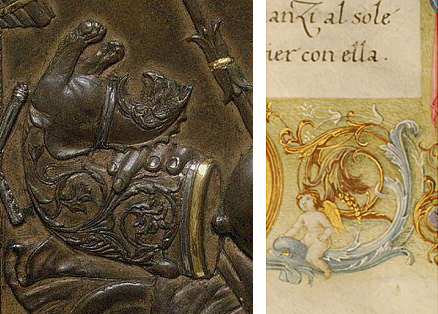
Fig. 39: Detail of the rhyton featured on the Martelli Mirror (left; Victoria & Albert Museum, inv. 8717.1863) and a detail from an illuminated sheet from Petrach’s Triumphs by Gaspare da Padua and Bartolomeo Sanvito, ca. 1480-83 (right; Walters Art Museum, inv. W755)
The elaborate and distinguished Hellenic hairstyle of the Bacchante also closely recalls that of the Diana composition and appears visually to be the work of the same artist (fig. 40).228 Just as we observe the previously discussed plaquette of Minerva and its enlarged variant reprised in the chalcedony of Alexander the Great, we may likewise consider the Martelli Mirror’s Bacchante as a reprisal of his ‘large cameo of a woman and her breast.’

Fig. 40: Plaster impression, reversed, of a Maenad with a Thyrsus, ca. 1900, reproduced from Adolf Furtwängler’s Die Antiken Gemmen after a carnelian intaglio (Mauritshuis, The Hague), here ascribed to Giuliano di Scipio (left); detail of the Bacchante from the Martelli Mirror, after a work here ascribed to Giuliano di Scipio (center; Victoria & Albert Museum, inv. 8717.1863); a bronze plaquette Bust of Diana after an engraved gem here ascribed to Giuliano di Scipio (right; Chateau d’Ecouen, inv. OA2433)
The Satyr generally follows an antique convex carnelian intaglio, lost, but also published by Gori (fig. 38, left).229 It relates to other antique sources like a bronze uncovered in Herculaneum and the fragment of an ancient Roman terracotta oil lamp at the Ashmolean.230
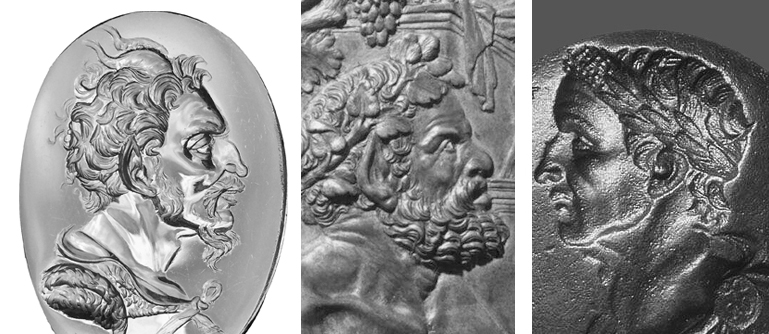
Fig. 41: Detail of a rock crystal intaglio of a Head of Pan, here attributed to Giuliano di Scipio, ca. 1480 (left; private collection); detail of the Satyr from the Martelli Mirror, after a work here ascribed to Giuliano di Scipio (center; Victoria & Albert Museum, inv. 8717.1863); detail of a bronze plaquette matrix of Julius Caesar after a carnelian intaglio here ascribed to Giuliano di Scipio (Museo Nazionale del Bargello, inv. 621B)
The Bacchante and Satyr stylistically compare with earlier discussed works here attributed to Giuliano. Foremost, the vivid naturalism of the subjects is apparent, observed in the facial physiognomy of the Satyr whose wrinkled forehead exists somewhere between that of the Julius Caesar’s and the Head of Pan (fig. 41). There is a similar meaty tenderness along the helix of the ear as well as a commensurate depth of the inner ear on the Satyr and Pan (fig. 42) as well the feature of raised cheekbones and the delicate articulation of teeth. The chest hair of the Satyr follows the same rhythmic pattern as the sideburns of Pan, although this has been somewhat exaggerated on the finished Martelli Mirror on account of the embellished chasing of the bronze.
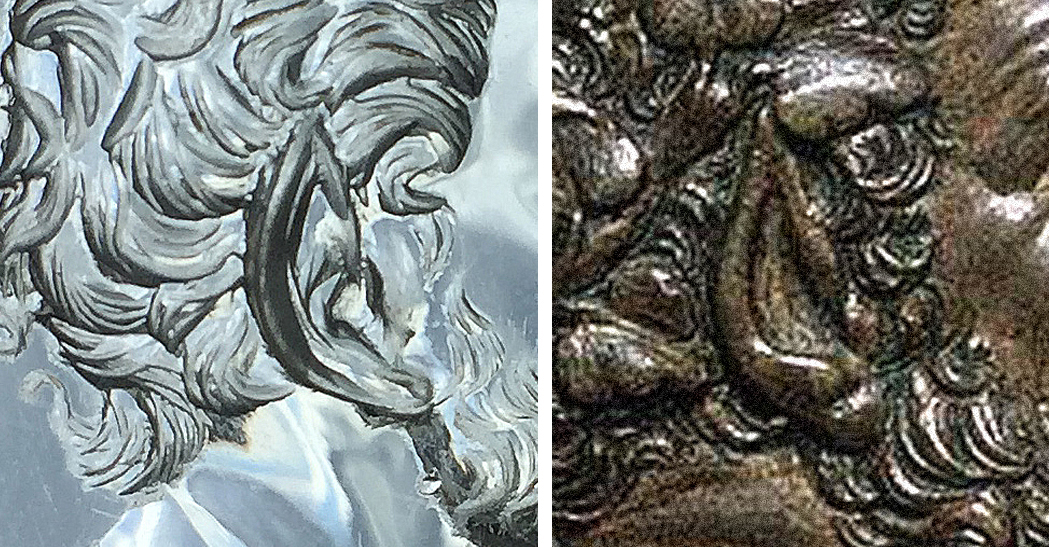
Fig. 42: Detail of a rock crystal intaglio of a Head of Pan, here attributed to Giuliano di Scipio, ca. 1480 (left; private collection); detail of the Satyr from the Martelli Mirror, after a work here ascribed to Giuliano di Scipio (right; Victoria & Albert Museum, inv. 8717.1863)
The classically inspired facial profile of the Bacchante almost precisely corresponds with the Maenad with a Thyrsus’ profile while the garland of vines in her hair precipitates that featured also on the Bacchante. Her bundled and elaborate hair is preceded in design also by that of the Diana whose overall character closely echoes the Bacchante (figs. 31, 40).
As noted most recently by Warren and Rossi, the Martelli Mirror’s relationship with a bronze tondo of Mars, Venus, Cupid, and Vulcan, attributed to Gian Marco Cavalli, ought to be considered.231 In particular, the Martelli Mirror would seem to have been cast in this Mantuan environment with its secular subject matter focused on love and fertility—particularly as concerns wedding ceremonies and gifts—which was a theme common to the Gonzaga court.232 The select fire gilt gold and applied silvering atop the surface of the bronze relief is especially tantamount to a Mantuan production as the Gonzaga and their artists were aware that authentic bronzes of the classical era were treated with the ancient damascening technique and therefore sought to reproduce this in their commissions, most evident in the work of Antico.233 These specific features associate the Martelli Mirror, if not confirm, its probable Mantuan origin.
However, one reason the Martelli Mirror has evaded any clear identification with a particular artist is because it is not the work of a single artist, but rather one or more collaborators of the Mantuan environment deploying what may have been compositions originating in Rome by an artist hereto brought forth from obscurity. However, it can only be conjectured as to what Mantuan artists may have been involved in preparing the relief.
Stylistically, the character of the Martelli Mirror has little to do with the output of Hermes Flavius di Bonis, although as George Francis Hill notes, he preferred incorporating leaves as ornament in his medals as well as the frequent use of moulded borders.234 His experimentation with a variety of differently sized medals also would appear related to the idea of a work as large as the Martelli Mirror although its more palpable cognates are found in the Herculean tondi of Antico.
In addition to his talents in bronze, Hermes was also an admired worker in gesso, as noted by his patron, Bishop Lodovico Gonzaga, who tasked him with the casting of various plaster copies of antiquities.235 If involved in any of the dissemination of Giuliano’s works in Rome, he would have certainly been qualified to produce examples in gesso or bronze, providing an avenue through which quality examples of the Bacchante and Satyr may have reached Mantua, although it is more likely the originals must have found their way to Mantua sometime after the death of Giuliano’ patron, Cardinal Francesco Gonzaga. We are unaware of what becomes of Giuliano after 1484 although his last contact with the Marquis Francesco II Gonzaga may have entailed a new era of patronage from the condottiero, unless otherwise entering the fold of the Cardinal’s brothers Bishop Ludovico, or Gianfrancesco Gonzaga di Bozzolo. Alternatively, Giuliano could have remained in Rome or have chosen to follow Gaspare da Padua to Naples. As his hand does not appear in any other aspect of the mirror, we are led to assume that at-the-time of its assembly he was outside of a Mantuan environment or had passed-away.
Hermes leaves Rome ca. 1479-81 to enter the service of Bishop Ludovico Gonzaga, sometime after the death of his uncle, Cristoforo Geremia in 1476. It is also during this time that his chief patron, Giovanni Alvise Toscani, withdraws from Humanistic book production and enters a stable clerical life, perhaps also prompting Hermes’ departure.236
It was during Hermes’ youthful activity in Rome, however, that a possible framework for the Martelli Mirror’s future conception may have had a stimulus. Of particular interest is a unique uniface medal by Hermes—apparently a self-portrait—which features the legend: DI LA IL BEL VISO . E QVI IL TVO SERVO MIRA, or ‘admire there your own beautiful face, and here your servant[‘s]’ (fig. 43). The blank verso of this medal suggests the original version was a mirror with the relief of Hermes’ self-portrait on the obverse, intended most likely as a gift for a friend or lover.237

Fig. 43: Bronze self-portrait ‘mirror medal’ of Hermes Flavio di Bonis, also called ‘Lysippus the Younger,’ ca. 1472-74 (British Museum, inv. 1887,0705.2)
This idea recalls not only the Roman mirrors of antiquity but also a contemporary interpretation of the antique that belongs to the same category as that of the Martelli Mirror. Only two other mirror-medal Renaissance plaquettes are known to survive: an example in speculum metal of Julius Ceasar, from the workshop of Filarete,238 and two examples of an octagonal relief of Tito Vespasiano Strozzi by Sperandio de’ Savelli, also of Mantua.239
Hermes’ self-portrait medal, made ca. 1473, foreshadows the Martelli Mirror, particularly as regards the subject of love, a theme frequently expressed in a quantity of Hermes’ other medals as well as in his poetry.240 These characteristics makes him a qualifier for an involvement in an object like the Martelli Mirror, even if only tangentially through the genesis of an idea that would later find full expression in the production of the Martelli Mirror.
I reiterate Claudia Kryza-Gersch’s comment that the intersection of “Cristoforo [Geremia], Lysippus [Hermes Flavius di Bonus], and Antico are too obvious to be ignored,”241 and to this mix we might add Giuliano who must have had an orbit within the space of these bronze workers.
While no documentary evidence has yet surfaced, it is believed the Mantuan, Pier Jacopo Alari, called Antico, trained in Rome under the auspices of a goldsmith and most probably Cristoforo Geremia.242 His tutelage may thus have occurred in tandem with the goldsmith’s nephew, Hermes, who was approximately the same age as Antico. It is surmised that Antico’s activity in this environment would lead to his later involvement in the restorations of the Dioscuri of Montecavallo sometime before 1496 and possibly as early as 1473 in coincidence with Pope Sixtus IV’s second campaign of restorations ordered in Rome that year.243 As with Hermes, we might place Antico in the same possible environs of plaquette casting where he could have learned the most elementary techniques of making bronzes. It is also suggested that he may have operated in the same circle of the Accademia Romana as Hermes did, possibly having inherited his epithet, ‘Antico,’ within this Roman environment.244
There are certain idiosyncrasies that Giuliano and Antico share, namely a strict adherence to the all’antica. Antico diverges from this only in his first portrait medal of Gianfrancesco Gonzaga in contemporary garb with his second medal of his patron featured donned in classicized all’antica attire.245 Giuliano only diverges from his faithful all’antica inventions when he produces the carnelian portrait of Paul II, and presumably the cameo he made of the same Pope.
We are aware Antico had an interest in gems and owned at least seven antique examples which were reproduced as wax seals on letters he sent in 1494, 1500, 1504 and 1505.246 We may also note the faithful level of detail in Giuliano’s mastery of gem engraving, to the point in which they were apparently considered legitimate works from the ancient world, much to the same aspirations Antico likely perceived for his bronzes. It could stand to reason that a figure like Antico may have been that missing link who serially continued the life of Giuliano’s creations in the medium of bronze plaquettes and dispersing their motifs to those in the circle and margins of the Accademia Romana, if not due to Hermes or Cristoforo Geremia. The initial focus of Antico’s career in the genre of creating low-relief portrait profiles for medals may have drawn him into Giuliano’s sphere as well as Antico’s particularly accomplished letterforms realized at the outset of his first medals, indicating he had a strong understanding of inscriptions and an awareness of the classically-inspired script prized by Roman Humanists.
It stands to reason Antico may have had some involvement in the production of the Martelli Mirror, as it has, on occasion been attributed to him or his circle.247 If considering our proposed dating of the mirror to 1489, to be discussed, such a work would have followed not long after his completion of the bronze Gonzaga Urn, made ca. 1487. There are only a few minor analogies to be drawn against this work regarding the mirror, chiefly the anatomical character of the torso on the statue of Priapus along the top of the composition or the comparatively densely packed trophies along the rim of the urn’s lid which may loosely relate to the densely packed contextual environs of the mirror’s scene.

Fig. 44: Bronze and partially gilt tondo of Hercules and the Lernaean Hydra by Pier Jacopo Alari Bonacolsi, called Antico (Museo Nazionale del Bargello, inv. 784B)
The mirror has more in-common with Antico’s later tondi, namely that of Hercules and the Lernaean Hydra, ca. 1496 (fig. 44), with the treatment and style of the tree with its broken branches and characteristic drapery as well as the modeling of the serpents, who compare, albeit, in much diminutive scale with that wrapped around the tree on the left of the mirror’s composition. That Antico’s trees follow along the outer perimeter of his compositions in a curved manner appears related to the ideas presented in the Martelli Mirror program, although at this later date in Antico’s production he is employing a masterful use of negative space and rarely ever exceeds the margins of his work unlike the mirror’s composition which has no concern in breaking the perimeters of its outer edge with foliage. The only notable characteristic that may significantly relate to Antico would be the minor adjustment made to the eye of the Bacchante which is explicitly different in the plaquettes which reproduce the original intaglio. The hard linear modification to the Bacchante’s brow line follows numerous of Antico’s inventions in the clean classicized manner (fig. 45). Nonetheless, any connection with Antico’s hand on the Martelli Mirror would seem superficial although not improbable.

Fig. 45: Detail of the Bacchante from the Martelli Mirror, after a work here ascribed to Giuliano di Scipio (left; Victoria & Albert Museum, inv. 8717.1863); detail of a bronze, partial gilt and silvered bust of Ariadne, ca. 1520-24 by Antico (Kunsthistorisches, Kunstkammer 5987)
However, the characteristics of the coldwork on the Martelli Mirror recall the details of the Mars, Venus, Cupid, and Vulcan roundel (fig. 46), notably—albeit superficially—the circular punch used to delineate the nipples on the Satyr (fig. 47), the attractively chased letterforms of the inscription, the corrugated texture of the ribbons, the similar chased treatment of nailbeds on the hands and feet of the protagonists and the characteristic silvering of the eyes with further spot gilding and silvering atop the relief’s other characteristic features.
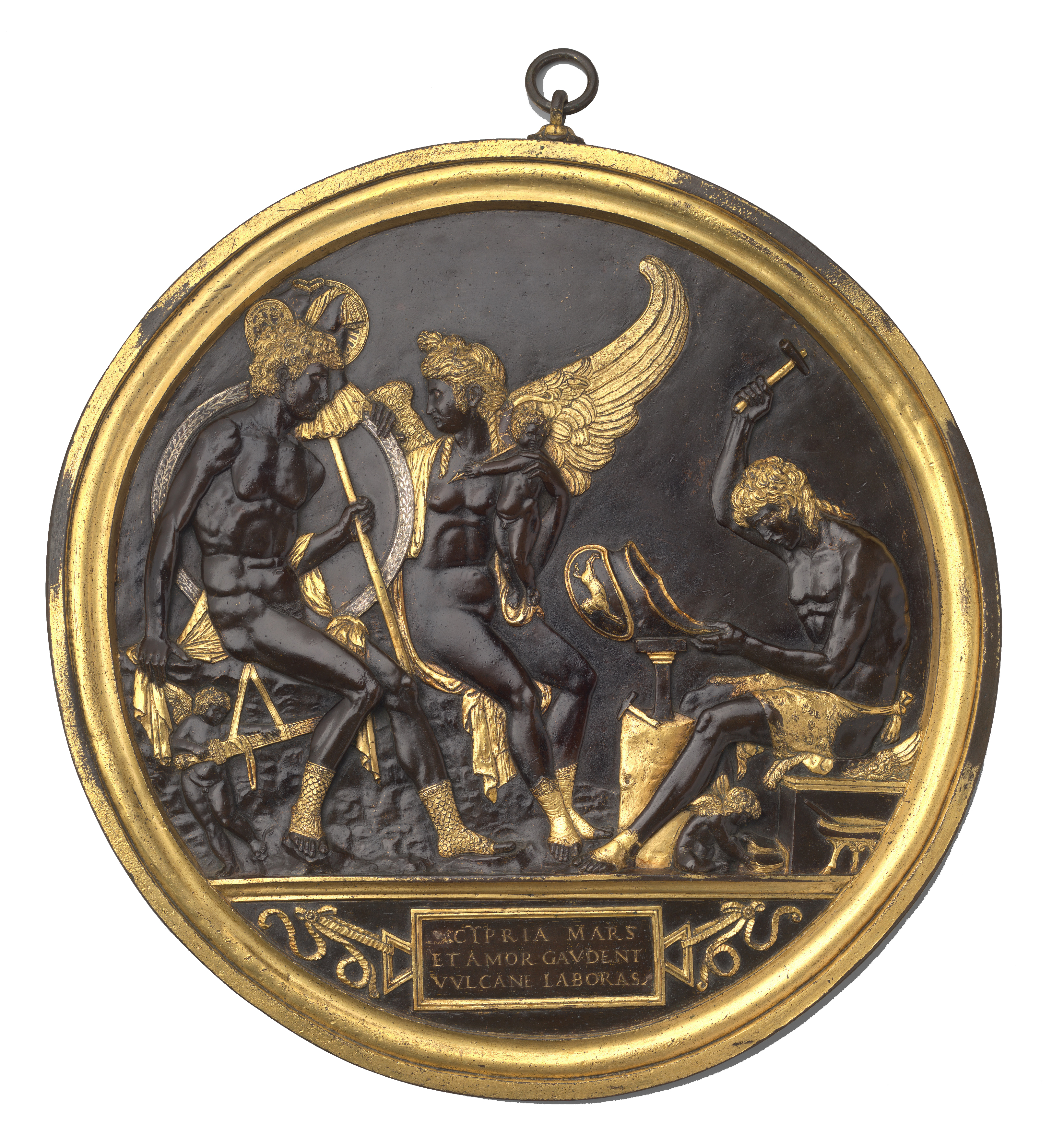
Fig. 46: Bronze tondo relief, partially gilt and silvered, of Mars, Venus and Cupid with Vulcan at his forge, attributed to Gian Marco Cavalli, ca. 1500 (Metropolitan Museum of Art, inv. 2022.6)

Fig. 47: Detail of the Satyr from the Martelli Mirror, after a work here ascribed to Giuliano di Scipio (left; Victoria & Albert Museum, inv. 8717.1863); detail of Vulcan from a bronze tondo of Mars, Venus and Cupid with Vulcan at his forge, attributed to Gian Marco Cavalli, ca. 1500 (right; Metropolitan Museum of Art, inv. 2022.6)
Considering the probability of a Mantuan origin, there is a reasonable likelihood the mirror was cast and finished by Gian Marco Cavalli, particularly if made in 1489, as will be suggested. It is believed Cavalli was instrumental in casting the early works of Antico during this period,248 and he actively served various members of the Gonzaga family during his career. In the closing line of an article dedicated to Cavalli, Guido Rebbechini noted: “one wonders whether he may be the author of the Martelli Mirror,”249 and it is with great probability, in the present author’s opinion, that Cavalli would have been, at minimum, the ‘fondatore’ responsible for casting and finishing it.250

Fig. 48: Bronze, partially gilt and silvered Entombment attributed to Gian Marco Cavalli, ca. 1480 (Kunsthistorisches, Kunstkammer 6059)
However, there are further points that reinforce Rebbechini’s instinct. For example, it is certain Cavalli knew the Satyr composition as he borrows it for the feature of the sagging pectorals on the reclining Christ in his grandiose Entombment relief (fig. 48).251 However, he does not simply use the Satyr composition as a point-of-reference, but rather, takes an impression of it for use on the composition itself, as the feature of the pectorals of his Christ match exactly to scale-and-depth that of the Satyr’s (fig. 49). Interestingly, to make his impression, Cavalli sets the base of the Satyr relief just above the horizontal plane of the sarcophagus just as it was similarly placed atop the horizontal plane of the cornice moulding on the exergue of the Martelli Mirror during its preparation (fig. 50). This practice is not unusual for a goldsmith’s workshop which would keep a variety of templated models in their studio to produce various works. Additionally, Cavalli’s experience in translating Mantegna’s prints into engravings on copperplates252 is not far-removed from the idea of using references and models in the production of a low relief graphically-inspired creation. This could especially be the case for a younger artist—as Cavalli was during this time—in the tasked production of sculpture when their greater strengths were more graphically inclined in engraved and chased metalwork. This use of the Satyr informs us that Cavalli had access to a quality example of it—either the original intaglio or a faithful plaster cast—and by circumstance, probably also the Bacchante, both of which would come together to subsequently form the basis of the Martelli Mirror. His use of the Satyr as a model for his Entombment relief may precipitate its later feature on the mirror, or possibly vice versa.

Fig. 49: Detail of a bronze Entombment attributed to Gian Marco Cavalli, ca. 1480 (left; Kunsthistorisches, Kunstkammer 6059); detail of the Satyr from the Martelli Mirror, after a work here ascribed to Giuliano di Scipio (center; Victoria & Albert Museum, inv. 8717.1863); a bronze plaquette of a Satyr superimposed atop Cavalli’s Entombment relief (right)

Fig. 50: Bronze plaquettes of a Satyr and Bacchante superimposed atop the Martelli Mirror (Victoria & Albert Museum, inv. 8717.1863)
The reprisal of various forms and facial profiles within Cavalli’s attributed oeuvre is amply discussed by Matteo Ceriana253 and Donald Johnston.254 However, that Cavalli may have taken a tertiary interest in plaquette production could be suggested by the known casts of these reliefs, probably of Mantuan origin, but also the presence of another plaquette which takes its cue from Giuliano’s Satyr but stylistically has more in common with the profiled silhouettes of his Entombment (fig. 48). This involves a small plaquette thought to depict Poseidon or Neptune (fig. 51, center). The portrait derives from the reverse of an antique coin of Antigonos Gonatas, king of Macedonia and its numismatic inspiration is further affirmed in a unique two-sided example of the plaquette in the Bardini Museum which features a Greek inscription inspired by other tetradrachms of that same king.255 The stylized treatment of chest hair on both Neptune and the Satyr as well as the treatment of the fleshy contours around their collarbone are coeval as is their similar height in-relief from the ground. Neptune also wears the headband typical of the Hellenistic-inspired motifs observed in the relief of the Bacchante. Unique to Cavalli, however, is the modest exposure of the forehead covered by tousled hair, long jaw line, exaggerated fleshy brow line and the way the wrinkles of the forehead are rendered by one or more dense striations rather than modeled as observed on Giuliano’s productions. It is to be wondered if this effigy of Neptune, possibly by Cavalli, might derive from a larger production related to four silver tondi of ‘the planets’ Bishop Ludovico Gonzaga commissioned from Cavalli in 1501.256 It is evident from the known works which survive of Cavalli’s that he renders his characters almost exclusively in-profile, which could be suggestive of an interest in antique coins and indicative of his latter career in service to the Mantuan mint between 1499-1501.257 A natural corollary to this could also relate to a theoretical earlier interest in producing plaquettes, of which the Neptune could be one such example.

Fig. 51: Bronze plaquette of a Satyr after an engraved glass or crystal intaglio here ascribed to Giuliano di Scipio (left; Museo Correr, Venice); bronze plaquette of Neptune, possibly by Gian Marco Cavalli, ca. 1490-1510 (?) (center; Museo Nazionale del Bargello, inv. 154B); detail of a bronze Entombment attributed to Gian Marco Cavalli, ca. 1480 (right; Kunsthistorisches, Kunstkammer 6059)
Further encouraging a connection with Cavalli is his intimate familiarity with Mantegna’s designs, one or more of which he had been tasked to render into engraved plates for the production of prints for Mantegna, beginning from 1475.258 If responsible for engraving the finest of Mantegna’s prints, he would have been involved in executing Mantegna’s Battle of the Sea Gods, ca. 1485-88 (fig. 52). He appears to have been acquainted with its design considering his friendship with Mantegna,259 as well as the print’s apparent influence on the Mars, Venus, Cupid, and Vulcan roundel.260 In the period in which we propose the mirror was conceived: 1489; Cavalli and Mantegna may have executed an important crucifix for the Cathedral of Mantua made in that year, presumably a collaboration of both artists.261

Fig. 52: Engraved print of the Battle of the Sea Gods by Andrea Mantegna, ca. 1485-88 (Metropolitan Museum of Art, inv. 18.12)
Stephen Campbell is apt to note the Martelli Mirror’s iconography emphasizing Virgilian narratives imbued with love and its cues borrowed from Mantegna’s aforenoted double-print of the Sea Gods. That the print and these subjects were possibly fresh on the mind of Cavalli are ably expressed in the mirror’s subject and allegorical concept. Of further note is J. Russell Sale’s observation that it is not a Medusa featured in the lower register of the Martelli Mirror—as is occasionally suggested—but rather a portrait of Invidia, or envy, whose countenance closely reflects Mantegna’s representation of Invidia in this same print, inclusive of her tousled hair and fillet head band (fig. 53).262 Perhaps it is not uncanny that in Mantegna’s print she also happens to look across the scene into a mirror (fig. 54). The incorporation of a freehand image, not borrowed from antiquity—as concerns other aspects of the Martelli Mirror’s relief—exemplifies the characteristic influence Mantegna had on the artistic production occurring in Mantua during this time. In consideration of the aforenoted familiarity Cavalli would have had of this design, as well as a probable insight into its subtle quips and overt meanings, it could be surmised that he may have been the one responsible for the mirror’s realization, as suggested by Rebbechini.

Fig. 53: Detail of Invidia from an engraved print of the Battle of the Sea Gods by Andrea Mantegna, ca. 1485-88 (left; Metropolitan Museum of Art, inv. 18.12); detail of Invidia from the lower exergue of the Martelli Mirror (right; Victoria & Albert Museum, inv. 8717.1863)
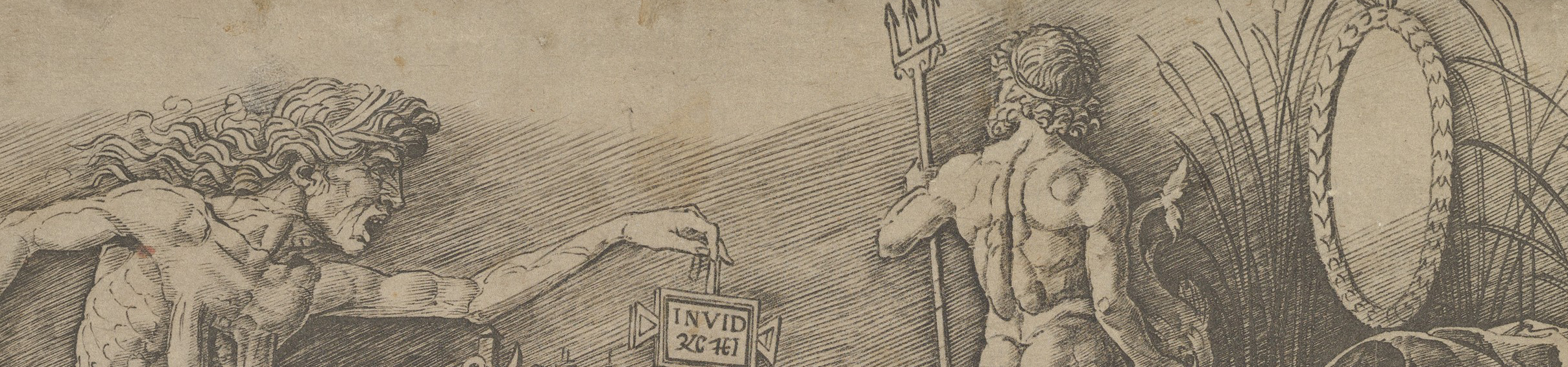
Fig. 54: Detail of Invidia looking into a mirror from an engraved print of the Battle of the Sea Gods by Andrea Mantegna, ca. 1485-88 (left; Metropolitan Museum of Art, inv. 18.12)
However, our understanding of Cavalli’s artistic output in the form of relief sculpture is still being understood and there is very little material with which to compare. Nonetheless a few modest observations can be noted which might encourage Cavalli’s possible hand in the realization of the somewhat melodramatic portrait of Invidia. Its immediate attempt at translating Mantegna’s graphic style into relief sculpture is foremost apparent, as is the way the portrait of Invidia is ‘pasted’ atop the composition recalling the variously stacked figural relief forms of his Entombment which are similarly applied and stacked in a somewhat ‘cut-and-paste’ manner. There is the pinched brow of Invidia whose wrinkles and crow’s feet are ‘engraved’ into the model and superficially recall the cold work on the figure of Vulcan on Cavalli’s roundel (fig. 55). The chunky strands of Invidia’s hair also recall those featured on Vulcan but Cavalli seems rather adept in his varied and talented portrayals of hairstyles. Lastly, there is the superficial comparison of the drapery which somewhat recalls that featured on Cavalli’s roundel although such forms feature more prominent in Antico’s productions. The tabula ansata is also an obvious corollary between the reliefs although the borders of their frames is modeled differently. While Cavalli’s hand in the sculptural program of the Martelli Mirror cannot be easily judged, he almost certainly was involved in casting and finishing it. His awareness of Giuliano’s Satyr, however, informs that the model was accessible to him in Mantua and could have been employed by him, along with the Bacchante, as the primary compositional scheme for the mirror’s inception.
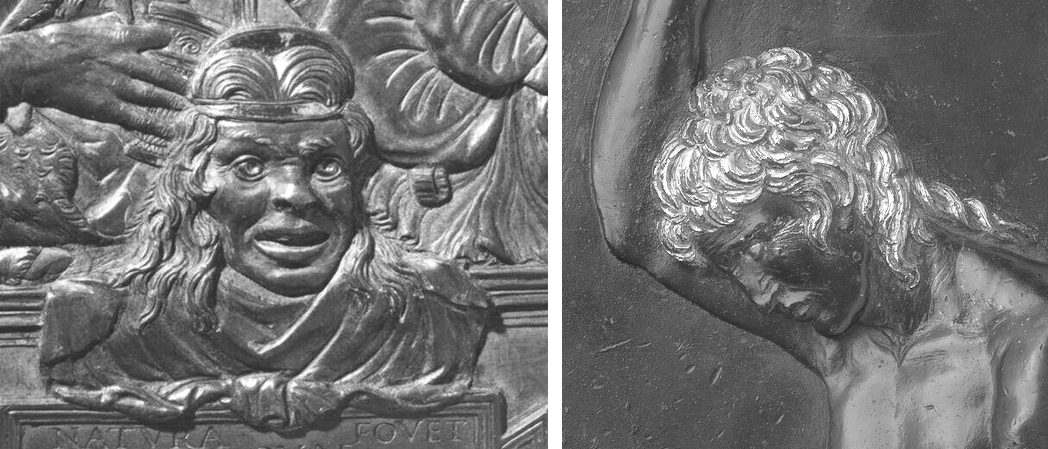
Fig. 55: detail of Invidia from the lower exergue of the Martelli Mirror (left; Victoria & Albert Museum, inv. 8717.1863) ; detail of Vulcan from a bronze tondo of Mars, Venus and Cupid with Vulcan at his forge, attributed to Gian Marco Cavalli, ca. 1500 (Metropolitan Museum of Art, inv. 2022.6)
While no record concerning a commission or presence of the mirror is yet identified in any documents or inventories, it is accepted that the mirror was most likely a wedding gift on account of its thematic iconography and inscription: NATVRA FOVET QUAE NECESSITAS VRGET or ‘nature encourages what necessity demands,’263 suggestive of love and procreation in an exemplary Gonzaga-Mantuan inspired language.
The present author proposes the mirror may have been a gift for Maddalena Gonzaga on occasion of her wedding to Giovanni Sforza on 18 October 1489. Maddalena was the third daughter of the former Marquis of Mantua, Federico I Gonzaga, who we know was a patron of Gian Marco Cavalli in the early 1480s264 during the same time his brother, Cardinal Francesco Gonzaga, was a patron of Giuliano’s.
We may also note here the Mantuan goldsmith, Bartolomeo Melioli, whose autograph oeuvre includes a portrait medal he made of Maddalena (fig. 56) as well as her older brother, the subsequent Marquis of Mantua, Francesco II Gonzaga. An additional medal of Maddalena is attributed to Melioli as well as one portraying her older sister, Chiara.265
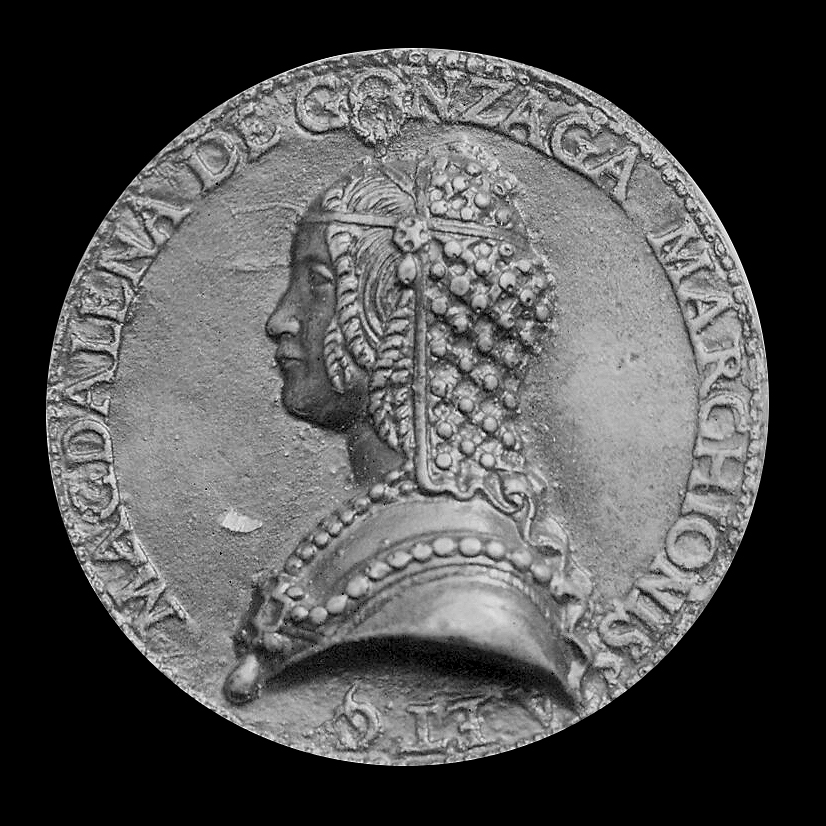
Fig. 56: Bronze portrait medal of Maddalena Gonzaga by Bartolomeo Melioli, before 1498 (Metropolitan Museum of Art, inv. 25.142.50)
Melioli’s involvement should also not be ruled out as a potential contributor to the Martelli Mirror, however, there are similar stylistic problems while attempting to associate the mirror’s features with Melioli’s medals, although some generic details like the outcropping of a wheat stalk bursting from an urn in the upper left of the mirror generally compares with the same modeled stalks on his verso for a medal of Francesco II Gonzaga, depicting an Allegory of Prudence standing between water and fire.266 The cartouche featured in the center of the Martelli Mirror appears to derive from a goldsmith’s stamp, several of which are integrally reproduced on the reverse of a unique example of Melioli’s portrait medal of Chiara Gonzaga at the National Gallery of Art in DC (fig. 57).267 The use of this goldsmiths technique is apparent in other details of the mirror, notably the stamped pattern work on the side of the urn in the upper left ledge in the relief, previously noted.

Fig. 57: Detail of the reverse of a bronze portrait medal of Chiara Gonzaga attributed to Bartolomeo Melioli, aft. 1496 (left; National Gallery of Art, DC, inv. 1957.14.662.b); detail of the silvered and gilt central cartouche from the Martelli Mirror (right; Victoria & Albert Museum, inv. 8717.1863)
Maddalena Gonzaga’s wedding took place in Pesaro approximately eight months after her older sister, Elisabetta Gonzaga, was wed to the Duke of Urbino, Guidobaldo da Montefeltro, in Mantua on 11 February 1489. With the sisters’ parents deceased, Maddalena’s and Elisabetta’s marriages were arranged by their older brother, the Marquis Francesco II Gonzaga, with Maddalena’s future Sforza husband secured as early as August of 1486.268
While it can only be speculated who may have given Maddalena such a hypothetical gift as the Martelli Mirror, it can be surmised it would have certainly been of Mantuan origin, and quite probably either their brother, the Marquis Francesco II Gonzaga, who had arranged the marriage, or one of her cultured uncles: Gianfrancesco Gonzaga di Bozzolo or Bishop Ludovico Gonzaga. During this time Antico was in service to the former and Hermes Flavius di Bonis was in service to the latter, chiefly acting as an architect.
Giuliano’s invention of the Bacchante and Satyr could have reached any three of these patrons. We observe for example, the last known document concerning Giuliano involved his petition of the Marquis, in 1484, to receive payment on outstanding debts owed to him for work and objects he had provided to Cardinal Francesco Gonzaga. It could be posited that Giuliano, after having served the cardinal for at least more than a decade, may have pursued a continued Gonzagan patronage under the Marquis. Giuliano’s works may have also found their way to Bishop Ludovico, if not through means of his former cardinal patron, then probably by way of Hermes who must have operated close to Giuliano’s orbit. As for Gianfrancesco, we may note his closeness to the cardinal which may have prompted an awareness of Giuliano’s work, even more so probably when Gianfrancesco occasionally visited Rome while serving as a military captain for the Apostolic Chamber during the 1470s. Gianfrancesco had one of the largest collection of coins in Italy,269 and this also may have put Giuliano into Gianfrancesco’s orbit, not only as a potential dealer of coins but also due to a shared interest in the subject. It should be noted as well that during the complex movements and petitions for items from Cardinal Francesco’s collection of gems following his death, these objects did not go to Bishop Ludovico, but rather, to Gianfrancesco, as noted in a letter Ludovico sent to his niece, Chiara, on 21 January 1485.270 In 1484 Gianfrancesco took the reins on managing a portion of the Cardinals estate, also purchasing certain items from it for himself, presumably inclusive of some of the 200 or more gems the cardinal owned, albeit, a majority of these also went to settle outstanding debts.271
The marriage of Maddalena Gonzaga and Giovanni Sforza strategically linked these dynastic families in a mutually beneficial alliance. If Maddalena was indeed the recipient of the Martelli Mirror, its symbolic program edifying fertility appears to have done its work, as Maddelena became pregnant only two months after the ceremony. However, its amulet-like devices intended to stave off evil forces was not as successful, as Maddalena tragically died on 8 August 1490 due to complications with her pregnancy.272 She was only 18.
We may wonder if little exists concerning our knowledge of the Martelli Mirror could be due to not only the Gonzaga’s preferences for maintaining tight control over their commissions but also because its recipient passed away at such a young age while her husband went on to remarry in February 1492 in a contracted marriage to Lucrezia Borgia. Informing of this possible context is the unusual discovery of a cryptic document hidden inside of the mirror (fig. 58) which corresponds to similar documents preserved in the secret archives of Milan made during the tenure of the city’s duke, Ludovico Maria Sforza.273

Fig. 58: Secret Milanese diplomatic document from the court of Ludovico Maria Sforza hidden inside of the the Martelli Mirror (left; Victoria & Albert Museum, inv. 8717.1863)
The contents of the diplomatic document found inside of the mirror discuss troop movements in the Lombard region,274 the kind of data relevant to clandestine communications and not a random sheet of paper employed by an artist in the making of a precious object. The presence of this document, hidden within the mirror, led subsequent scholars to assume a possible Milanese origin for the mirror, attributing it to Milan’s most famed goldsmith: Caradosso Foppa. However, as Warren has pointed out, there is no stylistic evidence to suggest an association with Caradosso275 and the present author proposes the document should alternatively be recognized for what it is: a secret communication.
Nonetheless, an adequate explanation for this document’s presence within the mirror may have more to do with its possible receipt by Giovanni Sforza who would have inherited it following Maddalena’s untimely death. It remains entirely possible Giovanni may have kept the mirror through his entire lifetime as we know he still had a painted portrait of Maddalena by Andrea Mantegna, now lost, which he had kept in his library up until his death.276
Giovanni Sforza’s subsequent marriage to Lucrezia Borgia was also political in nature, as the Borgia family saw value in Giovanni’s connections with Milan and under the influence of his relative, Cardinal Ascanio Sforza, Giovanni moved forward with the prescribed marriage to Lucrezia.277 Disadvantageous to the Borgia, however, Giovanni opted instead to serve his greater family and to operate as a spy on behalf of his uncle, the aforenoted duke, Ludovico Maria Sforza. Giovanni’s deception was subsequently discovered by Pope Alexander VI, later leading to an eventual annulment of the marriage. It could be surmised that the mirror served as a temporary hiding place for messages Giovanni received from Milan during this time and that a mirror would have been a suitable object within which to hide communications being something that would have been kept in a generally private environment.
A summary of Giuliano’s work
If accepting that Maffeo Vallaresso may have received from Paul II various plaquettes during his stay in Rome in 1468—which almost thirty years later would appear on the shrine of St. Simeon in Zadar—it could be presumed works like the Bust of a Classical Youth, Diana, Minerva, possibly along with a pendant Julius Caesar (perhaps based upon Paul II’s antique carnelian of the subject and serving as a precursor to the Divine Julius Caesar), are earlier works whilst his most famous Divine Julius Caesar would have been realized probably ca. 1466-67. Between 1467-71 he may have completed the chalcedony of Alexander the Great, enlarged, and based upon his earlier Minerva composition as well as his carnelian portrait bust of Paul II. During the 1480s we would see other works realized like the Head of Pan and two Maenads. His most mature work, probably after 1484, would be found in the Bacchante and Satyr.
In Giuliano’s creations we observe an artist focused through the lens of his own inventive and idealized vision of the classical world, set before an audience of influential collectors and academicians who continued his legacy in much the same way as their own literary, philosophical, and poetic ambitions…preserved for subsequent generations to take-up, admire and endure. Giuliano’s creations are at the precipice of the discovery of Rome’s ancient past and new beginnings, summarizing a picture of the Renaissance we so wonderfully admire today.
Endnotes:
[1] Giada Damen (2000): Antique Engraved Gems and Renaissance Collectors in Heilbrunn Timeline of Art History. The Metropolitan Museum of Art, NY.
[2] Antonio di Piero Averlino (1465; 1965 trans. J.H. Spencer): Trattato di Architettura / Filarete’s Treatise on Architecture, Being the Treatise by Antonio di Piero Averlino, Known as FIlarete. 2 vols, London, vol. 1, p. 317.
[3] Paul II’s desire for the cameo was so inflated that he offered an enormous sum for it as well as privileges for the basilica and the construction of a bridge for the city. Robert Weiss (1969): The Renaissance Discovery of Classical Antiquity. Oxford, pp. 187-88.
[4] The original 1st century carnelian intaglio is today preserved at the Museo Archeologico Nazionale di Napoli, inv. 26086.
[5] Laurie Fusco and Gino Corti (2006): Lorenzo de’ Medici: Collector and Antiquarian. Cambridge University Press p. 195, doc. 28.
[6] Ibid., p. 195, docs. 159 and 161.
[7] Ibid., pp. 195-96, doc. 63, fig. 133.
[8] Marika Leino (2013): Fashion, Devotion and Contemplation. The Status and Functions of Italian Renaissance Plaquettes. Peter Lang, Bern, Switzerland, pp. 20-21.
[9] Pietro Cannata (1982): Rilievi e placchette del XV al XVIII secolo, Roma. Museo di Palazzo Venezia, Roma, pp. 13, 16–17. See also Christoph Luitpold Frommel (1984): Francesco del Borgo: Architekt Pius’ II. und Pauls II., T. 2, Palazzo Venezia, Palazzetto Venezia und San Marco in Römisches Jahrbuch für Kunstgeschichte, 21, pp. 71–164.
[10] As noted by George Francis Hill, a particularly fine example of the medal at the British Museum shows how the original medal’s armorial verso was ‘replaced’ by a new verso. George Francis Hill (1930): A corpus of Italian medals of the Renaissance before Cellini, 2 vols., vol. 1, p. 191, nos. 737-38.
[11] Paul II likewise buried slightly different portait medals in the foundation of his other construction projects in Todi, Cascia, and Terracina between 1465–1466. See Hill, Ibid. For a discussion on the Renaissance practice of burying medals in foundations see Minou Schraven (2009): Out of sight, yet still in place. On the use of Italian Renaissance portrait medals as building deposits in Res: Anthropology and Aesthetics, vol. 55-56, pp. 182-93 and Luca Cappuccini and Benedetta Ficcadenti (2011): Monte Giovi. Saggio C in Notiziario della Soprintendenza per i beni archeologici della Toscana, vol. 7, pp. 222, 225. We may also note Paul II’s doctor, Jacopo Gottifredo, followed Paul II’s inspiration and commissioned a medal of himself that was buried in the foundation of the home he built for himself. See Hill, Ibid., p. 199, no. 761.
[12] Antonino Bertolotti (1889): Le arti minori alla corte di Mantova nei secoli XV, XVI e XVII: ricerche storiche negli archivi mantovani. Milano, p. 270.
[13] G. F. Hill (1930): op. cit. (note 10), nos. 759-73.
[14] P. Cannata (1982): op. cit. (note 5), pp. 16-17, nos. 2-4.
[15] Roberto Weiss (1958): Un umanista Veneziano: Papa Paolo II in Istituto per la Collaborazione Culturale. Venice, p. 54. See also P. Cannata (1982): op. cit. (note 5), p. 36.
[16] Luke Syson and Dora Thornton (2001): Objects of Virtue – Art in Renaissance Italy. London, p. 108.
[17] Eleonora Luciano (2011): Antico: Pier Jacopo Alari Bonacolsi (c. 1455-1528) in Antico: The Golden Age of Renaissance Bronzes. National Gallery of Art, DC, pp. 1-14.
[18] G. F. Hill (1930): op. cit. (note 10), no. 739.
[19] Francesco Caglioti and Davide Gasparotto (1997): Lorenzo Ghiberti, il ‘Sigillo di Nerone’ e le origini della placchetta ‘antiquaria’ in Prospettiva, no. 85, pp. 2-38.
[20] We may note how Cristoforo de Geremia sent antiquities to Ludovico III Gonzaga, as referenced in a letter of 6 April 1462. Umberto Rossi (1888a): Cristoforo di Geremia in Archivio storico dell’arte, vol. 1, pp. 404-10.
[21] Museo Archeologico Nazionale di Napoli, inv. 26051. The ownership of the gem in Trevisan’s collection is noted contemporaneously by Filarete: “…come la corniuola del Patriarcha, che c’è tre figure degnissime quanto sia possibile a fare: uno ignudo leghato, colle mani di rieto, a uno arbore seccho, et uno con uno certo strumento in mano con uno poco di panno dal mezzo in giù, et uno inginocchioni,” in Antonio Averlino detto Il Filarete (ca. 1464; trans. 1974 by Anna Maria Finoli, Liliana Grassi): trattato di architettura, p. 679.
[22] For an explanation as to why the Apollo, Marsyas and Olympus carnelian was believed to be the ‘Seal of Nero,’ see F. Caglioti and D. Gasparotto (1997): op. cit. (note 19).
[23] We may cite, for example, Paul II’s request to bring-to-Rome all the material possessions belonging to Ludovico Trevisan which had been kept in his Florentine residence where Trevisan had briefly served as bishop in 1437-39 and resided there on-and-off with relative frequency. Paul II’s request of Trevisan’s belongings included ‘many jewels’ and ‘different kinds of precious objects,’ as described by Gaspare da Verona. See Eugène Müntz (1879): Les Arts à la Cour des Papes Pendant le XVe et le XVIe siècle, 3 vols. Paris: Ernest Thorin, vol. 2, pp. 177-78. For Trevisan’s tenure in Florence, see F. Caglioti and D. Gasparotto (1997): op. cit. (note 19), pp. 4 and 23.
[24] P. Cannata (1982): op. cit. (note 5).
[25] At that time, valued at 80 ducats. Ulrich Pannuti, Nicole.Dacos, and Antonio Giuliano (1980): Il Tesoro di Lorenzo il Magnifico. Repertorio delle gemme e dei vasi. Florence, p. 101.
[26] Ashmolean Museum, inv. AN1966.1808.
[27] Regarding the Felix Gem, I would like to interject that the gem may have also originally been in the possession of Ludovico Trevisan, and later acquired by Paul II. Notably, the Felix Gem’s composition appears in Ansuino da Forli’s fresco made ca. 1451-57 for the Ovetari Chapel within the Church of Eremitani in Padua. Although it is partly obscured by a festoon, it appears adjacent to an antique scene based on another gem of Achilles Overcoming Troilus which may have also once been in Trevisan’s possession before entering Paul II’s collection and thereafter belonging to series of subsequent important collections (Lorenzo de’ Medici, the Grimani family, etc.). The Ovetari Chapel frescoes were overseen by Andrea Mantegna and Trevisan is noted for having shown Mantegna his collection. That Mantegna was familiar with the Felix Gem is emphasized further by Michael Vickers in Michael Vickers (1983): The Felix Gem in Oxford and Mantegna’s triumphal program in Gazette des Beaux-Arts, Series 6, vol. 101, pp. 97-102. For the observation of the Felix Gem’s depiction at the Ovetari Chapel see Francesco Rossi (1974): Placchette. Sec. XV-XIX. Vicenza. For Paul II’s acquisition of the Diomedes calcedony see F. Caglioti and D. Gasparotto (1997): op. cit. (note 19), see their footnote 39.
[28] As concerns casts of The Felix Gem, this last observation was recently noted in Jeremy Warren (2024): The Beauty of Bronze. Ashmolean Museum, pp. 46-47.
[29] Francesco Rossi (2003): Light of Apollo, vol. 1, S. 237, no 11.64.
[30] Stanko Kokole (2008): The Silver Shrine of Saint Simeon in Zadar: Collecting Ancient Coins and Casts after the Antique in Fifteenth-Century Dalmatia in Collecting Sculpture in Early Modern Europe, Studies in the History of Art, 70. National Gallery of Art, DC, pp. 111-27.
[31] Ibid. See also Radoslav Tomić (2005): Prilog proučavanju Škrinje sv. Šimuna i pojava renesanse u Zadru in Radovi Instituta za povijest umjetnosti, No. 29, pp. 75-92. The present author concurs with Radoslav Tomić’s suggestion that Maffeo Vallaresso may have most likely acquired the plaquette reliefs used on the Shrine of St. Simeone during his stay in Rome in 1468.
[32] R. Tomić (2005): op. cit. (note 31).
[33] This has led to the occasional erroneous suggestion that these casts were produced in Ghiberti’s workshop, in Florence during the 1430s, of which there is no reasonable evidence or explanation to support such a hypothesis.
[34] Douglas Lewis (2017): Apollo, Marsyas and Olympas, no. 30, inv. 1957.14.148 (unpublished manuscript, with thanks to Anne Halpern, Department of Curatorial Records and Files): Systematic Catalogue of the Collections, Renaissance Plaquettes. National Gallery of Art, Washington DC. Trustees of the National Gallery of Art. Lewis reinforces this idea with the additional observation that the XRF data concerning a similar metallic content conform to those early casts made after Paul II’s antique gems and that Pietro Barbo’s potentially early interest in reproducing this subject in bronze—even if from a wax seal—remained in alignment with his own fantasy-driven sense of imperial power. The present author further notes that this is not the only instance of a bronze plaquette deriving from a seal impression. A unique plaquette of the Punishment of Tityus was cast after a seal impression either based upon Michelangelo Buonarroti’s composition or freely based upon Giovanni Bernardi’s rock crystal version after Michelangelo. This plaquette of Tityus, after a wax seal, was in the 20th century collection of Max Falk (no. RA21) and with the dealer Paul Bosco in NYC.
[35] This new setting reads: PROSPICIENS · CLURA · QUE · TRINA · SIT · ISTA · FIGURA, translated as ‘That figure prophesying: let the closing [of the temple of Janus] be repeated thrice,’ which Douglas Lewis suggests refers to “Augustus’s unprecedented three closings of the temple of Janus (as symbols of universal peace) as seen to be “prophetic” of Nero’s achievement in closing them again,” as interpreted by the erudite Latin professor, Virginia Woods Callahan. Ibid. See also F. Cagliotti and D. Gasparatto (1997): op. cit. (note 19), see their figs. 36 and 37.
[36] It is to be wondered if a goldsmith like Giuliano di Scipio, familiar with gems and their settings, may have produced this new band for the Apollo, Maryas and Olympas intaglio, particularly on account of its nearness to Giuliano’s documented activity in serving Paul II. However, this can only be suggested, as the Pope worked with a variety of Roman goldsmiths and given that Cristoforo di Geremia had to study the carnelian in a very personal way to make his freehand copy of it, the band could just as logically have been due to him. Albeit, during this period Cristoforo may have sourced such a project to another goldsmith, as we observe him do with the execution after his designs for the mounts of a crystal salt cellar he completed for Ludovico III Gonzaga in 1461-62. The mounts were presumably executed by a certain Florentine goldsmith prominent in Rome at that time, named Simeon. See U. Rossi (1888a): op. cit. (note 20), p. 405-407. However, other possibilities exist with other goldsmiths in Paul II’s orbit like Emiliano Orfini da Foligno or Paul II’s favorite jeweler, Andrea di Nicolò da Viterbo.
[37] See D. Lewis (2017): op. cit. (note 34), F. Caglioti and D. Gasparotto (1997): op. cit. (note 19), and G. F. Hill (1930): op. cit. (note 10), no. 773.
[38] It is worth noting Claudia Kryza-Gersch’s observation that “critical events in Rome somehow always included the same group of people,” and this seems to extend to the encompassing Roman-Mantuan artistic enterprise discussed in this article and involving the sphere of Cristoforo Geremia, Antico, Lyssipus (Hermes Flavius de’ Bonis), Cardinal Francesco Gonzaga and by extension Francesco II Gonzaga, Gian Marco Cavalli, et al, as well as the overarching influence of Andrea Mantegna. Claudia Kryza-Gersch (2011): Why Antico Matters in Antico: The Golden Age of Renaissance Bronzes. National Gallery of Art, DC, pp. 15-26, see p. 21.
[39] Ernst Kris (1929): Meister und Meisterwerke der Steinschneidekunst in der italienischen Renaissance. Vienna, pp. 23–24, 34.
[40] E. Müntz (1879): op. cit. (note 23), pp. 114, 117–119.
[41] Ibid. Giuliano received 100 ducats in payment for his work from the Vatican treasurers. The price infers that Giuliano highly regarded his work, as the 100-ducat price tag was more than what was asked of certain high-quality gems in Paul II’s collection.
[42] The double-sided bronze versions of the plaquettes cast after Giuliano’s intaglio are probably due to the Pope’s foundry or ‘Officine di San Marco’ and may have involved Cristoforo Geremia’s oversight or that of his nephew, Lysippus the Younger (Hermes Flavius de’ Bonis) if not involving Giuliano himself. Ulrich Pfisterer makes the observation these were probably intended to be worn around the neck by recipients as gifts commemorating the event. Ulrich Pfisterer (2008): Lysippus und seine Freunde Liebesgaben und Gedächtnis im Rom der Renaissance oder: Das erste Jahrhundert der Medaille. Akadamie Verlag, pp. 241-42. The concept appears to relate to the present author’s observations (and that of Francesco Rossi’s [see footnote 29]) that those earlier plaquettes with integral added suspension loops served a similar purpose.
[43] Douglas Lewis (2017): Paul II, Pietro Barbo, Pope, no. 33, invs. 1942.9.157.a, 1942.9.157.b (unpublished manuscript, accessed February 2021, with thanks to Anne Halpern, Department of Curatorial Records and Files): Systematic Catalogue of the Collections, Renaissance Plaquettes. National Gallery of Art, Washington DC. Trustees of the National Gallery of Art. Lewis also outlines herein the most recent census of known casts, although to this should be added an additional art market example reproducing the original prototype.
[44] G. F. Hill (1930): op. cit. (note 10), p. 204, no. 787d. As Lewis notes, these examples cast in precious gold are one of the scarcest examples of a plaquette cast in precious material, which survives. Ibid.
[45] E. Müntz (1879): op. cit. (note 23), pp. 117-19. See also my footnote 102.
[46] Ibid.
[47] Domenico di Piero later sold the important carnelian of Apollo, Marsyas and Olympus to Lorenzo de’ Medici in 1486. For details of this transaction see Melissa Meriam Bullard and Nicolai Rubinstein (1999): Lorenzo de’ Medici’s Acquisition of the Sigillo di Nerone in the Journal of the Warburg and Courtauld Institutes, vol. 62, pp. 283-86.
[48] This alternative seems favored by Roberto Weiss. R. Weiss (1969): op. cit. (note 3), p. 197.
[49] ‘A testa de papa Paulo ligata in carneo, col re verso de uno rubino mazoretto e dui picolini, tre turchine e otto perle picole, ligata in ariento.’ This cameo, set in a bejeweled frame with rubies and pearls, is the first hardstone listed in Cardinal Francesco Gonzaga’s posthumous inventory. Clifford M. Brown, et al (1989): Lorenzo de’ Medici and the Dispersal of the Antiquarian Collections of Cardinal Francesco Gonzaga in Arte Lombarda, no. 90-91 (3-4), pp. 86-103.
[50] David S. Chambers (1992): A Renaissance Cardinal and his Worldly Goods: The Will and Inventory of Francesco Gonzaga (1444-1483). Warburg Institute Surveys and Texts, XX, p. 86.
[51] Paul Dover (2008): Saper la mente della soa Beatitudine: Pope Paul II and the Ambassadorial Community in Rome (1464-71) in Renassiance and Reformation, 31.3, pp. 3-34.
[52] Antonio Iacobini and Gennaro Toscano (2009): More graeco, more latino: Gaspare da Padova e la miniatura all’antica a Roma in Mantegna e Roma. L’artista davanti all’antico. Bulzoni Editore, pp. 125-90, see p. 153. It is worth noting that Cardinal Bessarion sponsored several artists and projects in Rome, following suit with Paul II’s interests in the revival of antiquity. He was also a collector of ancient coins. Laura Bolick (2014): Culture, Humanism and Intellect: Cardinal Bessarion as patron of the arts. PhD thesis The Open University.
[53] Clifford Brown notes the chalcedony Head of Alexander the Great may be the one noted by Giuliano in E. Müntz (1879): op. cit. (note 23), pp. 117-19. C. Brown (1989): op. cit. (note 49). Although there are a few gems representing Faustina in Francesco’s inventory, the present author suggests the large cameo of a draped Faustina, described by Giuliano, could be the second item in the Cardinal’s inventory, described as ‘a Faustina de calcedonio in faza relevata, ligata in ariento dorato.’ See D. Chambers (1992): op. cit. (note 50), I541, p. 160. However, David Chambers seems to liken it with another subsequent listing in his inventory described as ‘una Faustina in aqua marina ligata in ariento dorato cum un cordone verde.’ Ibid., I549, p. 161. Prior to Cardinal Francesco Gonzaga’s possession of the Faustina, it had earlier been with Cardinal Pietro Riario, the nephew of Pope Sixtus IV, which suggests Riario may have been one of Giuliano’s patrons.
[54] E. Müntz (1879): op. cit. (note 23), pp. 117-19.
[55] PAULUS II PONTIFEX MAXIMUS
[56] Diana Scarisbrick (1985): A Signet Ring of Pope Paul II in The Burlington Magazine, vol. 127, no. 986, pp. 292-94.
[57] Ibid.
[58] E. Müntz (1879): op. cit. (note 23), pp. 117-19.
[59] Ibid. It should be noted that Paul II’s papal ring, buried with Sixtus IV, is not the ‘carnelian of the king’ referenced by the Apostolic Chamber for Giuliano to edit, as that papal ring was a sapphire.
[60] D. Chambers (1992): op. cit. (note 50), p. 86.
[61] R. Weiss (1958): op. cit. (note 15), p. 64.
[62] Marika Leino (2013): op. cit. (note 8), p. 14.
[63] The present author originally suggested this idea in a footnote in Michael Riddick (2017): Head of Pan Lorenzo, Michelangelo, Attila and a lost plaquette prototype. Renbronze.com, see footnote 39. This idea was tentatively acknowledged by Alessandro Ubertazzi in a recent publication. Alessandro Ubertazzi (2023): Dall’immagine esoterica di Lorenzo il Magnifico a quella animalesca di Attila…e non solo – A proposito di alcune placchette e medaglie antiche poco approfondite. Scienze, arti e culture, no. 18, p. 118 (via an idea I initially shared via email with Sandro in February 2017).
[64] L. Fusco and G. Corti (2006): op. cit. (note 5), pp. 223-65. The Pope’s collection of coins exceeded more than 1,000 examples and he was also capable of identifying forgeries.
[65] The Pope himself was especially considered an expert in numismatics, as attested by his biographer and evinced in his earliest medallic portraits inspired by ancient coinage. Barbo’s biographer, Gaspare da Verona, called him “numismatumtam veterum quam recentium cognoscitor egregius investigatorque assiduus”; see Gaspare da Verona e di Michele Canensi (1904, ed. G. Zippel): Le vite di Paolo II, p. 4. For the numismatic inspiration found in the medallic oeuvre surrounding Paul II see Agnieszka Smołucha-sładkowska (2018): The First Early-Renaissance Medals with Inverted Reverses (6 o’clock Die Axes) in The Numismatic Chronicle (1966-), vol. 178, pp. 275–80.
[66] U. Rossi (1888a): op. cit. (note 20), p. 411.
[67] David Chambers notes Giuliano was a possible ‘faker’ but does not discuss his reasons for considering this possibility, albeit it likely has to do with Cristoforo Geremia’s comment. D. Chambers (1992): op. cit. (note 50), p. 86.
[68] Douglas Lewis (2017): Julius Caesar, no. 39, NGA inv. 1957.14.176 (unpublished catalog, accessed August 2017, with thanks to Anne Halpern, Department of Curatorial Records and Files): Systematic Catalogue of the Collections, Renaissance Plaquettes. National Gallery of Art, Washington DC; Jeremy Warren (2014): Medieval and Renaissance Sculpture in the Ashmolean Museum, vol. 3, Plaquettes, London, pp. 902-03, nos. 357-58; and Francesco Rossi (2011): La Collezione Mario Scaglia – Placchette, Vols. I-III. Lubrina Editore, Bergamo, pp. 48-50, no. I.17.
[69] Museo Nazionale in Siracusa, inv. no. 25.882.
[70] Various authors (1843): Trésor de numismatique et de glyptique, ou, Recueil général de médailes, monnaies, pierres gravées, bas-reliefs, etc., tant anciens que modernes, les plus intéressans sous le rapport de l’art et de l’histoire, vol. 4, vol. 3, pl. 2, fig. 11.
[71] These observations are due to Lewis’ in-depth analysis of authentic antique prototypes related to the composition in his unpublished essay. D. Lewis (2017): op. cit. – Julius Caesar, no. 39 (note 68). See also Nicholas Geoffrey Lemprière Hammond and Howard Hayes Scullard (1970): The Oxford Classical Dictionary, 2nd ed. Oxford Clarendon Press, pp. 189–190. It is to be wondered if this carnelian, formerly belonging to the Duke of Blacas, may have been the example in Paul II’s collection, perhaps used by Giuliano in his proposed execution of the Julius Caesar carnelian.
[72] D. Lewis (2017): op. cit., Julius Caesar, no. 39 (note 68). See also J. Warren (2014): op. cit. (note 68), nos. 357-58, pp. 902-03.
[73] Item aliud caput C. Caesaris in corniola parvum et est valoris quatuor ducatorum. U. Pannuti, N. Dacos, and A. Giuliano (1980): op. cit. (note 25), p. 98.
[74] Jullio Cesare in corniola, cum litere Divi Juli, ligato in ariento dorato habuit illustrissimus Dux Calabrie vigore legati. C. Brown (1989): op. cit. (note 49).
[75] Doug Lewis’ detailed survey of prototypes relating to the Julius Caesar plaquette rules out most options, leaving only the Gonzaga carnelian as the most likely candidate as its inspiration and source D. Lewis (2017): op. cit., Julius Caesar, no. 39 (note 68).
[76] L. Fusco and G. Corti (2006): op. cit. (note 5), p. 10. For the documents concerning this transaction see D. Chambers (1992): op. cit. (note 50), docs. 222 and 227. It should also be noted that not long after the Cardinal’s acquisition of these objects, he sought, in 1472, to have Andrea Mantegna look at his ‘cameos, bronze figures and other ancient objects.’ The Cardinal had plans to visit the baths at Porretta and petitioned his father to encourage Andrea Mantegna to meet him there. E. Müntz (1879): op. cit. (note 23), pp. 178-79.
[77] D. Chambers (1992): op. cit. (note 50), p. 58, doc. 62.
[78] Ibid. p. 86.
[79] Lewis’ study of this plaquette notes it must have existed at least by 1475. D. Lewis (2017): op. cit. – Julius Caesar, no. 39 (note 68).
[80] The presence of the carnelian of Julius Caesar in Cardinal Francesco Gonzaga’s estate, the fact that it was not among the works Giuliano describes as being held by Francesco, and according to the Cardinal’s petition to Mantua for portrait sketches of Caesars, we are led to logically assume that he was its commissioner. However, it also remains possible that Giuliano did not mention this work in his petition to the Apostolic Chamber because it may have already been paid for by the Pope, if commissioned by him.
[81] Philippe Malgouyres (2020): Bronzes italiens de la Renaissance (1430-1550). Louvre, Paris, p. 120.
[82] Book bindings featuring the Julius Caesar plaquette first appear in Venice ca. 1480-95 and subsequently emerge in other centers of book production in Bologna, Florence, and Rome and appear as late as ca. 1558 on a binding produced in Sicily. Anthony Hobson (1989): Humanists and Bookbinders: The origins and diffusion of the humanistic bookbinding 1459–1559, with a census of historiated plaquette and medallion bindings of the Renaissance. Cambridge, pp. 221–222, nos. 15a–s, 16a–c, figs. 84, 86.
[83] Andrew Burnett and Richard Schofield: The Medallions of the ‘Basamento’ of the Certosa Di Pavia. Sources and Influence in Arte Lombarda, no. 120 (2), 1997, pp. 5-28. It is noteworthy that the artist responsible for these tondi depended on a source for imperial effigies that was distinct from those executed for a similar suite of imperial effigies at the nearby Certosa di Pavia.
[84] Andrea Fulvio (1517): Illustrium Imagines. Rome, p. xvi.
[85] Jeremy Warren is aware of the feature of this plaquette’s composition among the four stucco reliefs of antique emperors featured on the wall, however, his awareness of it must have come sometime after his discussion of this plaquette in his 2014 catalog of plaquettes in the Ashmolean Museum (note 68).
[86] Christopher Hussey (1932): Country Life Magazine, 30 January.
[87] Richard Clark (2004): ‘Knight, William (1475/6–1547),’ Oxford Dictionary of National Biography, Oxford University Press.
[88] J. Warren (2014): op. cit. (note 68), pp. 820-22, nos. 278-80.
[89] The census of examples compiled by Bertrand Bergabauer cite six examples, four of which are attributed to the Master of 1603 (Bergbauer’s nos. A265, A266, A270, and A293) and two of which are attributed to the Master of Provins (Bergbauer’s nos. A908 and A910). Bertrand Bergbauer (2012): Les Mortiers Francais en Bronze du XVI au XVIII siécle: production, iconographie et diffusion. Tomes I-III. PhD diss., Université de Picardie Jules Verne. The present author counts a seventh example formerly with the dealer, Steven Bouchaert in Belgium. This example seems unrelated to either of the two aforenoted masters and their workshops but is quite likely also a 17th century production.
[90] Ibid., Tome I, p. 106.
[91] For the terracotta model reproducing the plaquette of Julius Caesar see Jean-Robert Armogathe, et al (1990): Bernard Palissy, mythe et réalité, ex. cat., Saintes, Musée de l’Échevinage (May-Sept, 1990), Niort, Musée du Donjon (Oct-Nov, 1990), Agen, Musée des Beaux-Arts (Dec 1990-Jan. 1991). Musée de Saintes, p. 70, no. 71.
[92] B. Bergbauer (2012): op. cit. (note 89).
[93] Anthony Hobson (2006): Three plaquette bindings and a German collector in Bibliophiles et reli-ures: mélanges offerts à Michel Wittock. Brussels, p. 266.
[94] D. Lewis (2017): op. cit., Julius Caesar, no. 39 (note 68).
[95] Leopoldo Cicognara (1831): Memorie spettanti alla storia della calcografia. Prato, vol. 2, pp. 163-66 and vol. 3, pl. XIV. Arthur Hind had attributed this deck to the engraver Nicoletta da Modena in Arthur M. Hind (1938–1948): History of Engraving and Etching, vol. 5, pp. 139-40, no. 121-C, vol. 6: pl. 698, although the attribution can only be tentative.
[96] R. Weiss (1969): op. cit. (note 3), p. 197, his footnote 4. ‘…el Cardinal de Mantoa a li giorni nostri ave uno camoino antichissimo dove era sculto la imagine di Cexare belissimo, valea 10 milia ducati.’ The original document is at the Biblioteca Ravenna, MS 468, c. 11.
[97] ‘Family members and regular diners’ at the Gonzagan household. Antonio Iacobini and Gennaro Toscano (2010): Illustrare Omero nell’Italia del Quattrocento. Sanvito, Rhosos e Gaspare da Padova nell’Iliade Vaticana in Come Nasce un Manoscritto Miniato – Scriptoria, Tecniche, Modelli e Materiali. Franco Cosimo Panini, pp. 64-80, see p. 67.
[98] D. Chambers (1992): op. cit. (note 50), p. 69.
[99] Item iure legate relinquo illustrissimo Principi et Excellentissimo domino domino Alphonso de Aragonia duci Calabrie, etc. quandum corniolam meam magnam, in qua insculpta est facies Julii Cesaris. C. Brown (1989): op. cit. (note 49), pp. 86–87, 88–90, 100.
[100] The artistic language of Gaspare da Padova and its transfer between Rome and Naples is succinctly outlined in Antonio Iacobini and Gennaro Toscano (2010): Gaspare da Padova e la diffusione del linguaggio mantegnesco tra Roma e Napoli in Andrea Mantegna l’impronta del genio: convegno internazionale di studi: Padova, Verona, Mantova, 8-10 November 2006. Accademia nazionale virgiliana di scienze lettere e arti, 19, pp. 363-96.
[101] Ibid.
[102] Giuliano di Scipione Amici had apparently received offers on a large cameo of a ‘woman’s head and breast,’ from a certain Mr. Agnello of Naples and an individual named Batistino Venitiano. He also received interest in a cameo of Alexander from a certain Jacobo Branco, also from Naples. We might assume the ‘Mr. Agnello’ is that Galeatio Agnello Neapolitano mentioned in Cardinal Francesco Gonzaga’s will who was a member of his household. D. Chambers (1992): op. cit. (note 50), p. 136.
[103] Ibid.
[104] A. Iacobini and G. Toscano (2010): op. cit. (note 100).
[105] L. Fusco and G. Corti (2006): op. cit. (note 5), pp. 3, 217, their footnote 27.
[106] Biblioteca Nazionale, Naples, MS XII.E.34.
[107] Excerpts from the Decades by Flavius Blondus. U.S. Library of Congress, no. 2021667740.
[108] A. Iacobini and G. Toscano (2010): op. cit. (note 100). Furthering this idea is Todeschino’s contemporary, Pietro Summonte, who praised Giovanni Todeschino’s work in a letter he sent to Marcantonio Michiel on 20 March 1524. The letter is reproduced in Teresa Urso (2008): Giovanni Todeschino: la miniatura “all’antica” tra Venezia, Napoli e Tours. Arte Tipografica, p. 10. Urso puts forth the interesting notion that Todeschino’s activity in Rome may be identified with the Roman illuminator dubbed the Master of the London Pliny, a tantalizing proposal, but challenged more recently by Jonathan James Graham Alexander (New York University Institute of Fine Arts). It is also worth noting here that the other celebrated Neapolitan illuminator, Cristoforo Majorana, is likewise believed to have visited Rome.
[109] D. Chambers (1992): op. cit. (note 50), p. 116.
[110] Biblioteca Casanatense, Rome, Ms. 125.
[111] Bartolomeo is believed to have joined Cardinal Francesco Gonzaga’s retinue in 1477. Albinia Catherine De la Mare, Laura Nuvoloni, Ellen Cooper Erdreich (2009): Bartolomeo Sanvito: The Life & Work of a Renaissance Scribe. Association internationale de bibliophilie, UK, p. 49. Their collaborative projects are well articulated in Antonio Iacobini and Gennaro Toscano (2010): Illustrare Omero nell’Italia del Quattrocento. Sanvito, Rhosos e Gaspare da Padova nell’Iliade Vaticana in Come Nasce un Manoscritto Miniato – Scriptoria, Tecniche, Modelli e Materiali. Franco Cosimo Panini, pp. 64-80
[112] Ibid., p. 45
[113] Victoria & Albert Museum, National Art Library, no. MSL/1947/101.
[114] The reverse of the binding features a plaquette impression of the emperor Septimius Severus, frequently identified erroneously in plaquette literature as Pompeo due to a quantity of cast examples bearing that inscription. A. Hobson (1989): op. cit. (note 82).
[115] Bibliothèque Nationale de France. Département des Manuscrits. Lat. 5814.
[116] U. Pfisterer (2008): op. cit. (note 42), p. 156.
[117] Vittorio Fanelli (1979): Ricerche su Angelo Colocci e sulla Roma Cinquecentesca. Città del Vaticano: Biblioteca Apostolica Vaticana.
[118] ‘Like-minded explorers of antiquity.’ Giacomo Lumbroso (1889): Gli Accademici nelle catacomb in Archivio della Società romana di storia patria, XII, p. 223.
[119] E. Müntz (1879): op. cit. (note 23), pp. 117-19.
[120] Conrad Eubel (ed. 1914): Hierarchia Catholica Medii Aevi sive Summorum Pontificum, S. R. E. Cardinalium, Ecclesiarum Antistitum Series ab anno 1431 usque ad annum 1503 perducta. Typis librariae Regensbergianae, vol. 2, pp. 62, 65.
[121] U. Pfisterer (2008): op. cit. (note 42), p. 210.
[122] Ibid., p. 212.
[123] Ibid., pp. 208, 213.
[124] Ibid., p. 209.
[125] Ibid., pp. 203-20.
[126] The term used in this letter, ‘medaglie,’ however, could refer to coins, medals or even plaquettes. For the use of this term and its various meanings see Marika Leino (2013): op. cit. (note 8). For Giuliano’s letter to the marquis Gonzaga, see D. Chambers (1992): op. cit. (note 50), pp. 78, 86, doc. 278.
[127] Vatican Library, Vat. lat. 2094, fol. 8r.
[128] Albinia Catherine De la Mare, Laura Nuvoloni, Ellen Cooper Erdreich (2009): Bartolomeo Sanvito: The Life & Work of a Renaissance Scribe. Association internationale de bibliophilie, UK, p. 213, nos. 59 and 68.
[129] Vat. lat. 3575.
[130] A. Hobson (1989): op. cit. (note 82), pp. 72-73.
[131] James Wardrop (1963): The Script of Humanism. Oxford, p. 27.
[132] Maria Grazia Blasio (1986): Lo Studium Urbis e la produzione romana a stampa: i corsi di retorica, latino e Greco in Un pontificato ed una cittá: Sisto IV (1471-1484). Atti del convegno Roma, 3-7 December 1984. Vatican City: Scuola vaticana di paleografia, diplomatica e archivistica, pp. 481-501.
[133] Howard Jones (2004): Printing the Classical Text. Bibliotheca Humanistica & Reformatorica, vol. 62. Brill, Leiden.
[134] Riccardo Olocco (2107): The Archival Evidence of Type-Making in 15th Century Italy in La Bibliofilia: Rivista di storia del libro e di bibliografia, vol. CXIX, no. 1, pp. 33-79, see pp. 55-56 and doc. 1.
[135] Ueli Kaufmann (2015): The design and spread of Froben’s early Italics, Phd Thesis, University of Reading, Department of Typography and Graphic Communication, pp. 9-11.
[136] A. Hobson (1989): op. cit. (note 82), pp. 45-48.
[137] For example, the Venetian patrician Girolamo Donato, the Dalmatian lawyer, Alvise Luigi Cippico, Benedictus Gislanda of Bergamo, et al. See Sotheby’s auction, 11 October 2023, lot 85: Bibliotheca Brookeriana: A Renaissance Library. Magnificent Books and Bindings. The Codex Lippomano, offered at this sale, is now located at The Morgan Library and Museum in New York (inv. PML 199044).
[138] A. Hobson (1989): op. cit. (note 82), p. 48.
[139] Yungjin Shin (2004): The Hidden Layers of the Codex Lippomano: A Study of the Earliest Plaquette Binding. TheMorgan.org (accessed December 2024).
[140] Ibid. Shin notes other bindings by Feliciano which feature this unique resin or glass beaded texture like the Codex Marcanova bound in 1465 (Estense University Library, Modena, inv. Lat 992) and Leonardo Bruni’s Commenatrius, bound ca. 1464-65 (Biblioteca Nazionale Marciana).
[141] A. Hobson (1989): op. cit. (note 82), pp. 214-15, nos. 1a–f and 2a.
[142] Examples of this circular variant are at the National Gallery of Art, DC (1957.14.170) and the collection of Mario Scaglia, respectively. Francesco Rossi (2011): op. cit. (note 68), pp. 59-60, no. I.26.
[143] Inv. 153B.
[144] Evelyn Karet (1998): Stefano da Verona, Felice Feliciano and the First Renaissance Collection of Drawings in Arte Lombarda, 124, pp. 31-51.
[145] A. Hobson (1989): op. cit. (note 82).
[146] Even though Cristoforo Geremia may have had a possible hand in the casting of gems in Paul II’s collection, he does not appear to have made any plaquettes of his own, preferring to remain in the realm of medals and other precious works. As Philippe Malgouyres aptly points out, the squared and bordered plaquette casts reproducing the reverse of his all’antica medal of Constantine the Great are all later aftercasts appropriated by later bronze founders. P. Malgouyres (2020): op. cit. (note 81), p. 124.
[147] Other identifications for this profiled bust have been suggested like Septimius Severus, Caracalla, Antiochus V Eupator, and Mithradates VI Eupator. F. Rossi (2011): op. cit. (note 68), pp. 59-60, no. I.26.
[148] A. Hobson (1989): op. cit. (note 82), p. 45, his footnote 43: “I have to thank Madame Nicole Dacos-Crifò for the suggestion that the gem may have belonged to Francesco Gonzaga.” The gem to which Nicole refers is probably that listed as ‘Antonino in plasma ligato in ariento dorato.’ D. Chambers (1992): op. cit. (note 50), I546. Douglas Lewis points out that Wilhelm Bode’s suggestion of a relationship of this plaquette to an intaglio that survives in Copenhagen, repeated in several subsequent catalogs, was incorrect. Wilhelm von Bode, Beschreibung der Bildwerke der Christlichen Epochen: Die Italienischen Bronzen. Berlin, Germany: Konigliche Museen zu Berlin, p. 48, no. 615. Douglas Lewis (2017): Bust of a Classical Youth, no. 36, inv. 1957.14.170 (unpublished manuscript, with thanks to Anne Halpern, Department of Curatorial Records and Files): Systematic Catalogue of the Collections, Renaissance Plaquettes. National Gallery of Art, Washington DC. Trustees of the National Gallery of Art, see his footnote 6.
[149] Paris, BnF, Lat. 8834
[150] L. Fusco and G. Corti (2006): op. cit. (note 5), pp. 100-02.
[151] D. Chambers (1992): op. cit. (note 50), pp. 119-21.
[152] Ibid., p. 126, his footnote 170.
[153] Fulton’s observation was due to a letter sent to the NGA in 1985, kept in their curatorial records. He notes tetradrachms representing Mithridates and an onyx chalcedony cameo from the Medici grand-ducal collection, in the Museo Archeologico, Florence, inv. no. 14520. D. Lewis (2017): op. cit., Bust of a Classical Youth, no. 36 (note 148).
[154] British Museum, inv. 1867,0507.389.
[155] D. Lewis (2017): op. cit., Bust of a Classical Youth, no. 36 (note 148).
[156] Francesco Rossi (1989): Placchette e rilievi di bronzo nell’etá di Mantegna. Skira, pp. 61-62, no. 69. Other discussion of this plaquette is found in: W. Bode (1904): op. cit. (note 148), p. 35, no. 487; John Pope-Hennessy (1965): Renaissance Bronzes from the Samuel H. Kress Collection. Reliefs, Plaquettes, Statuettes, utensils, and mortars. London, p. 76, no. 259; F. Rossi (1974): op. cit. (note 27), p. 1, no. 1, et al.
[157] First noted by Seymour de’ Ricci in Seymour de’ Ricci (1931): The Gustave Dreyfus Collection. Reliefs and Plaquettes. Oxford, vol. 2., p. 38, no. 39 and further elaborated in L. Fusco and G. Corti (2006): op. cit. (note 5), pp. 101-02.
[158] Museo Archeologico, Florence, inv. 14491. The cameo features Lorenzo’s inscription: LAV.R.MED.
[159] Bibliotheque Muncipale de Lyon, Ms. 5123, fol. 6v.
[160] A. Hobson (1989): op. cit. (note 82), p. 168.
[161] L. Fusco and G. Corti (2006): op. cit. (note 5), p. 10 and doc. 204.
[162] Ibid.
[163] W. Bode (1904): op. cit. (note 148), no. 570; J. Pope-Hennessy (1965): op. cit. (note 156), no. 261, et al.
[164] The Walters Art Museum, inv. W.755. The text of this manuscript is attributed to Bartolomeo Sanvito although the illuminations have been variably attributed to the brothers, Gherardo and Monte di Giovanni del Fore, active in service to Lorenzo de’ Medici. However, they have also been attributed to the Master of the Vatican Homer now identified as Gaspare da Padua.
[165] For an interesting discourse on the evolution of the effigy of Alexander the Great during the Renaissance and associations with power and conquest see Allison Nadine Fisher (2013): Artistic Interest in the Life of Alexander the Great During the Italian Renaissance: Designs in All Media, with a Focus on Raphael and his Workshop. PhD thesis, Queen’s University, Canada.
[166] D. Chambers (1992): op. cit. (note 50), I442, p. 157.
[167] Ibid, I557. Chambers also associates this gem from Paul II’s collection with this object in Gonzaga’s collection.
[168] A. Hobson (1989): op. cit. (note 82), pp. 219-20, nos. 12, 13.
[169] J. Warren (2014): op. cit. (note 68), pp. 909-10, nos. 368-70. It could be wondered that sculptor acquired such a reference through Hermes’ oversight of the architecture and construction of the Castello dei Gonzaga di Ostiano in Cremona during the 1480s.
[170] This book is preserved at the Biblioteca dell’Accademia Nazionale dei Lincei e Corsiniana in Rome, inv. 50.F.8. A. Hobson (1989): op. cit. (note 82), p. 216, no. 3a.
[171] Ibid., nos. 3 (b)- (g). To this is added an eighth binding from Rome, ca. 1510-20, being a copy Aldus Manutius’ Psalterium from the T. Kimball Brooker collection, Sotheby’s auction, 12 October 2023, lot 196.
[172] W. Bode (1904): op. cit. (note 148), no. 634; J. Pope-Hennessy (1965): op. cit. (note 156), p. 77, no. 264, F. Rossi (1974): op. cit. (note 27), p. 3-4, nos. 2-3; and J. Warren (2014): op. cit. (note 68), pp. 909-10, nos. 368-70.
[173] Email correspondence (November 2016).
[174] Biblioteca Casanatense, Rome, Ms. 125.
[175] Douglas Lewis (2017): Diana, no. 44, inv. 1957.14.168 (unpublished manuscript, with thanks to Margaret Doyle, Department of Curatorial Records and Files): Systematic Catalogue of the Collections, Renaissance Plaquettes. National Gallery of Art, Washington DC. Trustees of the National Gallery of Art. An example of this coin is reproduced in LexIMC 2: 1 (1989): 680–682, esp. 680 no. 764, repro. on pl. 507.
[176] Lorenzo acquired a ‘Chariot Scene’ gem from Cardinal Francesco Gonzaga’s collection which must be that of Dionysus on a Chariot Led by Psychai, today preserved in the Archeological Museum in Naples, inv. 25840. L. Fusco and G. Corti (2006): op. cit. (note 5), p. 15. This was considered an important gem as it was reproduced also on the base of the Ptolemy’s Geografia illuminated by Attavante in Florence and while in the possession of Cardinal Gonzaga it likewise appeared on an illuminated page executed by Gaspare da Padua and Bartolomeo Sanvito for a copy of Petrach’s Triumphs.
[177] L. Fusco and G. Corti (2006): op. cit. (note 5), p. 21, doc. 110.
[178] Giorgio Vasari (1550/68): Le vite de’più eccellenti pittori, scultori ed architettori. Con nuove annotazioni e commenti di Gaetano Milanesi (1878-85). Firenze, vol. 6, p. 368.
[179] 2006 Grove Encyclopedia of Decorative Arts, Vol. 1; p. 411. For the debate concerning the involvement of Lorenzo in this matter see L. Fusco and G. Corti (2006): op. cit. (note 5), p. 252, their footnote 44.
[180] L. Fusco and G. Corti (2006): op. cit. (note 5), doc. 271, pp. 369-70.
[181] Museo Argenti, Palazzo Pitti.
[182] Riccardo Fubini (1996): Gentile Becchi. Tra servizio mediceo e aspirazioni cardinalizie, e una sua intervista bilingue a Papa Paolo II (1 Marzo 1471), in Quattrocento fiorentino. Politica, diplomazia, cultura. Pisa, pp. 333-46.
[183] Nicolai Rubinstein (1986): ‘Il “De optimo cive”’del Platina in Bartolomeo Sacchi il Platina (Piadena 1421 – Roma 1481). Atti del Convegno internazionale di studi per il V centenario. (Cremona, 14-15 novembre 1981). Padova, Antenore, p. 137.
[184] M. Riddick (2017): op. cit. (note 63).
[185] Ibid.
[186] Allan Ruff (2015): Arcadian Visions: Pastoral Influences on Poetry, Painting and the Design of Landscape. Windgather Press, UK, p. 31
[187] Kathryn Frances Hall (2009): Pan’s Follower: Baccio Bandinelli’s Villano Statue at the Boboli Garden. Wofford College; pp. 18-19.
[188] For a discussion and analysis of this drawing and its relation to the Head of Pan intaglio see M. Riddick (2017): op. cit. (note 63).
[189] Arduino Colasanti (1905): Il memorial di Baccio Bandinelli in Repertorium für Kunstgeschichte, 28, pp. 418-19.
[190] “…il quale spesse volte il Giorno lo faceva chiamare, monstrandogli sue gioie, corniole, medaglie e coso simiglianti di motlo pregio…” Asciano Condivi (1553): Vita di Michelagnolo Buonarroti, pp. 12-13.
[191] Museo Nazionale di Napoli, inv. 1534.
[192] The precise meaning of the “R” in Lorenzo’s epigram, LAV.R.MED, remains debated although Fusco and Corti provide a detailed look at the subject, citing, Lorenzo’s brother-in-law’s contemporaneous comment about the inscription, and its intent as a “memorial for the posterity of his royal splendor.” See L. Fusco and G. Corti (2006): op. cit. (note 5), pp. 150-55.
[193] Ibid., p. 96.
[194] Eva Helfenstein (2013): Lorenzo de’ Medici’s Magnificent Cups: Precious Vessels as Status Symbols in Fifteenth-Century Europe in I Tatti Studies, vol. 16, no ½, pp. 415-44.
[195] Royal Collection at Hemsterhuis. Antonio Giuliano (1973): La glittia antica e le gemme di Lorenzo il Magnifico – Catalogo delle gemme che recano l’iscrizione: LAV.R.MED in Il Tesoro di Lorenzo il Magnifico, I. Le gemme. Exhibit., Palazzo Medici Riccardi, Florence., pp. 19-32, 39-66, see no. 40.
[196] Naples Archeological Museum.
[197] L. Fusco and G. Corti (2006): op. cit. (note 5), pp. 286-87, doc. 24.
[198] Ibid., pp. 16, 135, 291, doc. 33
[199] Giuliano’s work in porphyry is noted in Cardinal Francesco Gonzaga’s request—by way of Gaspare da Padua—to execute a porphyry spice grinder. While inglorious and practical, it attests to the many standard productions commissioned of goldsmiths and hardstone carvers of the period. D. Chambers (1992): op. cit. (note 50), p. 86. We may also note the ‘unmounted’ lapis lazuli vase Giuliano had prepared for Paul II, which Paul II had probably intended for a precious mount before passing away in 1471. E. Müntz (1879): op. cit. (note 23), pp. 117-19.
[200] F. Rossi (2011): op. cit. (note 68), pp. 54-55, no. I.21.
[201] Adolf Furtwängler (1900): Die Antiken Gemmen, Geschichte der Steinschneidekunst im Klassischen Altertum, vol. II, p. 196, plate XLI, no 19.
[202] Vincent Ilardi (1976): Eyeglasses and Concave Lenses in Fifteenth-Century Florence and Milan: New Documents in Renaissance Quarterly, vol. 29, no. 3, pp. 341–60.
[203] J. Warren (2014): op. cit. (note 68), pp. 909-10, nos. 368-70.
[204] J. Graham Pollard (1989): The Plaquette Collections in the British Museum in The History of Art, vol. 22, National Gallery of Art, Washington, DC, pp. 227-45, see p. 230.
[205] Charles Avery and Anthony Radcliffe (1976): The ‘Chellini Madonna’, by Donatello in The Burlington Magazine, vol. 118, no. 879, pp. 377-87.
[206] Patrick McCray (1999): Glassmaking in Renaissance Venice: The Fragile Craft. Routledge, p. 133.
[207] See Victoria & Albert Museum inv. A.1-1976 and National Gallery of Art, DC., inv. 1957.14.512, respectively.
[208] See footnote 156.
[209] F. Rossi (2011): op. cit. (note 68), p. 38, no. I.7. Rossi’s census counts only seven known examples. Its type follows that of the Minerva and Alexander the Great discussed in this paper and probably represents a very early work by Giuliano, probably in the early-to-mid 1460s.
[210] Inv. 496B. Giuseppe and Fiorenza-Vannel Toderi (1996): Placchette Secoli XV-XVIII nel Museo Nazionale del Bargello. Firenze, p. 20, no. 9.
[211] The present author suggests this could be a very early work probably from the mid-1460s. The most recent study on this plaquette is in F. Rossi (2011): op. cit. (note 68), p. 58, no. I.24. The matrix is in Berlin. Ernst Bange (1922): Die Italienischen Bronzen der Renaissance und des Barock, Zweiter Teil: Reliefs und Plaketten. Berlin and Leipzig, pp. 14-15, no. 15. To Rossi’s census we may add one additional, albeit very crude and defective cast in the collection of Sandro Ubertazzi (his no. 52). See also Bertrand Jestaz (1997): Le placchette e i piccoli bronzi, catalogo del Museo Civico di Belluno, Grafiche Antiga, Cornuda, maggio 1997, p. 104, fig. 115.
[212] A. Hobson (1989): op. cit. (note 82), p. 218, no. 8.
[213] This plaquette is frequently attributed to Giovanni Bernardi, which I suggest is incorrect. It closely follows the Bust of a Classical Youth in respect to the height of the relief, scale, and attire. To the present author’s knowledge, only Seymour de’ Ricci considered it a 15th century work. S. Ricci (1931): op. cit. (note 157), pp. 42-3, No. 47.
[214] Museo Nazionale del Bargello, inv. 182B, is a rather crisp example of this composition. G. Toderi and F. Vannel (1996): op. cit. (note 210), p. 26, no. 20.
[215] Douglas Lewis (2017): A Satyr (Allegory of Necessitas, from The Martelli Mirror), no. 140, inv. 1957.14.168 (unpublished manuscript, with thanks to Margaret Doyle, Department of Curatorial Records and Files): Systematic Catalogue of the Collections, Renaissance Plaquettes. National Gallery of Art, Washington DC. Trustees of the National Gallery of Art.
[216] The plaquettes of the Bacchante and Satyr have received a variety of attributions regarding their context based on a variety of ideas and observations in plaquette literature: E. Bange (1922): op. cit. (note 211): p. 39, nos. 293-94; J. Pope-Hennessey (1965): op. cit. (note 156), pp. 37-38, nos. 115-16; G. Pollard (1989): op. cit. (note 204): p. 239, no. 132-33, et al.
[217] Inv. 2003.1.137. Emmanuel Lamouche (2018): Bronzes, plaquettes et médailles in Splendeurs médiévales. La collection Duclaux révélée (catalogue d’exposition, Angers, Musée des Beaux-arts, 9 novembre 2018 – 24 février 2019), Ville d’Angers, pp. 95-124, see pp. 114-16, no. 46.
[218] Malgouyres has more recently suggested that these may have been the work of an amateur faker. This is entirely possible and it would be interesting to someday collect XRF data on these casts to see how they compare against other period bronze plaquettes. P. Malgouyres (2020): op. cit. (note 81), p. 103.
[219] Èmile Molinier (1886): Les Bronzes de la Renaissance. Les plaquettes. Paris, vol. I, pp 15-16, no. 29.
[220] P. Malgouyres (2020): op. cit. (note 81), pp. 94-103.
[221] L. Fusco and G. Corti (2006): op. cit. (note 5), p. 144.
[222] ‘Uno anello d’oro, entrovi legato uno chammeo in che è intagliato di rilievo una donna insino a cintola chon uno panno armachollo et prieme el latte in s’uno chono…’ Ibid., pp. 96-97, doc. 62.
[223] Ibid., docs. 151-52.
[224] E. Müntz (1879): op. cit. (note 23), pp. 117-19.
[225] Ibid.
[226] Ibid.
[227] D. Chambers (1992): op. cit. (note 50), p. 86.
[228] It is to be wondered if this might be why Ernst Bange originally attributed the Diana plaquette to Donatello and his workshop, as the Martelli Mirror, at that time, was regarded as Donatello’s workmanship. E. Bange (1922): op. cit. (note 211), p. 11, no. 65.
[229] The gem was in the Florentine Gherardesca collection at that time.
[230] Ashmolean Museum, inv. AN.1893.278.
[231] The attribution of this roundel to Gian Marco Cavalli is discussed briefly in Denise Allen (2011): Gold, Silver, and the Colors of Bronze. Antico’s Language of Materials in Statuettes and Reliefs in Antico – The Golden Age of Renaissance Bronzes. National Gallery of Art, DC, pp. 139-56 and reinforced more recently in Guido Rebecchini (2021): A bronze roundel for the Mantuan Court: Towards an oeuvre of Gian Marco Cavalli in Burlington Magazine, 163, pp. 798-805.
[232] Stephen J. Campbell (2011): Antico and Mantegna – Humanist Art and the Fortune of the Art Object in Antico – The Golden Age of Renaissance Bronzes, National Gallery of Art, DC, pp. 27-44.
[233] D. Allen (2011): op. cit. (note 231).
[234] G. F. Hill (1930): op. cit. (note 10), p. 205.
[235] Umberto Rossi (1888b): Ermes Flavio de Bonis in Rivista italiana di numismatica, vol. 1, p. 35.
[236] U. Pfisterer (2008): op. cit. (note 42), pp. 211, 216.
[237] G. F. Hill (1930): op. cit. (note 10), pp. 206-07, no. 796.
[238] Museo Nazionale del Bargello, inv. 223B.
[239] One example is at the Ashmolean Museum, Oxford, inv. WA1899.CDEF.B801. See also J. Warren (2024): op. cit. (note 28), pp. 50-51, no. 10. For an interesting discussion on this subject see Stefano Casu (2015): Speculum Principis. Notes on Two Plaquettes by Filarete in The Medal, 66, pp. 38-49.
[240] Ulrich Pfisterer (2014): Mirrors of Love and Creativity around 1500 in Renaissance love: eros, passion, and friendship in Italian art around 1500. Italienische Forschungen des Kunsthistorischen Institutes in Florenz, Berlin, pp. 185-94.
[241] Kryza-Gersch (2011): op. cit. (note 38), p. 22.
[242] Well noted by E. Luciano (2011): op. cit. (note 17) and C. Kryza-Gersch (2011): op. cit. (note 38).
[243] E. Luciano (2011): op. cit. (note 17).
[244] C. Kryza-Gersch (2011): op. cit. (note 38).
[245] E. Luciano (2011): op. cit. (note 17).
[246] L. Fusco and G. Corti (2006): op. cit. (note 5), p.183, their footnote 28.
[247] John Pope-Hennessy (1964): Catalogue of Italian Sculpture in the Victoria and Albert Museum. London, vol. 2, pp. 325-329, no. 359; vol. 3, fig. 350f.
[248] Dylan Smith and Shelley Sturman (2011): The Art and Innovation of Antico’s Bronzes – A Technical Investigation in Antico – The Golden Age of Renaissance Bronzes. National Gallery of Art, DC, pp. 157-77, see p. 173.
[249] G. Rebbechini (2021): op. cit. (note 231).
[250] It should be interesting to see XRF data taken on the Martelli Mirror, if not already tested, to see if it might maintain the same copper impurities consistent with Antico’s other earliest productions.
[251] Kunsthistorisches, Wien, inv. Kunstkammer 6059.
[252] Andrea Canova (2001): Gian Marco Cavalli incisore per Andrea Mantegna e alter notizie sull’oreficeria e la tipografia a Mantova nel XV secolo in Italia medioevale e umanistica, 42, pp. 149-79.
[253] Matteo Ceriana (2008): ‘Deposizione’ in F. Trevisani and D. Gasparotto, eds.: exh. cat. Bonacolsi l’Antico. Uno scultore nella Mantova di Andrea Mantegna e Isabella d’Este, Mantua (Museo di Palazzo Ducale), pp.158-6.
[254] Dondald Johnston (2003): A Parcel-Gilt and Silvered Bronze Roundel Depicting Mars, Venus, Cupid and Vulcan in Important European Furniture, Sculpture and Tapestries, Christie’s, 11 December 2003.
[255] ANTIΓΩNOΣ BAΣIΛEΩΣ. These analogies are noted by G. Toderi and F. Vannel (1996): op. cit. (note 210), p. 33, nos. 44-45.
[256] U. Rossi (1888c): Gian Marco Cavalli in Rivista italiana di numismatica, vol. 1, pp.444-45, 448-50.
[257] Ibid., p. 450.
[258] Andrea Canova (2002): Andrea Mantegna e Gian Marco Cavalli: Nuovi documenti Mantovani in Italia medioevale e umanistica, 43, pp. 201-29. See also Keith Christiansen (2009): The Genius of Andrea Mantegna. Metropolitan Museum of Art, NY, pp. 48-51.
[259] Cavalli and Mantegna knew one another for at least more than thirty years, attested by the date of their contract in 1475 and that Cavalli played an intimate role in Mantegna’s will. Ibid.
[260] G. Rebbechini (2021): op. cit. (note 231).
[261] A. Canova (2002): op. cit. (note 258). Rebbechini has suggested this possible collaboration on account of five finials for a cross that Mantegna designed during the 1480s which could be related to this project. See Ibid., his footnote 24. For Mantegna’s sketches concerning this possible project see David Ekserdjian (1992): Five Designs for a Cross in J. Martineau and S. Boorsch, eds.: exh. cat. Andrea Mantegna London (Royal Academy of Arts) and New York (Metropolitan Museum of Art), pp. 223-24.
[262] The identity of this figure in the exergue of the Martelli Mirror is adequately and suggestively explained in J. Russell Sale (2016): Protecting Fertility in Fra Filippo Lippi’s ‘Portrait of a Woman with a Man at a Casement’ in Metropolitan Museum of Art Journal, v. 51, pp. 65-83.
[263] J. Pope-Hennessy (1964): op. cit. (note 247).
[264] U. Rossi (1888c): op. cit. (note 255), pp.440-42.
[265] G. F. Hill (1930): op. cit. (note 10), pp. 48-49, nos. 194, 196-97, 200-02.
[266] It should be noted that Francesco’s II’s uncle, Cardinal Francesco Gonzaga, was rather enthusiastic to work with Melioli when both were in Bologna in 1479. The goldsmith had at least produced a group of precious breadknives for the cardinal. D. Chambers (1992): op. cit. (note 50), p. 85, I120.
[267] Inv. 1957.14.662.b
[268] Julia Cartwright (1926): Isabella d’Este, marchioness of Mantua, 1474-1539: a study of the Renaissance. NY, E.P. Dutton and Company, vol. 1, p. 42.
[269] Clifford Brown (2006): Gianfrancesco Gonzaga di Bozzolo: Lo studiolo di un collezionista nel contado mantovano al tempo di Andrea Mantegna in Civiltà mantovana, 41, p. 200.
[270] D. Chambers (1992): op. cit. (note 50), p. 123, his footnote 147. State Archives of Mantua, Fondo d’Arco 85, fol. 365.
[271] Ibid., pp. 123-25.
[272] J. Cartwright (1926): op. cit. (note 268), p. 52.
[273] Its encrypted text used cipher keys first compiled by Cicco Simonetta, the chancellor of Ludovico’s father, Francesco I Sforza, and developed later by a member of Simonetta’s retinue: Francesco Tranchedino. Nick Pelling (2017): New Paper on Fifteenth Century Cryptography. Ciphermysteries.com (accessed December 2024).
[274] Peta Motture (1997-2000): Victoria & Albert Museum, Sculpture Conservation, pp. 177-78, no. 54.
[275] J. Warren (2014): op. cit. (note 68), pp. 831-35, nos. 289-91.
[276] This painted profile portrait of Maddalena appears in the 1500 inventory of the contents of Giovanni Sforza’s library. Augusto Vernarecci (1886): La Libreria di Giovanni Sforza, signore di Pesaro in Archivio storico per le Marche e per l’Umbria, III, p. 522.
[277] Giovanni Sforza was the distant cousin of the Duke of Milan and a member of the influential Sforza family. Giovanni had influence over Northern Italy and access to a large army, thus making him a valued ally. On a tertiary note, he may have encountered works by Giuliano through Domenico di Piero, from whom he purchased engraved gems.
 Renaissance Bronze
Leave a comment