
by Michael Riddick
Download / Preview High-Resolution PDF
Antonio Gentili was born in Faenza in 1519 to the goldsmith Pietro Gentili and his wife Ginerva Aremenini. Antonio followed in the goldsmith’s trade of his father who had a workshop in Faenza. In his late teens and early twenties Antonio would have observed his father’s role as prior in the Society of San Michele in Faenza and as a member of the Faenza Confraternity of the Battuti Rossi.1 Antonio’s observation of his father’s participation in these societies were a possible influence on him that precipitated his future service in organizational roles like Chamberlain and Consul member of the Confraternity of Goldsmiths in Rome and later as Assayer of the Papal Mint.
Antonio’s choice tenure in these institutions is noteworthy as some goldsmiths appear to have operated independent of traditional guilds like Benvenuto Cellini, for example.2 We can assume Antonio had an esteem for traditions and a possible conservative disposition to his personality and this likewise informs of his workmanship which is in-keeping with the conventional tastes of his time and perhaps only approaching audacity by his aptitude and standard for technical virtuosity and elegance to which he was to be praised in comparison with that aforenoted Cellini.3
Judging by the quality of his productions, Antonio was detail-oriented and an apt problem-solver, capable of integrating an ensemble of various parts into a seamless and technically accomplished work-of-art. Even more so was his ability to achieve an outstanding harmony in his workmanship, being less reliant on richly executed individual parts and excelling in an elegant language of ornament meets figural form. This ingenuity is observed in his earliest known surviving work, the Farnese Altar Service (no. 1, cover), comprised of two complex decorative candlesticks and an altar cross intricately formed by a series of individually prepared parts and boasting as many as forty-six individually realized sculptural components which exemplify the zenith of Antonio’s talents.
Antonio’s commitment to his work and his presumed conservative disposition might also be responsible for his rather late marriage to Costanza Guidi in June of 1561, at approximately the late age of forty-two. However, a dispute concerning matters of jealousy regarding a certain Faustina, eight years prior, might indicate an earlier unrequited love.4 By the time of Antonio’s marriage to Costanza he is already an established goldsmith. The couple had three children together: Alessandro, Pietro and Geneva. Their middle-child, Pietro, would adopt the goldsmiths trade and later succeed Antonio as Assayer of the Papal Mint in 1602.5 Pietro may have been involved in the realization of the relief depicting the Skills of a Prince (no. 4) and documents cite Pietro’s participation alongside Antonio in earlier projects like a cross realized for the Monastery of San Martino in Naples in 1593—probably destroyed in 17946 (no. 37)—and on certain unknown works for Cardinal Federico Borromeo.7 8
The earliest recognition of Antonio as a goldsmith is a document from Rome in 1552 and sources indicate his presence in the city as early as 1549-50.9 Antonio’s earliest documented commission involved the production of twelve silver reliquaries he made in collaboration with the silversmith Pier Antonio di Benevenuto for Pope Pius V in 1570 (no. 14).10 During the 1570s Antonio would gather commissions from numerous other important patrons like Duke Muzio Mattei and Cardinal Ferdinando de’ Medici.11
Antonio’s most important commission, the Farnese Altar Service, completed for Cardinal Alessandro Farnese, would come by way of inheriting a project left unbegun or incomplete by Manno di Bastiano Sbarri following that goldsmith’s death in 1576.12 That the Cardinal entrusted Antonio with the completion of the Altar Service implies his repute and trusted capability by this time.

Fig. 1: Drawing of a Candlestick or Altar Cross base attributed to Francesco Salviati and workshop (unidentified collection)
Although nearly two decades of Antonio’s activity between 1552-69 produces no body-of-work with which to refer, we can assume he mastered his tradecraft during this time, increasing his associations with others of his profession and developing a network of patronage. There is reason to suggest his work was profoundly influenced during this time by the creativity of the painter and draughtsman Francesco de’ Rossi (called Francesco Salviati) who presumably furnished designs for the celebrated Farnese Casket by Sbarri13 (fig. 14) and likewise provided the designs for the Farnese Altar Service.14 While no evidence of a friendship between Antonio and Salviati is found in sources, Salviati’s frequent presence in Rome during this period and his documented camaraderie and collaboration with Sbarri in Rome, could lead to the assumption Salviati and Antonio were possibly acquainted. Antonio certainly owned drawings by Salviati which he had acquired through the sculptor and draughtsman Guglielmo della Porta.15
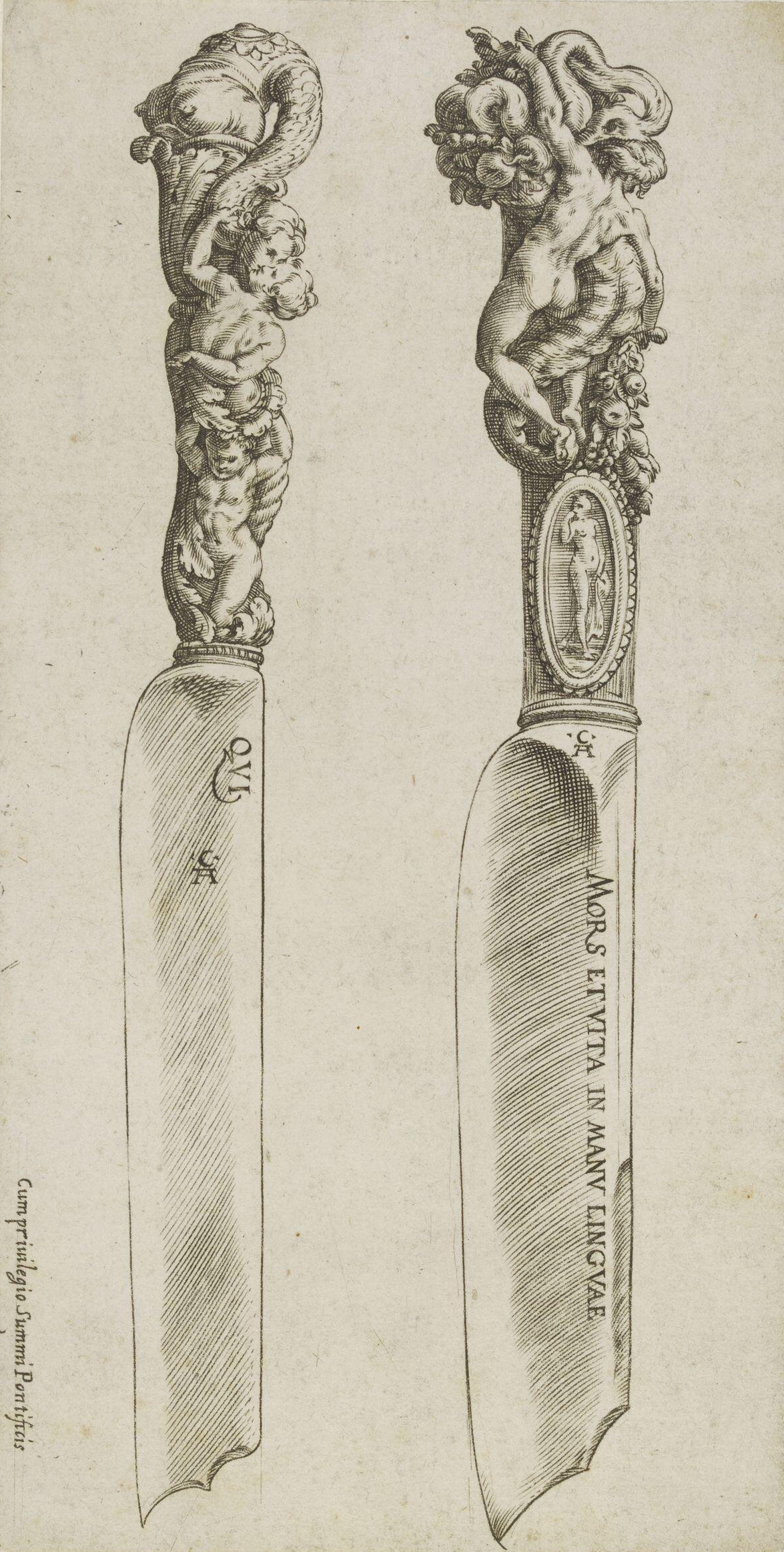
Fig. 2: Engraved print of Designs for Cutlery by Cherubino Alberti, 1583, after Francesco Salviati (Victoria and Albert Museum, inv E.1722-1979)
A sheet attributed to Salviati, of an elaborate candlestick or altar cross base, exhibits characteristics tantamount to the decorative language observed throughout Antonio’s body of work (fig. 1).16 Also synonymous is a sketch of a chalice by Salviati which appears to echo the Mannerist muses and interlocking putti found on Antonio’s Farnese Altar Service (fig. 3). Additionally, a pair of silver cutlery pieces attributed to Antonio (no. 5) are inspired by Salviati’s templates which were recorded in an engraving by Cherubino Alberti in 1583 (fig. 2).17

Fig. 3: Drawing of a Chalice attributed to Francesco Salviati, ca. 1530’s (left; Louvre, inv. RE 53024 verso); detail of a Farnese Candlestick by Antonio Gentili da Faenza, 1578-81 (right; Treasury of St. Peter’s Basilica, Vatican City)
Another apparent influence on Antonio is the work of Perino del Vaga, who was already an esteemed draughtsman recruited regularly for his inventive disegni in the area of decorative arts during Antonio’s early activity as a goldsmith. Beatriz Chadour has called attention to Perino’s influence on Antonio, distinguished by corollaries featured in Perino’s visual repertoire in the apartments of Pope Paul III at the Castel Sant’Angelo in Rome and the Sala Regia in the Apostolic Palace of Vatican City.18 Perino also furnished the designs for the rock crystals cut by Giovanni Bernardi de Castelbolognese that were destined for the Farnese Casket and those later inherited for incorporation on Antonio’s Farnese Altar Service.19
Guglielmo della Porta, likewise had an influence on Antonio, evident by Antonio’s earliest documented commission—the previously noted twelve silver reliquaries made for Pius V—which were based on designs provided by Guglielmo (no. 14).20 Antonio’s operation alongside other sculptors and metal-workers also collaborating with Guglielmo—like Sbarri, Baldo Vazzano da Cortona, Bastiano Torrigiani and Jacobus Cornelis Cobaert—provide further examples of Antonio’s operation in-and-around Guglielmo’s orbit.
Antonio’s employ of a crucifix for the Farnese Altar Cross, whose sculpted model had been executed by Guglielmo, is additional evidence for the working relationship between Antonio’s workshop and that of Guglielmo’s during the 1570s.21 Further evidence of this relationship is exemplified by other productions involving Antonio’s incorporation and reproduction of Guglielmo’s models into works cast and finished by Antonio and his workshop (see nos. 7-11). Most importantly, the crucifix featured on the Farnese Altar Service allows for a comparison between Guglielmo’s original invention and its interpretive treatment by Antonio who subdues, even oppresses the free and energetic manner of Guglielmo’s models, opting for a simplified and polished approach that we may presume further signifies Antonio’s predilection toward a conservative style (fig. 17).22 Nonetheless, the impact of Guglielmo’s creative impetus is still evident in Antonio’s occasionally adventurous interplay of Mannerist elegance meets overstated pomp expressed by his uniquely articulated masks, caryatids and bursting cornucopias of figs (fig. 4).23

Fig. 4: Drawings of Vases with Caryatids attributed to Guglielmo della Porta (left; private collection; center, Victoria & Albert Museum, inv. 9253); drawing of a Candlestick attributed to Guglielmo della Porta (right, Pierpont Morgan Libray, inv. I, 33, detail of the recto)
During the initial decades of activity in which Antonio established himself in Rome, we can envision him diligently producing and refining workshop models, several of which would reprise themselves in various incarnations throughout his identifiable body-of-work. While some scholars have suggested Antonio was only a metal caster,24 his identification as an “excellent sculptor” by Giovanni Baglione25 and the contemporaneous reference as having “sculpsit” his relief of the Skills of a Prince, leads to a confident conclusion that he excelled in sculpture as well, a notion first forwarded by Werner Gramberg.26
In addition to producing his own models there is documentation regarding Antonio’s procurement and possession of models from other sculptors and tradesmen during the course of his career, a practice typical of the goldsmith trade during this era. Antonio commented on owning plasters and moulds of models by many “worthy sculptors” including Michelangelo.27 Indeed, Michelangelo was not averse to giving his models away as he saw fit, perhaps even with the tacit hope specialists in metalwork might preserve them.28 Antonio’s employ of Guglielmo’s crucifix for the Farnese Altar Cross is one example already cited, however, a Pietà model or relief depicting the “expired Christ in the arms of the Virgin”29 by Antonio’s friend, Jacobus Cornelis Cobaert, was also possibly in his workshop.30 The composition was likewise based on a design by Guglielmo and enjoyed a widespread diffusion31 indebted to contemporary castings executed by more than a single workshop,32 and suggesting Antonio could have been responsible for some possible casts of the relief. Indeed, the Medici Archives cite a framed relief in silver that Antonio made of the “Passion of Christ with the Most Holy Madonna,” on 19 February 1585 (no. 34).33
A series of reliefs depicting Ovid’s Metamorphosis—also executed by Cobaert and based on Guglielmo’s designs—were similarly diffused among goldsmiths and sculptors.34 Bronze casts of these reliefs are found in various public and private collections and a series made in gold repoussé were realized by another goldsmith in Guglielmo’s circle: Cesare Targone, which had formerly been erroneously attributed to Antonio.35 Two silver casts from the series, depicting Jupiter Striking the Giants and the Battle of Perseus and Phineus at the Vatican Museums are executed with such fidelity, refinement and finishing as to possibly be silver casts made in Antonio’s workshop, although both are set in later, presumably late 19th or early 20th century settings (fig. 5).36 For a period, Antonio was in possession of the original clay models of the Metamorphosis reliefs made by Cobaert, having received them from Bastiano Torrigiani.37 Antonio and Torrigiani shared an earnest friendship, evident in their business transactions and attested in Baldo Vazzano’s personal account of their amity, in addition to Antonio’s company the night before Torrigiani’s death.38
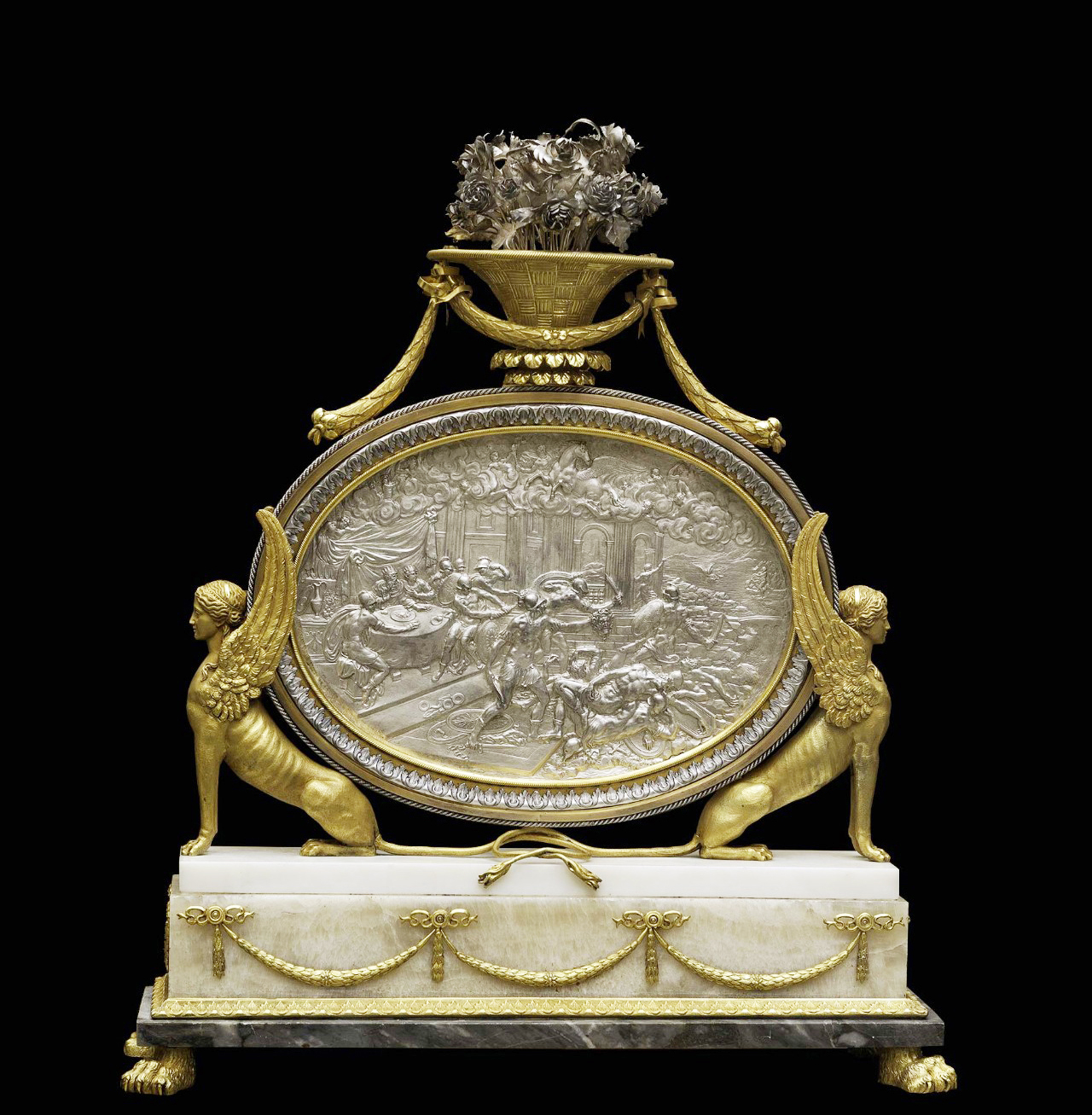
Fig. 5: Silver relief of the Battle of Perseus and Phineus, possibly cast by Antonio Gentili da Faenza, from a model by Jacob Cornelis Cobaert, ca. 1550-60, after a design by Guglielmo della Porta, mounted in a later 19th or 20th century setting (Vatican Museums, inv. 65505)
In 1586 Antonio had purchased from Phidias della Porta, Guglielmo’s eldest son, a wax model of Mount Calvary, unwitting that Phidias had stolen the model illicitly from his father’s estate. The model was subsequently purchased back from Antonio by Guglielmo’s legal heir of the artwork, Teodoro della Porta, in 1589.39 Several casts of the Mount Calvary are likely indebted to Antonio’s production (see nos. 7-9).
By 1563 Antonio had successfully established himself as a prominent goldsmith and was elected as one of four appointed Consuls among the Confraternity of Goldsmiths in Rome. The confraternity would meet at the guild’s church, Sant’Eligio degli Orefici, attending Feast Days and Sundays and reinforcing Antonio’s presumed penchant for tradition (fig. 6).40 It is to be speculated if Antonio’s election on the Consul in this year may have been influenced by the confraternity’s efforts to seek Papal backing against those unlawfully in possession of their archives and property. In this same year a decree was also issued limiting the appraisal of gold and silverwork beyond the value of one scudo, a ruling certainly involving Antonio’s influence, as it was enacted only a month after his election to the Consul.41 Other decrees occurring during Antonio’s tenure involved penalties for opening a shop without a license from the Consuls and a prohibition toward the use of glass doubled with a thin stratum of precious stones. This latter decree being in-keeping with the high standards we can observe already in Antonio’s regard for quality workmanship.

Fig. 6: Sant’Eligio degli Orefici, Rome
The location of Antonio’s workshop along via del Pellegrino is identified in a document of 156542 and in 1567 he purchased an additional warehouse in the Trastevere area for 500 scudi, about a twenty-minute walk from his main workshop. This latter purchase demonstrates the prosperity of his business during this period. Soon thereafter, in 1569-70, Antonio was elected Chamberlain of the Confraternity of Goldsmiths as its leading steward.43 Antonio’s role and influence among the goldsmiths of Rome during this period can be observed in a deed drafted and witnessed in his workshop on 12 March 1572 concerning business on behalf of several silversmiths, for example.44
In 1570, Antonio’s participation with the Brescian painter, Girolamo Muziano, and the Roman illuminator, Lorenzo de Rosolis, resulted in the collaborative realization of a series of 130 copper engravings depicting reliefs from the Trajan column in Rome (fig. 7),45 later published as Historia utriusque belli Dacici a Traiano Caesare gesti: ex simulachris quae in columna eiusdem Romae visuntur collecta, and dedicated to King Philip II of Spain. We know the effort took no more than six years to complete as the first edition was printed in 1576 by Francesco Zanettei and Bartolomeo Tosi as well as by Bonifacio Breggi. A further edition was published in 1585 by Paulo Graziano and a final edition was printed in 1616 by Giacomo Mascardi.46

Fig. 7: Engraved print (pl. 25) from the 1576 edition of Historia vtriusque belli Dacici a Traiano Caesare gesti printed by Bonifacio Breggi (Emory University)
Regrettably, Antonio’s specific role in this project is unknown. It seems Muziano was the one granted unique license to organize the publishing of the prints of Trajan’s friezes and may not have been involved in all or any of the draftsmanship, to which he is often credited,47 but was presumably delegated to Lorenzo or others. By 1578 we may observe, for example, Muziano’s appointment by Pope Gregory XIII to exclusively preside over all Vatican commissions,48 and thus this managerial role in the project seems more likely than the notion of an aggressive solo production of 130 drawings with more than 2,500 figures depicted. It is also generally believed the plates reproducing the friezes were possibly born from earlier drawings by Jacopo Ripanda who was first to produce complete sketches of the column while being suspended from its peak.49
We might assume Antonio’s role in the project may have been similar to Muziano’s, serving as an organizer to contract the execution of the plates by several engravers and possibly inclusive also of his own participation. This magnanimous responsibility precludes later multifaceted managerial tasks like his oversight on the completion of the Altar of the Holy Sacrament at the Basilica di San Giovanni in Laterano in subsequent decades.50 Antonio’s role as Chamberlain to the Confraternity of Goldsmiths in this year (1570) would have placed him in the unique position to have access to Rome’s engravers, notwithstanding his possible provision and preparation of the prepared copper plates required for the ambitious project.
We can assume Antonio had skills as an engraver since the chasing of metal in the practice of goldsmithing is related. The high-quality engravings featured on the interior plates for the binding of the Farnese Hours that Antonio produced (no. 3), if not executed by one or more assistants, is of a superior quality and could be indicative of Antonio’s talent as an engraver (fig. 8). In spite of Antonio’s close proximity with the Trajan column project, the iconographic program depicted on the column doesn’t seem to have had much influence on him in respect to style or composition.
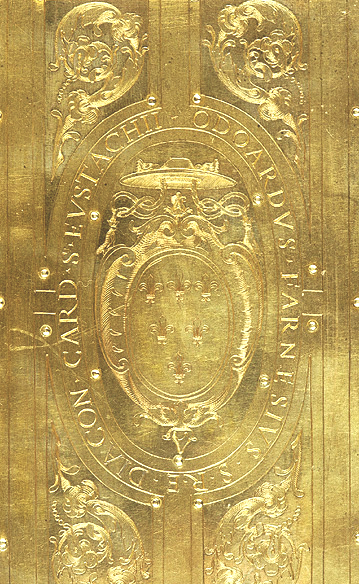
Fig. 8: Detail of the engraved interior back cover binding for the Farnese Hours, depicting the heraldic escutcheon of Odoardo Farnese by Antonio Gentili da Faenza, ca. 1589-94 (Pierpont Morgan Library, NY, inv. MS.69)
A group of five engravings forming a large format reproduction of the Farnese Altar Service is logically considered an engraving made by Antonio,51 as adjudged by its annotated inscription which notes its personal authorship by Antonio and likewise commemorates Cardinal Alessandro Farnese who, by this time, had already passed away (fig. 9).52 As the Altar Service was already in St. Peter’s, Antonio appears to have relied upon his sketches of the project to formulate the engraving, as accounted for by the differences observed between the print and the finished work.53 Only four examples of the print are known: two in Paris,54 one in Brüssels55 and another in Vienna.56 There is an additional engraving of a chalice at the Bibliothèque Nationale in Paris, glued to one of the prints for the Altar Service, which, according to Chadour, can be favorably linked to Antonio’s authorship.57
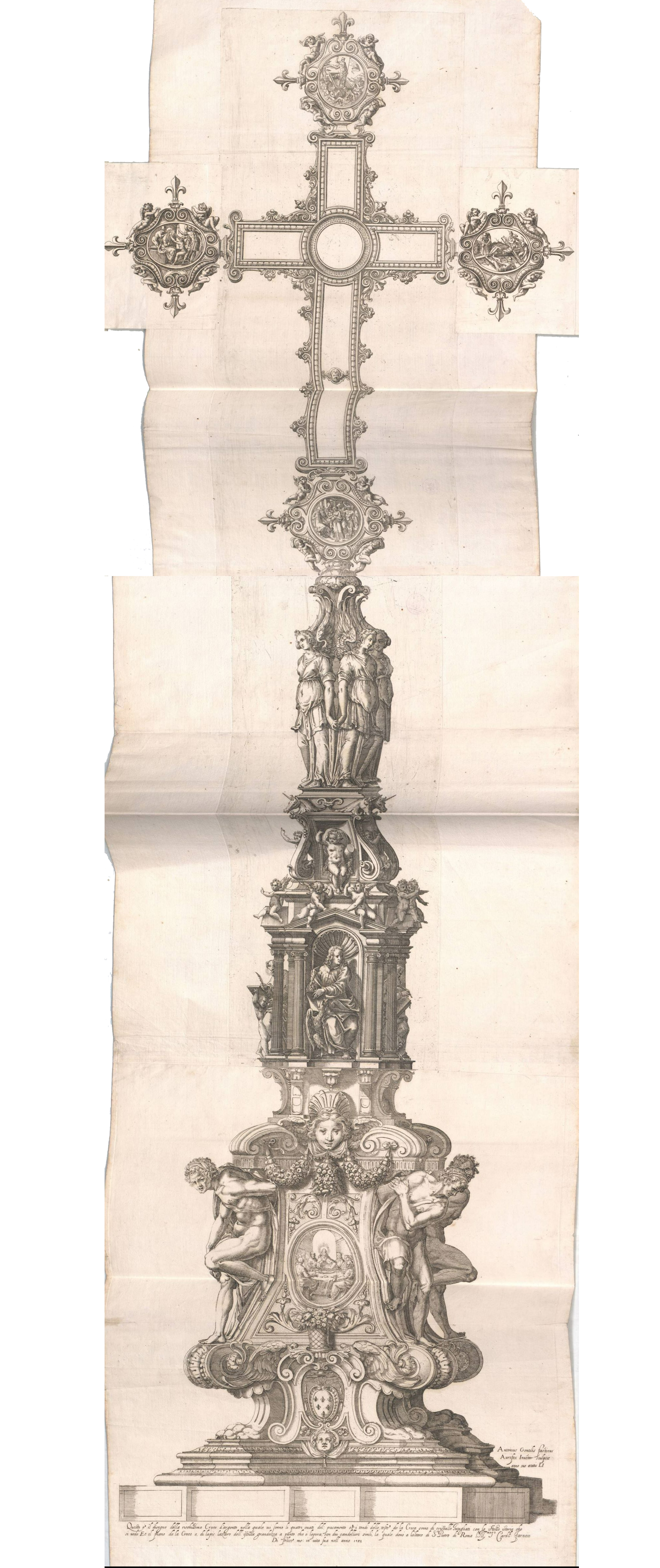
Fig. 9: A collection of assembled engraved sheets depicting the Farnese Altar Cross, attributed to Antonio Gentili da Faenza, ca. 1589-96 (Museum für angewandte Kunst, inv. KI7413)
Antonio’s talents seem to have extended beyond his technical powers and into the realm of design as Baglione praised Antonio’s skill in drawing and his execution of designs for fountains.58 A mid-16th century fountain in the Lazio Viterbo Ronciglione Piazza del Duomo, the summer palace of Cardinal Alessandro Farnese, is attributed to Antonio, not only on account of its visual language, incorporating unicorns and low-relief masks, but also due to its probable commission by Alessandro who was Antonio’s regular patron (fig. 10).59 While it is unlikely Antonio had any involvement in carving the stone fountain, he may have had some role in the preparation and execution of its bronze elements. His experience in managing the production of a work-in-stone may be reprised later, when in 1601 he was procured to jointly oversee the execution of two marble prophets sculpted as decorative embellishments for the organ at Santo Giovanni Laterno, executed by two stone sculptors.60
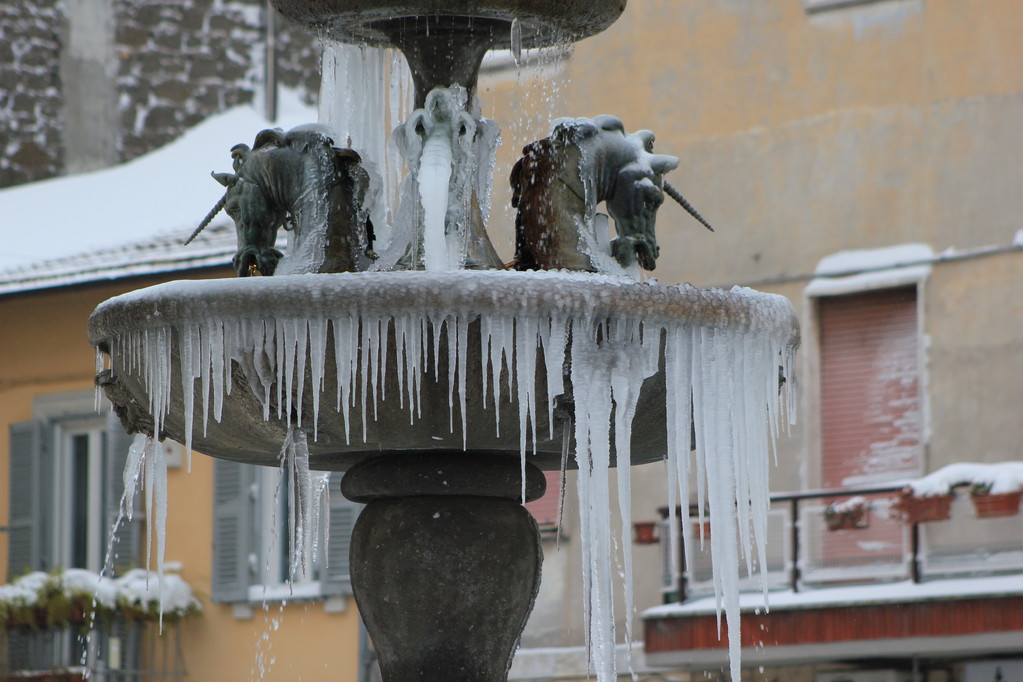
Fig. 10: Detail of a fountain in the Lazio Viterbo Ronciglione Piazza del Duomo, whose design is attributed to Antonio Gentili da Faenza, ca. 1553-65
The Ronciglione fountain is thought to have been realized sometime between 1553-65 and would place it within the period for which there are no known sources concerning Antonio’s activity.61 At least one of his tableware productions, an elaborate ewer for the Medici, to be discussed, was executed “in the style of a fountain,”62 and could infer Baglione’s claim in realizing such designs (no. 19). The technical virtuosity involved in conceiving the ewer is tantamount to a brilliant mind capable of producing equally elaborate outdoor fountains. While several drawings have been associated with Antonio’s hand, though none reproducing designs for fountains, the authorship of drawings associated with him is debated and his sketched oeuvre remains largely ambiguous but worthy of future research.
Although speculative, Antonio could have had involvement in the preparatory designs for fountains in-and-around Rome, namely those involving Antonio’s patron, Muzio Mattei, who financed his own independently sponsored fountains as well as those commissioned by Antonio’s other patron, Pope Sixtus V, for whom Mattei oversaw the realization of fountains like the Quattro Fontane at the juncture of via delle Quattro Fontane and via del Quirinale in Rome.63 The Roman architect, Domenico Fontana, was also involved in the realization of the Quattro Fontane and in 1590 both Fontana and Antonio are observed working together on behalf of Sixtus V in overseeing the final work for the production of the tabernacle at Sta Maria Maggiore.64 Fontana and Antonio’s mutual activity in Naples later in their careers may also suggest a possible collaboration in the production of fountains in that city during the late 16th and very early 17th century.65 We might consider the Pope’s assignment to Fontana concerning the restorations he ordered for Trajan’s column during the mid-1580’s could have drawn these two artists together in consideration of Antonio’s previous participation in the preparation of the plates reproducing the column’s scenes. Antonio’s close friend, Torrigiani, whose workshop executed the large statue of St. Peter for the top of the Trajan column, may have again brought Fontana into Antonio’s orbit. The otherwise ambiguous intersection and association of these various artists and patrons may suggest Antonio’s otherwise undocumented participation in the fountain designs for which Baglione praises him.
In 1575 Antonio was elected third Consul of the Fraternity of Goldsmiths and in this same year Sixtus V reconfirmed the privilege of the confraternity to remain exempt from paying shop and street taxes while the acting Pope, Gregory XIII, granted a new title to the confraternity, naming it the Collegio e Nobil Arte, and placing it under the control of the Camera Apostolica. Antonio’s evidently good standing with these individuals would in all likelihood lead to his future appointment as Assayer of the Papal Mint in 1584.
In May of 1576, Antonio rented an additional property along via del Pellegrino for a period of five years at an annual rate of 50 scudi. It could be presumed that this rented property, already close to his established workshop along the same street, was leased in association with the advent of a company he established that year with the goldsmiths Orazio Marchesi, with whom he is noted as having earlier collaborated, and a certain Gabriele Berardi.66 It is possible Antonio, at approximately fifty-seven years-of-age, and with presumably increasing workloads—evident in the various projects he executed for the Medici during this period—sought to establish a broader company to increase profits, pool debts or to focus his personal attention on works of anticipated greater importance like the Farnese Altar Service, delegating lesser tasks to steadily contracted assistants. Only a year later, Antonio would dissolve this formal partnership with Marchesi and Berardi and adopt another goldsmith into his fold: Carlo Boni from Faenza.
It could be speculated that Antonio’s turnover of these goldsmiths could be on account of the tradition among the confraternity in hosting and aiding incoming gold-and-silversmiths from outside of Rome until they established themselves.67 This is potentially the case with Gabriele Berardi who may have originally been active as a silversmith in Palermo in Southern Italy and originally a native of Majorca, off-the-coast of Spain.68 The Berardi were a noble family of Jewish converts living in Southern Italy and we might assume, if arriving in Rome for work, would have been resident in the Jewish community within Rome where one of Antonio’s Catholic clients, Duke Muzio Mattei,69 also happened to live.70 We could assume Berardi had already completed work for Mattei and came to Antonio by way of Mattei’s recommendation or that Antonio may have met Berardi while working for Mattei in the Jewish subdivision of Rome.
It could also be assumed Carlo Boni da Faenza might also have partnered with Antonio for this same reason but he appears already present in Rome as part of the Confraternity of Goldsmiths as early as 1570. Also present in Rome are other goldsmiths from Faenza, such as: a certain Alessandro Bernardi71 and an Andrea de Monte,72 both of whom were possibly attracted to Rome on account of Antonio’s success.
While little is known of Orazio Marchesi, it would seem he was a trusted collaborator of Antonio’s. It’s possible he was either the son or a relative of the Brescian goldsmith, Panfilo Marchesi, who was active in Rome during the 1550s and appears to have been well-connected. For example, the accomplished sculptor, Vincenzo Danti—responsible for the bronze statue of Pope Julius III situated outside the Duomo di Perugia—lived and worked in Panfilo’s workshop in Rome during the mid-1550s.73
In Antonio’s documented service to the Medici, under the auspices of Francesco I de’ Medici—Grand Duke of Tuscany from 1576-85—we can gather perspective on requests made between patron and goldsmith. In one instance Antonio is called upon to clean and refresh a work he had earlier created (no. 19) and in another instance he is called upon to update a devotional treasure (no. 25). These otherwise banal tasks offer insight into the simpler responsibility’s goldsmiths experienced in their trade, being a divergence from the elaborate masterworks for which they are most celebrated.
For the Medici, Antonio realizes a variety of objects to include utilitarian luxury items like ewers, platters, tableware, jars, caskets and an oil lamp and devotional items like reliquary crosses, a chrismatory and a tabernacle. Some requests are for the Medici themselves while others are intended as gifts, forming part of the cultural milieu of the period, notwithstanding the employ of gifts as part-and-parcel in matters of diplomacy and status.74
Antonio’s earliest dated work for the Medici involved the creation of a tall silver ewer featuring harpies and masks of naiads in low-relief with two cartouche-style handles (no. 19). This elaborate ewer had three mouths for individually pouring water and two kinds of wine while the interior featured a fourth central compartment to store ice. The lid of the ewer featured vines in-relief surmounted by a jar bursting with fruits.75 A sketch of a vase at the Rijksmuseum, associated with Antonio, might be indicative of the type of visual language described for the ewer, and if representing a work executed by Antonio, could date it to a period in which he was producing alike objects for the Medici during the late 1570s (fig. 11). The location and fate of the ewer is unfortunately lost; however, it was originally destined for the Medici Guardaroba in Florence but appears to have remained in Rome.76
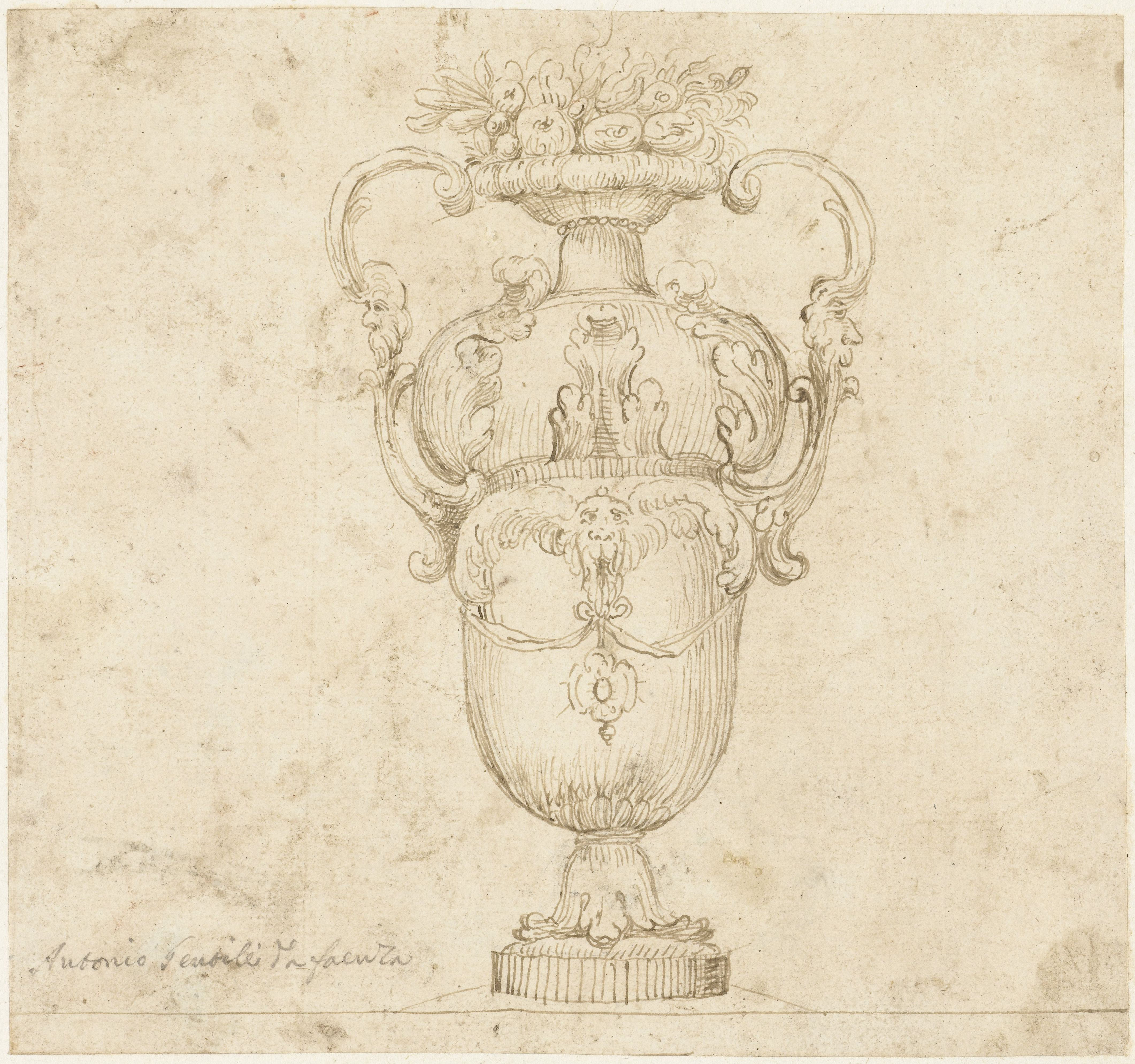
Fig. 11: Drawing of a Decorative Vase with Fruits, attributed to Antonio Gentili da Faenza, probably late 1570s (Rijksmuseum, inv. RP-T-1956-113)
Antonio may have contributed to the preservation and display of precious antiquities kept among the Medici possessions in Florence. For example, a gold setting was realized by Antonio for a small agate cup that may have been of Classical origin (no. 23).77 Antonio’s setting for a turquoise-glass paste bust of Emperor Augustus is certainly indicative of Antonio’s role in enhancing the Medici ducal collection at-this-time (no. 2).
By 28 September 1583, Antonio had executed for the Medici, a gilt silver and ornamented frame for a portrait of the Madonna painted by Scipione Pulzone (called Il Gaetano) (no. 29).78 Notably, a signed and dated portrait of the Madonna, by Il Gaetano, from 1583 survives (fig. 12).79 The painting is a small devotional work, approximately 35 x 25.4 cm, befitting for the precious frame described as approximately one-half a braccia or a half-arm’s length in the Medici inventory. A later 1627 posthumous inventory of Cardinal Francesco Maria del Monte cites two Madonna panels also by Il Gaetano: a larger example in an ebony frame and a smaller example, commensurate with the surviving painting, described with a golden frame, and presumably that of Antonio’s invention, now lost.80

Fig. 12: Painting of the Madonna by Scipione Pulzone, called Il Gaetano, 1583 (private collection)
Of note are the various items the Medici commissioned from Antonio to be used as gifts. On 12 April 1584 two works contracted to Antonio: a golden quill pen and a small gilt silver beaker or jar with a lid and narrow mouth; was presumably a writing set destined for the studiolo of Francesco I’s daughter: Eleanor de’ Medici (no. 31).81 The set was likely intended as a gift in celebration of her marriage to Vincenzo I Gonzaga which took place later that month on 29 April 1584.
The Medici also commissioned Antonio to produce works destined for the Hapsburg court of Spain, namely Philip II, for whom Antonio made a silver chrismatory (no. 33). An armorial, presumably of the Spanish crown, was applied to it and the object was sent to Philip II as a gift for the reliquaries of San Lorenzo in the treasury of the Cathedral of Seville on 31 December 1584.82 Additionally, two golden crosses made by Antonio—with relics set behind rock crystal windows—were both sent to Spain as gifts in October of 1581 and February of 1583 respectively (nos. 24, 26).83 An awareness of Antonio’s skill and talent was evidently recognized by the court of Philip II, as his daughter, Catalina Micaela, would later commission Antonio to produce a silver plaque of the Skills of a Prince as a gift for the Doge of Venice, a new discovery published in this catalog for the first time (no. 4). Further, the inscribed base of a pax attributed to Antonio and a cast of the Mount Calvary relief that may have been commissioned by Philip II and subsequently donated to the Monastery of El Escorial, are suggestive of the dissemination of Antonio’s productions into Spain (nos. 7 and 12).
On 7 April 1584, at approximately sixty-five years-of-age, Antonio received the title of Assayer of the Papal Mint, an appointment he would fulfill for eighteen years. Antonio’s service in this capacity is found in his involvement in the final statement of work for the Sta Maria Maggiore tabernacle in Rome in 1590, executed by Bastiano Torrigiani and Ludovico del Duca;84 his appraisal of a gilt copper armorial at Castel Sant’Angelo, executed by Bernardo Salvioni for Clement VIII in 1596;85 and his oversight in the production of the cast metal components for the Altar of the Holy Sacrament at the Basilica di San Giovanni in Laterano executed by Pompeo Targone and Curzio Vanni.86 In the latter effort Antonio organized as many as twenty-three individual specialists in the execution of the altar, indicative of his immense responsibility, respect and vast network.87 Antonio subsequently presided over another work in that location: the two marble prophets for the organ made by Mastro Ambrosio from Milan and Fra Lalbino in August of 1601, already noted, and after his tenure, Antonio would continue serving as an occasional consultant in such matters, evident by his involvement in overseeing a reliquary executed by the silversmith, Carlo Minotto, for the Marquis of Vigliena in Sicily in October of 1607.88
During his tenure as Assayer of the Papal Mint, Antonio, in 1586, rented a house from Tommaso Castellani along via Giulia which would later become Antonio’s new workshop. In 1588 the silversmith, Baldo Vazzano da Cortona, was resident in Antonio’s workshop, having arrived in Rome in 1582 and learning the art of smelting alongside Bastiano Torrigiani and training thereafter under the auspices of the silversmith, Pietro da Prato.89 Vazzano would continue to work with Antonio as late as 1605.90
In March of 1588, Antonio’s service to the Medici dynasty was tangentially reprised when Francesco de’ Medici’s younger brother, Ferdinando de’ Medici—by then, the new Duke of Tuscany—in preparing a purchase of horses and silver from the estate of Cardinal Jacopo Savelli in Rome, appointed Antonio to evaluate the works of silver and gold being purchased.91
Antonio and his son, Pietro, must have spent a significant part of their career between Rome and Naples from 1593 to 1603 while the production of the cross for the Monastery of San Martino occupied their attention (no. 37).92 This large cross, around 7 feet tall, featured forty-two figures, numerous reliefs and weighed over a hundred pounds.93 Antonio’s delegation of the casting for his Skills of a Prince relief in January 1597, to the silversmith Cristoforo Vischer, may have been due to Antonio’s presence in Naples during the looming deadline for its final production.
Antonio may have initially begun collaborating with Vischer in Naples around 1594-95. Vischer was a silversmith from Augsburg, Germany who appears to have had associations with Naples and his brother, Giorgio Vischer, also a silversmith, was certainly in Naples during this period.94 It could be presumed the Vischer brothers served as assistants to Antonio while working on the San Martino cross. Cristoforo Vischer may have followed Antonio to Rome after completion of the cross, as he appears registered among Rome’s goldsmiths in 1604, just following the year in which the San Martino cross was completed. Vischer later established his own workshop in Rome along the same street as Antonio’s during the 1610’s. Apart from the Skills of a Prince cast by Vischer, only one additional known work bearing Vischer’s hallmark is identified on a pax from about 1617-25, belonging to a church within the Diocese of Adria-Rovigo and featuring a Pietà relief whose frame is attributed in this catalog to Antonio’s invention (nos. 12, 13; fig. 31), and further reinforcing the theoretical working relationship shared between Vischer and Antonio.
In 1599 Antonio purchased Torrigiani’s former property along Borgo Pio, which may have served briefly as a foundry for a few years, until he shortly thereafter sold it back to Torrigiani’s son in 1601.95
In an attempt to possibly preserve his family legacy, Antonio may have been instrumental in establishing his son, Pietro, as Assayer of the Papal Mint in 1602. During the first part of 1609 Antonio would be summoned to testify in an inconclusive case involving the unsanctioned use of models from Guglielmo della Porta’s studio, the testimonies of which, provide ample insight into the interconnectedness of goldsmiths in Rome during this period. For example, at this late date, Antonio appears to have relied on a formatore other than Vazzano, who was, by this year, working elsewhere and instead employed Sebastiano Marchini to produce wax models derived from a plaster form belonging to Antonio’s workshop (no. 40).96 Later that year, on 29 October 1609, Antonio died at the age of 89 or 90. He was buried at the church of St. Biago along via Giulia in Rome.
For Antonio we may gather the picture of a goldsmith who not only excelled in his trade, fittingly performing an art in-keeping with the conventions of his time, but also excelling by his aptitude for problem-solving, where feats of engineering were coupled with a visually sublime elegance. It was Antonio’s ability to produce sophisticated works-of-art in a timely and accomplished manner that afforded the respect of patrons both noble and religious, heralding him as an artist in his trade “to which there was no rival,” as proclaimed by Baglione.97 In all, it is his attention to all of these details that award Antonio as one of the most important Italian goldsmiths of late 16th century Rome. His creations would later enjoy their own renaissance during the late 18th century when the English sculptor, John Flaxman, in 1770, ordered and acquired plaster casts of the figures featured along the base of the Farnese Altar Cross from Rome, at-that-time, superficially thought to be models by Michelangelo. The models would find their way into the studios of Josiah Wedgwood and the clock-maker Matthew Boulton who both subsequently reprised Antonio’s models on their own unique inventions (fig. 13).98
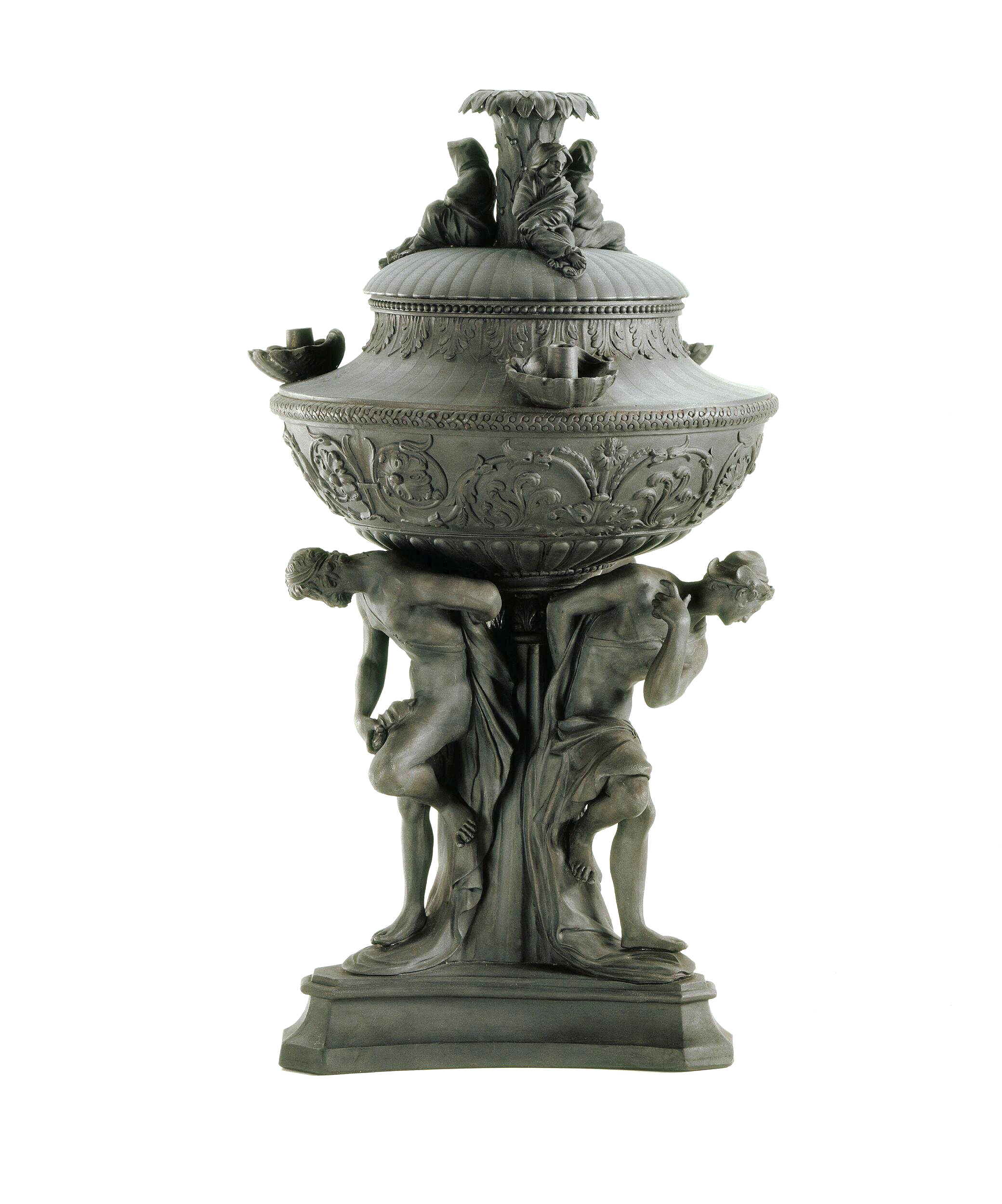
Fig. 13: Black basalt Michelangelo Lamp by Josiah Wedgewood and factory, after a design introduced about 1772, this example possibly 19th century, with figures after the Farnese Altar Cross (Victoria & Albert Museum, inv. 4790&A-1901)
Endnotes:
1 Carlo Grigioni (1988): Antonio Gentili detto Antonio da Faenza in Romagna arte e storia, XXIV, pp. 83-118.
2 Sidney J. A. Churchill (1907): The Goldsmiths of Rome under the Papal Authority: Their Statutes Hitherto Discovered and a Bibliography in Papers of the British School at Rome, vol. 4, no. 2, pp. 163–226.
3 Various authors (1964): Le Muse: enciclopedia di tutte le arti. Novara, Instituto Geografico de Agostini, vol. V, p. 203.
4 This dispute takes place in June of 1553. C. Grigioni (1988): op. cit. (note 1).
5 Salvatore Fornari (1968): Gli argenti Romani. Rome, p. 76.
6 Carlo Celano (1758): Notizie Del Bello, Dell’antico e del Curioso della Citta di Napoli. Naples, p. 31.
7 Antonio and Pietro Gentili’s collaboration on works for Federico Borromeo are inferred in a letter Pietro sent to the Cardinal on 5 November 1616 in which he refers to past commissions the father-and-son team executed for him. C.D. Dickerson (2006): Bernini and Before: Modeled Sculpture in Rome, ca. 1600-25, PhD. thesis, Institute of Fine Arts, New York University, p. 396.
8 Regrettably, the core of Pietro’s commissions is lost with exception of an elegant silver reliquary bust of Saint Bibiana, executed between 1609-10, preserved in the Basilica Papale di Santa Maria Maggiore. The reliquary was commissioned by the canon, Girolamo Manlili, for which Pietro was paid a sum of 223 scudi. S. Fornari (1968): op. cit. (note 5). However, C.D. Dickerson has suggested the reliquary present in the Basilica may be an 18th or 19th century work. C.D. Dickerson (2006): op. cit. (note 7), pp. 404-05.
9 The earliest document concerning Antonio’s role as a goldsmith is dated, 18 December 1552. C. Grigioni: (1988): op. cit. (note 1).
10 Werner Gramberg (1960): Guglielmo della Porta, Coppe Fiamingo und Antonio Gentili da Faenza in Jahrbuch der Hamburger Kunstsammlungen, V, pp. 31-52.
11 For Duke Mattei’s commissioning of Antonio see Minna Heimbürger Ravalli (1977): Architettura scultura e arti minori nel barocco italiano: Ricerche nell’archivio. Spada. Florence, p. 85. Documents concerning Antonio’s work for the Medici are preserved in the Medici Archives in Florence, chiefly in Guardaroba, filza 79. Invetarij Generale a Casi A. 1571-1588 and elsewhere.
12 Anna Beatriz Chadour (1982): Der Altarsatz des Antonio Gentili in St. Peter zu Rom in Wallraf-Richartz-Jahrbuch, vol. 43.
13 Christina Riebesell (1995): La Cassetta Farnese in I Farnese: Arte e Collezionnismo. Milan, pp. 58-69.
14 John Forrest Hayward (1977): Roman Drawings for Goldsmiths’ Work in the Victoria and Albert Museum in The Burlington Magazine, vol. 119, no. 891, pp. 412-21; Gianvittorio Dillon (1989): Novità su F. Salviati disegnatore per orafi in Antichità viva, XXVIII, 2-3, p. 48; and Catherine Monbeig Goguel (1998): Il disegno in Francesco Salviati in Francesco Salviati, 1510-1563, o la Bella Maniera. Electa, Milan, pp. 31-46.
15 Antonino Bertolotti (1881): Artisti lombardi a Rome nei secoli XV, XVI, XVII. Studi e ricerche negli archivi romani, 2 vols., Milan, vol. I, p. 129.
16 The sheet is kept in the Pierpont Morgan Library drawings collection (inv. 1964.3). Another sheet by Salviati, depicting a desk casket, at the Uffizi, is also comparable (inv. 1577E).
17 Cherubino Alberti’s plates were either refreshed or reengraved in another edition of this print executed by Aegidius Sadeler II in 1605. Anna Beatriz Chadour (1980): Antonio Gentili Und Der Atarsatz von St. Peter. Westfälische Wilhelms-Universität, PhD. thesis, pp. 182-83.
18 Ibid.
19 Giorgio Vasari (1568): Lives of the Most Eminent Painters, Sculptors and Architects. Translated by Gaston Du C. De Vere. Macmillian, London (1913), vol. VI, pp. 76-78.
20 W. Gramberg (1960): op. cit. (note 10), pp. 31-52.
21 Michael Riddick (2017): Reconstituting a Crucifix by Guglielmo della Porta and his Colleagues. Renbronze.com (accessed June 2022).
22 Ibid.
23 Both sheets feature early attributions to Giovanni da Udine, inscribed thereon and discounted by modern scholarship. Peter Ward-Jackson and Elena Parma have suggested the Victoria & Albert sheet belongs to the hand of Perino del Vaga: Peter Ward-Jackson (1979): Italian Drawings: 14th-16th century. Victoria & Albert Museum, London and Elena Parma (2001): Perino del Vaga, tra Raffaello e Michelangelo, ex. cat., Galleria civica di Palazzo Te. However, Parma earlier followed the original attribution to Guglielmo della Porta in E. Parma (1986): Perin del Vaga, l’anello mancante. Genoa. The proposal of these sheets and their attribution to Guglielmo is first proposed by Bernice Davidson in Bernice Davidson (1966): Perino del Vaga a la sua cerchia (ex. cat., Florence). This assessment is currently endorsed by Linda Wolk-Simon in Linda Wolk-Simon (2003): Reviewed works: Perino del Vaga, tra Raffaello e Michelangelo in Master Drawings, vol. 41, no. 1, pp. 44-58 and also by Florian Härb in Florian Härb (2001): Review of exhibition Perino tra Raffaello e Michelangelo, Mantua in Burlington Magazine, 143, no 1183, pp. 652-54.
24 Rosario Coppel (2012): Guglielmo della Porta in Rome in Guglielmo della Porta: A Counter-Reformation Sculptor. Coll & Cortes, p. 56.
25 Giovanni Baglione (1642): Le vite de’ pittori scultori et architetti. Dal pontificato di Gregorio XIII del 1572. In fino a’ tempi di Papa Vrbano Ottauo nel 1642. (…e modellava da sculture Eccelentemente…)
26 W. Gramberg (1960): op. cit. (note 10), pp. 31, 33, 38 and 48.
27 A court record of 1609 records Antonio’s comment: “In bott ega mia io…ho bene li molto gessi et forme di molti valenti homini e di Michelangelo et d’alteri, che saria longo a raccontare.” or ”In my workshop…I have had many plasters and moulds by many worthy men and of Michelangelo and of others.” A. Bertolotti (1881): op. cit. (note 15), vol. 2, pp. 136-37.
28 Victoria Avery (2018): Divine Pipe Dreams: Mature Michelangelo and the mastery of metal in Michelangelo: Sculptor in Bronze. Bloomsbury Publishing, UK, pp. 80-105 and Michael Riddick (2020): The Thief of Michelangelo. Models Preserved in Bronze and Terracotta. Renbronze.com (accessed June 2022).
29 G. Baglione (1642): op. cit. (note 25), pp. 100-01. “Formo ancora altri modelli di cose sacre, e tra le altre un Christo morto in braccio alla Vergine Madre, affai bello.”
30 A witness, Johannes Baptista Montani Mediolanensis, at the 1609 trial concerning the contested use of models belonging to Teodoro della Porta, describes seeing a Pietà and/or a Descent from the Cross in Antonio’s possession: “Io di queste robe ho visto in mano di Mº. Antonio da Faenza una pietà o Cristo in Croce cosa bellísima che era di cera longa più di una canna che vedendo io quella bella cosa mi disse che quella opera andava in S. Pietro…” or “Among these things I have seen in the hand of Master Antonio da Faenza a most beautiful Pieta or Christ on the Cross made of wax, of more than one caña in length, and when I saw that beautiful object, he told me that the piece was in St. Peter’s.” A. Bertolotti (1881): op. cit. (note 15). It is possible this was a Descent from the Cross forming a group of eight individual scenes of the Passion of Christ that were displayed at St. Peter’s in 1564. Charles Avery (2012): Guglielmo della Porta’s Relationship with Michelangelo in Guglielmo della Porta, A Counter-Reformation Sculptor. Coll & Cortés, pp. 113-137. Antonio was quite likely in possession of a model of the Pietà executed by Cobaert after Guglielmo’s design. It is likely he cast an example of this Pietà for the Medici in 1585 (see no. 34 in the present catalog).
31 Ulrich Middeldorf commented that this composition was the most popular devotional image around the year 1600. Ulrich Middeldorf (1944): Medals and Plaquettes from the Sigmund Morgenroth Collection. Donnelley & Sons Co., Chicago, IL., no. 186, p. 28. For further analysis of this composition and its diffusion see Michael Riddick (2017): A Renowned Pieta by Jacob Cornelis Cobaert. Renbronze.com (accessed June 2022).
32 For example, we know another Roman sculptor and bronze founder, Bastiano Torrigiani, also cast one or more examples of this composition as an unpublished archive cites him having cast a Pietà made by Cobaert for the collector Simonetto Anastagi in 1585. Emmanuel Lamouche (2011): L’activité de Bastiano Torrigiani sous le pontificat de Grégoire XIII. “Dalla gran scuola di Guglielmo Della Porta.” in Revue de l’art, no. 173, pp. 51-58 (see his footnote 54).
33 Medici Archivio, Guardaroba, filza 79. Invetarij Generale a Casi A. 1571-1588, fol. 373r.
34 G. Baglione (1642): op. cit. (note 25), p. 100 and A. Bertolotti (1881): op. cit. (note 15), vol. 2, pp. 140-43.
35 Davide Gasparotto (2014): The power of invention: Goldsmiths and Disegno in the Renaissance in Donatello, Michelangelo, Cellini. Sculptor’s Drawings from Renaissance Italy. University of Chicago Press, pp. 40-55. See also Michael Riddick (2017): A Group of Gold Repoussé Reliefs attributable to Cesare Targone. Renbronze.com (accessed June 2022).
36 Vatican Museums invs. 65504-05. Werner Gramberg has alternatively suggested these may have been cast by Jacob Cornelis Cobaert. Gramberg (1960): op. cit. (note 10), pp. 47-48.
37 Antonio’s possession of the original models is noted in the 1609 trial. A. Bertolotti (1881): op. cit. (note 15).
38 Emmanuel Lamouche (2022): Les fondeurs de bronze dans la Rome des papes (1585-1630). École française de Rome, p. 87.
39 Antonio had purchased the Mount Calvary model from Phidias della Porta for 50 scudi, and was subsequently reimbursed when the model was purchased back by Teodoro della Porta by court order. A. Bertolotti (1881): op. cit. (note 15), vol. II, pp. 122, 154.
40 S. Churchill (1907): op. cit. (note 2).
41 Ibid. The decree is dated 29 July 1563 while the installment of new Consul members took place on the 25th of June.
42 Marina Cipriani (2000): Gentile, Antonio, detto Antonio da Faenza in Dizionario Biografico degli Italiani – Volume 53. http://www.treccani.it (accessed August 2022).
43 Costantino G. Bulgari (1958): Argentieri, gemmari e orafi d’Italia, I, Roma, p. 509.
44 A. Bertolotti (1881): op. cit. (note 15), vol. 1, p. 325.
45 C. Grigioni (1988): op. cit. (note 1), p. 90.
46 Giovanni Agosti and Vincenczo Farinella (1985): Il fregio della colonna Traiana…, in Annali della Scuola normale superiore di Pisa, s. 3, XV, p. 1109. See also Tocino Fernández (2023): La Historia utriusque belli Dacici a Traiano Caesare gesti ex simulachris quae in columna eiusdem Romae uisuntur collecta de Alfonso Chacón. PhD. thesis, Universidad de Cádiz.
47 For recent analysis concerning the variety of drawings that relate to this project see Volker Heenes (2017): Zu den kopien der reliefs der Trajanssäule im 16. Jahrhundert: Zwei neue zeichnungen eines unbekannten rotulus in Columna Traiani – Trajanssäule – Siegesmonument und kriegsbericht in bildern. Verlag Holzhausen GmbH, pp. 271-78.
48 Patrizia Tosini (2012): Girolamo Muziano e Gregorio XIII: Una Rapporto Privilegiato in Unità e Frammenti di Modernità in Arte e Scienza nella Roma di Gregorio XIII Boncompagni (1572-1585). Fabrizio Serra Editore, 2012, pp. 278-97.
49 These sketches, the Codice Ripanda, are preserved in the Biblioteca dell’Istituto Nazionale di Archeologia e Storia dell’arte, Palazzo Venezia, Rome, ms. 254. Their attribution was designated to Jacopo Ripanda by Roberto Paribeni in 1929 but have more recently been challenged by Arnold Nesselrath. Roberto Paribeni (1929): La Colonna Traiana in un codice del Rinascimento in Rivista dell’Istituto di Archeologia e Storia dell’Arte 1, pp. 9-28 and Arnold Nesselrath (2010): XVI secolo, rilievo e fregio della Colonna Traiana in Le meraviglie di Roma antica e moderna, exh. cat. Rome, pp. 35-36.
50 E. Lammouche (2022): op. cit. (note 38), p. 183, see his footnote 160.
51 Wolfgang Lotz (1951): Antonio Gentili or Manno Sbarri? in The Art Bulletin, 33(4), pp. 260-262. and Andreas Andresen (1870): Handbuch für Kupferstichsammler. Leipzig, p. 563.
52 “Questo e il disegno della richissima croce d’argento nella quale vi sono di quatri ovati del posamento et i tondi delle teste de la croce sonno di cristallo intagliati con le istesse istorie che si vede. Et il piano de la croce e de lapis lazaro dell’istessa grandeza a punto che è l’opera con due candellieri simili, la quale dono a l’altare di Sa Pietro di Roma l’Illmo. Card. Farnese di felice me. vita sua nell’anno 1582” or “This is the design of the rich silver cross which has four ovals in the base and the tondos in the head of the cross in carved glass with the same stories on view. And the foot of the cross is in Lapis lazuli of the exact same size than the work with the two similar candle sticks, which he donated to the altar of Saint Peter in Rome the honorable Cardenal Farnese in loving memory in the year 1582.”
53 A.B. Chadour (1980): op. cit. (note 17), pp. 66-69.
54 Bibliothèque Nationale, Paris, fol. Vb 108.
55 Bibliothèque Royale Albert, Brüssel Foto Nr. E 377.
56 Museum für angewandte Kunst, Inv KI7413.
57 A.B. Chadour (1980): op. cit. (note 17), p. 254 (see her footnote 267).
58 G. Baglione (1642): op. cit. (note 25).
59 Amico Ricci (1859): Storia dell’ architettura in Italia, dal secolo IV al XVIII, voI. III, Modena, p. 85.
60 Various Authors (1886): Deputazione di storia patria per le province di Romagna Bologina: Documenti e studi. vol. 1.
61 The dating of the fountain is based upon the respective years Cardinal Alessandro’s children passed away and whose armorials are featured on the fountain. A.B. Chadour (1980): op. cit. (note 17), pp. 177-79.
62 Medici Archivio (1571-88): op. cit. (note 33), fol. 9r. This entry is undated but probably dates from the late 1570s and describes the ewer appearing “like a fountain.”
63 Frederick Cope and Maurizia Tazartes (2004): Fontaines de Rome. Citadelles & Mazenod.
64 Jennifer Montagu (1996): Gold, Silver & Bronze: Metal Sculpture of the Roman Baroque. Princeton University, p. 20 and appendix 1. The records are located: ASV, Archivium Arcis, Arm. B, vol. 7, ff. 125-30v. In addition to Antonio Gentili, Domenico Fontana also signed-off on this statement-of-work.
65 For Domenico Fontana’s work on fountains in Naples see Ferdinando Ferrajoli (1973): Palazzi e fontane nelle piazze di Napoli. Naples, pp. 28-30.
66 A. Bertolotti (1881): op. cit. (note 15), vol. 1, p. 326.
67 S. Churchill (1907): op. cit. (note 2).
68 Gabriele Berardi could be the same namesake mentioned in the will of a certain Pere Tarongí (also called Perot and Perotto Torongi), a Jewish banker and businessman originally from Majorica, Spain, but living in Palmero, Italy who died there in 1539. In his will he granted money to a Gabriele Berardi, also a Jewish convert of Valencian descent. Gabriele’s brother, Galceran, had married Tarongí’s sister, Francina. Another of Tarongí’s sisters, Elionor, was married to a certain silversmith, Lluís de Vallseca, who was instrumental in various family dealings, having assisted in accounts of the business Galceran and Tarongí conducted together in Palermo and also serving as witness to Tarongí’s will and ensuring the succession of Galceran’s trust to his brother, Gabriele Berardi. There is some indication Galceran and Gabriele’s father, Joanot Berardi, was both a merchant and silversmith. Upon his death, Joanot’s mercantile efforts may have been passed to his son Galceran while his silversmith trade may have been passed to Gabriele. Gabriele may likewise have worked alongside or as an apprentice to Lluís who would have been his brother-in-law’s sister’s husband. As an occasionally persecuted minority, the Jewish community typically remained in well-knit circles. Pedro de Montaner Alonso (2010): Viejos y nuevos datos sobre los Tarongí y los Vallseca, judeoconversos mallorquines ennoblecidos en Sicilia in Memòries de la Reial Acadèmia Mallorquina d’Estudis Genealògics, Heràldics i Històrics Història, no. 20, Academia Asociada al Instituto de España, pp. 95-186.
69 M. Heimbürger Ravalli (1977): op. cit. (note 11).
70 At one time, by issue of the Pope, the Jewish community of Rome was ordered to be gated off although the Pope gave Duke Muzio Mattei a key to move in-and-out of the ghetto, as his palace was located therein. Anne Kristine Tagstad (2005): Fontana delle tartarughe, the iconography of a Roman fountain. PhD. thesis, University of Oslo, Norway.
71 Deputazione… (1886): op. cit. (note 60), p. 107.
72 Ibid., p. 207.
73 Ibid., pp. 104-07.
74 For a survey on the use of objects-of-virtue for personal, public and political use see Dora Thornton and Luke Syson (2001): Objects of Virtue: Art in Renaissance Italy. Los Angeles, J. Paul Getty Museum and Lars Kjaer and Gustavs Strenga (2022): Gift-Giving and Materiality in Europe, 1300-1600: Gifts as Objects. Bloomsbury Publishing.
75 Medici Archivio (1571-88): op. cit. (note 33), see fols. 9v, 9r for the ewer and fol. 6v for its accompanying plain silver basin. The former completed by 7 August 1577 and the latter inventoried by 12 August 1577. Antonio Gentili “refreshes” the ewer in 1584 while executing an accompanying set of three platters and six pieces of tableware by 10 July 1584 (see fol. 407v).
76 Ibid.
77 Medici Archivio (1571-88): op. cit. (note 33), fol. 26v. This citation is undated but we could presume it dates to the late 1570s.
78 Ibid., fol. 399v and 399r. See also A.B. Chadour (1980): op. cit. (note 17), p. 204.
79 Christie’s auction, 28 January 2014, lot 175 (ex-collection of Victor Cavendish, 9th Duke of Devonshire).
80 “Una testa d’una Madonna di mano di Scipione gaetano con Cornice Indorate alta palmi uno, et ¾.” Alexandra Dern (2003): Scipione Pulzone (ca. 1546-1598). Weimar, p. 126, no. 31, fig. 37.
81 Medici Archivio (1571-88): op. cit. (note 33), fols. 4v, 4r, 407r. See also A.B. Chadour (1980): op. cit. (note 17), pp. 200 and 205.
82 Ibid., fols. 373v, 373r.
83 Ibid., fols. 2v, 2r.
84 J. Montagu (1963): op. cit. (note 64).
85 State Archives of Rome, Carmerale I, Giustificazione di Tesoreria, vol. 24, fasc. 9. 24 July 1596. See also E. Lamouche (2022): op. cit. (note 38), p. 30.
86 Ibid., pp. 134-35.
87 Ibid., p. 183, see his footnote 160.
88 Deputazione… (1886): op. cit. (note 60), p. 204.
89 A. Bertolotti (1881): op. cit. (note 15). See also E. Lamouche (2022): op. cit. (note 38) pp. 45, 75. Before working for Antonio Gentili, Baldo Vazanno appears to have previously been employed in Bastiano Torrigiani’s workshop as early as 1582.
90 Ibid. In 1605 Baldo Vazanno is tasked with casting a silver Descent from the Cross he had taken a mould from when the original wax model was in Antonio’s studio between 1586-89. See no. 40 in the present catalog.
91 The Medici Archive Project: bia.medici.org (accessed July 2022). Doc ID 15263. Ferdinando’s secretary in Rome, Orazio di Luigi Rucellai, was tasked with this endeavor, appointing Antonio and another unidentified goldsmith to the matter. It is presumed the latter could have been Antonio’s assistant, Baldo Vazzano.
92 Stefano De Mieri (2022): Don Severo Turboli e il cantiere della Certosa di Napoli: precisazioni su Giovanni Antonio Dosio, Lorenzo Duca, Ruggiero Bascapè, Antonio Gentili da Faenza e Pietro Bernini in Il capitale culturale, n. 26, 2022, pp. 13-56. The payments received by Antonio for the continual production of the silver cross for the San Martino Monastery appear to have been variably dispersed between banks and churches in Rome and merchant-banks in Naples.
93 Ibid.
94 Cristoforo Vischer worked alongside his brother, Giorgio Vischer, also a silversmith. Giorgio had fled Rome to Nuremberg, Germany while under persecution from the Roman Inquisition, which was still unsettled by the advent of the Reformation and whose roots were in Nuremberg. Cristoforo’s ailing health prevented him from escaping and upon his death in 1626, his children and estate were held ‘ransom’ in Rome. During correspondence concerning the complicated fate of his estate, Giorgio is cited as having lived in Naples for nine years. It is to be presumed Cristoforo likewise lived and worked with his brother in Naples prior to his earliest debut in Rome before 1597, adjudged by his involvement in the Skills of a Prince relief (no. 4). By 1610 onward Cristoforo is cited as living along via del Pellegrino where Antonio’s workshop was likewise located, by then, presumably under Pietro Gentili’s auspices. If Cristoforo arrived in Rome by 1597, it could be presumed he was active as a silversmith in Naples from 1595, placing him in vicinity of Antonio’s efforts on the silver crucifix for the Monastery of San Martino in Naples from 1593. For the controversies and complexities surrounding Cristoforo Vischer’s estate, see Irene Fosi (2020): Cristoforo Gaspare Fischer: a Goldsmith, his Inheritance and the Inquisition in Inquisition, Conversion, and Foreigners in Baroque Rome. Brill publishing, pp. 71-84.
95 E. Lammouche (2022): op. cit. (note 38), p. 90. See also C. Grigoni (1988): op. cit. (note 1), pp. 97-98, 113.
96 A. Bertolotti (1881): op. cit. (note 15).
97 G. Baglione (1642): op. cit. (note 25), p. 109.
98 Gordon Campbell (ed.) (2006): The Grove Encylopedia of Decorative Arts, Vol. 1. Oxford University Press, p. 417.
Antonio Gentili da Faenza
Autograph Works (nos. 1-4)
No. 1
Farnese Altar Service
Gilt silver inset with lapis lazuli and engraved crystal compositions
Antonio Gentili da Faenza and workshop; Rome, Italy (silverwork)
Giovanni Bernardi (rock crystals, ca. 1546-53)
Muzio Zagaroli (rock crystals, aft. 1553)
1578-81; commissioned by Cardinal Alessandro Farnese
Vatican Treasury
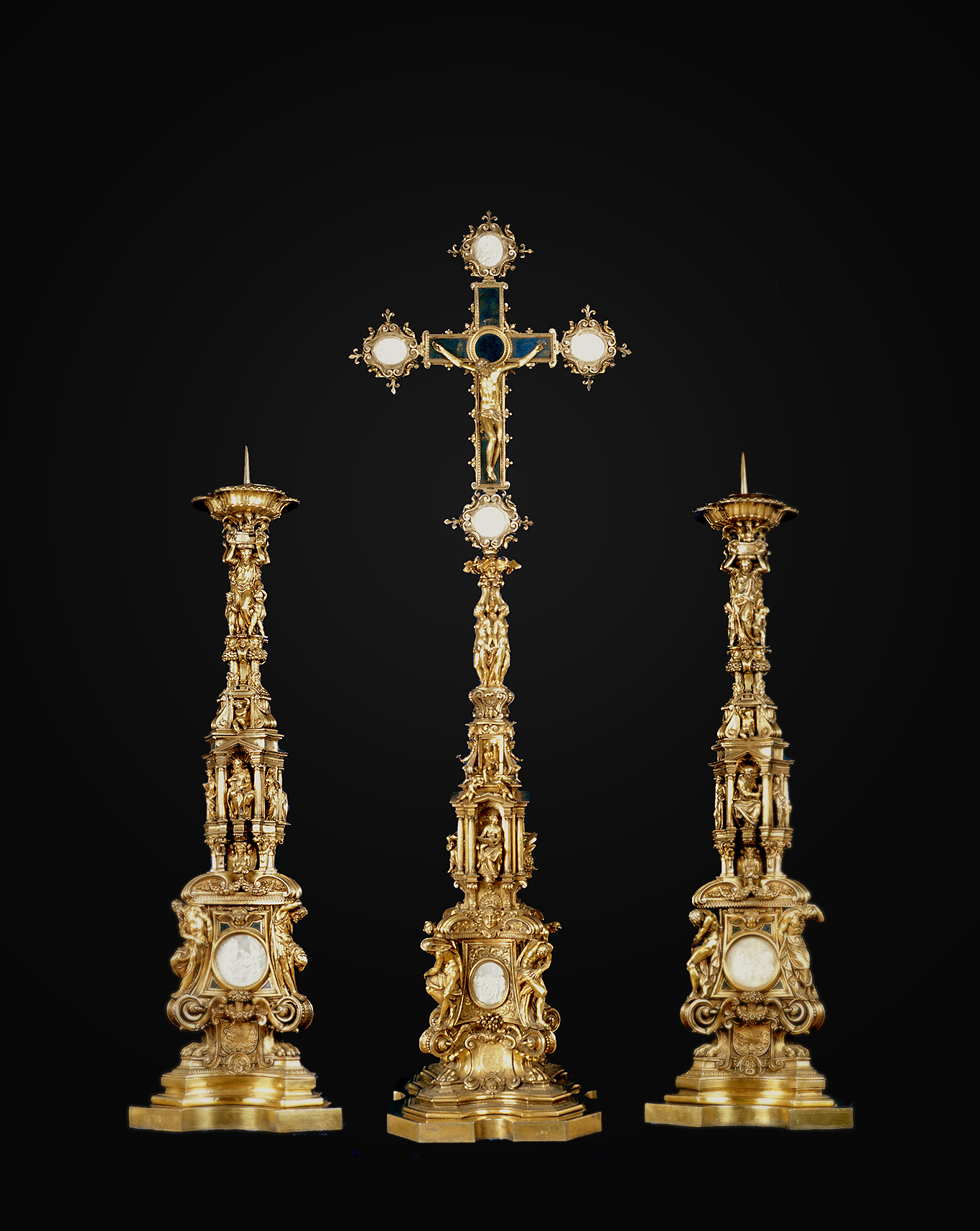
The origins of the Farnese Altar Service are traced to correspondence between the goldsmith, Manno di Bastiano Sbarri, and his patron, Cardinal Alessandro Farnese in 1561.1 Sbarri came to Rome from Florence where he had previously served as a pupil of Benvenuto Cellini.2 The Cardinal had commissioned the production of the elaborate Farnese Casket (fig. 14) from Sbarri as early as 1543,3 having completed it around 1560 following delays due to the Cardinal’s financial pressures.4 5
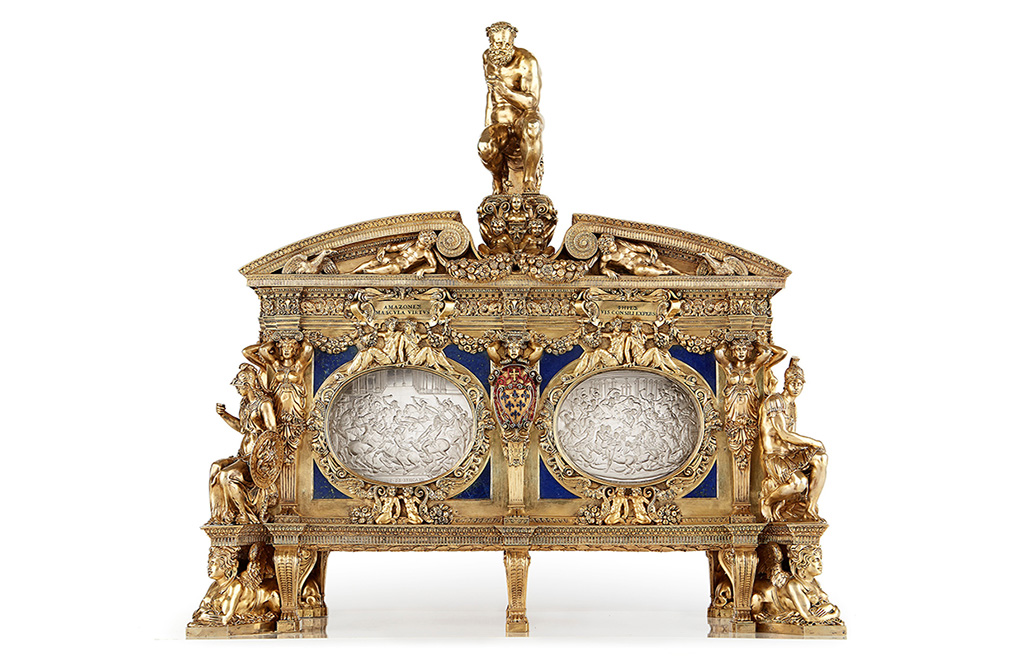
Fig. 14: Farnese Casket by Manno Sbarri (goldsmith)and Giovanni Bernardi (crystal engraver), 1543-61 (Museo di Capodimonte, Naples)
After Sbarri’s completion of the Farnese Casket, the Cardinal subsequently tasked Sbarri with new commissions for a golden altar cross, two candlesticks, a pax and figures of St. Peter and St. Paul, cited in Sbarri’s petition, on 28 June 1561, to begin work on the project6 and also reiterated in Alessandro’s will of 1574, which indicated the project was incomplete or not begun by that year.7 Sbarri’s subsequent death in 1576 left the project unfinished or altogether unbegun.
However, during the thirteen-year period in which Sbarri presided over the project, designs for the Farnese Altar Service were likely worked out. The initial designs were furnished by Francesco de’ Rossi (called Francesco Salviati) around 1548.8 9 Salviati was presumably also responsible for providing the designs for the Farnese Casket executed by Sbarri.10 Notably, the Farnese Casket has, on occassion, erroneously been thought to involve Antonio Gentili due to the similarity of materials used for both the Farnese Casket and Farnese Altar Service and both having a mutual impetus in Salviati’s imagination.
Delays in Sbarri’s realization of the Farnese Altar Service may have been due to the particular tastes and careful preferences of the Cardinal,11 notwithstanding that the production of the Cardinal’s casket had itself taken eighteen years to complete. Evidence for this lengthy process may survive in a series of goldsmith’s drawings representing what appear to be an early series of iterations on the design of the Farnese candlesticks, two of which are preserved in the Victoria and Albert Museum, and two identified in the art market.12 Each iteration is respectively dated: 1561 (fig. 15), 1562, 1564 and 1571. The earliest iteration interestingly correlates with the year of Sbarri’s petition in 1561 to begin the project.

Fig. 15: Pen and wash rendering of a Farnese candlestick featuring the date, 1561, b. 1670 (private collection)
The Farnese Altar Service shares in common with the Farnese Casket the incorporation of lapis lazuli as well as a suite of engraved rock crystals executed by Giovanni Bernardi de Castelbolognese.13 In discussing the Farnese Casket, Giorgio Vasari noted it’s crystals were based on “the cardinal’s most beautiful fancy,”14 worked after designs furnished by Perino del Vaga and “other masters.”15 At least one of Perino’s sketches for Bernardi’s crystals incorporated on the Farnese Altar Service survive: the Raising of Lazarus at the Louvre (inv. RF 539).16 Perino’s sketches for these religiously themed crystals appear derived from the decorations he made around 1538-39 for the Cappella Massimi in Trinità dei Monti, destroyed during the 19th century, of which only a fragment survives in the Victoria & Albert Museum (inv. 262-1876).17
While the Farnese Casket’s crystals reflected mythological subjects pertinent to the Cardinal’s humanist and political ambitions, the Farnese Altar Service depended instead upon religious subjects pertinent to the form and function of its sacred use. However, certain details still infer the calculated ingegno of Alessandro in its inception. This is most evident in features incorporated on the Farnese Altar Service like the armorial along the base of the altar cross depicting a ribbon bearing the Greek inscription: ΔΙΚΗΣΚΡΙΝΟΝ, meaning “Lily of Justice,” a Farnese family motto attributed to Alessandro, as described in a letter by Alessandro’s secretary, Annibale Caro, to the Duchess of Urbino.18
The continued familial theme is present also in the feature of lilies on the terminating ends of the altar cross and is likewise implied by the subtle series of lilies in the form of two volutes surmounted by an orb which serve as a type of crocket décor bordering the outer margins of the altar cross. The Farnese impresa of the unicorn (figs. 2, 9) also forms part of its imagery, symbolizing virtue overcoming vice.
The elevation of the Farnese-themed iconography present on the Farnese Altar Service is perhaps indebted to the changes made during the realization of the Farnese Casket in which some elements that could have been misread as supporting the Holy Roman Empire of Charles V, with whom tensions were mounting, resulted instead in an iconography ensuring a clear association with, and affirmation of, Farnese familial unity.19 Similar motifs were expressed during renovations of the Farnese chapel within the Palazzo della Cancelleria, overseen by Salviati during the late 1540s, and their familial emblems likewise appear at Farnese sponsored projects like Paul III’s addition to the Vatican loggie and renovations made to the library at Castel Sant’Angelo.
The particular feature of an arrow accompanying a banderole with the Greek inscription: BAΛΛ OYTΩΣ, also on the base of the altar cross, refers to Homer’s words, “strike thus,” meaning to hit the target spot-on and symbolizes success in forwarding a just cause, in this case, that of the Roman reformation of the church under Farnese auspices.20
The edification of the Farnese name on the altar service is thus a thematic and motivated calculation on the part of Alessandro and features also on the Farnese Ostensory attributed to Antonio (no. 6) which features a figural effigy and armorial in tribute to the Cardinal’s grandfather: Pope Paul III.
Apart from Vasari’s mention of Bernardi’s contribution to the Farnese Altar Service, a letter from 4 April 1546, between Alessandro and Bernardi, discusses his completion of four of the Farnese Altar Service crystals.21 Bernardi’s death in 1553 seems to have left three of the required crystals for the altar service unrealized. The scenes depicting Christ and the Captain of Capernaum, the Crowning of Christ with Thorns and an autographed crystal depicting the Healing of the daughter of Jairus22 were subsequently executed by Bernardi’s pupil and assistant, Muzio Zagaroli.23
Sbarri’s death in 1576 necessitated the Cardinal’s reassignment of the project to Antonio.24 At this time, aged fifty-nine, Antonio was already an established master, having formerly served as Chamberlain of the Confraternity of Goldsmiths in Rome and active during this period also as a member of its Consul. The Cardinal would pay a substantial 18,000 scudi for Antonio’s completion of the project.25 After four years of work Antonio delivered the project in 1581 and on 2 June 1582, the Cardinal donated the altar service to the canon of St. Peter’s Basilica, Aurelio Coperchio. The Farnese Altar Service remains in the basilica’s treasury to-this-day.
While it is unclear how much of Sbarri’s efforts were devoted to the Farnese Altar Service prior to Antonio’s inheritance of the project, some scholars have put forth various ideas about Sbarri’s potential involvement in its particular features. For example, Wolfgang Lotz suggested the aediculae and its figures of sibyls and prophets in their niches along with the figure of Christ for the crucifix and the cross, sans its terminals, were the possible work of Sbarri,26 although the crucifix is now recognized as deriving from a model by Guglielmo della Porta, to be discussed. Some of Lotz’s observations were calculated from a sketch of the base of the altar cross initially attributed to Antonio at the Cooper Union Museum in New York but more recently considered a work by Carlo Spagna who later made a series of studies of Antonio’s cross for the production of four additional candlesticks to accompany the altar service, to be discussed.27 The invention of the winged Victories circumnavigating the upper shaft and the figures of the Atlases along the base of the cross have also been suggested as Sbarri’s work.28
However, the lack of progress on the project, indicated by the Cardinal’s will of 1574 suggests it may not have progressed much, if it all, and it is evident by the Cardinal’s will that Bernardi’s crystals certainly had not yet been set into the cross and candlesticks by this time and these were certainly integrated by Antonio.29
The four dated drawings for one of the candlesticks, previously discussed, may testify to the lack of progress made during Sbarri’s tenancy of the commission.30 The group of presumed preliminary drawings for the candlestick informs that only minor edits were made to its design over a nine-year period, suggesting the Cardinal’s final approval for the candlestick’s design was a tenaciously protracted process or that the initial commission was beset by certain unknown delays, some perhaps due to changing tastes on account of church reforms. The slight differences between these designs suggest Sbarri may not have begun any tangible work on the candlestick until at least after the latest dated drawing of 1571, allowing only a period of five years to complete any of its parts. However, the large sum Antonio is paid to execute the project seems to insist he is handling the effort entirely from its outset.
On stylistic grounds, Beatriz Chadour suggested the entire altar service to be the work of Antonio and his workshop, drawing from the contemporary Mannerist influences of sculptors like Michelangelo, Guglielmo della Porta and Andrea Sansovino while embellishing his own heterogenous panache to the mix.31 Certain sculpted and decorative features of the Farnese Altar Service appear to be the product of assistants to which she assigns provisional names. Antonio’s son, Pietro, training under his father during his late teens, may also have had an involvement in some of the production. During this period, we are aware of at least one of the collaborators active in Antonio’s workshop: Carlo Boni da Faenza, who we can assume played some role in the execution of the altar service. Chadour’s suggestions that Antonio was responsible for the project carry additional weight when considering also the style, quality and exceptional figures adorning the Farnese Ostensory attributed to Antonio (no. 6).
Although Angelo Rocca’s publication, De particular ex pretioso et vivifico ligno santissimae crucis, published in Rome in 1609, cites Sbarri as the author of the cross and candlesticks,32 Antonio’s signature along the concealed support shaft for the altar cross: ANTONIO GENTILI FAENTINO F., is further evidence for Antonio’s exclusive execution of the work (fig. 16).33 Additionally, the engraved print of the altar cross (fig. 9), believed executed by Antonio, ca. 1589-1609, likewise claims his creation of the work, sans the crucifix which is omitted from the engraving possibly because Antonio desired not to claim authorship for its invention as the model was a known creation of Guglielmo della Porta’s, reproduced further by other metalsmiths connected with his workshop (nos. 7-9). C.D. Dickerson further emphasizes Antonio’s lack of claim for the original disegno of the altar cross, as implied by the manner of his signature which omits the use of the term: OPUS.34

Fig. 16: Signed mounting shaft for the Farnese Altar Cross by Antonio Gentili da Faenza, 1578-81, (Treasury of St. Peter’s, Rome)
The use of Guglielmo’s crucifix-model for the Farnese Altar Cross may have been the choice preference of the Cardinal himself notwithstanding both Guglielmo and Antonio were actively working for the Cardinal at-this-time. The Cardinal was made aware of Guglielmo’s crucifix when he received an example sent to him as a gift from Guglielmo, resulting in a letter of praise and gratitude from the Cardinal, to Guglielmo, in 1571.35 The reprisal of Guglielmo’s crucifix-model, cast and incorporated by Antonio for the altar cross (fig. 17, right), is made evident in court documents in which a trial initiated by Guglielmo’s son, Teodoro della Porta—concerning the illegal use of his father’s models by certain metalsmiths in Rome—provides a testimony given by Giovanni Battista Montano who infers Antonio’s employ of Guglielmo’s crucifix-model for inclusion on the Farnese Altar Cross.36 Other metalsmiths like Guglielmo’s collaborator, Bastiano Torrigiani, likewise reproduced and slightly reinterpreted this same crucifix-model in gilt bronze for an altar cross commissioned by Pope Gregory XIII in 1583, also preserved today in the treasury of St. Peter’s Basilica.37 Guglielmo’s crucifix-model was likely further reproduced by Antonio and Torrigiani, several additional casts of which have been ascribed to these metalsmiths.38 Guglielmo’s workshop certainly produced a great number of them as adjudged by the quantity of crucifixes remaining in his workshop after his death.39
Antonio observably embellishes Guglielmo’s original crucifix-model with his own interpretive form and style by removing the sign of blessing made by Christ’s proper right hand, raising his arms approximately 1.2 cm, and centering Christ’s head over his chest. More importantly, Antonio tempers Guglielmo’s model, reducing the stress of Christ’s musculature while softening the features of his face. He also exchanges Guglielmo’s signature inverted triangular umbilicus with a circular one and transforms the tousled sinewy strands of Christ’s hair into a subdued form that is less bodied while the beard is given more volume and is shortened (fig. 17).
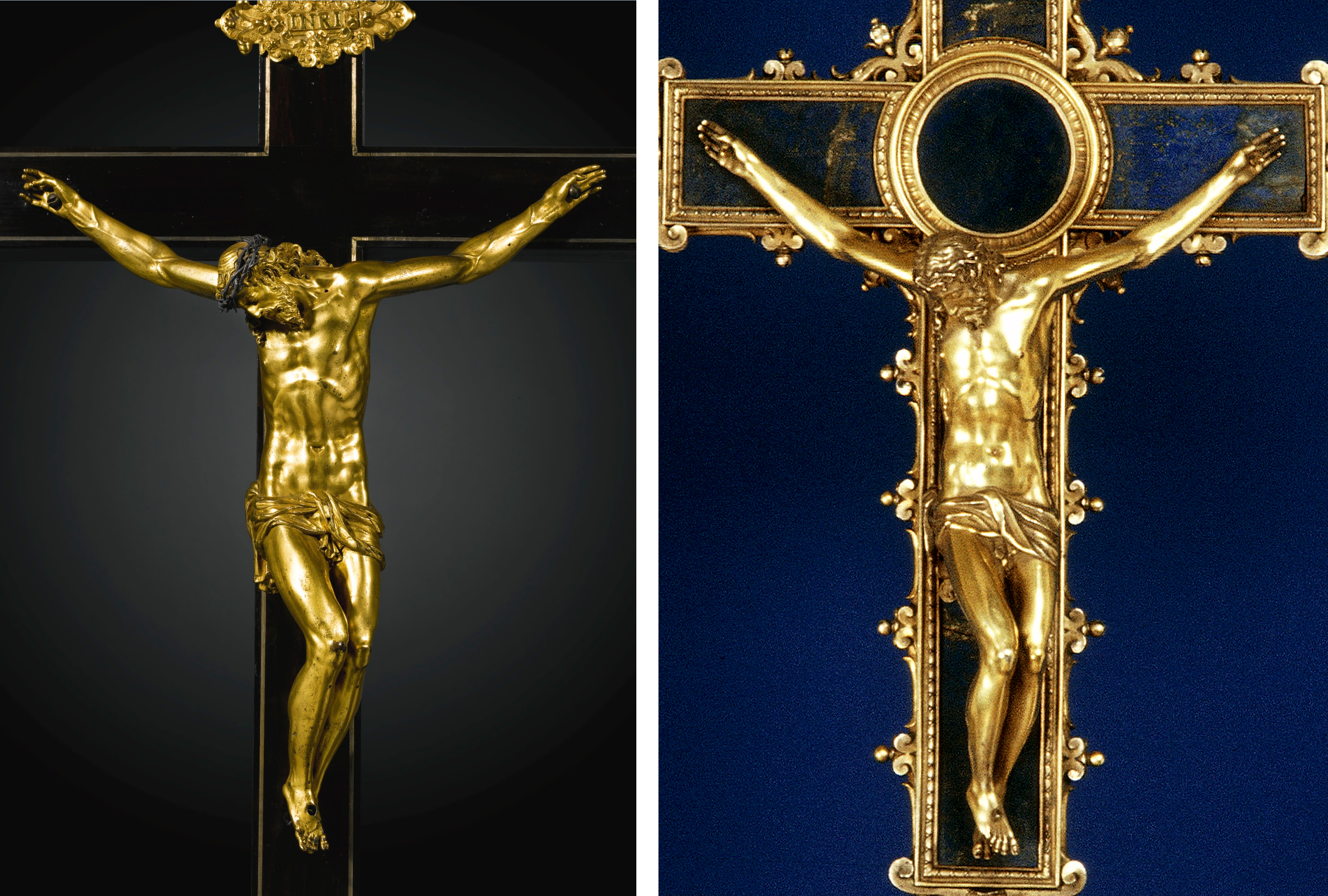
Fig. 17: A gilt copper crucifix attributed to Guglielmo della Porta, ca. 1570 (left; Capponi family, Rome); detail of the Farnese Altar Cross, Antonio Gentili, 1578-81, after a model by Guglielmo della Porta (Treasury of St. Peter’s, Rome)
This reserved treatment and tempering of Guglielmo’s model allows further comparisons between Guglielmo’s own workshop casts of his inventions and those casts produced alternatively in Antonio’s workshop. This same treatment is observed in other casts Antonio executes after Guglielmo’s models like his relief of Mount Calvary (nos. 7-9), the Risen Christ (no. 10), and Flagellation of Christ (no. 11). Satisfying comparisons may also be drawn with a gilt silver corpus Guglielmo made as a gift for Maximilian II of Austria in 1569, preserved in the Kunsthistorisches’s Geistliche Schatzkammer in Vienna.40 The softened features and matte-like finishing of this crucifix are indicative of Antonio’s casting quality and may be a work cast by Antonio on behalf of Guglielmo, who, during this period, was actively collaborating with him on the realization of twelve reliquary busts for Pope Pius V in 1570 (no. 14).41
The format for the Farnese Altar Service project, by the time of Antonio’s adoption of it in 1578, appears to lack the pax and figures of Sts. Paul and Peter initially forming part of the original commission. Chadour notes that the group consisting of a central altar cross inclusive of a figure of Christ and its flanking candlesticks are in-keeping with the reforms instituted by Pope Pius V, beginning in 1566, and reaching a standardized formula in his 1570 Missale Romanum, possibly influencing Alessandro’s choice reduction of the overall project, although the Farnese Ostensory could be a later incarnation of the original commission, if not the product of Alessandro’s patronage or possibly that of Cardinal Odoardo Farnese, who had commissioned the binding for the Farnese Hours from Antonio (no. 4).42 The figures of Sts. Peter and Paul on the ostensory almost certainly have their impetus in the original vision for the Farnese Altar Service suite.
Concerning the materials for this ambitious project, the records of Giacomo Grimaldi, preserved in the Vatican, suggest the silver provided to be used for the Farnese Altar Service had been sourced from the remnants of Charlemagne’s cross, melted down in 1550.43 The cross was a donation given by Charlemagne on the occasion of Pope Leo III’s coronation in 800. However, the matter is much more complicated and the silver melted down in 1550 appears to instead derive from the remnant of a gilt silver crucifix donated by Pope Innocent II during the 12th century, the weight of which was a staggering 100 pounds.44
As previously noted, in 1670, the Archpriest of the St. Peter’s Basilica, Cardinal Francesco Barberini, commissioned the stem of the Farnese Altar Cross to be lengthened, recruiting the Roman goldsmith, Carlo Spagna, to execute the embellishments in addition to creating four additional candlesticks to enlarge the suite, completed between 1670-72.45 Spagna’s modification to the altar cross incorporates a voluted knop featuring the Barberini familial bee-motif just below the upper stem portraying the Victories.
It is to be wondered if Barberini, at this time, may have also removed what could have been an enameled Farnese armorial presumably once featured on the altar cross. It is unusual that the cross lacks this accoutrement which appears on both the Farnese Casket by Manno Sbarri and the Farnese Ostensory attributed to Antonio.46
No. 2
Gold setting for a Bust of Caesar Augustus
Colored glass paste bust on a modeled gold body mounted to an agate base
Antonio Gentili da Faenza and workshop; Rome, Italy (goldsmithing)
1580; commissioned by the Grand Duke of Tuscany, Ferdinando de Medici
Museo degli Argenti, Palazzo Pitti, Florence
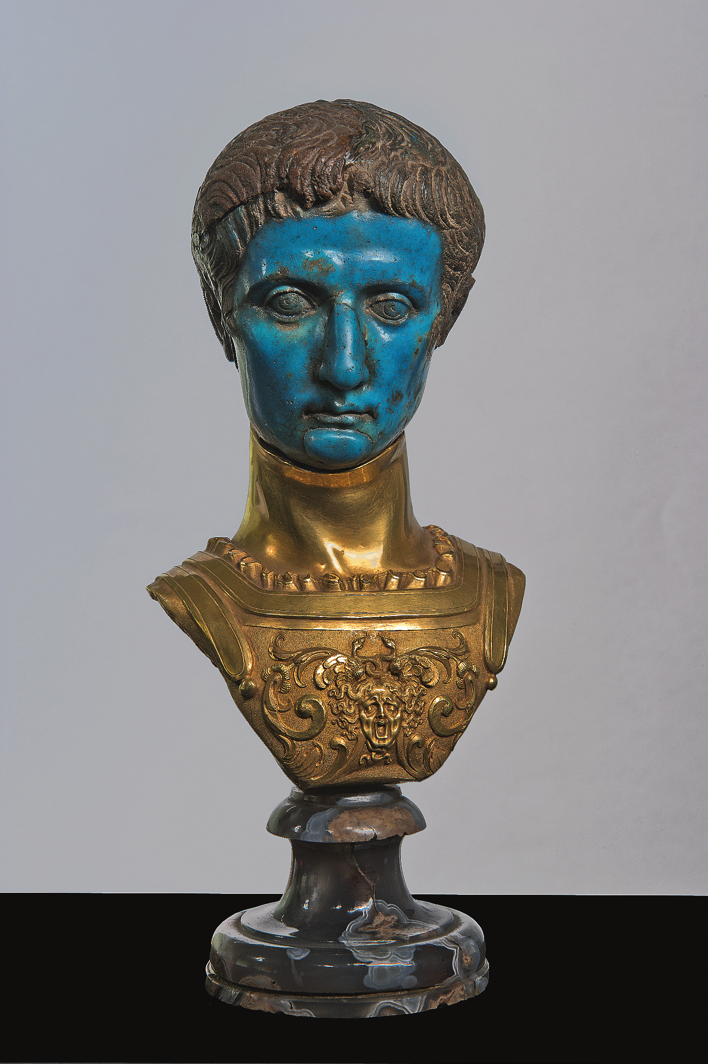
The golden setting for a glass paste bust of Emperor Caesar Augustus is the only securely identified work by Antonio during his period of activity for the Medici. An entry in the Medici inventories, kept in the State Archives of Florence, confirms Antonio’s creation of the setting for the bust.47 However, a silver pax featuring a relief of the Risen Christ Surrounded by Apostles, still residing in the Treasury of the Grand Dukes at the Pitti Palace in Florence (no. 10), is another possible vestige of Antonio’s activity under Medici patronage.
Antonio’s setting displays a turquoise-colored glass paste bust of Emperor Augustus, mistakenly identified in earlier literature as a bust of Emperor Tiberius.48 49 Antonio’s setting is exquisite in detail and refinement, being a testament to his skill during this central point of his career. The bust pivots gracefully upon Antonio’s all‘antica invention of a Roman cuirass whose subtle scarf bursts eloquently from the neckline while the armored portion introduces serpentine-inspired volutes and acanthi tendrils which frame the grotesque effigy of Medusa. Antonio’s frequent use of volutes and his talent in rendering masks in low-relief are brought to bear in this stunning example of delicate and refined workmanship.
Antonio appears to have referenced a contemporary knowledge of antique military attire, born from the availability of antiquities in Renaissance Rome and probably also indebted to circulated sketches like those preserved in the Uffizi (invs. 548O, 549O). His familiarity with the Trajan column may also have suited well for this project.
The agate base of the bust may have been furnished by the stone carvers later active in the Opificio delle Pietre Dure, established in 1588 under the auspices of Ferdinando de’ Medici, by then the new Duke of Tuscany, and responsible for precious works executed in colored stone. Two other works for the Medici that were made by Antonio from this period likewise incorporate agate elements, like the orbs serving as the feet for a silver and gold tabernacle he executed in June of 158250 (no. 25) and a golden band or setting he made for a small agate cup, perhaps antique, made probably ca. 1580-82 (no. 23).51
No. 3
Book binding for the Farnese Hours
Engraved and openwork parcel gilt silver
Antonio Gentili da Faenza and workshop; Rome, Italy (silverwork)
1589-94; commissioned by Cardinal Odoardo Farnese
Pierpont Morgan Library, NY (inv. Ms M.69a)

Antonio’s authorship of the intricate cover binding for the Farnese Hours—an illuminated devotional work completed in 1546 by Giulio Clovio and commissioned by Cardinal Alessandro Farnese—is found in the 1653 inventory of assets belonging to the Palazzo Farnese in Rome.52 The binding was commissioned by Alessandro’s grand-nephew, Cardinal Odoardo Farnese, who inherited the manuscript from Alessandro after his death in 1589.53 Odoardo thereafter commissioned Antonio to replace the original soft leather binding of the manuscript,54 formerly enclosed by two red silk ribbons, as observed in El Greco’s portrait of Clovio at the Museo Nazionale di Capodimonte in Naples.
The book may have seen some regular use as the original metal clasps belonging to Antonio’s binding are lost. The binding’s interior front cover plate is engraved with the name and arms of Cardinal Alessandro Farnese while the interior back plate is engraved in alike manner with the name and arms of Cardinal Odoardo Farnese (fig. 8).55
Antonio’s elaborate program of openwork and solid gilt silver plates forming the binding is in-keeping with contemporary tastes of the period and is evocative of high Renaissance Mannerist modalities. The corners feature the Farnese ‘Lilies of Justice’ while the border of each cover features a remarkable series of eight mascarons. This elaborate series of distinctive masks recalls those also featured along the reverse of the crucifix belonging to the Farnese Altar Cross (no. 1., see also fig. 29 right), which depicts a group of six similarly realized faces. Antonio may have employed one or more of the same workshop models in the execution of these two projects.
Each cover is distinguished by a central low-relief figure set within a cartouche. The recto depicts an Angel of the Annunciation whose fiery-hair recalls Antonio’s treatment of an angel on his cast version of a Mount Calvary relief by Guglielmo della Porta (no. 9), while the verso of the binding depicts a figure of the Virgin Mary who shows a stylistic comparativeness with a relief of Doubting Thomas, attributed in this catalog to Antonio (no. 12, fig. 32). The grace of modeling in each of these two figures on the Farnese Hours are expertly realized and point to the talent of Antonio as a modeler in low-relief. Each central cartouche is flanked around each corner by further remarkably modeled metamorphic foliate half-figures which may have an impetus in designs like a Triton holding a Vase attributed to the school of Perino del Vaga (fig. 18).56

Fig. 18: Ink and wash of a Triton holding a Vase, attributed to the school of Perino del Vaga (Louvre, inv. 35298, recto)
A simple non-gilt silver applique frame brings the entirety of Antonio’s design together with a superb graphic appeal that both harmonizes its varying parts and altogether frames its elegantly illustrious features.
Beyond Antonio’s expertise in the design of this project, his brilliance in the facture of this work showcases his technical skills through the clever use of multiple hidden metal hinges that secure various portions of the manuscript leaves together. The leaves themselves have lost their original sewn vellum stitching in favor of a neatly stitched gold or silken string stitching,57 which we might wonder could be the workmanship of the goldsmith shops that worked out the fine gold threads for incorporation on luxuriant tapestry productions of the period.
The significance of Clovio’s illuminations and Antonio’s binding have resulted in various facsimiles produced after the original, most recently in limited standard and luxury editions by Ziereis Faksimiles in Regensburg, Germany in 200158 and earlier, in-part, by Webster Smith in 1976.59
No. 4
The Skills of a Prince
Silver plaque in high-relief inset with engraved crystal portraits
Antonio Gentili da Faenza and workshop; Rome, Italy (modeling)
Cristoforo di Gaspare Vischer; Rome, Italy (casting, finishing)
Simone Saracchi (?); Milan, Italy (engraved crystals)
January 1597; probably commissioned by the Duke and Duchess of Savoy for the Doge of Venice
Museum Collection

The present work is a hitherto unknown late production involving Antonio, indicated by a freely engraved note along the lower left base of the relief: Antonio Gentilis . Faentinus . aurifex . sculpsit . – An . II . 1597 . suae . act LXVI – (fig. 19, below). The inscribed text is not original to the finished work as indicated by its freehand nature and is apparently intended to record data about the object on behalf of its owner, the Doge of Venice, Marinus Grimani, as specified by additional text inscribed along the lower margin of its central cartouche: devote animo Marinus Grimani 11 Martius 1597 (fig. 19, above).

Fig. 19: Detail of the Skills of a Prince silver plaque by Antonio Gentili da Faenza and workshop, 1597, with later freehand inscriptions along the lower margin of the relief’s central cartouche (above) and left lower base (below) (Museum Collection)
These inscriptions indicate Grimani received the object on 11 March 1597, but his age, 66 (indicated by the numerals in the left-most inscription), suggests the inscriptions on the plaque were made sometime after the Doge’s 66th birthday on 1 July 1597. That the work was embellished with these inscriptions not long after its receipt, suggests an importance on the part of its owner to document and record its history and origin. In the summer of 1596 Grimani had only recently established his Statuario Pubblico, in which an inventory of antiquities was made, perhaps stimulating a continued attention toward preserving historical data for sake of posterity.60 As will be discussed, the plaque was likely a gift to the Doge in celebration of his marriage that year and one of numerous precious gifts marking that occasion which may have also resulted in an evident need to record its origin.
A third inscription along the lower right base of the relief: Joan Sadeler inv. Et delineavit . – , informs that the relief is based upon a work by Jan Sadeler the Elder. In particular, the relief is based upon Sadeler’s engraved frontispiece for the Schema, sev Speculum Principum, printed in Venice in 1597, which depicts the figures of Authority, Nobility and Benevolence: the three important qualities of a prince and the overarching subject of that book (fig. 20). The frontispiece is indebted to original designs executed by Jan van der Straet whose preliminary sketches for Sadeler’s copper engraving are found in the Morgan Library in New York (inv. 1979.14:4) and Teylers Museum in Haarlem (inv. N 004).61
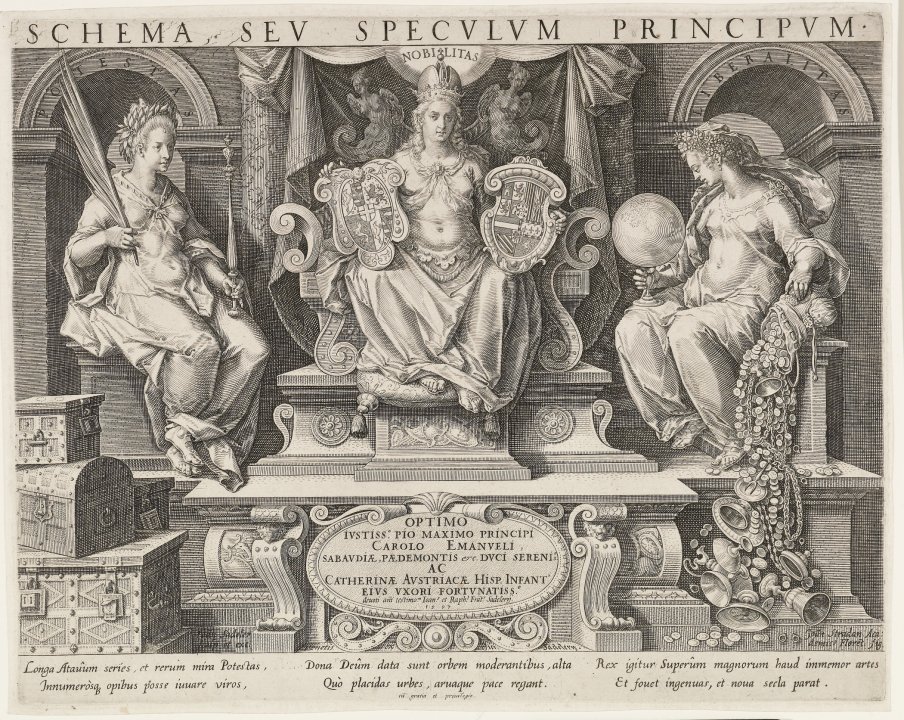
Fig. 20: Engraved frontispiece for the Specvlvm Principvm by Jan Sadeler I, 1597, after Jan van der Straet (Albright-Knox Art Gallery, NY)
It is to be assumed Antonio was aware of Sadeler’s finished engraving through a proof print as the plaque slightly predates the official publication of the book, presumably by only a few months. Antonio’s access to such a proof is within reason considering his earlier exploits in the realm of engraving like the publication of the Historia utriusque belli Dacici a Traiano Caesare gesti in 1576, in which Antonio probably served as the general contractor responsible for organizing the engraving of 130 plates, notwithstanding his own possible involvement in the preparation and execution of some plates62 or Teodoro della Porta’s belief that Antonio may have sold some of his father’s drawings to the Roman printer, engraver and dealer: Giovanni Orlandi.63
In Sadeler’s engraving, the central figure of Nobilitas holds the coat-of-arms of the Duke and Duchess of Savoy, creatively featured on the relief as individually engraved crystal plaques mounted in silver appliques. The appliques are attached through piercings on the hands and thighs of Nobilitas. Lacking are the accoutrements—probably originally cast in silver—held in the extended hands of Power and Benevolence which may have once been suspended or loosely fitted and thus easily lost. In particular, a piercing along the lower right base of the relief, just above the Sadeler inscription, shows where the accessory held by Benevolence was originally mounted.
While the central relief of the plaque faithfully follows Sadeler’s engraving, its inventive framed border confirms Antonio’s involvement in the project. The frame features the distinct scrolling volutes and clusters of figs typical of the visual schema in Antonio’s other productions like his altar service for Alessandro Farnese now kept in the treasury of St. Peter’s Basilica in Rome (no. 1). However, the present work was realized at the end of Antonio’s prolific career and three years after his decade-long tenure as Assayer of the Papal Mint had ended.64 At seventy-eight years-of-age his involvement in this production was perhaps more administrative with an emphasis on design and its technical construction. Antonio would have also been greatly occupied with the ambitious silver cross he was producing with his son and protégé, Pietro, for the Monastery of San Martino in Naples (no. 37). Particularly informative of this preoccupation is the interesting hallmark depicting a prancing horse, indicating the relief’s casting and finishing was undertaken by the silversmith Cristoforo di Gaspare Vischer and not by Antonio (fig. 21).

Fig. 21: Detail of the Skills of a Prince by Antonio Gentili da Faenza and workshop, 1596, featuring the hallmark of Cristoforo Vischer (Museum Collection)
Antonio’s delegation of the casting and finishing to Vischer was probably on account of Antonio’s possible presence in Naples during the time in which the relief was due to be cast. Antonio appears to have been actively traveling between Rome and Naples between 1594-98 and may have depended on a confidante in Rome to complete the project.65 It is reasonable to presume Vischer could have been an earlier assistant or collaborator of Antonio’s in Naples and possibly also worked with him on the early production for the silver cross at San Martino, a project begun in 1593 (no. 37). Vischer himself was likely active in Naples as a silversmith from around 1595, and just prior to his documented activity in Rome as early as 1604.66 He continued to travel to Naples later in his career, for example.67 The feature of Vischer’s hallmark on the Skills of a Prince is new evidence of his presence in Rome as early as 1597.
The finish-treatment of the figure’s draperies are more in-keeping with the advent of the early Italian Baroque and are beautifully executed in short wave-like striations that follow the drapery’s undulating folds. The high-quality execution of the present relief is discovered further in its finish-work which is managed with extraordinary patience and talent. Of note are the chased-and-punched pattern-work of the curtains flanking the throne of Nobility, the carefully peened surface texture for flesh and the exquisitely treated draperies of the figures, already noted. These features may be emphatic of Vischer’s post-casting talents and an indication of why he was able to later establish himself as a preeminent silversmith in Rome during the first part of the 17th century.68
It is also probable Antonio’s son, Pietro, adopted some responsibility for the relief’s execution. Informing of this is the firmer countenance of the protagonists which lack the suave character of Antonio’s earlier productions. Documents cite Pietro’s participation in the production of the Monastery of San Martino crucifix in Naples, similarly featuring a combination of statuettes and relief work,69 begun only four years prior to the production of the Skills of a Prince. In 1597, Pietro would have been approximately thirty-five years-of-age and soundly capable in his trade as his father was when he became qualified as a goldsmith at approximately the same age.70 Additionally, Antonio still operated an occupied workshop during this late period as evinced by the presence of at least one assistant, Baldo Vazzano da Cortona, during the 1590s and early 1600s.71
The plaque is secured to a backing by a folded toothed border and the backing itself is wrapped in old, perhaps contemporary crimson velvet with glued sheets pasted thereunder, presumably formed from excerpts of pages from an early treatise on Roman Canon law. A concealed suspension loop on the reverse indicates the work was intended for wall display and not for setting into a cabinet or other utilitarian object.
The overall program of the present relief, incorporating crystals, echoes several of Antonio’s other projects involving the integration of precious objects in silverwork like his feature of carved rock crystals on the aforenoted Farnese Altar Service, and the feature of a reverse-painted rock crystal on an ostensory also made for the Farnese and now kept in the collections of the Smart Museum in Chicago (no. 6). Also notable is Antonio’s documented incorporation of crystals on a silver reliquary executed for Pietro Fonseca, the Father General of the Society of Jesus, in 1578 (no. 20),72 or more specifically, the incorporation of crystals from Milan, featured in a lavish, now lost, silver and gold tabernacle completed in June of 1582 for the Medici (no. 25).73
The origin of the engraved crystals featured integral with the present plaque may be reasonably linked to the couple they represent: Charles Emmanuel I, Duke of Savoy and his wife, the Duchess of Savoy, Catalina Micaela of Spain, who were also responsible for commissioning the publication of the Speculum Principum (fig. 22). The couple were conceivably the patrons of this present work, apparently intended as a gift for the Doge of Venice, Marinus Grimani on 11 March 1597, as indicated by the freely inscribed text along the lower margin of its central cartouche. The gift preempts Catalina’s death by less than eight months74 and was likely given to the Doge in celebration of his forthcoming wedding to Morosina Morosini, future Dogaressa of Venice who was extravagantly coronated in May of 1597.75 The remarkable plaque would have been one of many luxurious gifts received by the Doge and Dogaressa on account of the festivities and likely resulted in the need to record the origins of the work and its connection with Antonio, as adjudged by the inscriptions previously discussed.

Fig. 22: Detail of the Skills of a Prince by Antonio Gentili da Faenza and workshop, 1596, depicting engraved rock crystals representing the Duke and Duchess of Savoy, possibly by Simone Siracchi, after Annibale Fontana (?), ca. 1590-96 (Museum Collection)
Documents close to this time indicate Charles and Catalina commissioned other objects of artistic virtuosity, intended as gifts, like those for Catalina’s sister, Isabella Clara Eugenia and another for Queen Margaret of Austria.76 The family also personally prized virtuous artworks made in crystal, like Charles’ father who, on the occasion of the couple’s wedding in 1585, commissioned very expensive works from the Saracchi dynasty of crystal artisans in Milan. Furthermore, Charles’ own commissions from the Saracchi and his individual purchase of other works like an engraved crystal plaque depicting Christ at the Column by Annibale Fontana in 1594, are further indication of their tastes in this medium. After Catalina’s unexpected early death, Charles continued to offer further gifts involving works in crystal, such as a pax for Cardinal Granvella upon recommendation from Savoy’s ambassador to Milan: Giacomo Antonio Della Torre.77
In addition to the Saracchi, Catalina may also have had an earlier awareness of Antonio’s productions by way of her father, King Philip II of Spain, who on 31 December 1584, had received a gilt silver chrismatory made by Antonio for the reliquaries of San Lorenzo in the treasury of Seville Cathedral, gifted to him by Francesco I de’ Medici, the Grand Duke of Tuscany (no. 33).78 Additionally, two golden crosses with relics set behind rock crystal windows, executed by Antonio, were both sent to Spain, probably as gifts to Philip II and his court in October of 1581 and February of 1583, also from the Medici (nos. 24, 26).79 Charles may likewise have had an intermediate awareness of Antonio’s work by way of his appreciation for Cardinal Alessandro Farnese’s collections. In 1583, Charles purchased the Roman collection of Girolamo Garimberti who had once served as a consultant to Alessandro Farnese and his collection of antiquities.80 As a regular patron of Alessandro, Antonio’s name may have been in proximity with Charles’ pursuit for the most extraordinary works-of-art.
Based on stylistic grounds and the evident commerce between them, the two crystals featured on this plaque are conceivably the work of the Saracchi family, and specifically Simone Saracchi who is most noted during this period for his talents in intaglio crystal engraving.81 In the production of such profile portraits a visual source would have been referenced for their execution, and most often a coin or medal. Although untraced in modern times, a probable source for the crystal portrait of Charles is found in the 18th century numismatic collection of the Milanese Viscount, Gisbertus Franco, who cites a singly known silver portrait medal of Charles bearing the same inscription.82 It’s possible such a medal, and presumably a lost pendant medal of Catalina, could have been executed by Annibale Fontana, a documented medal-maker who was himself married into the Saracchi family and frequently provided designs for the Saracchi workshop.83
Endnotes – Autograph Works:
1 Wolfgang Lotz (1951): Antonio Gentili or Manno Sbarri? in The Art Bulletin, 33(4), pp. 260-262.
2 Benvenuto Cellini (1558-63, trans. Guglielmo Piatti, 1829): Vita di Benvenuto Cellini : orefice e scultore fiorentino, vol. I, p. 381.
3 Giorgio Vasari (1568): Le vite de più eccelenti pittore scultori ed architettori scrite da Giorgio Vasari, pittore aretino, vol. V.
4 Lucia Fornari Schianchi and Nicola Spinosa (1995): I Farnese, Arte e Collezionismo (ex. cat.), Parma, Munich, Naples, no. 149, pp. 148-51.
5 Aldo de Rinaldis (1923): Il Cofanetto Farnesiano del Museo di Napoli in Bollettino d’Arte, no. 24, pp. 145-65. These financial pressures are regarded in letters Sbarri addressed to Alessandro on 7 November 1556, 22 December 1558 and 22 June 1561.
6 ‘…poco innanzi alla partita di V. Ill.ma S.ria quella mi commesse che io dovessi attendere alla Croce et alli Candelieri. Io ho dato ordine, et posso, ad ogni hora che V. Ill.ma S. vorrà, cominciar a lavorare…’ in Mario Salmi (1928-29): Dedalo, vol. IX, p. 97.
7 For excerpts from Cardinal Alessandro Farnese’s will of 1574, formerly kept in the Archivio di Stato di Napoli but destroyed during WWII, see W. Lotz (1951): op. cit. (note 1).
8 John Forrest Hayward (1977): Roman Drawings for Goldsmiths’ Work in the Victoria and Albert Museum in The Burlington Magazine, vol. 119, no. 891, pp. 412-21; Gianvittorio Dillon (1989): Novità su F. Salviati disegnatore per orafi in Antichità viva, XXVIII, 2-3, p. 48; Catherine Monbeig Goguel (1998): Il disegno in Francesco Salviati in Francesco Salviati, 1510-1563, o la Bella Maniera. Electa, Milan, pp. 31-46.
9 A drawing by Salviati for the Farnese Altar Service is preserved in the National University Library of Turin. Cinzia Piglione (2000): Le Arti Minori nei secoli XV e XVI: Centri di produzione in Italia. Milan, p. 49.
10 Christina Riebesell (1995): La Cassetta Farnese in I Farnese: Arte e Collezionnismo. Milan, pp. 58-69.
11 Clare Robertson (1992): Il Gran Cardinale: Alessandro Farnese, Patron of the Arts. Yale University Press.
12 J. Hayward (1977): op. cit. (note 8). Hayward reproduces all three candlestick drawings with exception of the art market example we publish here (fig. 15). The V&A inventory numbers are not cited by Hayward. The art market examples include one auctioned in Weinmuller Versteigerungskatalog, Munich, 1938, lot 732 (there attributed to Alessandro Vittoria), rediscovered by the present author at a sale in Vienna, Austria at Im Kinsky auction house, 26 April 2017, lot 609 and another from the Houthakker collection in Amsterdam, see Peter Fuhring (1989): Design into Art: Drawings for Architecture and Ornament. The Lodewijk Houthakker Collection. Scala books.
13 Wolfgang Frtiz Volbach (1948): Antonio Gentili da Faenza and the large candlesticks in the Treasury of St. Peter’s in The Burlington Magazine, October 1948. See also G. Vasari (1568): op. cit. (note 3), his Vite on Valerio Belli and Aldo de Rinaldis (1923): Il Cofanetto Farnesiano del Museo di Napoli in Bollettino d’Arte, no. 24, pp. 145-65. Bernardi’s suite of engraved crystals for the Farnese Casket were realized between 1539-47.
14 G. Vasari, ibid.
15 G. Vasari, ibid. See also Ernst Kris (1929): Steinschneidekunst in der italienischen Renaissance. Vienna, pp. 64-71.
16 Elena Parma Armani (2001): Perino del Vaga tra Raffaello e Michelangelo (ex. cat.), Mantua, Palazzo Te, March 18-June 10, Milan, nos. 139-142.
17 John Gere (1960): Two late fresco cycles by Perino del Vaga: the Massimi Chapel and the Sala Paolina in The Burlington Magazine, CII, pp. 9-14.
18 Girolamo Ruscelli (1566): Le imprese illustri.Venice, pp. 45-46.
19 Patrizia Piscitello (2022): Inventori, artieri e maestri di stile: l’officina della Cassetta Farnese in I Farnese: Architettura, arte, potere (ex. cat., Parma, Milan), Electa, pp. 180-85.
20 Patricia Rubin (1987): The Private Chapel of Cardinal Alessandro Farnese in the Cancelleria, Rome in Journal of the Warburg and Courtauld Institute, vol. 50, pp. 82-112.
21 Alessandro had apparently saved the crystals for an important project, eventually deciding to incorporate them on the altar service. This calculated ambition may have been the result of showcasing his ingegno, in which the taste and vision of the patron was just as important as the disegno of an object. This may also explain why Alessandro was quick to donate the masterpiece to the institution he served. For a discussion on patrons and ingegno see Luke Syson and Dora Thornton (2001): Objects of Virtue: Art in Renaissance Italy. British Museum Press, London, pp. 135-81 and C.D. Dickerson III (2008): The “Gran Scuola” of Guglielmo della Porta, the Rise of the “Aurifex Inventor” and the Education of Stefano Maderno in Storia dell’arte, 121, pp. 25-71.
22 The rock crystal features Muzio’s signature: MUZIU S.Z.A.F.
23 Anna Beatriz Chadour (1980): Antonio Gentili Und Der Atarsatz von St. Peter. Westfälische Wilhelms-Universität, PhD. thesis, pp. 38-45.
24 Rosario Coppel (2012): Guglielmo della Porta: A Counter-Reformation Sculptor. Coll & Cortes, pp. 53-54.
25 Christina Riebesell (1998): Francesco Salviati (1510-1563) o la Bella Maniera (ex. cat.), curated by C. Monbeig Goguel. Milan, pp. 256-258.
26 W. Lotz (1951): op. cit. (note 1).
27 Rudolf Berliner (1951): Two Contributions to the Criticism of Drawings Related to Decorative Art: I in Art Bulletin, XXXIII, pp. 51ff. The present author tends toward Berliner’s belief that this could be a drawing by Antonio. The reverse of the sheet features a Pietá sketch that closely resembles the design for a relief the present author thought could be a possible work by Antonio, previously ascribed to an anonymous Northern artist or possibly an Italian one. The near exclusive feature of this relief in Italian pax frames of Roman origin seem to suggest such a possibility. Michael Riddick (2019): The Paxes and Reliefs of Antonio Gentili da Faenza. Renbronze.com (accessed February, 2024), see fig. 15.
28 Marina Cipriani (2000): Gentile, Antonio, detto Antonio da Faenza in Dizionario biografico degli italiani, vol. 53, Roma, Istituto dell’Enciclopedia Italiana.
29 W. Lotz (1951): op. cit. (note 1).
30 J. Hayward (1977): op. cit. (note 8).
31 A. B. Chadour (1980): op. cit. (note 23).
32 ‘Anno 1550 in usus sacraria basilicae conflates et conversus in calices, in crucem altaris pulcherrimam inauratam cum duobus candelabris magnis argenteis, quae a Manno Pisano aurifice egregio opera fabrefactae, item in duas Petri et Pauli apostolorum statuas ad usum altaris a domino Manno elaborates, atque in sex alia candelabra minora, ut notant libri sacristiae dicti anni, relicto schemate et exemplo dicti sanctissimi crucifixi in eodem sacrario ad hanc diem.’ Reproduced in W. Lotz (1951): op. cit. (note 1).
33 ANTONIO GENTILI FAENTINO F.(ecit) / Antonio Gentili of Faenza made this.
34 C.D. Dickerson (2008): op. cit. (note 21), see his footnote 126, p. 56.
35 Alessandro’s letter to Guglielmo was written on 8 December 1571 stating: “I have received the crucifix that it was your pleasure to send me and because it is a work of such merit and made with so much care and diligence by such a perfect hand as your own, it has pleased me so much, to the furthest extent to which I can express myself, and indeed I know not of any image that could be sculpted with greater mastery and more skill than this one, so the greater is my gratitude to you.” From the State Archives of Naples, reproduced in R. Coppel (2012): op. cit. (note 24).
36 Antonino Bertolotti (1881): Artisti lombardi a Rome nei secoli XV, XVI, XVII. Studi e ricerche negli archivi romani, 2 vols., Milan.
37 Anna Beatriz Chadour (1982): Der Altarsatz des Antonio Gentili in St. Peter zu Rom in Wallraf-Richartz-Jahrbuch, vol. 43.
38 Werner Gramberg (1981): Notizien zu den Kruzifixen des Guglielmo della Porta und zur Entstehungsgeschichte des Hochaltarkreuzes in S. Pietro in Vaticano in Münchner Jahrbuch der bildenden Kunst, XXXII, pp. 95-113.
39 A. Bertolotti (1881): op. cit. (note 36), vol. 1., p. 142.
40 23 May 1569, Vienna, State Archives, Varia fasc. 4. Published by W. Gramberg (1981): op. cit. (note 38), p. 96. See also Werner Gramberg (1964): Die Düsseldorfer Skizzenbücher des Guglielmo della Porta. Berlin, 3 vols., p. 96.
41 Werner Gramberg (1960): Guglielmo della Porta, Coppe Fiamingo und Antonio Gentili da Faenza in Jahrbuch der Hamburger Kunstsammlungen, V, pp. 31-52.
42 A. B. Chadour (1980): op. cit. (note 23), pp. 46-50.
43 Giacomo Grimaldi (1619-21): Liber de sacrosanto sudario Veronicae in Miscellanea Bibliothecae Apostolicae Vaticanae.
44 For an in-depth survey on this matter see Katharina Christa Schüppel (2013): The stucco crucifix of Saint Peter’s reconsidered in Old Saint Peter’s, Rome. Cambridge University Press, pp. 306-23.
45 A. Colasanti (1909): Il Tesoro della basilica Vatican in Emporium, XXX, pp. 405, 409, 412-414.
46 A. B. Chadour (1980): op. cit. (note 23), pp. 110-16.
47 Medici Archivio, Guardaroba, filza 79. Invetarij Generale a Casi A. 1571-1588, fol. 23r.
48 A. B. Chadour (1980): op. cit. (note 23), pp. 172-73. See also Grazia Maria Fachechi (2011): Varietas delectate: towards a classification of mixed-media sculpture in the Middle Ages in Peregrinations: Journal of Medieval Art and Architecture, vol. 3, no. 2, pp. 162-77.
49 For discussions of this bust see Mario Scalini (2008): Le ragioni della mostra: aspetti della fortuna dei materiali antichi nella rinascita delle arti dalMedioevo al Rinascimento in Augusta fragmenta. Vitalità dei materiali dell‟antico da Arnolfo di Cambio a Botticelli a Giambologna, catalogue of the exhibition in Aosta 2008, ed. M. Scalini. Milano: Silvana Editoriale, p. 28, fig.15 and Carlo Grigoni (1988): Antonio Gentili detto Antonio da Faenza in Romagna arte e storia 8/24, pp. 83-118.
50 Medici Archivio (1571-88): op. cit. (note 47), fol. 373v.
51 Ibid., fol. 26v.
52 Meta Harrsen (1953): Italian manuscripts in the Pierpont Morgan Library. New York, p. 58 and A. B. Chadour (1980): op. cit. (note 23), pp. 174-76.
53 M. Harrsen (undated): Hours of the Virgin. Unpublished manuscript notes from The Pierpont Morgan Library describing The Farnese Hours, p. 11.
54 ‘Un Officio della Madonna manuscritto in carta bergamina con diverse historie, e figure di mano di Don Gulio Clovio legato in oro dal Faenza tutto intagliato con due stecche d’ebbano e borsa di vellutto paomasso.’ Archivio di Stato, Parma.
55 Respectively, ALEXANDER CARD[INALIS] FARNESIVS EP[ISCOPUS] OSTTEN S[UORUM] R[EVERENTIORUM] E[MINENTISSIMORUM] VICECAN[CELLARIVS] and ODOARDVS FARNESIVS S[UORUM] R[EVERENTIORUM] E[MINENTISSIMORUM] DIACON CARD[INALIS] S[ANCTI] EVSTACHII.
56 Carel van Tuyll (2008, Louvre inventory notes) has commented that this drawing copies a drawing attributed to Pellegrino Tibaldi after painted decorations for the Palazzo Poggi in Bologna, Italy.
57 Mary Jeanette Cerney (1984): The Farnese Hours: A Sixteenth-Century Mirror. PhD thesis, Ohio State University, pp. 35-36.
58 The luxury edition, limited to 100 copies, faithfully reproduces Antonio’s binding.
59 Webster Smith (1976): The Farnese Hours. The Pierpont Morgan Library, New York.
60 Marilyn Perry (1978): Cardinal Domenico Grimani’s Legacy of Ancient Art to Venice in Journal of the Warburg and Courtauld Institutes, vol. 41, pp. 215-44.
61 Felice Stampfle (1991): Netherlandish Drawings of the Fifteenth and Sixteenth Centuries and Flemish Drawings of the Seventeenth and Eighteenth Centuries in the Pierpont Morgan Library. New York, Pierpont Morgan Library, no. 97, p. 57 and Ilja M. Veldman, Yvonne Bleyerveld and Michiel C. Plomp (2016): The Netherlandish drawings of the 16th century in Teylers Museum. Primavera, Teylers Museum, no. 214.
62 C. Grigioni (1988): op. cit. (note 49), pp. 83-118.
63 A. Bertolotti (1881): op. cit. (note 36), vol. 2, p. 121.
64 Constantino G. Bulgari (1958): Argentieri, gemmari e orafi d’Italia. Rome, vol. 1, pp. 509-10.
65 Stefano De Mieri (2022): Don Severo Turboli e il cantiere della Certosa di Napoli: precisazioni su Giovanni Antonio Dosio, Lorenzo Duca, Ruggiero Bascapè, Antonio Gentili da Faenza e Pietro Bernini in Il capitale culturale, n. 26, pp. 13-56. The payments received by Antonio for the continual production of the silver cross for the San Martino Monastery appear to have been variably dispersed between banks and churches in Rome and merchant-banks in Naples from 1593 to 1603, and especially between 1594-98.
66 A register of goldsmiths in Rome documents Cristoforo Vischer’s presence in Rome as early as 1604. Irene Fosi (2020): Cristoforo Gaspare Fischer: a Goldsmith, his Inheritance and the Inquisition in Inquisition, Conversion, and Foreigners in Baroque Rome. Brill publishing, pp. 71-84.
67 A court case notes how Vischer and several other silversmiths were robbed in Velletri on their way to Naples in 1609. A. Bertolotti (1881): op. cit. (note 36), p. 285 and v/a (1908-22): Monatshefte für Kunstwissenschaft. Deutscher Kunstverlag GmbH Munchen Berlin, vols. 14-15, p. 288.
68 Although Vischer suffered in the latter part of his life due to health issues and persecution from the Holy Tribunal on charges of inquisition, the drama surrounding his wealthy estate are evidence of his success as a silversmith. I. Fossi (2020): op. cit. (note 66).
69 Carlo Celano (1758): Notizie del Bello, Dell’antico e del Curioso Della Citta di Napoli. Naples., p. 31.
70 C. Grigioni (1988): op. cit. (note 49).
71 A. Bertolotti (1881): op. cit. (note 36), vol. 2, pp. 157-61.
72 C. Grigioni (1988): op. cit. (note 49).
73 Medici Archivio (1571-88): op. cit. (note 47), fol. 373v.
74 ‘devote animo Marinus Grimani 11 Martius 1597’ / Devoted to the soul of Marinus Grimani (Doge of Venice) 11 March 1597.
75 Edgcumbe Staley (1910): The dogaressas of Venice: The wives of the doges. London, T. W. Laurie.
76 Paola Venturelli (2013): Splendidissime gioie: Cammei, cristalli e pietre dure milanesi per le Corti d’Europa. Edizione Firenze, pp. 121-22.
77 Ibid., pp. 129-30.
78 Medici Archivio (1571-88): op. cit. (note 47), fols. 373v, 373r.
79 Ibid., fols. 2v, 2r.
80 Anna Maria Bava, Gabriella Pantó and Chiara Accornero (2016): Le meraviglie del mondo: le collezioni di Carlo Emanuele I di Savoia. Sagep editori, Genova.
81 P. Venturelli (2013): op. cit. (note 76), p. 51.
82 Caspar Pfau (1745): Catalogus Numismatum Antiquorum Tam Græcorum Quam Romanorum Ex Argento Et ære: Magno Hactenus Sumtu, Majore Cum Delectu & Summo Denique Labore & Studio Congestorum Nunc Post Præmatura Fata B. Collectoris Casparis Pfau … Venalium. Stuttgardiae: typis Stollianis, no. 30, p. 19.
83 Rudolf Distelberger (1975): Die Sarachi-Werkstatt und Annibale Fontana in Jahrbuch der Kunsthistorischen Sammlungen, LXXI, pp. 95-164.
Antonio Gentili da Faenza
Attributed Works
(nos. 5-13)
No. 5
Silver tableware (a knife and spoon)
Silver tableware with figural handles worked in-the-round
Antonio Gentili da Faenza and workshop; Rome, Italy
Probably 1580s or earlier
Metropolitan Museum of Art, NY (invs. 47.52.1 and 47.52.3)

A group of three silver tableware pieces at the Metropolitan Museum of Art (MET) descend from the mid-20th century Sangiorgi collection in Rome who were first to identify them as works by Antonio Gentili.1 During the last two decades it was discovered the fork belonging to this group was of late 19th or early 20th century invention, apparently intended to complete an otherwise incomplete modern table setting.
The MET’s acquisition in 1947, of a drawing depicting designs for a fork and spoon, from Lord Amherst’s collection, helped encourage the designation of this cutlery to Antonio (fig. 23), as discussed by Werner Gramberg.2 The drawing features inscriptions presumably ascribing the spoon’s invention to Antonio and the fork’s invention to Stefano della Bella, a 17th century Florentine engraver and draughtsman who produced a wide variety of subject matter. The reference to Antonio is featured in the sheet’s center, just below the spoon, whose depiction accurately corresponds to that belonging to the MET group.
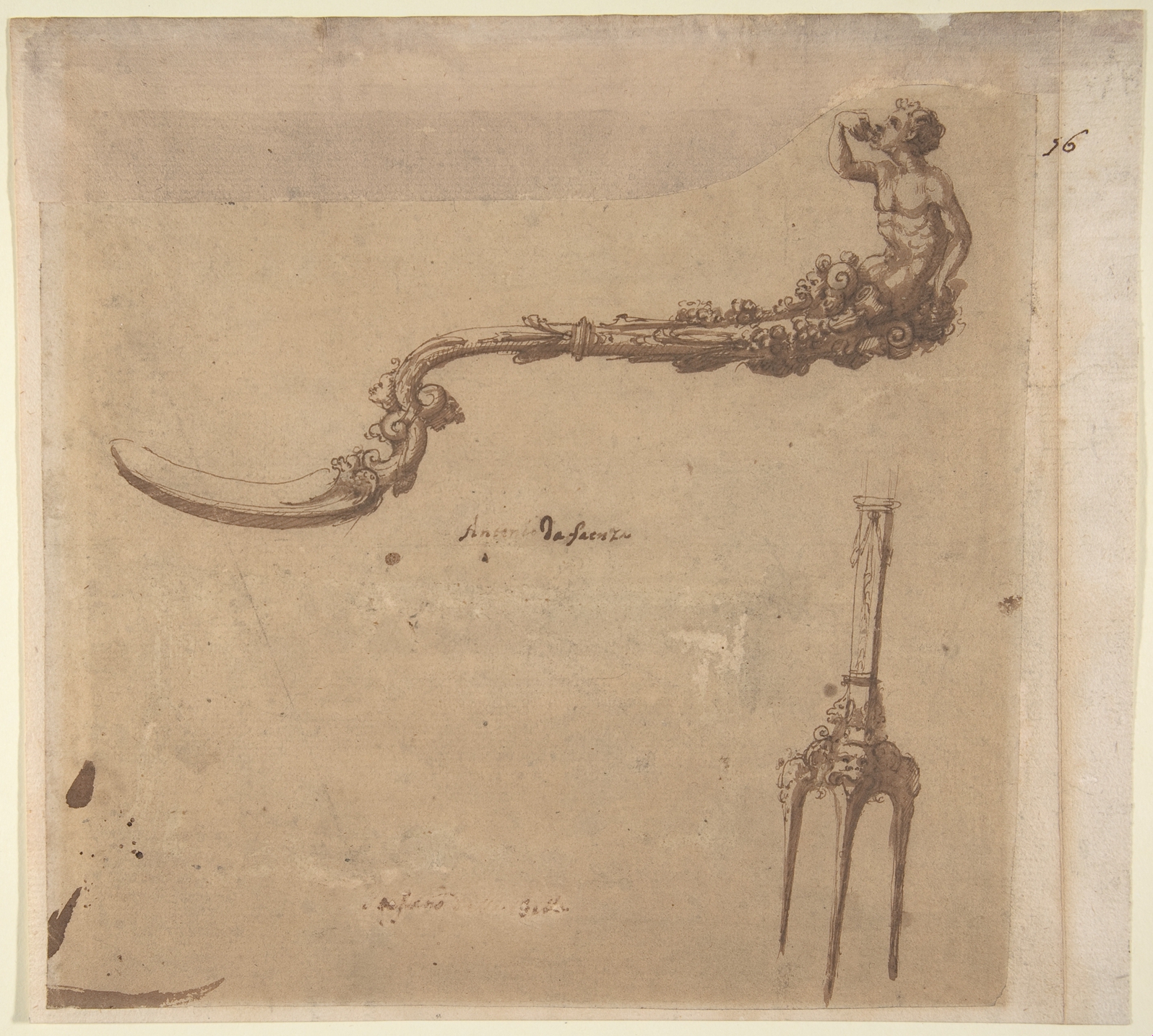
Fig. 23: Anonymous goldsmiths drawing with designs by Antonio Gentili da Faenza and Stefano della Bella, probably second-half of the 16th centry (Metropolitan Museum of Art, inv. 47.52.4)
Antonio’s tableware may have drawn inspiration from Francesco Salviati’s designs. They share a particular homogeny with a print representing designs by Salviati for two cutlery handles engraved in 1583 by Cherubino Alberti (fig. 2). The styling of the hair along the back of the grotesque creatures’ heads would also seem to suggest a possible in situ awareness of Manno Sbarri’s figures for the Farnese Casket (fig. 14).
That Antonio made tableware is evinced by a document in the Medici archives noting a gilt silver fork completed on 27 March in 1580 for a member of the influential Orsini family in Rome (no. 22)3 and a set of six forks, or three pair, to accompany a set of three silver platters made in 1584 (no. 32), intended to form a table service centered around an elaborate ewer Antonio earlier completed for the Medici in 1577 (no. 19).4
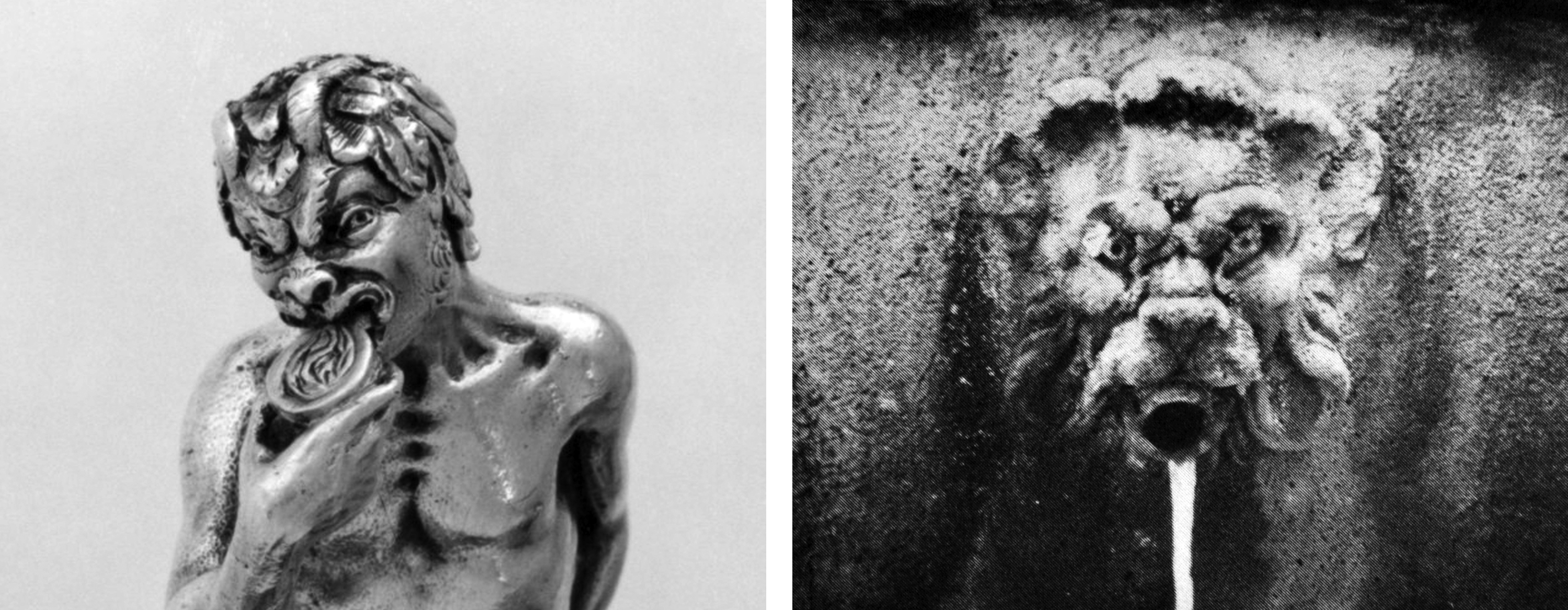
Fig. 24: Detail of a silver spoon by Antonio Gentili da Faenza, ca. 1580s or earlier (above; Metropolitan Museum of Art, inv. 47.52.3); detail of the fountain in the Lazio Viterbo Ronciglione Piazza del Duomo, whose design is attributed to Antonio Gentili da Faenza, ca. 1553-65
That Antonio was focused on the production of tableware ca. 1580-84 could also suggest a similar dating for the MET group. However, Antonio’s patronage from a variety of nobility could suggest these belong to even earlier patronage. For example, the unruly figure on the MET spoon has a general likeness with one of the grotesque masks featured along the Farnese fountain at Ronciglione and could theoretically form a tableware setting intended for that palace (fig. 24). A drawing preserved at the Municipal Library of Palermo, forming part of a Roman goldsmith’s copy book of the mid-16th century, reproduces a silver chalice that would have suited well for such a speculative tableware piece in that palace (fig. 25).5 The chalice or cellar is surmounted by a unicorn, the Farnese emblem of virtue which the family adopted in the early 16th century (see also fig. 10).6
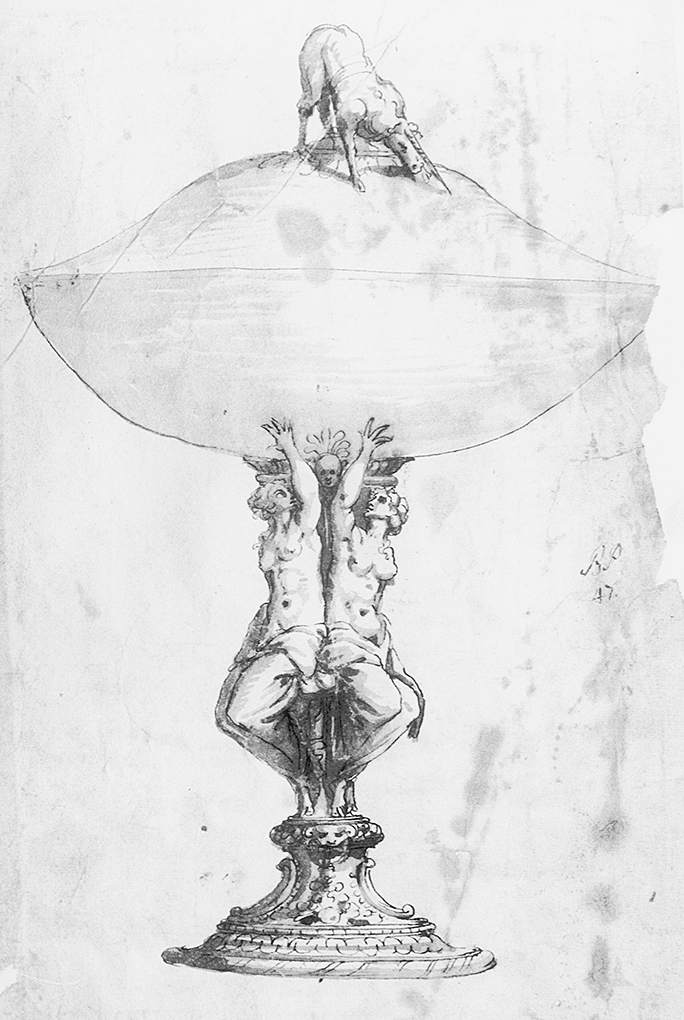
Fig. 25: Anonymous Roman goldsmiths drawing of a chalice or cellar, mid-16th century (Municipal Library of Palermo)
No. 6
Farnese Ostensorium
Gilt silver, lapis lazuli, rock crystal reverse-painted rock crystal and enamel
Antonio Gentili da Faenza and workshop; Rome, Italy (silverwork)
Anonymous, possibly Agostino Decio (?); probably Milan, Italy (reverse-painted rock crystal)
Probably ca. 1581-88; possibly commissioned by Cardinal Alessandro Farnese
SMART Museum (inv. K1613)
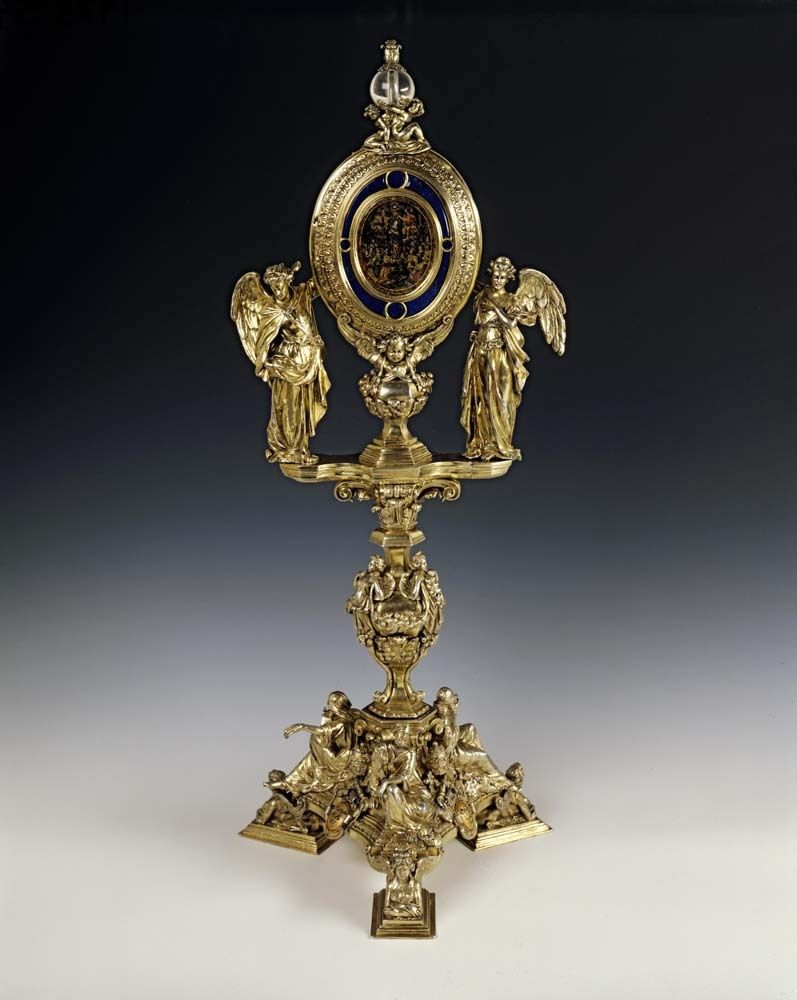
The Farnese Ostensorium, whose date and origin are not known by documents, has traditionally been associated with and attributed to Antonio Gentili.7 The ostensory may have had an impetus in the original commission awarded to Manno Sbarri for the execution of a pax and figures of Saints Peter and Paul whom are both depicted seated along the base of the ostensory along with a figure of the Farnese Pope Paul III.8 These characteristics suggest the work was probably commissioned by Cardinal Alessandro Farnese and may have had an earlier incarnation under the auspices of Sbarri. The project could have been taken up again in the form of an ostensory sometime after Sbarri’s death and probably at a date following Antonio’s completion of the Farnese Altar Service in 1581 (no. 1).
The ostensorium’s mature Mannerist qualities further encourage the idea that it must postdate the completion of the Farnese Altar Service yet may have been finished before the Cardinal’s death in 1588. In spite of its later inception, the ostensorium still retains the visual influence of Francesco Salviati, namely in the execution of the seated figures along the base, which again, probably have an earlier impetus in Alessandro’s commission to Sbarri in 1561, being a period closer to Salviati’s lifetime.9
While the general character of the ostensorium relates to Antonio’s production of the Farnese Altar Service—as regards its gilt silver medium with lapis lazuli insets framing a crystal—its visual language suggests it was not intended to follow the formula of the altar service. Unlike the Farnese Altar Service, the ostensorium does not appear to have reached St. Peter’s if it were ever intended to have been donated there by the Cardinal. If intended for the basilica, it may not have been entirely complete before the Cardinal’s last will in 1588. Nonetheless, a realization of the project between 1582-88 seems most plausible.
The feature of a reverse-painted rock crystal, likely executed in Milan—where this art form had its zenith during the third quarter of the 16th century—could certainly date the ostensorium close to this period. Antonio produced other related works during this period like the silver and gold tabernacle he made for the Medici in June of 1582, incorporating a rock crystal dome made in Milan (no. 25)10 or the slightly earlier silver reliquary with crystals that Antonio completed for Pietro Fonseca in 1578
(no. 20).11
In Silvana Pettenati’s survey of Italian reverse-painted crystals at the Palazzo Madama—the largest collection of its type—only one dated example of this object-type is identified and features a dedication to Cardinal Alessandro Farnese in the year 1576. The verre églomisé crystal depicts the Cardinal’s armorial on one side and a Crucifixion scene on the other.12 Alessandro’s patronage of this artwork informs us that he was commissioning these types of precious artworks during this period and his esteem for miniature paintings is certainly established by his patronage to the “prince of miniaturists,” Giulio Clovio and his pupil, Claudio Massarelli.13 The quality of reverse-painted crystals is also in-keeping with the Cardinal’s passion and taste for collecting and commissioning the finest devotional works of the era and we may assume the Cardinal probably commissioned the ostensorium’s reverse-painted crystal—probably originally as an independent work-of-art set in a small pendant frame, as many such contextual objects survive—and was probably later incorporated into the ostensorium’s design. The reverse-painted crystal would theoretically have been provided to Antonio in the same manner Alessandro had likewise provided the engraved crystals produced by Giovanni Bernardi and Muzio Zagaroli for the Farnese Altar Service.
The crystal’s complex composition in small-scale echoes other works preserved in the Palazzo Madama like that of a Madonna of the Rosary (inv. 207-3073B) and an Assumption of the Virgin (inv. 99-2986). Stylistically they could relate to the talented Decio dynasty of miniaturists who are documented as producing celebrated objects of this type, most notably, Agostino Decio.14
Praised by Giovanni Paolo Lamazzo,15 Agostino was the most famous member of his namesake’s dynasty of luminaries and goldsmiths. His stylistic preference for gilt Raphael-inspired draperies, the use of tin-backed red hues, and his superb talent at capturing volume and dimension in small compositional spaces is superficially comparable with the ostensorium’s crystal. During his career, Decio’s documented patrons included the Duke of Savoy, Carlo Emanuele I16 and the Milanese Archbishop, Cardinal Federico Borromeo.17
Ulrich Middeldorf described the crystal’s compositions as representing the Coronation of the Virgin on one side and the Virgin bestowing a crown and palms above a group of kneeling saints on the other.18 However, previously unnoticed is the sleeve of one of the kneeling saints depicted in the Coronation scene at the lower-right, which features a subtle inscription, ‘S·LA.’ As none of the other saints featured in the scene are given this subtle, yet descriptive quality, we might consider the acronym highlights Saint Lucia because it is not the Virgin bestowing a crown and palm on the opposing side of the crystal, but rather a scene portraying the Veneration of Saint Lucia (fig. 26a). Palms were not typically associated with Mary but rather with martyred saints and the function of an ostensory was to either serve as a receptacle for the relic of a martyred saint or as a devotional artwork dedicated to the veneration of a particular martyr. We may therefore surmise that the reverse-painted crystal was made in relation to the devotion of Saint Lucia and may consider further that the entire ostensory was created for this purpose.

Fig. 26a – Detail of the Farnese Ostensory, attributed to Antonio Gentili da Faenza, ca. 1582-88, depicting a reverse-painted rock crystal of the Coronation of the Virgin, possibly by Agostino di Decio (?), ca. 1555
The ostensorium was probably intended for the Chiesa di Santa Lucia in Vico, located just northwest of the Farnese summer palace, Lazio Viterbo Ronciglione Piazza del Duomo. The church served as a frequent stop along the way to the palace and we may still observe there a small provincial fountain bearing the Farnese Lily flanked by Farnese armorials nearby. Documents indicate renovations were made to the church in 158519 and this may coincide with a commission for the ostensory, placing it in the proper time frame of its presumed creation, ca. 1582-88.
We may further consider that if the crystal was produced at an earlier date, the Cardinal may have had it commissioned during the period in which Ronciglione was being developed into the Cardinal’s summer retreat, ca. 1553-65,20 and also in possible accordance with the activity of Agostino Decio or his atelier, who we know was actively producing these object-types between 1554-57.21 However, the suggestion of Decio’s authorship of the crystal can only remain tenuous, as while Pettenati briefly discusses the ostensorium’s crystal, she does not proactively connect it as a possible work by Decio.22
The feature of the enameled Farnese armorial on the ostensory is of interest, as it relates to that also featured on the Farnese Casket (fig. 14) by Manno Sbarri. Beatriz Chadour speculates if the Farnese altar cross may have once featured a similar enameled armorial, possibly replaced during the changes made to the altar service under the sponsorship of Cardinal Francesco Barberini in 1670.23
A Roman goldsmith’s sketch from the 1550s, preserved in the Municipal Library of Palermo,24 could reflect a possible similar work conceived in Antonio’s workshop (fig. 26b). Certain features like the incorporation of a circular rock crystal, the manner of the winged angel, treatment of the grotesque mask or the feature of the alternating busts of a caryatid and ram at the summit of the base are superficially related to Antonio’s productions. The presence of a Farnese Lily in the upper right margin of the drawing could suggest a connection with an unidentified Farnese sponsored project.

Fig. 26b: Anonymous Roman goldsmiths drawing of an ostensory or candlestick base, mid-16th century (Municipal Library of Palermo)
Nos. 7-9
Casts of Guglielmo della Porta’s Mount Calvary
No. 7
Silhouetted silver reliefs against slate, set in an ebonized wood tabernacle
Antonio Gentili da Faenza and workshop; Rome, Italy (silverwork)
Cast after a model by Guglielmo della Porta and workshop
Probably ca. 1571; possibly commissioned by Philip II
El Escorial, Monastery (inv. 10048054)
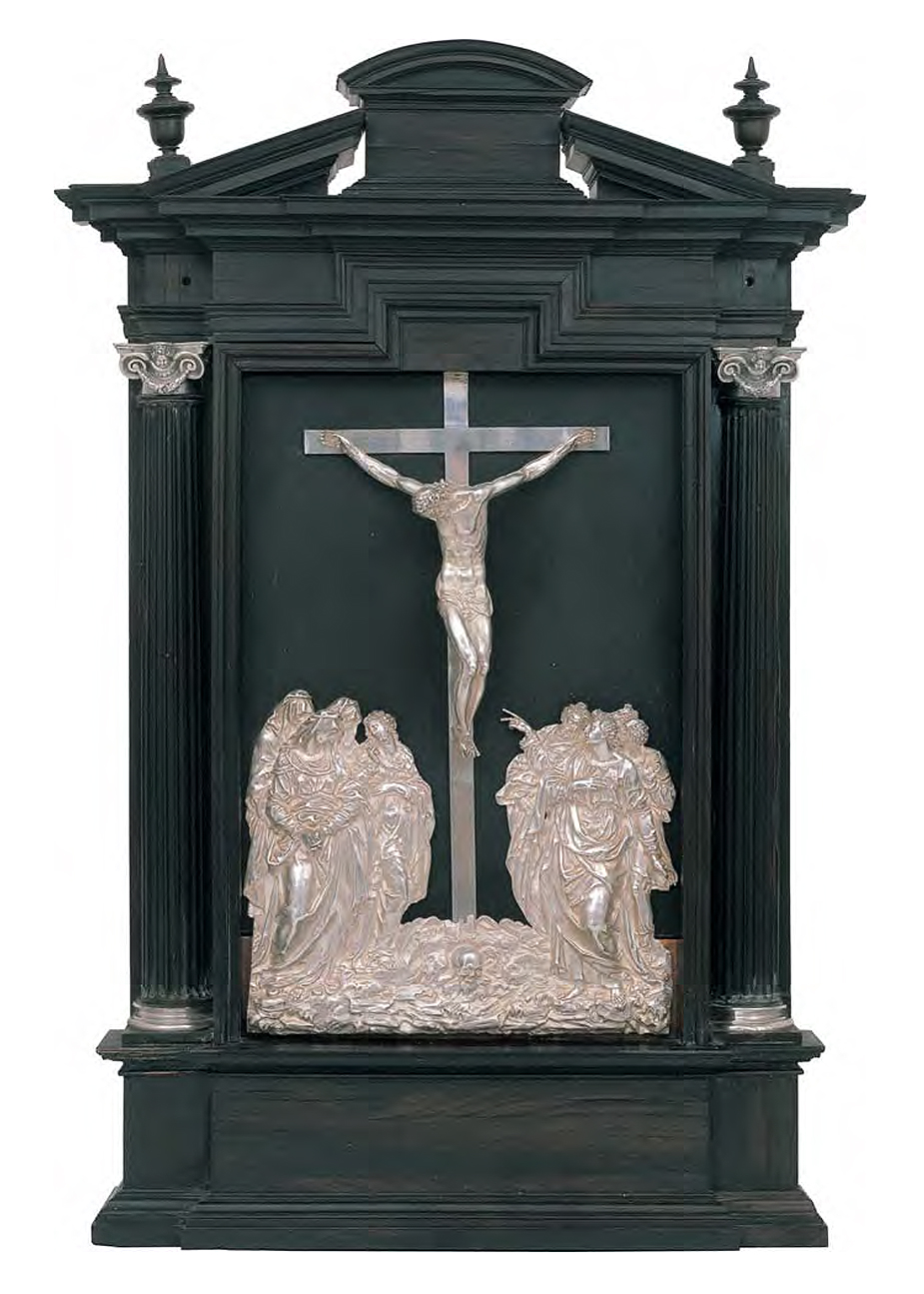
No. 8
Gilt silver relief set in an ebonized wood tabernacle
Antonio Gentili da Faenza and Bastiano Torrigiani; Rome, Italy (silverwork)
Cast after a model by Guglielmo della Porta and workshop
1579-80; commissioned by Pope Gregory XIII
El Escorial, Bedchamber of Philip II (inv. 10014408)

No. 9
Gilt bronze relief
Antonio Gentili da Faenza and workshop; Rome, Italy (silverwork)
Cast after a model by Guglielmo della Porta and workshop
Probably ca. 1586-89
Private Collection (formerly with Coll & Cortes)

Guglielmo della Porta’s authorship of a relief depicting ‘Our Savior Jesus Christ on Mount Calvary’ is confirmed through sources, namely its mention in the second posthumous inventory taken of Guglielmo’s workshop on 2 October 1578.25 More specifically, however, are details revealed in the 1609 trial instigated by Guglielmo’s son, Teodoro della Porta, in which an inquiry was made as to whether Antonio ever made waxes or moulds of “an altar of Our Savior Jesus Christ on Mount Calvary, a work made by Teodoro’s father,” which upon Guglielmo’s death, was consigned for a period to his assistant, Bastiano Torrigiani, and then formally inherited by Teodoro in 1589, who afterward granted permission to Torrigiani (his step-father) and Teodoro’s half-brother, Michelangelo Torrigiani, to continue using various moulds and models still kept in Guglielmo’s estate.26
Elaborations of Guglielmo’s preparation for the design of the relief is evident in drawings preserved in his sketchbooks, ca. 1555-60,27 and by 1568 Giorgio Vasari comments on having seen related designs by Guglielmo in his studio.28
The original model for Guglielmo’s Mount Calvary composition was in Antonio’s possession from 1586-89, deduced by the trial records which reveal that Antonio had purchased the model from Guglielmo’s eldest son, Phidias della Porta, for 50 scudi, unwitting of the fact that Phidias had illicitly broken into Guglielmo’s workshop and stolen it, among other effects. By court order, Antonio returned the model to Teodoro and Torrigiani and was reimbursed the 50 scudi he had paid to Phidias.29
It would seem reasonable Antonio would not have purchased the model unless he had plans to make a cast or casts of it. Furthermore, the model’s absence from the first inventory of Guglielmo’s estate, taken in February 1577, could suggest the model was elsewhere at the time of Guglielmo’s death and possibly in another studio like Antonio’s, particularly if called upon by Guglielmo to prepare a version in silver at an earlier date.
Current scholarship is aware of six examples of Guglielmo’s Mount Calvary—two in silver,30 three in bronze31 and one in terracotta —and the present author cites here an additional 19th century brass aftercast in the art market.33
Silhouetted bronze casts of the male and female mourners featured at the base of the Mount Calvary relief are known in various collections, the most recognized (and highest quality) being those from the Lazaro Galdiano collection and museum.34 Their silhouetted shape suggests the originals were modeled individually in clay or wax and subsequently formed together with a separately modeled background to create a complete relief scene. This is not unlike the numerous wax pieces that comprised a slightly larger Descent from the Cross relief also discussed in the 1609 trial (no. 40). The presence of these silhouetted examples is featured in two silver cast versions of the Mount Calvary35 and an observation of the reverse of two bronze versions of the relief indicate the manner in which the separate wax relief components were seamed together to form a compete relief scene comprised of five individual models.36
Not well noted is the diffusion of these silhouetted models into Augsburg during the first half of the 17th century. A silver cast featuring only the figures of Mary and John is at the Museo Diocesano de Albarracín in Spain and was cast in the Augsburg workshop of Jeremias Michael during the 1620s and donated to the Albarracín Cathedral by the cathedral’s dean and former rector of the Bolivian city of Potosí: Don Francisco Xarque. The relief was received by the cathedral on 26 June 1659 and it appears in inventories as early as 1684.37 The singular figures of Mary and John also appear as appliques mounted to a silver Mount Calvary by the Augsburg silversmith Albrech von Horn from around 1640, preserved at the Museo Nacional de Artes Decorativas in Madrid.38 An earlier Augsburg production by Jeremias II Flicker (the younger), ca. 1620-30, at the Maximilianmuseum, features the entire figural groups set as appliques against an elaborate ground of multi-tiered silhouetted silver reliefs. An overall earlier iteration of these figures in Augsburg is found in a Crucifixion relief by Melchior I Gelb made in 1605 while still a journeyman in Hans IV Pfleger’s workshop39 and Pfleger himself appears to have used the figures of Mary and John as inspiration for a silver house altar he produced around 1600.40
One of the finest Mount Calvary examples is in Budapest, being a gilt bronze cast set in its original contemporary ebonized wood frame beset with an elaborate gilt bronze decorative scheme of acanthi and scrolling volutes (fig. 27).41 The fidelity of this cast showcases the exquisite workmanship of Guglielmo’s sculptural talent and its quality suggests it was made immediately from Guglielmo’s original model. However, the scrolling volutes and acanthi forming its frame are very likely the product of his assistant, Bastiano Torrigiani, comparable in style and finishing to the altar service Torrigiani made for Pope Gregory XIII’s chapel at San Giacomo Maggiore in Bologna in 1581.42
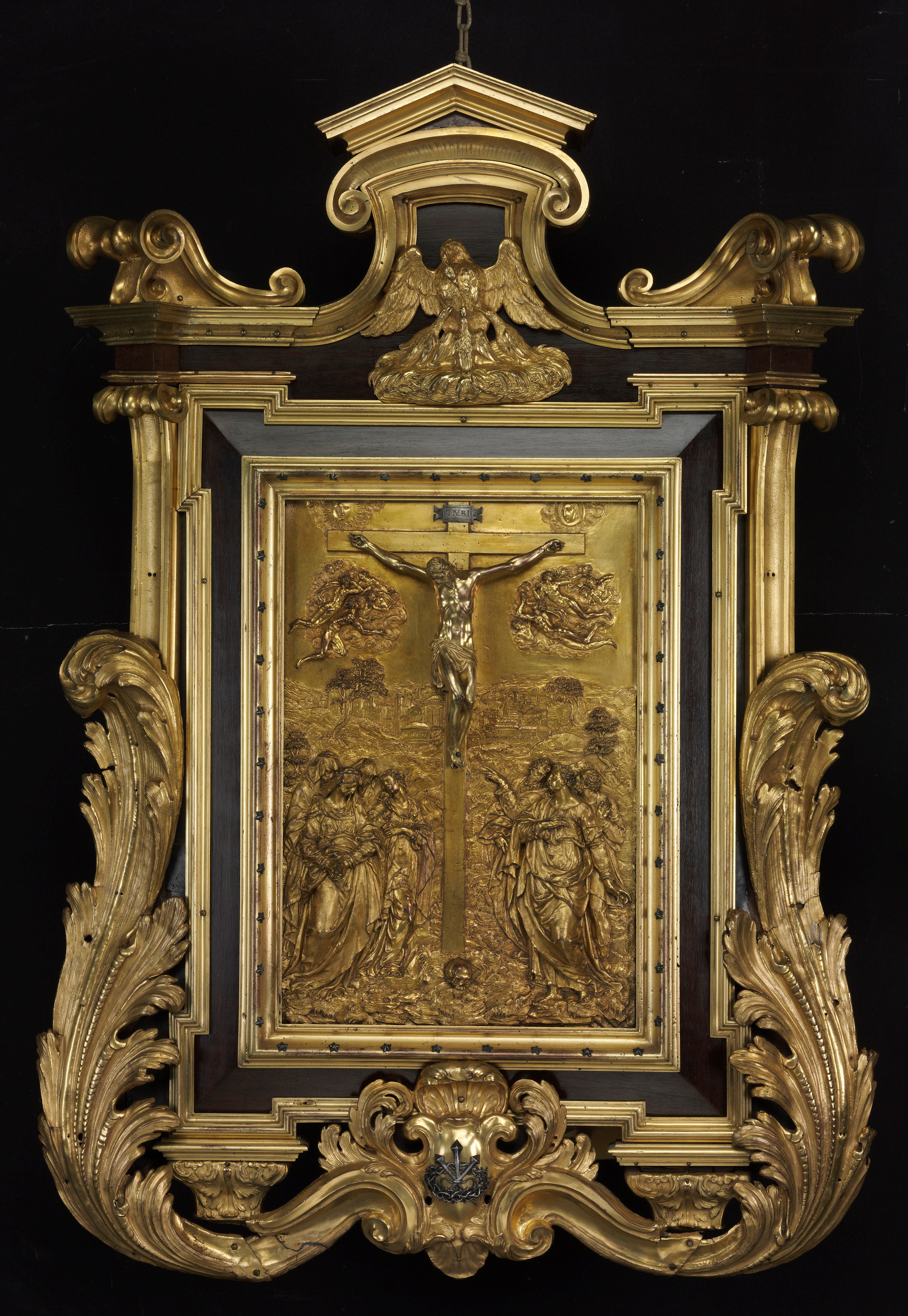
Fig. 27: Framed gilt bronze and silver relief of Mount Calvary, here attributed to Bastiano Torrigiani, after an original model by Guglielmo della Porta; Rome, Italy; ca. 1577-86 (Budapest Museum of Fine Arts, inv. 51)
While preparations for the Mount Calvary relief may have begun in the mid-to-late 1560s, the execution of its model was probably realized during the latter part of the decade. The separately applied crucifix, in-the-round, however, contrasts against the nervous vitality of the relief’s backdrop and is conceivably by another hand or was perhaps made in collaboration with an assistant at a later date.43 It was not uncommon for Guglielmo to provide only a design and rely on individual sculptors to perform the modeling, as he did with Jacob Cornelis Cobaert.45 While the crucifix model is synonymous with Guglielmo’s designs and is most often assigned to the master himself, it is evidently a tempered interpretation of his otherwise nervous and intense style.46 A logical candidate for having an influence on this crucifix could be Torrigiani, whose hand is almost certainly or even exclusively involved in the Budapest cast and likewise gives impetus for his continued use of this crucifix model in 1581 where it is reprised on the San Giacomo Maggiore altar service, already discussed, and is again featured on the Sta Maria Maggiore ciborium Torrigiani executed in collaboration with Ludovico del Duca between 1587-89 (a project in which Antonio happened to be supervisor on behalf of the Pope).47
It would stand to reason that Torrigiani, being in possession of the Mount Calvary and proprietor of Guglielmo’s estate from 1577-89, made casts of the Mount Calvary during this period, sans 1586-89, the period in which it was in Antonio’s possession. However, it can’t be ruled out that as Guglielmo’s chief assistant, the production of the Budapest cast could also have been conceived while Guglielmo was still living. A confident dating could place it ca. 1577-86, but taking into consideration also the latter idea, perhaps ca. 1569-86.48
Two casts in silver are of notable distinction, both found in the collections of El Escorial in Madrid, Spain. An impressive gilt example set in a remarkable ebonized wood frame with columns crested by silver capitals, was originally commissioned as a gift to Bianca Capello, Granduchess of Tuscany, from Pope Gregory XIII in 1580 (no. 8),49 and probably intended as a wedding gift for the couple whose already extant marriage was suddenly announced publicly in June the previous year. Its casting after Guglielmo’s death in 1577 is almost certain to connect it with Torrigiani during his ownership of the model. As one of the leading workshops in Rome for precious objects during the late 1570’s, and in consideration of the Pope’s regular employ of his Bolognese compatriot, it would seem a logical choice Torrigiani and his “Bolognese workshop,” as it was known in Rome,50 was commissioned to produce this gift intended for Bianca. Indeed, a subtle parallel exists between this silver example of the Mount Calvary and the bronze example in Budapest. Namely, the exact same silver titulus applique is featured but also commensurate is the feature of an applique of “a pelican with three chicks in its nest,” as described in El Escorial inventories but since lost.51 While Torrigiani is the most likely candidate to have made this cast, if he received its commission, it is not without reason that he could have outsourced the casting on account of his preoccupation with furnishing the Gregorian chapel in St. Peter’s in 1579, a project greatly occupying his attention that year. If this is the case, Antonio would have been a natural candidate to make the silver cast for Torrigiani, as the two had likewise made a similar arrangement for the realization of a silver Descent from the Cross, previously noted (no. 40).52 In fact, Werner Gramberg already suggested the Mount Calvary for Bianca was probably cast and afterworked by Antonio53 and the idea would appear convincing on account of its silky matte-like finish while still retaining a proper expression of Guglielmo’s complete energetic ‘horror vacui’ as Gramberg described it.54 The altarpiece was subsequently given by Bianca as a gift for the bed chamber of Philip II of Spain in 1585, hoping the monarch would justify her son Francesco, conceived from a previous relationship, as the new couple’s legitimate heir, since the couple never conceived children of their own.55
The other fine silver example at El Escorial, donated by Philip II to its monastery,56 lacks a background and reproduces the relief in silhouetted form (no. 7). The work is framed in an ebonized wood tabernacle, and is set alternatively against a slate background. This example is perhaps the earliest of all identified casts, an idea likewise suggested by Gramberg.57 Most suggestive of this is the feature of a crucifix whose model is certainly by Guglielmo’s hand, reflective of the one he gave also to Cardinal Alessandro Farnese in 1571.58 If the background motif had not yet been worked-out by Guglielmo, he may have already completed the composition’s figural components, inclusive of the crucifix and individual reliefs of the flanking mourners. Certainly, the scale of the corpus is more accurate than the others and its clear execution by Guglielmo’s hand enables a consistency of style not observed in all other casts. Though not gilt, the relief features the same matte-like polish commensurate with Antonio’s other productions and is a cast reasonably linked to Antonio’s workshop. In fact, Antonio’s hypothetical involvement in this early cast could be the impetus for his later acquisition of the model from Phidias, who may have been aware Antonio had worked with the model previously. Although Gramberg hesitated to provide a dating for this example, it could have been reasonably cast around 1571, a period in which Antonio was actively collaborating with Guglielmo and also the same year we know Guglielmo had already completed an example of this crucifix model.
Lastly, a privately owned gilt bronze cast of Mount Calvary (no. 9) is perhaps a cast also made by Antonio, albeit after having purchased the model from Phidias della Porta. Its feature of the crucifix belonging to the Budapest cast is indicative of its evolution between ca. 1571-86 and its facture in bronze allows a close comparison against the faithful Budapest example in which we may observe Antonio’s softening of the model and pacification of Guglielmo’s anxious manner, being a treatment commensurate with Antonio’s handling of Guglielmo’s crucifix for the Farnese Altar Service (no. 1) and his treatment of Guglielmo’s small relief models, to be discussed. There are other stylistic corollaries like the treatment of the angels’ hair, which follow in alike manner with Antonio’s mascarons on the Farnese Altar Service and those featured also on the binding he produced for the Farnese Hours (no. 3).
No. 10
Silver pax of the Risen Christ Appearing to the Apostles
Silver pax
Antonio Gentili da Faenza and workshop; Rome, Italy (silverwork and engraving)
Central relief cast after a model by Guglielmo della Porta and workshop
Probably ca. 1580s (probably before 1589); possibly commissioned by Cardinal Ferdinando de’ Medici
Palazzo Pitti, Museo degli Argenti, Florence (inv. 66)
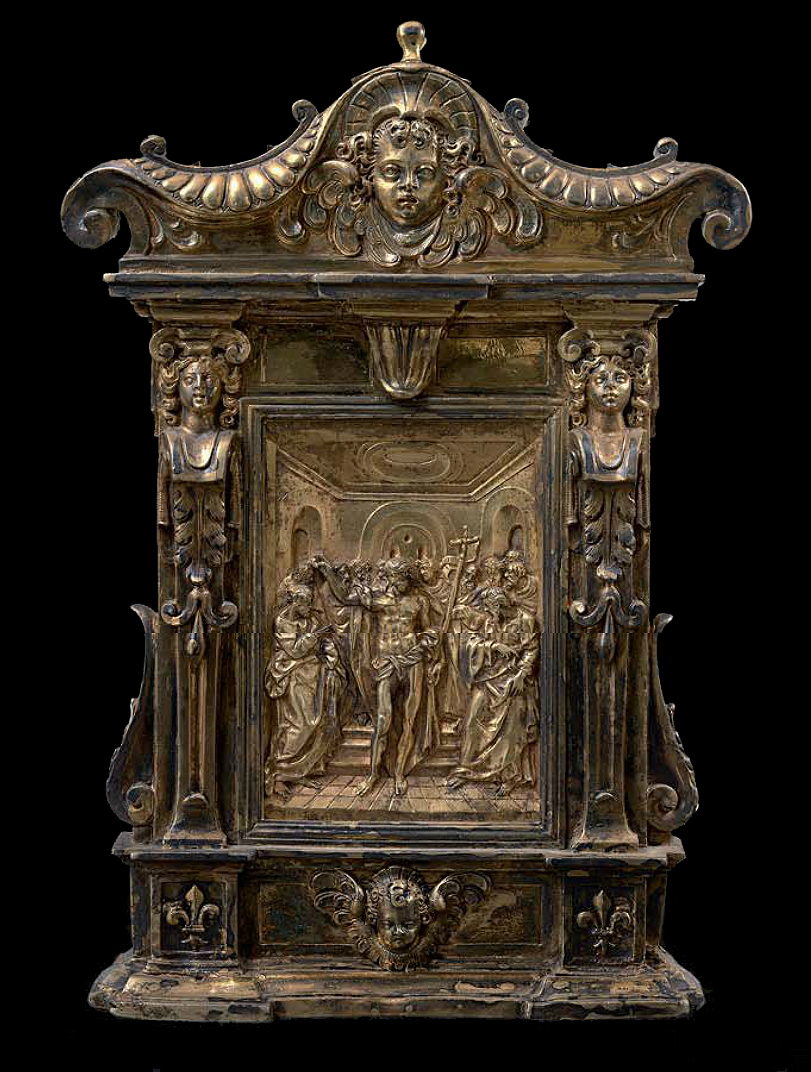
In 1991, a gilt bronze pax at the Metropolitan Museum of Art (MET)—featuring a central relief scene of the Risen Christ Appearing to the Apostles59 (fig. 28)—was adequately attributed to Guglielmo della Porta on account of its relationship to his sketches.60 In discussing this pax, Stefanie Walker noted a related silver pax at the Palazzo Pitti (no. 10) which featured the same relief composition, albeit, with the exclusion of one figure in the background and the addition of a chased grid-like ground to help draw the viewer’s attention into the relief’s scene.61
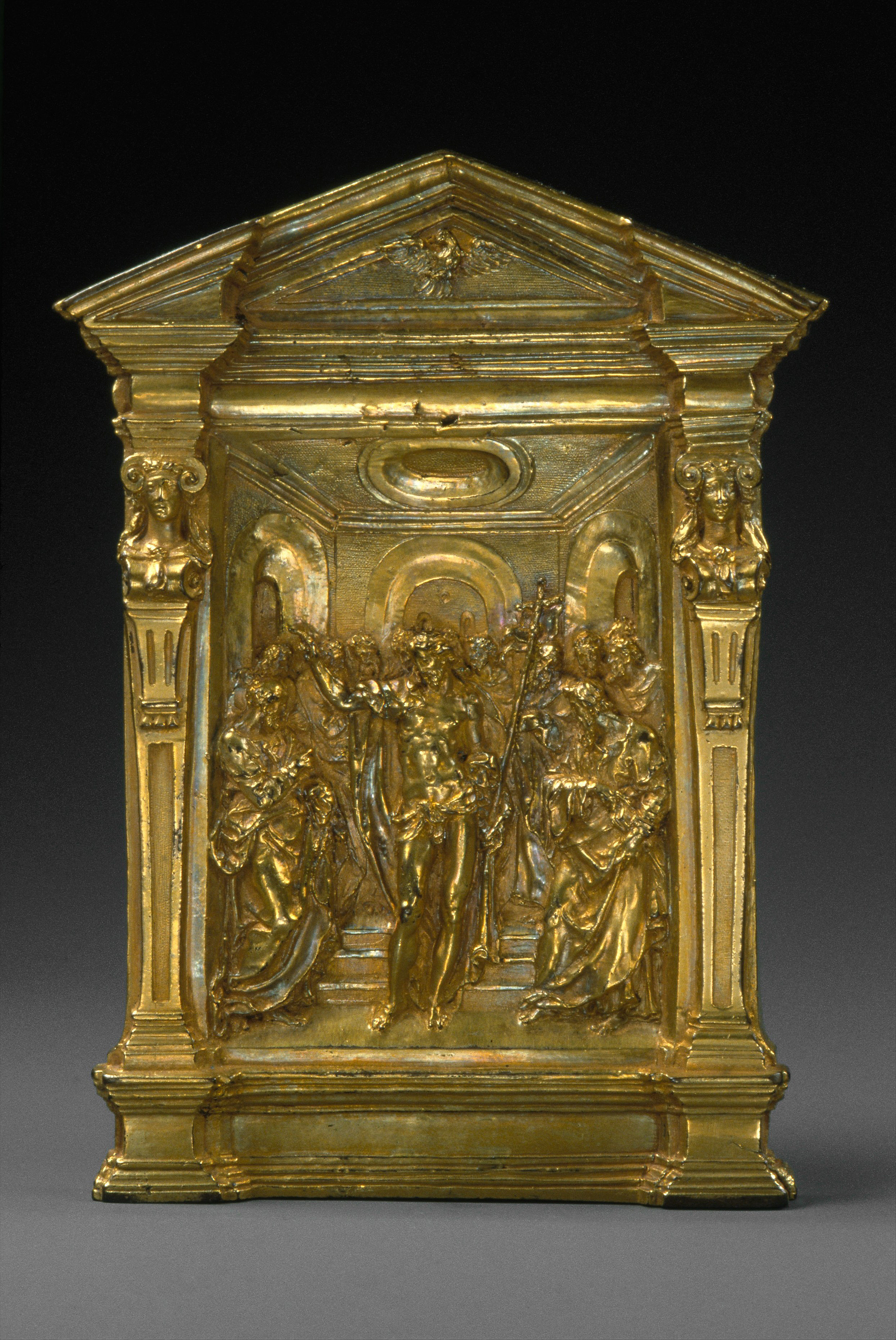
Fig. 28: Gilt bronze pax depicting The Risen Christ Appearing to the Apostles, attributed to Guglielmo della Porta, ca. 1566-77 (Metropolitan Museum of Art, NY)
Walker drew further comparisons between the Palazzo Pitti pax and a silver plaquette of the Flagellation at the Los Angeles County Museum of Art (LACMA) (no. 11)—whose original design is also attributed to Guglielmo della Porta—observing their “extremely close” chasing and polish with figures that have been “calmed and smoothed” and hair given fluid form when compared against their vigorously modeled and earlier dated counterparts. She also noted the obfuscated cherub beneath the column of the Flagellation relief which follows closely with one featured along the base of the Palazzo Pitti pax. In light of the later style of the Palazzo Pitti pax frame, Walker suggested these productions could be due to Teodoro della Porta.62 However, we attribute them here instead to Antonio Gentili and his workshop on account of their distinct tempering of Guglielmo’s original models—likewise observed in his execution of the crucifix featured on the Farnese Altar Cross (no. 1)—and due to the unique characteristics of the pax frame which follow Antonio’s visual repertoire.
A stylistic congruence is observed between the cherubim of the Palazzo Pitti pax and the mascarons featured on Antonio’s binding for the Farnese Hours (no. 3) as well as the rarely discussed series of cherubim featured along the reverse stem of the Farnese Altar Cross and those along its central knop just above its base (fig. 29). Beatriz Chadour has commented on the distinctiveness of Antonio’s mascarons, being his own probable creation or that of a remarkably qualified journeyman in his workshop.63 The former is more probably the case, with ornamentation being an idiosyncratic trait for which Antonio was celebrated.
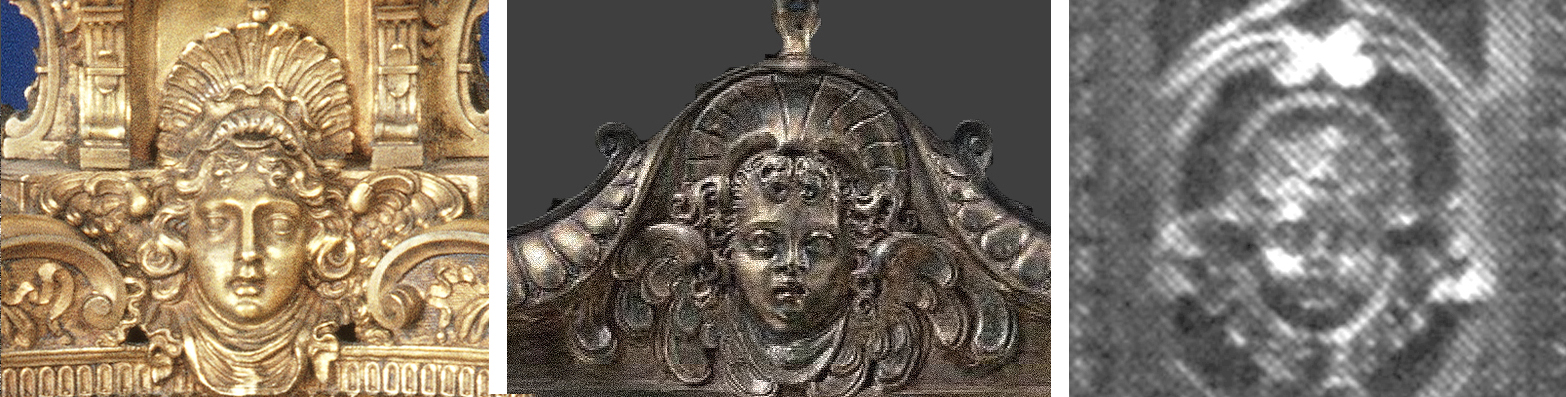
Fig. 29: Detail of a Farnese Altar Candlestick (left; Vatican Treasury); detail of a silver pax of the Risen Christ (center; Palazzo Pitti); detail of the reverse of the Farnese Altar Cross (right; Vatican Treasury)
The modeling of Antonio’s cherubim and masks are frequently framed by a shell niche with thickly chased strokes forming a symmetrical series of grooved lines. He also prefers rounded or oval pupils formed by two chased curves to accentuate eyes. Antonio’s facial types have an art nouveau character about them which may have likewise appealed to 18th century neo-Renaissance art entrepreneurs inspired by Gentili’s creations such as Josiah Wedgewood, Matthew Boulton and Jean-Louis Prieur.64 The cheeks are often full and the chin always protrudes outwardly in a subtle rounded form. Fiery strands of hair occasionally protrude from these innocently modeled faces while the feathers of the wings that flank these faces are modeled in a stacked two-tiered fashion with eloquent concave curvatures.
The elaborate and beautiful handle affixed to the reverse of the Palazzo Pitti pax continues Antonio’s visual language with an arched caryatid-like angel reclining to form the upper body of the handle and terminating below in an acanthi leaf motif. This arched figure strongly recalls the arched and back-leaning angels featured on the central knop of the Farnese Ostensory (no. 6).
Further suggestive of an origin with Antonio is the elegantly engraved silver backplate of the pax which features a variety of scrolling motifs framed by a double-ruled border not unlike those executed by Antonio on the interior binding plates for the Farnese Hours (fig. 8). The engraved hatched shading is alike, beginning with a downward stroke from right-to-left and forming a series of right-leaning angled lines to produce texture.
It is thought-provoking to consider who may have commissioned this elaborate pax. Its features echo Antonio’s productions of the late 1580s and early 1590s, a time in which Antonio was serving two important patrons: Cardinal Ferdinando de’ Medici and Cardinal Alessandro Farnese, among probable others. Before entering the Florentine silver museum, the pax was previously kept in the Palazzo Pitti chapel,65 and this heritage may prompt us to assume an origin with Cardinal Ferdinando Medici. It may also explain why the pax apparently is not listed in his brother, Francesco’s, earlier commissions from Antonio. However, the feature of lilies along the base of the pax could either be interpreted as symbols of the city of Florence or possibly the Farnese family, whose feature are likewise observed on Antonio’s Farnese Altar Service and his binding for the Farnese Hours. It is tempting to suggest a more probable origin with the Medici given its location and former presence in the palace chapel.
We may consider Antonio’s access to this model by Guglielmo came by way of either Bastiano Torrigiani or Jacob Cornelis Cobaert. We’re aware Torrigiani and Antonio shared resources during the mid-1580’s and we could assume this pax may predate 1589, the year in which Torrigiani’s control over Guglielmo’s workshop models were transferred to his stepson and Guglielmo’s natural son: Teodoro della Porta.66
No. 11
Silver relief of the Flagellation of Christ
Silver relief
Antonio Gentili da Faenza and workshop; Rome, Italy (silverwork)
Cast after a model by Guglielmo della Porta and workshop
Probably ca. 1580s or possibly late 1590s and early 1600s
Los Angeles County Museum of Art (LACMA) (inv. M.85.103)
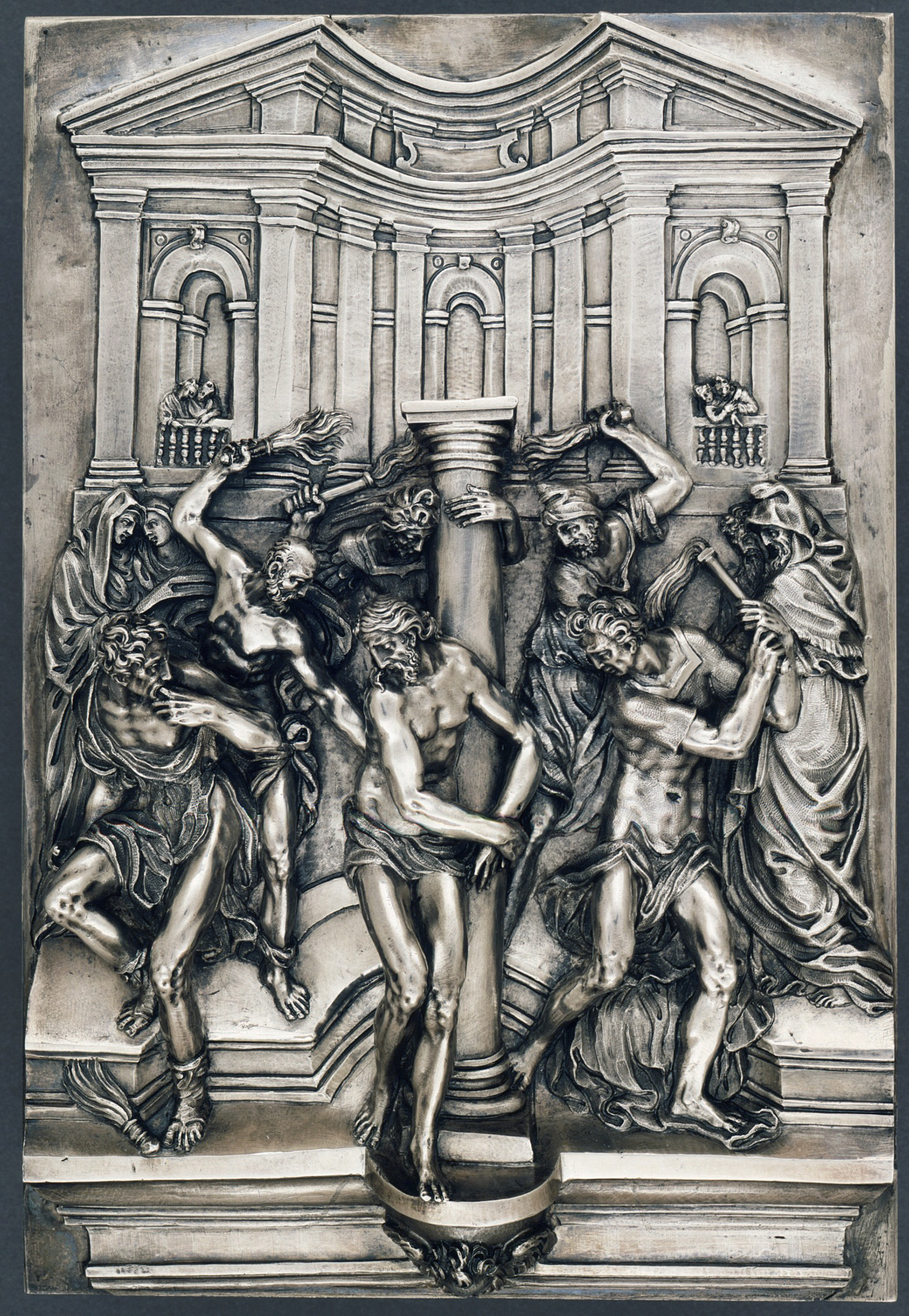
Like the former relief, a plaquette composition portraying the Flagellation of Christ has likewise been adequately attributed to Guglielmo della Porta’s invention based on his surviving sketches.67 Guglielmo’s earliest designs for the Flagellation are observed in sketches he produced around 1556-57 for the side doors of St. Sylvester on Quirinal Hill in Rome to be executed by Giovanni Dosio.68 A large-scale wax model of Guglielmo’s Flagellation was made, but never cast, originally forming part of a second iteration of an unrealized bronze monument of Charles V.69 Guglielmo’s continued treatment of the subject of Christ’s Passion is noted by eight Passion scenes Pope Pius IV purchased from Guglielmo in 156470 as well as the models retained in the inventory of Guglielmo’s studio after his death.71
The 1609 trial against Antonio by Guglielmo’s son, Teodoro della Porta, includes Antonio’s testimony concerning models he had which descended from Guglielmo’s workshop, including a Christ of the Column in black wax,72 which we may conveniently link here to the present relief. We may note black wax was likewise used in the preparations of the original Mount Calvary model which Antonio produced casts of (nos. 7-9).
Concerning the Flagellation, four complete casts are identified. Bronze examples are at the Victoria & Albert Museum73 and the Berlin collections74 and silver examples are at the Museo Nazionale del Bargello75 and the present example, here attributed to Antonio, at the Los Angeles County Museum of Art (LACMA).76 Independent casts of only the figure of Christ and the column or piecemeal models taken from the relief are also known.77 It is to be wondered if the ‘Christ of the Column’ described in the 1609 trial, possessed by Antonio, may refer only to a portion of the Flagellation relief—its central scene—or the entirety of it.
While these reliefs are all attributed to Guglielmo or his workshop on account of their shared design, there are distinctions among them that help suggest more specific origins. Foremost, the Bargello example is housed in an exquisite ebony frame with silver filigree, lapis lazuli and carnelian inlays of late 16th century invention and probably at the request of a venerable commission. Guglielmo is documented for the employ of German woodworkers specializing in ebony cabinetry78 although it remains possible this tabernacle could post-date Guglielmo’s lifetime, like that of the elaborate stone inlaid ebony wood tabernacle housing his detailed wax model of the Crucifixion at the Galleria Borghese whose frame dates to the first part of the 1600s (fig.39).
The silver Bargello example is the finest of the group and features a remarkable vitality and detail (fig. 30, left). There are features that also distinguish it from the others, namely the simple whip handled by the central-left flagellant who grips the column in lieu of the scourging whip handled by other figures in the scene. There is also the bald flagellator on the left of the scene who is later given a beard in further iterations of the relief. An additional difference is the right-most attendant who faces forward into the scene unlike this same character on the other reliefs whose head is lowered and turned closer toward the viewer. Without taking into account its elaborate and important setting it is probable the Bargello example reproduces Guglielmo’s original model.79
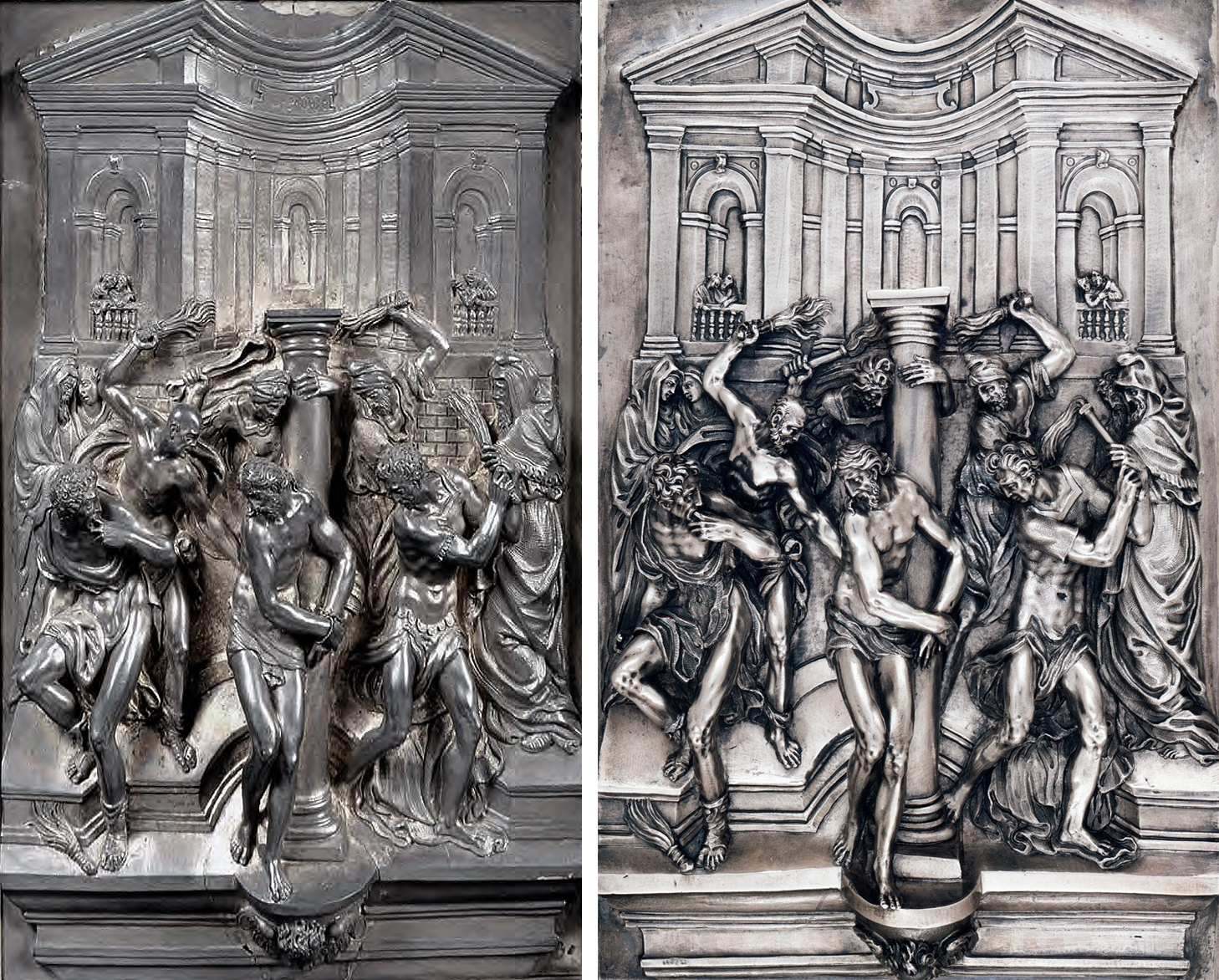
Fig. 30: Silver relief of the Flagellation by Guglielmo della Porta, 1560s-70s (left; Museo Nazionale del Bargello, Florence; Silver relief of the Flagellation attributed to Antonio Gentili da Faenza, after a model from the workshop of Guglielmo della Porta, probably last quarter 16th century (right, LACMA)
A subsequent iteration or refreshing of the model is preserved in the Victoria & Albert cast and this seems also to be the source employed in the LACMA cast. The Berlin example is altogether a later aftercast further debased in its features. However, the LACMA cast uniquely reworks the scene in a fresh manner that recalls Antonio’s softening of the scene (fig. 30), particularly as regards the modeling of the hair and the reduction of details like the attire of the flagellants, chased lines delineating a brick wall and details of the cartouche along the top of the relief which altogether are carefully distinguished in the Bargello cast’s coldwork but subdued, reworked and polished on the LACMA cast with Antonio’s signature treatment.
The LACMA cast is housed in a period ivory frame and quite possibly was produced by a Flemish or German worker in Antonio’s orbit like those surrounding his later activity of the late 1590s or early 1600s (see nos. 37 and 40, for example).
No. 12
Silver relief of the Incredulity of Saint Thomas and a Gilt pax frame
Silver relief and gilt copper pax frame
Antonio Gentili da Faenza and workshop; Rome, Italy
Possibly inspired after a design by Guglielmo della Porta
Probably late 1580s
Private Collection
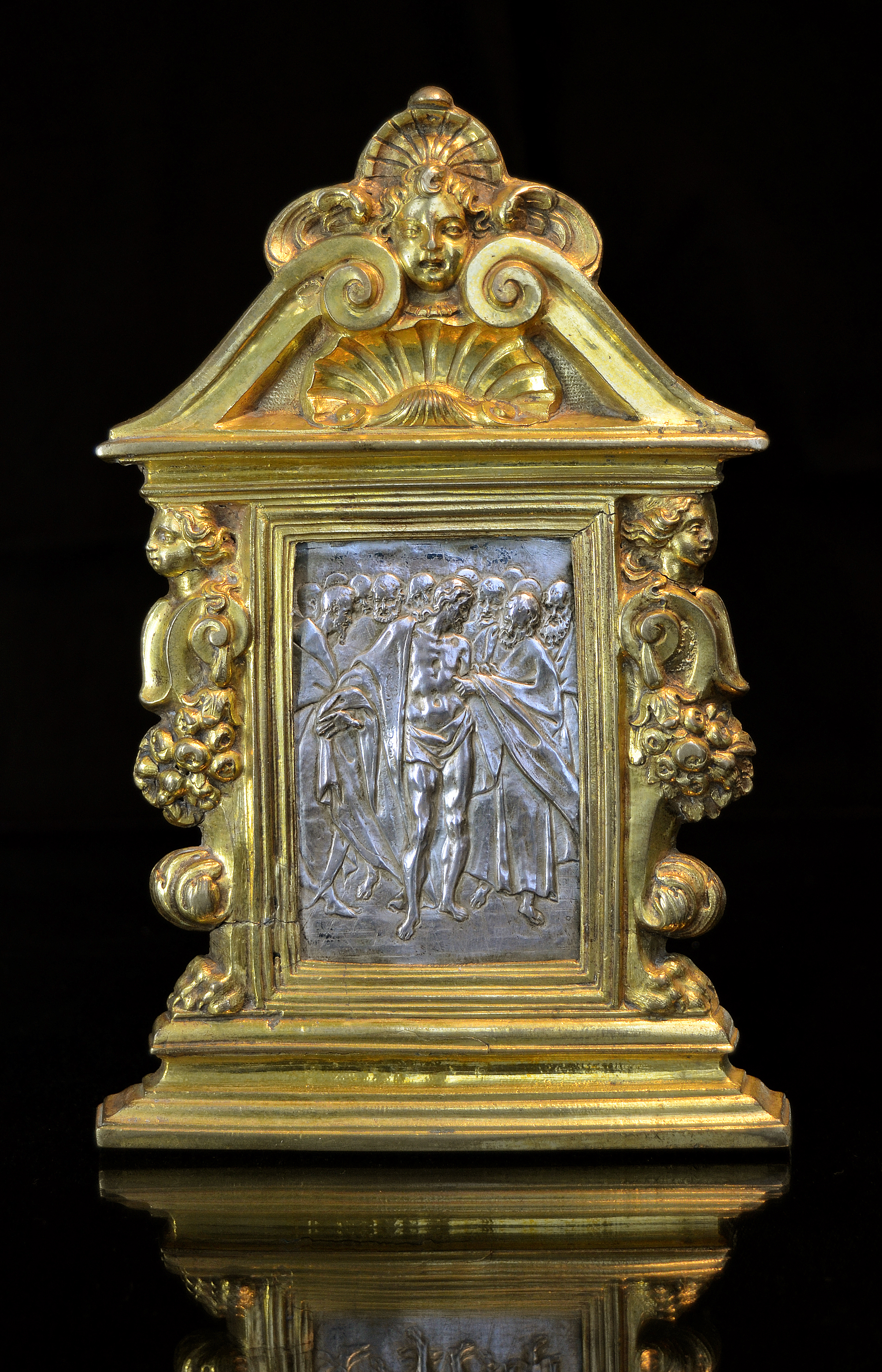
An observation of Antonio’s typology for masks and cherubim draws attention to an unpublished pax featuring a silver relief depicting the Incredulity of Saint Thomas and its accompanying gilt copper pax frame. The cherub depicted in its pediment is remarkably close in manner to that featured on The Risen Christ Appearing to the Apostles pax preserved at the Palazzo Pitti (no. 10). Both frames share the same filleted border treatment around the relief while the use of scrolling volutes and the incorporation of eaves and teardrops used to heighten the visual drama of the frames is commensurate. Further linking the frame with Antonio is his probable exposure to the innovative architectural influences of Giacomo Barozzi da Vignola at the Villa Farnese and Palazzo Farnese. In particular, a relationship can be seen between Giacomo Barozzi’s unconventional mantlepiece with flanking Herms and volutes framing a pediment for the bed chamber of Cardinal Ranuccio at the Villa Farnese and the design of this pax frame.80 The Herms with garlands may also relate to the expressive handles on ewers Antonio may have prepared for the Farnese during the 1560s (no. 19).
Another contemporaneous example of this frame, slightly reworked, is identified from the former collection of Yves St. Laurent and Pierre Berge (no. 13). However, later reworked aftercasts of this frame are quite prevalent and frequently feature an integrally cast Pietá relief of late 17th or early 18th century origin with many examples residing in Italian provincial churches. The frame was also diffused in southern Spain through a similar serial facture in bronze, probably during the late 17th century, and featuring a popular depiction of the Madonna of the Crescent, belonging to a Flemish-Spanish relief series of saints.81
While no other contemporaneous examples of this frame are identified incorporating the Incredulity of Saint Thomas relief—with the exception of a slightly reworked early bronze aftercast in the Russell-Cotes Art Museum in the UK—examples of the relief itself are known elsewhere, both independently and featured alternatively within a diverse array of later frames.
A terminus ante quem for the frame is established by a punched inscription along the base of the present example: FRANCISCVS . SPAGNIA . CVSTOS . 1634. The inscription indicates the name of a former owner, being marked as a piece of property for prevention against theft or loss rather than the name of a donor or maker as would traditionally appear on the obverse or reverse of paxes.82 The year thus relates to the probable date of acquisition from a 17th century owner, in this case, a Spaniard (SPAGNIA) who was the ecclesiastic custodian (CVSTOS) over a provincial region.83
Another terminus ante quem for the frame is established by a hallmarked early silver cast featuring a Pietá relief, belonging to an unidentified church in the Diocese of Adria-Rovigo (fig. 31, left). The underside of the handle features two silver hallmarks: one belonging to the Chamber of the Papal States, depicting the crossed keys of Saint Peter beneath a liturgical umbrella, and linking the pax with the guild in Rome; and another depicting a prancing horse, the hallmark of Cristoforo Vischer di Gaspare (fig. 31, right), active in Rome during the last part of the 16th century and the first quarter of the 17th century.

Fig. 31: Hallmarks and silver pax of the Pieta by Cristoforo di Gaspare Vischer, Rome, ca. 1617-25, with a frame after a model by Antonio Gentili da Faenza (Diocese of Adria-Rovigo)
As noted already in the essay discussing Antonio’s career, it is believed Cristoforo and his brother, Giorgio, may have been assistants in Antonio’s workshop in Naples while producing the cross for the Monastery of San Martino (no. 37). Cristoforo would later cast Antonio’s Skills of a Prince, on his behalf, in 1597 (no. 4), indicating the working relationship between the two artists and explaining why or how Cristoforo could have been in possession of a good quality model of Antonio’s pax frame design.
It remains within reason to also suggest the Pietá relief accompanying this pax by Vischer could be the work of Vischer himself,84 having later been celebrated for his accomplishments until being unfairly condemned by the Inquisition when the Papal authorities sought to seize his estate in 1626.85
Rarely discussed in the literature on plaquettes is the relief depicting the Incredulity of Saint Thomas. An example in Berlin was first considered German by Emilé Molinier86 a suggestion followed with hesitation by Wilhelm Vöge.87 Ernst Bange accepted a German origin while emphasizing a Dutch influence88 and an example in Warsaw led Maria Stahr to also follow the possibility of a German origin.89 Arthur Sambon, whilst cataloging an example in his collection, was the first to forward an Italian connection, although attributing it to the Venetian sculptor Andrea Spinelli.90 While discussing an example in the Morgenroth collection, Ulrich Middeldorf later disregarded this attribution but accepted a Venetian possibility in relation to works by Alessandro Vittoria and Girolamo Campagna.91 Other uncatalogued examples include two formerly in the collection of Neil Goodman,92 one formerly in the Johan Willem Frederiks collection,93 one in the Palazzo Madama,94 an art market example set into a later pax frame,95 an aftercast brass example made integrally in a later pax frame of unidentified origin in a church within the Diocese of Perugia-Citta della Pieve. One other contemporaneous silver example is known in an unidentified church within the Diocese of Latina-Terracina-Sezze-Priverno and features a contemporary gilt bronze pax frame from Bastiano Torrigiani’s workshop,96 presumably made in the late 1580s when Torrigiani and Antonio appear to have been actively collaborating (see nos. 34 and 40).
Certain characteristics of the Thomas relief further link its creation to Antonio. An initial observation is the incorporation of a perspectival-grid similar to the one added by Antonio on the Palazzo Pitti pax. The modeling of Christ’s chest, subtle in low-relief, corresponds also with his figures on the Farnese Altar Service (no. 1) and similarly with a figure of Christ on a silver Deposition, possibly executed by Antonio, at the Museo Civico Medievale in Bologna (fig. 42). Most evident, however, is the closeness of Christ with Antonio’s depiction of the Virgin on his binding for the Farnese Hours (no. 3; fig. 32), notwithstanding the use again of a grid pattern for the ground. The draperies are full-bodied and the protagonists’ “lively body shapes appear through the fabric,” as Beatriz Chadour notes of Antonio’s manner.97 The modeling of Christ’s hands, almost too large, compares similarly with his depiction of the Virgin, while the essence of each character—as if frozen-in-time—maintain a similar ethos.
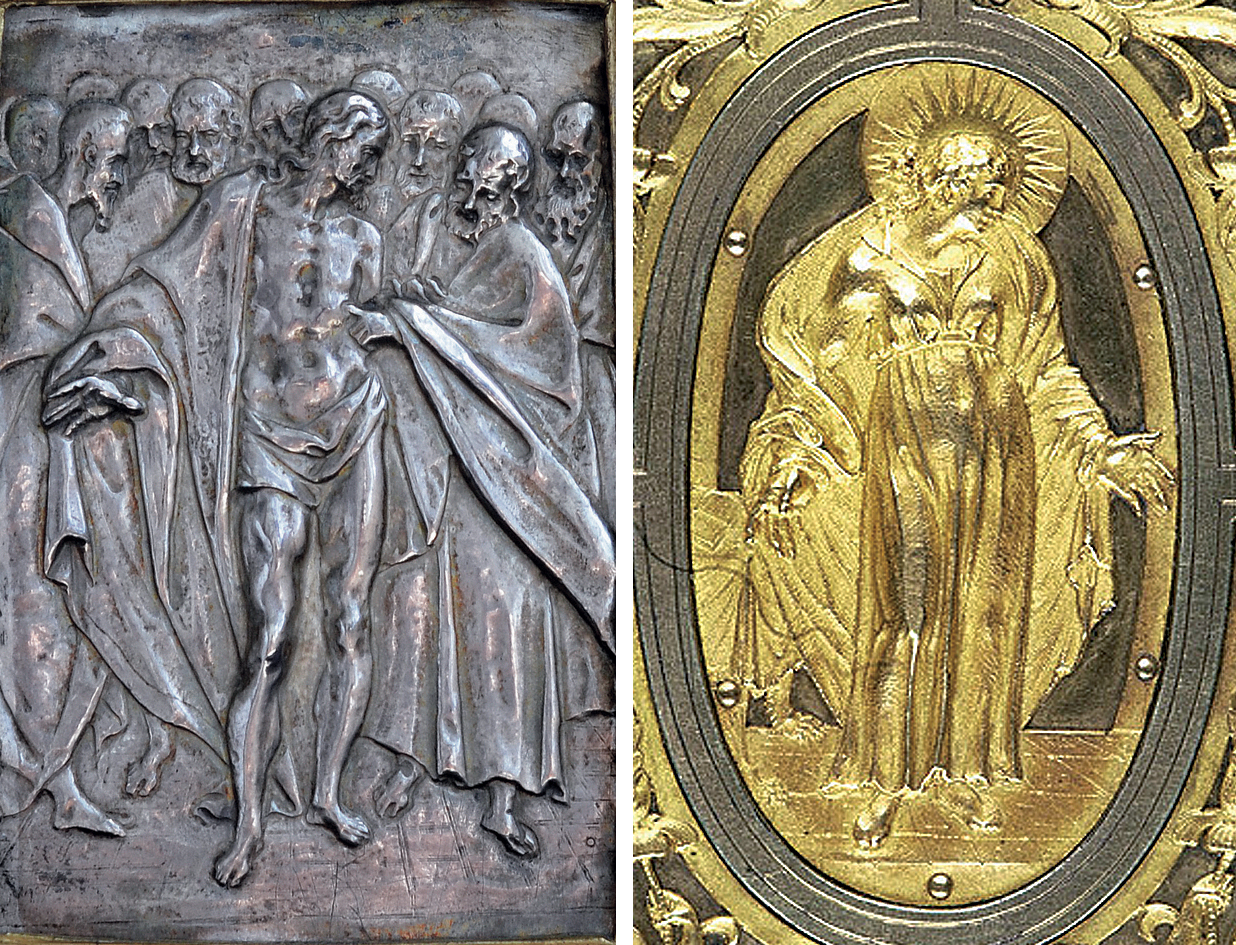
Fig. 32: Silver relief of the Incredulity of Saint Thomas attributed to Antonio Gentili da Faenza, Rome (left; private collection); detail of the Farnese Hours binding depicting the Virgin (right; Pierpont Morgan Library, NY)
No. 13
Gilt Pax Frame with Herms
Gilt copper pax frame
Antonio Gentili da Faenza and workshop; Rome, Italy
Probably ca. 1580s
Private Collection
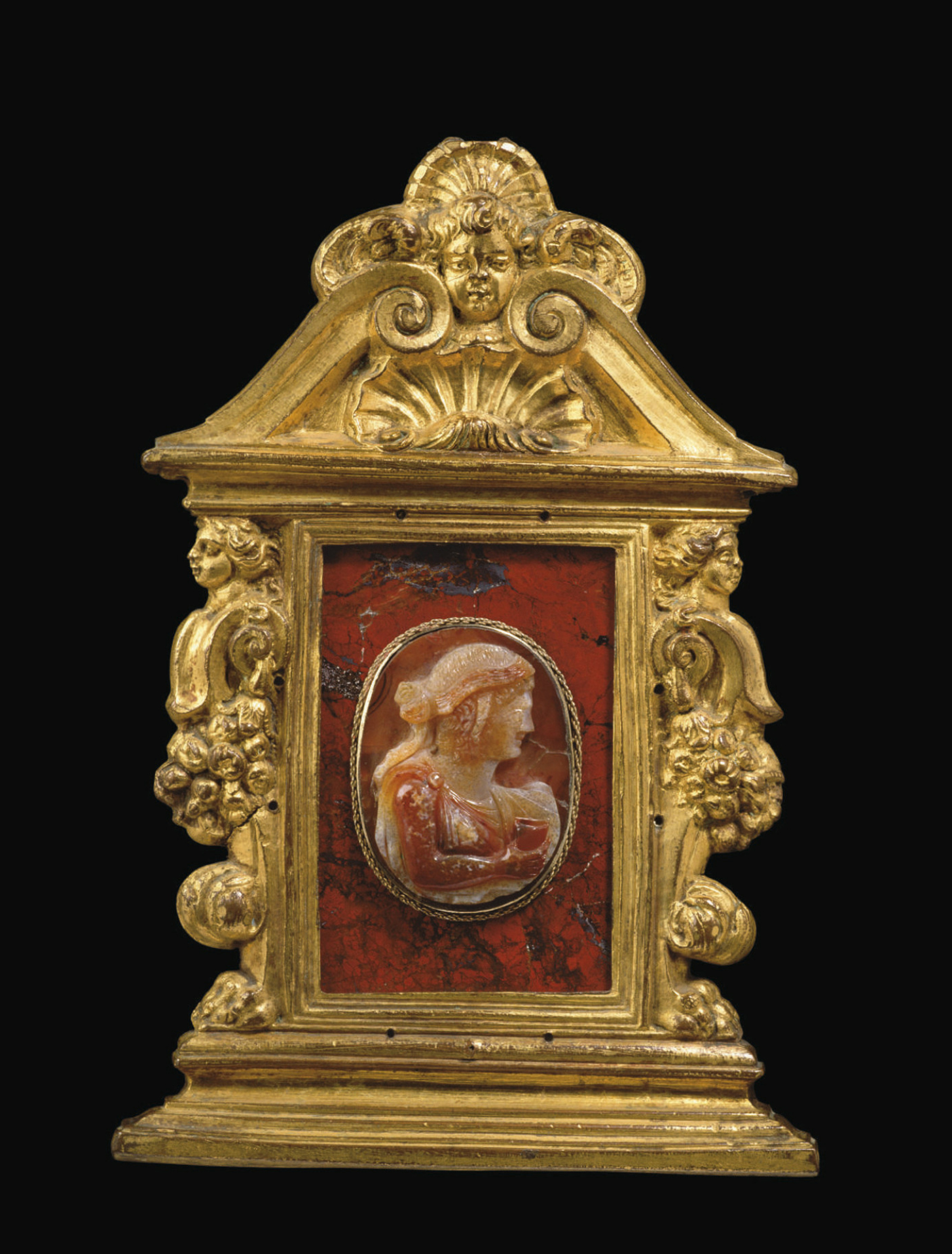
A gilt copper pax frame housing a hardstone cameo is of commensurate quality and facture with that depicting the previously discussed silver relief of The Incredulity of Saint Thomas (no. 12). While the frame for this object almost certainly descends from Antonio’s workshop, the entire production itself may be contemporary.
The pax frame houses a 16th century carved agate cameo bust of a woman, possibly a portrait of Sophonisba, set against a red jasper ground. The pairs of holes running along all four margins of the inner pax frame suggest the remnant of a former mounting, perhaps individual appliques supporting further precious materials, unless the frame is herewith repurposed to display the cameo and lacking an original more contemporaneous setting.
While it’s possible the frame may have once featured a metal relief—herewith exchanged for a precious stone ground and affixed cameo—the idea of a contemporaneous presentation is not without reason considering Antonio’s other projects incorporating hardstone (nos. 1, 2, 6, 23, and 25).
Simonetta Prosperi Valenti Rodinò suggests an elaborate goldsmith’s frame reproduced in a mid-16th century sketch, for example, may have once been intended to display what could have been a contemporaneous cameo depicting an Allegory of Prudence.98 Other Italian productions of the 16th century incorporated hardstone cameos like an anonymous pax frame of the 1540s made for Cardinal Marino Grimani.99 Hardstone grounds have also featured on paxes like an example for Pope Pius IV datable before 1565.100 One may also consider Cesare Targone’s productions from the school of Guglielmo della Porta, which incorporate precious goldsmiths work atop hardstone grounds.
Endnotes – Attributed Works:
1 Giuseppe Sangiorgi (1932): Opere di Antonio orefice faentino in Bollettino d’Arte, XXVI, pp. 220-29; Wolfgang Fritz Volbach (1948): Antonio Gentili da Faenza and the large candlesticks in the Treasury of St. Peter’s in The Burlington Magazine, LXXXVI, pp. 281-86; and Various Authors / The Detroit Institute of Arts (1959): Decorative Arts of the Italian Renaissance, 1400–1600, ex. cat., November 18, 1958–January 4, 1959., no. 400, p. 153.
2 Werner Gramberg (1964): Die Düsseldorfer Skizzenbücher des Guglielmo della Porta. Berlin, 3 vols.
3 Medici Archivio, Stato von Florenz: Guardaroba, filza 79. Invetarij Generale a Casi A. 1571-1588, fol. 13v.
4 Ibid., fol. 407v. This silver group consisting of three platters and six forks were completed by 10 July 1584, along with a refreshing of the elaborate vase Antonio Gentili had earlier made for the Medici family (see fol. 6v).
5 Simonetta Prosperi Valenti Rodinò (2001): Officina farnesiana: Disegni per oreficerie in Francesco Salviati et la Bella Maniera. Actes des Colloques de Rome et de Paris, pp. 405-28.
6 Patricia Rubin (1987): The Private Chapel of Cardinal Alessandro Farnese in the Cancelleria, Rome in Journal of the Warburg and Courtauld Institute, vol. 50, pp. 82-112.
7 Linda Seidel (2001): Pious Journeys: Christian Devotional Art and Practice in the Later Middle Ages and Renaissance, exh. cat., Chicago: The David and Alfred Smart Museum of Art, pp. 27-29; Ingrid D. Rowland (1999): The Place of the Antique in Early Modern Europe, Chicago: The David and Alfred Smart Museum of Art, 1999, pp. 53-56; and Sue Taylor and Richard Born (eds.) (1990): The David and Alfred Smart Museum of Art: A Guide to the Collection. New York: Hudson Hills Press, p. 38-39.
8 It’s been speculated if the effigy of Paul could instead be Matthew. We might compare, for example, the figure of Matthew seated and holding a billowing scroll on Niccolò Trometta’s fresco at the church of Santa Maria in Aracoeli (Rome), a study for which is in the Pierpont Morgan Library & Museum (inv. 1962.17).
9 Compare for example Francesco Salviati’s seated figure of Paul III in his fresco at the Palazzo Farnese or his drawing of the Judgment of Solomon (Museu Nacional de Arte Antiga, Portugal).
10 Medici Archivio (1571-88): op. cit. (note 3), fol. 373v.
11 Carlo Grigioni (1988): Antonio Gentili detto Antonio da Faenza in Romagna arte e storia, XXIV, pp. 83-118; see p. 91.
12 Silvana Pettenati (1978): I Vetri Dorati Graffiti e I Vetri Dipinti. Museo Civico di Torino., no. 63, pp. 44-45. Civic Museum of Turin, inv. 109-2995. The crystal’s inscription reads: Alexander Farnesius Cardinalis accipit traditaum anno 1576 Alexandri Cardinalis Farnesii miniator eximius. See Gerolamo D’Adda (1885): L’arte del minio Ducato di Milano dal secolo XIII al XVI in Archivio Storico Lombardo. Società storica lombarda. pp. 759-68; John William Bradley notes Claudio Massaroli worked for Clovio in Rome, see John William Bradley (1891): The Life and Works of Giorgio Giulio Clovio, Miniaturist, 1495-1578. London. p. 68; and Stefano Onofri (2013): La Cerchia di Giulio Clovio: Gli incontri, I viaggi, le amicizie di un artista Europeo. PhD Thesis, Universita di Bologna, pp. 99-101.
13 Anna Beatriz Chadour (1980): Antonio Gentili Und Der Atarsatz von St. Peter. Westfälische Wilhelms-Universität, doctoral thesis, pp. 110-16.
14 The dynasty and legacy of the Decio family of goldsmiths and miniaturists has long been confounded in art historical literature, however, the patrimony of the family has recently been clarified in Rossana Sacchi (2005): Il disegno incompiuto. La politica artistica di Francesco II Sforza e di Massimiliano Stampa, 2 vols., Milan. See vol. II, Appendix I: Una dinastia di miniaturisti: i Decio, pp. 524-558.
15 Giovanni Paolo Lomazzo (1584): Trattato dell’ arte della pittura, scultura et architetettura. Milan.
16 Ibid.
17 Frederico Borromeo (1625): Musaeum. La Pinacoteca Ambrosiana nelle memorie del suo fondatore; Agostino Santagostino (1671): L’immortalità e gloria del pennello. Catalogo delle pitture insigni che stanno esposte al pubblico nella città di Milano, a cura di M. Bona Castellotti, Milano, 1980; and Giovanni Galbiati (1951): Itinerario per il visitatore della Bibl. Ambrosiana, della Pinacoteca e dei monumenti annessi, Milano, p. 278.
18 Ulrich Middeldorf (1976): Sculptures from the S.H. Kress Collection, European Schools, London, p. 79.
19 Various Authors (2011): Ronciglione e il lago di Vico. itinerari turistici. Palombi Editori, p. 22.
20 The dating of the fountain is based upon the respective years Cardinal Alessandro’s children passed away and whose armorials are featured on the fountain. A.B. Chadour (1980): op. cit. (note 13), pp. 177-79.
21 This dating is adjudged by Silvio Leydi’s keen observation that a group of reverse-painted rock crystals on a travelling altar at the Victoria & Albert Museum (inv. M.54-1930), are the workmanship of Agostino Decio who was present with the maker of that altar, Giovanni Battista Panzeri, in 1554. Silvio Leydi (2016): Mobili milanesi in acciaio e metalli preziosinell’età del Manierismo. Fatto in Italia. Dal Medioevo al Made in Italy. Silvana Editorial, Turin, pp. 121-37.
22 S. Pettenati (1978): op. cit. (note 12), pp. XXXV-VI. Pettenati has alternatively forwarded some attributions of other works to Decio in Silvana Pettenati (1977): I Decio and the eglomisés glasses in Per Maria Cionini Visani. Writings of friends, Turin, pp. 48-58.
23 A.B. Chadour (1980): op. cit. (note 13), pp. 110-16.
24 S. Rodinò (2001): op. cit. (note 5).
25 Un monte Calvario de metallo (A metal Mount Calvary). See Antonino Bertolotti (1881): Artisti lombardi a Rome nei secoli XV, XVI, XVII. Studi e ricerche negli archivi romani, 2 vols., Milan, Vol. I, p. 142.
26 Ibid., vol. 1, p. 142, and documentary appendix, pp. 140-41.
27 W. Gramberg (1964): op. cit. (note 2), see Book II, nos. 154, 160 and 174, for example.
28 Giorgio Vasari (1568): Le vite de più eccelenti pittore scultori ed architettori scrite da Giorgio Vasari, pittore aretino, con nuove annotazione e commenti di Gaetano Milanesi, vol. V. Firenze, 1880; vol. VII, 1881, pp. 548-549.
29 A. Bertolotti (1881): op. cit. (note 25), vol. II, pp. 122, 154.
30 Both are located in El Escorial, invs. 10014408 and 10048054.
31 A gilt bronze cast at the Budapest Museum of Fine Arts, inv. 51.927; a gilt bronze cast in a private collection, formerly with Coll & Cortes; a bronze cast lacking the crucifix and possibly derivative or related to the terracotta example, Boston Museum of Fine Arts, inv. 29 1026.
32 First cited by Piero di Genari (1938): L’Arte, 1, pp. 299-300 and subsequently discussed in Jolán Balogh (1964): Un bas-relief en bronze de l’atelier de Hans Reichle in Bulletin du Musée Hongrois des Beaux-Arts, 24, pp. 79–84, 138–39.
33 Regrettably the source for this cast is not known but its quality and appearance indicate a modern facture. There is large scar running across the relief, cast integrally into the bronze and apparently suggesting the mould or model had broken in-half but was still used for the creation of this cast (photos in author’s personal files).
34 Museo Lázaro Galdiano, invs. 02171, 02177. See also Werner Gramberg (1973): Das Kalvarienberg-Relief des Guglielmo della Porta und seine Silber-Gold-Ausführung von Antonio Gentile da Faenza in Intuition und Kunstwissenschaft: Festschrift für Hanns Swarzenski, Berlín, pp. 449-60.
35 The two silver casts of Mount Calvary that feature silhouetted figures are the examples donated by Philip II to the Monastery of El Escorial, set against a slate background (no. 7) and the example at the Museo Diocesano de Albarracín, originally set against black velvet.
36 Reproduced in Charles Avery (2012): Guglielmo della Porta’s Relationship with Michelangelo in Guglielmo della Porta, A Counter-Reformation Sculptor. Coll & Cortés, p. 136 and more recently reproduced in M. Szócs (2013): op. cit. (note 41).
37 Published in Ernesto Arce Oliva (2014): Museo Diocesano de Albarracín in Artigrama, 29, pp. 163-188. This silhouetted example portrays only the singular figures of Mary and John, and Christ on the cross against a red velvet backing that was originally a black velvet backing, according to the contemporary inscription attached to its reverse. It is altogether set in an ebony frame with various silver appliques including several depicting individually silhouetted angels holding the symbols of the Passion which Ingrid Weber dates circa 1610 and in the manner of Christoph Lencker from Augsburg. The models for these appliques appear to have been used variably among Augsburg workshops, appearing also on a house altar in the chapel at Rügenwalde Castle, monogrammed HK, and on another house altar at Schloss Donaueschingen, inventoried there as early as 1642. See Ingrid Weber (1975): Deutsche, Niederlandische und Franzosische Renaissanceplaketten, 1500-1650. Bruckmann Munchen, Germany, nos. 398.1-.4, pp. 206-07. The figurative sun and moon are not original to the relief and were added during the 18th century. The relief itself features an Augsburg hallmark as discerned in Cristina Esteras Martín (1975): Inventario artístico de la orfebrería religiosa en la ciudad de Albarracín in Teruel, 53, Teruel, Instituto de Estudios Turolenses, p. 108 and C. Esteras Martín (1980): Orfebrería de Teruel y su provincia. Siglos XIII al XX, 2 vols., Teruel, Instituto de Estudios Turolenses, p. 409, while the makers mark featured on the relief belongs to Jeremias Michael as discerned in José Manuel Cruz Valdovinos (1997): Platería europea en España (1300-1700). Madrid, Fundación Central Hispano, pp. 209-210.
38 Inv. CE01459, published in José Manuel Cruz Valdovinos (1997): Platería europea en España (1300-1700). Madrid: Fundación Central Hispano, pp. 212-13, no. 62.
39 Helmut Seling (2007): Die Augsburger Gold-und Silberschmiede 1529-1868, Munich, no. 1305a.
40 Saint Louis Art Museum, inv. 115:1969.3.
41 Budapest Museum of Fine Arts, inv. 51. This example of the relief was discussed in greater depth by Miriam Szócs (2013): From Hans Reichle to Guglielmo Della Porta. Bulletin du Musée Hongrois des Beaux-Arts. Budapest, pp. 129-47.
42 Andrea Bacchi (2002): Il Michelangelo incognito, pp. 228-236 and Emmanuel Lamouche (2011): La carrière de Bastiano Torrigiani sous le pontificat de Grégoire XIII in Revue de l’art, CLXXIII, pp. 51-58.
43 This idea was first proposed in Various Authors (1986): Centenario del Monasterio de El Escorial, Madrid, exhibition catalog, pp. 158-59.
44 The work was made by Jacob Cornelis Cobaert in Guglielmo della Porta’s workshop. A. Bertolotti (1881): op. cit. (note 25).
45 This crucifix model was first attributed to Guglielmo della Porta in Ulrich Middeldorf (1977): In the Wake of Guglielmo Della Porta in Connoiseur, 194, pp. 75-84, see figs. 13 and 14 and expounded upon further in W. Gramberg (1981): Notizien zu den Kruzifixen des Guglielmo della Porta und zur Entstehungsgeschichte des Hochaltarkreuzes in S. Pietro in Vaticano in Münchner Jahrbuch der bildenden Kunst, XXXII, pp. 95-113, see fig. 3.
46 For a discussion of Guglielmo’s crucifixes see M. Riddick (2017): Reconstituting a Crucifix by Guglielmo della Porta and His Colleagues. Renbronze.com (accessed February 2022). A good example of a cast very likely reproducing Guglielmo’s original wax model with great fidelity is one featured on a private devotional altar cross formerly belonging to the Capponi family in Rome (see figs. 3 and 5 in the aforenoted article).
47 It has traditionally been understood that Ludovico del Duca was exclusively responsible for the tabernacle’s ciborium, however, Torrigiani appears to have shared some of his models for use on the ciborium, such as the winged putto appliques set within the triangular pediments along its central tier, for example. For a detailed discussion on the creation of the Sta Maria Maggiore tabernacle see Jennifer Montagu (1996): Gold, Silver & Bronze: Metal Sculpture of the Roman Baroque. Princeton University Press, pp. 24-28.
48 Werner Gramberg, who first attributed the relief’s design to Guglielmo della Porta, originally suggested a dating of the Mount Calvary between 1570-75. See W. Gramberg (1973): op. cit. (note 34). Guglielmo was certainly focused on producing crucifixes as early as 1569 and quite likely at an even earlier period, as evinced in the semantics and subject of a letter Guglielmo sent to Bartolomeo Ammannati, discussing four crucifixes Guglielmo was making for important recipients: “I have turned my endeavors once again to several figures of Christ on the cross…” See W. Gramberg (1964): op. cit. (note 2), nos. 128 and 1981, p. 96.
49 The provenance of this object is recorded in a dedication at the foot of the frame: Questa imagine del Santissimo Crocifisso fu donnata in questo quadro per Gregorio Papa XIII alla Serenissima Signora Bianca Capello Medici Gran Ducchesa di Toscana con privilegio dell’indulgente e gratie infrascritte a Sua Alt. Ser. Concedute l’anno della salute MDLXXX… (This image of the Most Holy Crucifix was given in this frame by Pope Gregory XIII to Her Serene Highness Bianca Capello Granduchess of Tuscany, with the privilege of the indulgences and graces listed below conceded to Her Serene Highness in the year of Salvation 1580…). See Rosario Coppel (2012): Catalogue (Mount Calvary). Guglielmo della Porta, A Counter-Reformation Sculptor. Coll & Cortés, pp. 98-111, see p. 106.
50 Giovanni Baglione (1642): Le vite de’ pittori scultori et architetti. Dal pontificato di Gregorio XIII del 1572. In fino a’ tempi di Papa Vrbano Ottauo nel 1642. (…e modellava da sculture Eccelentemente…), p. 323.
51 Reproduced in Eusebio Julián Zarco-Bacas y Cuevas (1930-31): Inventario de las alhajas, relicarios, estatuas, pinturas, tapices y otros objetos de valor y curiosidad donados por el rey Felipe II al Monasterio de El Escorial. Años 1571-1598 (I) y (II)” in Boletín de la Real Academia de la Historia, vol. XCVI-XCVII, Madrid. pp. 113-114, no. 1595 and reproduced in English in R. Coppel (2012): op. cit. (note 49).
52 Emmanuel Lamouche (2022): Les fondeurs de bronze dans la Rome des papes (1585-1630); Ecole Francaise de Rome, p. 85.
53 W. Gramberg (1973): op. cit. (note 34), pp. 449-460.
54 Ibid., p. 453.
55 See Archivo General de Simancas, Estado, 946, fol. 300-301. Bianca Cappello to Philip II, Florence, 13 January 1585.
56 J. Zarco-Cuevas (1930-31): op. cit. (note 51).
57 W. Gramberg (1973): op. cit. (note 34), p. 452.
58 Alessandro’s letter to Guglielmo was written on 8 December 1571 stating: “I have received the crucifix that it was your pleasure to send me and because it is a work of such merit and made with so much care and diligence by such a perfect hand as your own, it has pleased me so much, to the furthest extent to which I can express myself, and indeed I know not of any image that could be sculpted with greater mastery and more skill than this one, so the greater is my gratitude to you.” (State Archives of Naples, first published by W. Gramberg (1981): op. cit. (note 45) and reproduced by R. Coppel (2012): op. cit. (note 49). See also M. Riddick (2017): op. cit. (note 46).
59 Metropolitan Museum of Art, inv. 32.100.168.
60 Stefanie Walker (1991): A Pax by Guglielmo della Porta. Metropolitan Museum Journal, 26, pp. 167-176.
61 In addition to Walker’s identification of Guglielmo della Porta’s Risen Christ relief featured on the MET and Palazzo Pitti paxes, the present author has also noted further examples such as: a silver or silvered bronze cast featured in a frame of similarly Classicized character as that of the MET example and potentially the product of Guglielmo’s workshop, located at an unidentified church in Bologna; a very crude silver aftercast featuring the relief set into a frame belonging to Bastiano Torrigiani’s invention along with another of slightly better quality, in a different frame, of gilt silver or bronze, both located at unspecified churches in the Roman Catholic Archdiocese of Siena-Colle di Val d’Elsa-Montalcino; and a heavily afterworked later cast reproducing also the Palazzo Pitti pax frame in bronze with a silver (or silvered) central relief and colored enamel treatments, probably altogether of 19th century production, at the Museu Frederic Marés in Spain. One further silver example, reproducing only the frame of the Palazzo Pitti pax and alternatively featuring an enameled scene of the Crucifixion, possibly of 17th or 18th century invention, was identified in the art market (Hampel auction, 23 June 2007, lot 803). For the identification of Bastiano Torrigiani’s frame see M. Riddick (2019): The Paxes and Reliefs of Antonio Gentili da Faenza. Renbronze.com (accessed January 2024) and E. Lamouche (2022): op. cit. (note 52), fig. 30.
62 Ibid.
63 Anna Beatriz Chadour (1982): Der Altarsatz des Antonio Gentili in St. Peter zu Rom. Wallraf-Richartz-Jahrbuch, vol. 43, pp. 133-93.
64 Gordon Campbell (ed.) (2006): The Grove Encylopedia of Decorative Arts, Vol. 1. Oxford University Press, p. 417.
65 Thomas Richter (2003): Paxtafeln und Pacificalia: Studien zu Form, Ikonographie und liturgischem Gebrauch. Verlag und Datenbank für Geisteswissenschaften, Weimar, p. 110.
66 A. Bertolotti (1881): op. cit. (note 25), vol. II, pp. 122, 154.
67 Rosario Coppel (2012): Catalogue. Flagellation of Christ in Guglielmo della Porta: A Counter-Reformation Sculptor. Coll & Cortes, pp. 83-87.
68 Carolyn Valone (1977): Paul IV, Guglielmo della Porta and the rebuilding of S. Silvestro al Quirinale in Master Drawings, XV, pp. 243-255, plates 1-8.
69 The monument to Charles V was to include fourteen relief scenes from the Passion of Christ. Giorgio Vasari praises and describes these models in G. Vasari (1568): op. cit. (note 28). See also endnote 72 in ‘Unlocated Works’ in this paper for details on the later provenance and history of these 14 reliefs.
70 A. Bertolotti (1881): op. cit. (note 25), vol. I, p. 135.
71 Rome State Archive, Not. Tarq. Severo, 1577-78, f. 754-55, published in part by A. Bertolotti (1881): op. cit. (note 25) vol. I, pp. 142-143.
72 A. Bertolotti (1881): op. cit. (note 25), vol. 1, p. 137. The model is described: “d’un historietta d’un Christo alla colonna di cera Negra.”
73 Victoria & Albert Museum, inv. A.1-1977.
74 Ernst Bange (1923): Die Bildwerke des Deutschen Museums. Die Bildwerke in Bronze und in anderen Metallen. Walter de Gruyter & Co., Berlin, no. 1863, pp. 57-58.
75 Museo Nazionale del Bargello, inv. 753.
76 Los Angeles County Museum of Art (LACMA), inv. M.85.103.
77 For example, a very good independently cast figure of Christ in-the-round and an accompanying column from this Flagellation scene is preserved in the Bargello Museum (Carrand collection, no. 752), the Fitzwilliam Museum (Inv. M.265-1912), one formerly in the early 20th century collection of George L. Durlacher of Hilcote (Sotheby’s, 9 November 1938, lot 100…more recently offered at Bonham’s, 30 November 2023, Lot 4) and a variant in applique-form from Coll & Cortes which makes use of disparate elements of the relief while adding an additional figure to the right-most group in the scene. On this latter example, the production features a gilt copper ground with superimposed silver appliques in low-and-high relief set into an octagonal ebonized wood framework with further silver appliques circumnavigating the frame. The figure of Christ has been exchanged with a tempered version and the entirety of the various elements of this production convincingly descends from Guglielmo’s workshop models. Although the tabernacle is attributed to Guglielmo, ca. 1569-77, it is more likely to be a later product of someone with access to his models, perhaps even Teodoro della Porta, but probably not Torrigiani or Gentili. See R. Coppel (2012): op. cit. (note 67).
78 Ulrich Middeldorf (1935): Two wax reliefs by Guglielmo della Porta. The Art Bulletin, vol.17, no. 1, March, p. 95.
79 It shouldn’t be ruled out that the finished model could instead be the product of Jacob Cornelis Cobaert following after Guglielmo’s design. Cobaert is documented as being responsible for modeling the series of Ovid’s Metamorphoses reliefs after Guglielmo’s designs, among others. See G. Baglione (1642): op. cit. (note 50), pp. 100-01.
80 M. Riddick (2019): op. cit. (note 61), see fig. 13.
81 For a recent discussion of these widely diffused Spanish reliefs see Jeremy Warren (2014): Medieval and Renaissance Sculpture in the Ashmolean Museum, Vol. 3: Plaquettes. Ashmolean Museum Publications, UK, nos. 504-06, pp. 1045-48.
82 Anthony Geber (1989): Name Inscriptions: Solution or Problem? Studies in the History of Art, Vol. 22. Italian Plaquettes. National Gallery of Art, Washington DC., pp. 251-52.
83 A Custos, or custodian and guardian, was a religious superior in the Franciscan Order (FRANCISVS), and typically one assigned to preside over a province.
84 It is worth pointing out one additional contemporary silver cast of this Pieta relief (lacking a frame) that was eloquently afterworked by a competent hand and formerly on the art market: Cambi auction, 15 April 2014, Lot 29 (the plaquette features a 19th century French silver assay punch mark in the lower right flange of the relief).
85 Irene Fosi (2020): Cristoforo Gaspare Fischer: A Goldsmith, his Inheritance and the Inquisition in Inquisition, Conversion, and Foreigners in Baroque Rome. Brill publishing, pp. 71-84.
86 Émile Molinier (1886): Les Bronzes de la Renaissance: Les Plaquettes. 2 Vols. Paris, France. Vol. 2, no. 695, p. 171.
87 Wilhelm Vöge (1910): Die deutschen Bildwerke und die der anderen cisalpinen Länder. 2nd ed. Berlin: Reimer, no. 818.
88 E. Bange (1923): op. cit. (note 31), no. 1485, plate 28.
89 Maria Stahr (1994): Plakiety renesansowe: Muzeum Narodowe w Poznaniu, Poznań, no. 137.
90 Arthur Sambon (1914): Sammlung Dr. A. Sambon, Jacob Hirsch auction, 9 May 1914, Lot 131.
91 Ulrich Middeldorf (1944): Medals and Plaquettes from the Sigmund Morgenroth Collection. Donnelley & Sons Co., Chicago, IL., no. 184, p. 28.
92 Email correspondence (2010s).
93 Morton & Eden auction, 18 April 2001, Lot 600 (cataloged as Netherlandish, end of the 16th century).
94 Palazzo Madama Inv. 1273/B.
95 Sotheby’s auction 21 April 1988, Lot 207.
96 See last portion of endnote 61.
97 A.B. Chadour (1982): op. cit. (note 63), p. 173.
98 S. Rodinò (2001): op. cit. (note 5).
99 The pax is located at the Cathedral of Santa Maria Assunta, donated by Marino’s brother, Giovanni in 1558. Sergio Tavano and Giuseppe Bergamini (2000): Patriarchi: quindici secoli di civiltà frà l’Adriatico e l’Europa centrale. Skira, Milan, p. 350, no. XXVI.8.
100 Milan Cathedral Treasury, inv. no. 1713.
Antonio Gentili da Faenza
Unlocated Works
(nos. 14-40)
No. 14
Twelve Silver Reliquaries
1570
Antonio Gentili, along with the silversmith Pier Antonio di Benvenuto Tati, received the commission for twelve silver reliquaries from Pope Pius V. The commission was mitigated through the Pope’s treasurer and the project involved the creation of ten busts in gilt silver and an additional reliquary in the form of an arm and another in the form of a leg, presumably to house bones thought to belong to those body parts of the respective saints. The designs for the reliquaries were provided by Guglielmo della Porta.1
No. 15
Pair of Candlesticks
ca. 1572-85
Antonio is cited as having produced two metal candlesticks for the High Altar of the Chapel of the Most Holy Sacrament.2 Wolfgang Fritz Volbach suggested these survive in the treasury of St. Peter’s, albeit, much embellished with various later accoutrements and a Baroque period program (fig. 33).3

Fig. 33: Bronze candlestick (Treasury of St. Peter’s Basilica, Rome)
No. 16
Reliquary of St. Petronilla
ca. 1572-85
Antonio completed a reliquary bust intended to hold the relic head of St. Petronilla, to be displayed on the altar dedicated to Petronilla in St. Peter’s.4 The whereabouts of the reliquary remain unknown although a drawing by Giacomo Grimaldi in the Vatican Apostolic Library preserves its general appearance which conforms to the preferred tastes of the period (fig. 34). Grimaldi informs us that the reliquary was made during the reign of Pope Gregory XIII, and thus dates the object ca. 1572-85.5
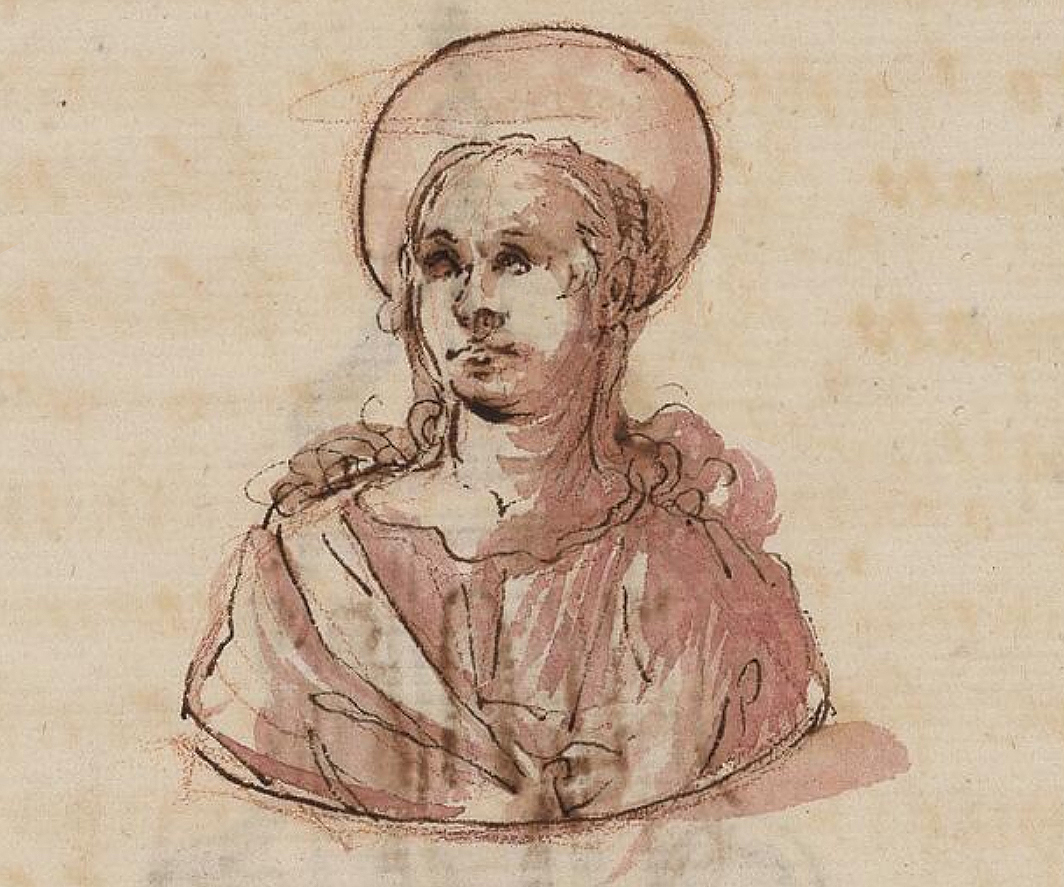
Fig. 34: Sketch by Giacomo Grimaldi of a reliquary of St. Petronilla by Antonio Gentili da Faenza (Vatican Apostolic Library)
No. 17
Silver Candlestick
Probably mid-1570s
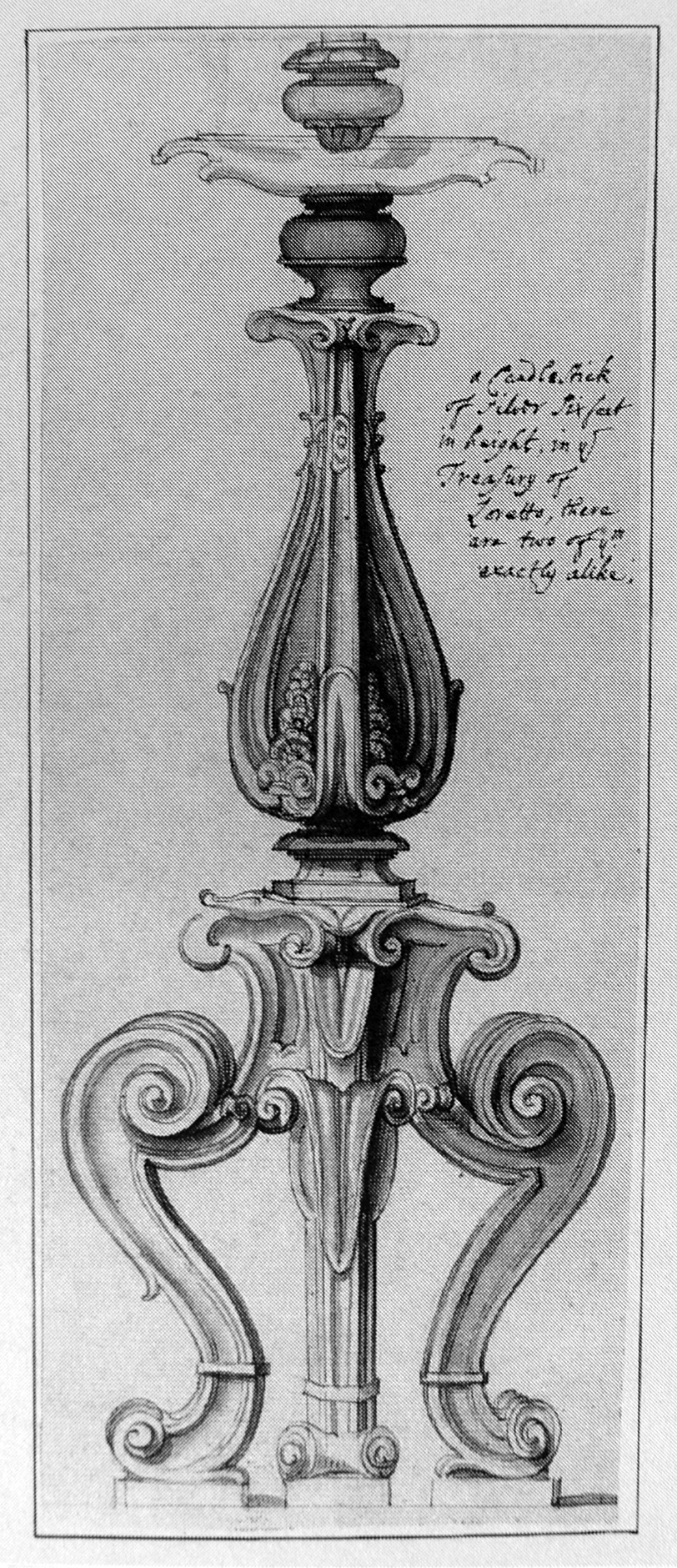
Fig. 35: Drawing of footed base for a large candlestick formerly in the Treasury of Santa Casa, Loreto (John Talman collection)
A silver candlestick Antonio made for Muzio Mattei, of the important banking and political family in Rome, is cited in documents pertaining to a later altar service conceived for the altar of the Spada chapel in S. Girolamo della Carità in that same city. Documents note the Spada altar service was to be executed by Francesco Travani and evidently based on a candlestick Antonio had made earlier for Mattei.6 Jennifer Montagu and Marc Worsdale have cited a drawing formerly in the collection of John Talman,7 preserving the effigy of a six-foot tall silver candlestick formerly in the treasury of the Santa Casa in Loreto that had been gifted by the Barberini (fig. 35). They note how the drawing shares a semblance with the candlesticks in the Spada Chapel and could possibly be a vestige of one of Gentili’s productions.8 The scrolling volutes flaring thickly at their crest and long descending eaves along its upper base suggest Antonio’s influence although any firm association with his workmanship remains only speculative. Wolfang Fritz Volbach also drew attention to three watercolor sheets of candlesticks, preserved in the Chigi Codex at the Vatican Apostolic Library, which he thought might likewise reproduce works by Antonio. In particular, one of the designs seems rather convincing and could theoretically reproduce a candlestick envisioned or executed by Antonio (fig. 36) and presumably for the Chigi family or another patron.9
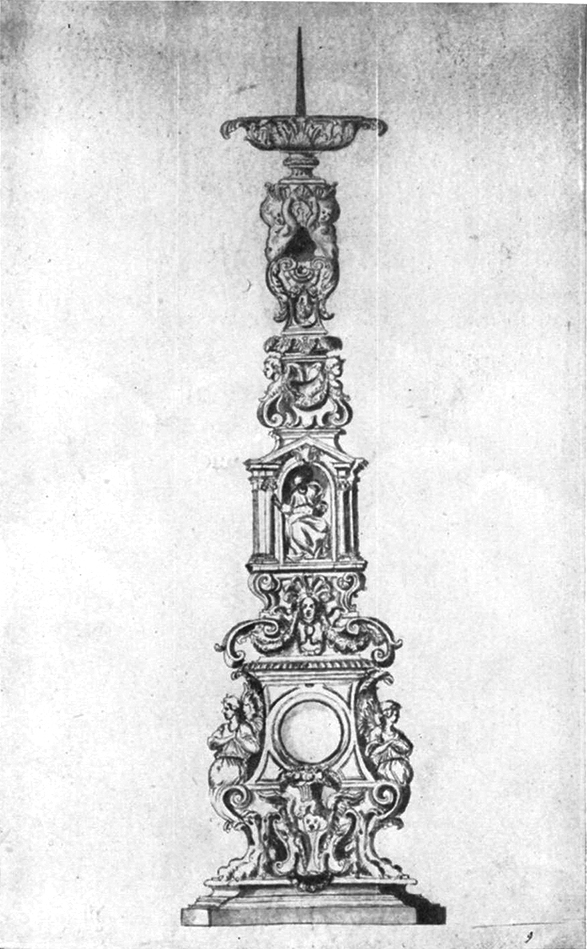
Fig. 36: Drawing for a candlestick probably by or after Antonio Gentili da Faenza, Rome (Chigi Codex, folio 9, Vatican Apostolic Library)
No. 18
Silver for an indeterminate project
After 12 March 1576
Commissioned by Cardinal Ferdinando I de’ Medici
‘Two silver sheets are delivered to Antonio for the execution of a project.’ The translation of the entry is challenging but could refer to the supplies required for the silver ewer and platter referenced in no. 19. Alternatively, it could refer to an ewer in the form of a boat or ship, such as a nef, being a type of tableware accoutrement employed for a variety of purposes. Nefs were used for holding salt or spices or for storing tableware and linens or could be used as a wash basin. The use of the term ‘caruola’ could also be interpreted to refer to a bed-warmer, also being the occasional enterprise of metalsmiths. The silver sheets for this project were furnished by Cardinal Ferdinando I de’ Medici, the younger brother of Francesco de’ Medici.10
No. 19
Silver Ewer in the manner of a Fountain
Before 7 August 1577
Commissioned by Francesco de’ Medici
The present ewer is described as a large, round silver ewer with a high foot, ‘like a fountain,’ comprised of four harpies with masks in relief; two cartouche handles towards the mouth of the vase; four masks of sea monsters with two wings at the opening of the vase; and two masks along the body of the vase with three mouths for pouring two kinds of wine and water. The interior of the vase was divided into four compartments with a central column intended to store ice and the additional compartments—circumnavigating the central column—was employed for storing the liquids. The lid is described as being worked with vine leaves with a jar on top, full of grapes and fruits. The entire object (inside-and-outside) was finished in gilt silver.
The ewer had been intended for the Medici Guardaroba in Florence but appears to have remained in Rome.11 A plain silver basin with a folded rim was made to accompany the ewer and was subsequently completed by Antonio before 12 August 1577.12 Antonio appears to ‘refresh’ the ewer in 1584 when furnishing the Medici with three plates and three sets of forks (no. 32) to presumably be paired with the ewer.13 A drawing preserved in the Rijksmuseum, by or after Antonio, closely resembles some of the descriptive features of this ewer and could theoretically refer to preparations for its design (fig. 11).
Antonio may have executed other ewers, possibly for the Farnese, as inferred by John Forrest Hayward in discussing two drawings of ewers at the Victoria & Albert Museum (fig. 37). The ewers reflect an inspiration from the decorative language of the Farnese Altar Service (no. 1) as well as Manno Sbarri’s Farnese Casket (fig. 14).14 Beatriz Chadour has theorized these drawings were possibly based upon a goldsmith’s pattern book from Gentili’s workshop.15 Other related goldsmith sketches bearing possible Farnese motifs are preserved at the Municipal Library of Palermo, assembled in Rome during the late 17th century by Father Sebastiano Resta (see figs. 25 and 26, for example).16
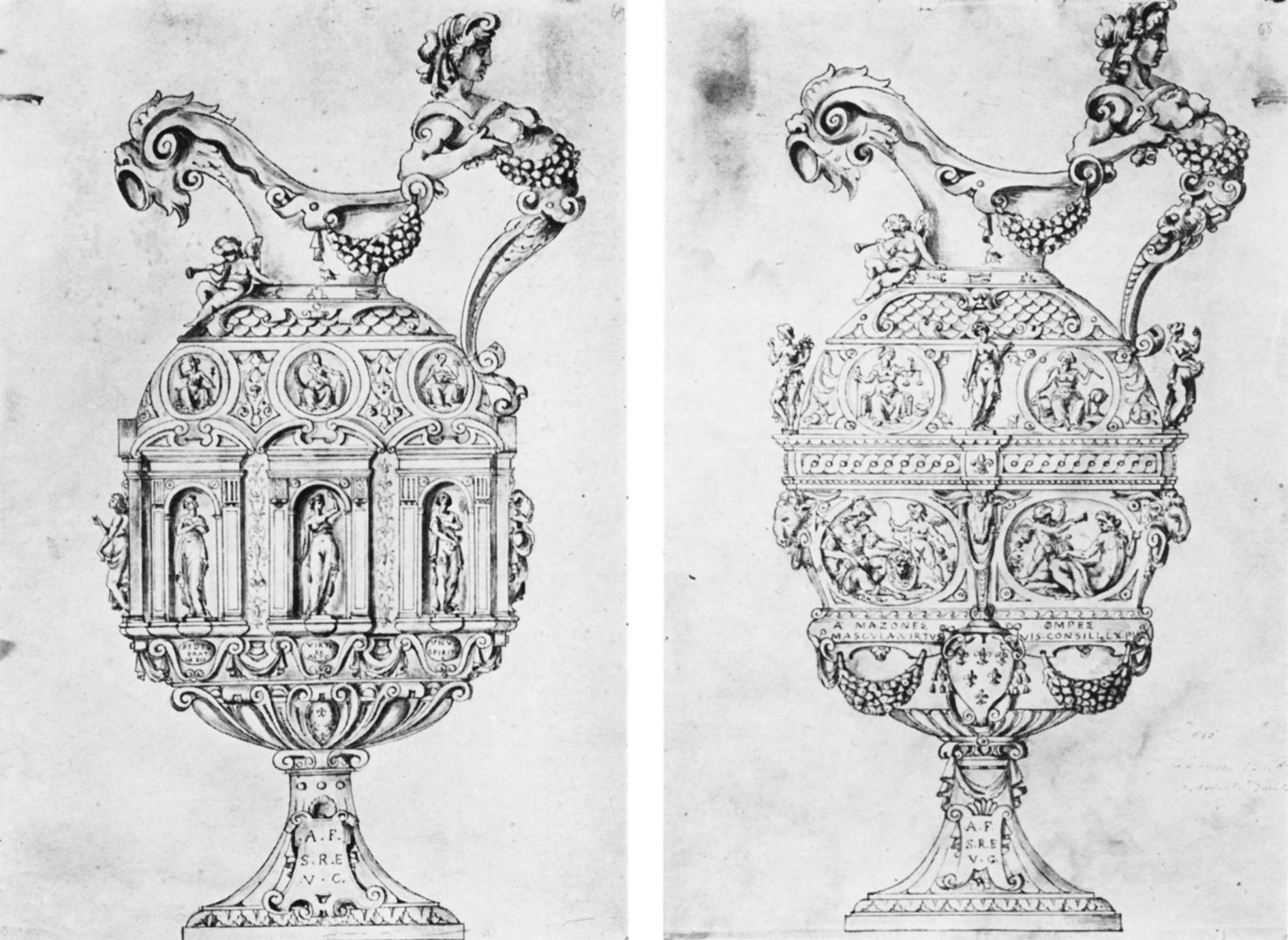
Fig. 37: Pen and wash sketches of designs for ewers intended for the Farnese family from an anonymous goldsmiths copy book of the mid-to-late 16th century (Victoria & Albert Museum)
The 1587 inventory of the Guardaroba belonging to Alessandro’s brother, the Cardinal Ranuccio Farnese, mentions four ewers with their basins, featuring the Farnese arms in their center.17 One of the drawings indeed features the Farnese arms surmounted by a Cardinal’s hat in the center of its lower base (fig. 37, left) and both feature the inscription: A.F.S.R.E.V.C. (Alexander Farnesius Sanctae Romane Ecclesiae Vice Cancellarius). A similar inscription is featured on a cartouche along the base of the Farnese altar cross and a further related motif, albeit engraved, is featured on the interior binding of the Farnese Hours, representing the arms of Cardinal Odoardo Farnese (fig. 8).
Ranuccio’s tenure as Cardinal between 1545-65 would suggest if Antonio did realize an elaborate ewer for him, that it would have been made prior to Ranuccio’s death and could suggest a production of Antonio’s during the period in which there is an absence of documentary works and also a project anticipating his subsequent commission for the Farnese Altar Service. We could presume the unique feature of Greek on this ewer may have been connected with Ranuccio’s patronage of Federico Commandino and his translations of Greek into Latin. It would seem possible that Francesco Salviati could have provided early designs for such an ewer. The drawings echo a sketch by Salviati for a vase with Farnese Lilies preserved at the Metropolitan Museum of Art (inv. 50.605.11).18
The Victoria & Albert folio of sketches in which the drawings of these ewers are kept also include the sketches depicting early iterations of Antonio’s candlesticks for the Farnese Altar Service (no. 1, and related fig. 15), and as such, could indicate these sketches probably relate to Antonio’s projects produced for both Alessandro and his older brother, Ranuccio, as suggested by Chadour. The knowledge of such elaborate works may have prompted Francesco I de’ Medici to commission this object-type from Antonio, as Francesco avidly pursued the best and most distinguished works-of-art in his time.
No. 20
Silver and Rock Crystal Reliquary
17 May 1578
Commissioned by Pedro da Fonseca
Antonio delivered a silver reliquary with crystals to Pietro Fonseca (Father General of the Society of Jesus).19 It is to be wondered if this object could have had some stylistic semblance with the Farnese Ostensory (no. 6) also probably made in-and-around this time period (ca. 1582-88) and likewise incorporating a rock crystal, albeit reverse-painted. A sketch in the Municipal Library of Palermo, probably datable to the 1550’s and of Roman origin,20 if associable with Antonio’s production, might preserve some idea of what this reliquary could have looked like, sans the secular iconography (fig. 26).
No. 21
Silver Oil Lamp
Before 2 March 1580
Commissioned by Francesco de’ Medici
A three-piece silver oil lamp set upon a high footing. The upper portion, shaped like a pear, probably in all’antica manner, was used to store the oil followed by a central deck and lower base in the form of a niche.21
No. 22
Gilt Silver Fork
27 March 1580
Commissioned by Francesco de’ Medici
A gilt silver fork commissioned by Francesco I, was completed on 27 March of 1580, and given to Virginio Orsini, the son of Francesco’s deceased sister, Isabella Romola de’ Medici.22
No. 23
Gold Setting for a Banded-Agate Cup
probably ca. 1580-82
Commissioned by Francesco de’ Medici
Antonio is noted for completing a gold setting for a small banded-agate cup, possibly antique.23
No. 24
Gold Reliquary Cross
13 October 1581
Commissioned by Francesco de’ Medici
A golden cross with relics inside and a ring, presumably for suspension. This cross was donated to Spain on 20 October 1581.24
No. 25
Silver and Gold Tabernacle or Reliquary
June 1582
Commissioned by Francesco de’ Medici
A silver and gold tabernacle in the form of a rounded classical temple with eight columns with capitals and harpies, set altogether upon a base supported by agate orbs. A figurine was set upon its silver dome which also incorporated rock crystal from Milan. The work may have been an earlier invention edited by Antonio here in 1582, in which he removes a figure previously atop the dome and replaces it with a gilt silver figure of St. Helena. The item is apparently here converted into a reliquary.25
No. 26
Gold Reliquary Cross
7 February 1583
Commissioned by Francesco de’ Medici
A golden cross with six oval-shaped rock crystal windows with relics set therein. The cross featured four cherubim, presumably finials. The cross was donated to Spain on 28 February 1583.26
No. 27
Possibly a Jewelry Box or Table Accoutrement
7 February 1583
Commissioned by Francesco de’ Medici
A silver box, possibly with an open-work lid set with a wooden handle.27
No. 28
Silver Ink Well
26 February 1583
Commissioned by Francesco de’ Medici
A dome-shaped silver cup comprised of three pieces that could be screwed together. The three compartments were designated for sand, ink and wax, altogether presumably intended as an inkwell set.28
No. 29
Silver Frame
Before 28 September 1583
Commissioned by Francesco de’ Medici
Antonio had executed a gilt silver and ornamented frame for a portrait of the Madonna painted by Scipione Pulzone (called Il Gaetano).29 Notably, a signed and dated portrait of the Madonna, by Il Gaetano, from this year survives (fig. 12).30 The painting is a small devotional work, approximately 35 x 25.4 cm, befitting for the precious frame described as approximately one-half a braccia or a half-arm’s length in the Medici inventory. The Cardinal Francesco Maria del Monte’s 1627 posthumous inventory cites two Madonna panels by Il Gaetano: a larger example in an ebony frame and a smaller example commensurate with the surviving example, described with a golden frame, presumably of Antonio’s invention and in gilt silver, now lost.31
No. 30
Gold Jar
10 December, probably 1582-83
Commissioned by Francesco de’ Medici
A footed gold jar, made in the manner of an egg, which opens in the center.32
No. 31
Gold and Silver Writing Set
Before 12 April 1584
Commissioned by Francesco de’ Medici
as a wedding gift for his daughter, Eleanor
A golden quill pen and a small gilt silver beaker or jar with a lid and narrow mouth, presumably a writing set, which was destined for the studiolo of Francesco I’s daughter, Eleanor de’ Medici, and very likely a gift in celebration of her wedding to Vincenzo I Gonzaga which took place on 29 April 1584.33
No. 32
Three Silver Platters and Six Silver Forks
Before 10 July 1584
Commissioned by Francesco de’ Medici
Three silver platters and six silver forks (two to accompany each platter), presumably to form a set accompanying the large silver ewer Antonio executed in 1577 (no. 19), as he refreshes the ewer at this time.34
No. 33
Silver Chrismatory
Before 31 December 1584
Commissioned by Francesco de’ Medici
A silver chrismatory with a lid and screw-mounted cross atop. An armorial, presumably of the Spanish crown, was applied to the face of the casket. The object was sent to the King of Spain, Philip II, to form part of the reliquaries of San Lorenzo in the treasury of the Cathedral of Seville on 31 December 1584.35
No. 34
Framed Silver Relief of the Pietá
19 Feb 1585
Commissioned by Francesco de’ Medici
A silver framed relief Antonio produced for the Medici is described as a scene of the ‘Passion of Christ with the Most Holy Madonna.’36 It is quite possible this production involves a Pietá relief modeled by Jacob Cornelis Cobaert after a design by Guglielmo della Porta.37 Cobaert was an assistant and collaborator of Guglielmo and his execution of this relief is described by him during the 1609 trials instigated by Teodoro della Porta.38 The trial defines the relief as a Pietá and a scene of the ‘dead Christ in the arms of the Virgin.’40 Giovanni Baglione would later praise the composition and describe it as a scene of ‘Christ expired in the arms of the Virgin Mother, most beautiful.’ The trial records also inform that Cobaert had noted Antonio had an example of this model, probably loaned to him by Cobaert or by Bastiano Torrigiani. We may note, for example, that Torrigiani also cast one or more examples of this composition in the same year that Antonio likewise produced this example, evinced by an archival document which cites Torrigiani’s production of a cast of a Pietà made by Cobaert for the collector Simonetto Anastagi in 1585.41 The finest known example of this relief, probably cast in Guglielmo della Porta’s workshop, is preserved at the National Gallery of Art, Washington DC (fig. 38).
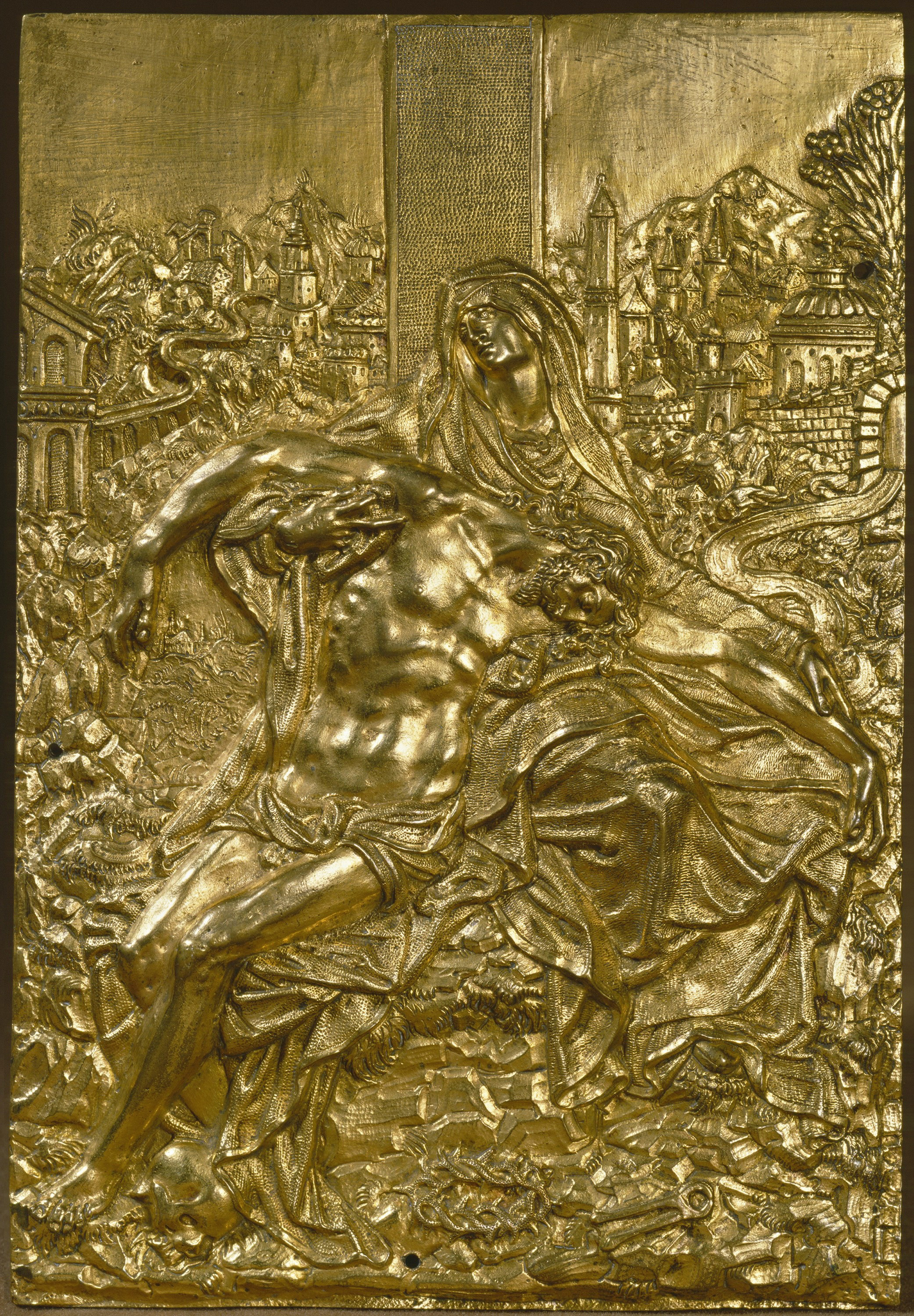
Fig. 38: Gilt bronze relief of the Pieta, attributed to Guglielmo della Porta and workshop, ca. 1569 (National Gallery of Art, Washington, DC, inv. 1989.57.1)
No. 35
Silver Cross
Probably 1580s
Commissioned by Cardinal N. Perelli
Based on descriptions and their coincidence with features of the Farnese Altar Service (no. 1), Carlo Grigioni suggested that Antonio made a silver cross for Cardinal N. Perelli that was subsequently donated to the Church of San Lorenzo in Damaso, Rome. If this is accurate, we are to presume such a cross was executed in the 1580’s, post-dating the Farnese Altar Service, but pre-dating his activity in Naples after 1593.42
No. 36
Silver half-figure relief of St. John
ca. 1586-89
In Cobaert’s testimony of 1609 he mentions a silver St. John, half-figure, in the hands of an apprentice active in Antonio’s workshop.43 Coabaert seems to imply that the half-figure was based upon the figure of St. John he had prepared for the Descent from the Cross (no. 40).
No. 37
Large Silver Altar Cross
11 November 1593
Commissioned by Don Severo Turboli
Antonio, age 74, and his son, Pietro, are commissioned by Don Severo Turboli—a refined and sophisticated prior at the Monastery of San Martino in Naples—to make a large silver and gilt cross, described as many palmi in height44 and apparently reaching a zenith of 9 palmi, or approximately 7 feet in height.45 Pietro, in 1613, noted its weight as one hundred twenty-two pounds and four ounces.46
The initial contract for the project involved a budget of 1,700 scudi and was to be completed within three years47 but appears to have much exceeded its original ambitions in cost and labor. The price to produce the cross was 12,000 ducats—almost twice its original cost—and while noted in various records as requiring fourteen years to complete, it appears to have been a ten-year effort.48 Stefano de Mieri has recently brought attention to a previously unpublished account of records citing Antonio’s receipt of monthly payments for the project up until 1603.49 The initial expectation of completing the project within three years was probably on account of the time required for Antonio to complete the similarly ambitious Farnese Altar Service (no. 1), completed just twelve years prior and accomplished after three years of labor.
A late 17th century description of the cross comments on its remarkable height and its feature of no less than forty-two figures and numerous low-relief scenes.50 A life-size drawing of the cross by Pietro Saia, was formerly kept in the Treasury in Naples but is lost.51 In light of the magnanimous nature of this cross, it is reasonable to assume Antonio may have reprised certain aspects of his earlier Farnese altar cross on this astounding project.
The initial contract made provisions for Antonio to produce a model which appears to have been completed within six-to-seven months while more substantial payments began arriving from May of 1594 onward.52 This large project would have required a retinue of assistants, particularly in consideration of Antonio’s continued travel and activities also in Rome. Probable assistants could have included the brothers Cristoforo and Giorgio Vischer. Cristoforo was responsible for casting and finishing the silver relief of the Skills of a Prince (no. 4) and a later silver pax bearing his hallmark reproduces a pax frame herein attributed to Antonio (no. 12, fig. 31). Another theoretical candidate could be Eugenio Clodio, with whom Cristoforo lived and worked in Rome between 1606-11. Clodio also traveled with Cristoforo to Naples in 1610.53 Clodio, in 1613, served as Chamberlain for the Confraternity of Goldsmiths in Rome and would have been well acquainted with Pietro Gentili who was serving as Assayer of the Papal Mint at that time.
The last documented mention of the cross is in 178954 and most likely saw its fate in 1794 when Ferdinando IV ordered the smelting of silver from Neapolitan churches that year to help fund war expenses.55
No. 38
Two Silver Altar Cruets
1596
Commissioned by Don Severo Turboli
To accompany the previously noted cross, Antonio also executed on behalf of Don Severo Turboli, a pair of silver altar cruets for the Monastery of San Martino. As Stefano De Meiri points out, these are noted in the records of payments concerning the cross.56 Regrettably, the cruets, as with the cross, are lost and were probably destroyed in 1794.
No. 39
Silver Reliquary of St. Menna
1600
Antonio executed a silver case with the head of St. Menna which became part of the Treasury of St. Peter’s, apparently unlocated.57
No. 40
Framed Silver Relief of the Descent from the Cross
1605
Probably commissioned by Alessandro Centurione, ca. 1587-88
The subject of a ‘Descent from the Cross,’ three palmi in height and two palmi in width, is a prime topic in the 1609 trial instigated by Teodoro della Porta concerning the misuse of his father’s models.58 Teodoro describes that it was made ‘in low and high relief, with many figures inside, excellently carved’ and ‘one of the most beautiful works my father has ever done.’59 The work was realized by both Guglielmo della Porta and Jacob Cornelis Cobaert, the latter of which cites his execution of the model in clay.60 It should be noted that while many sculptural reliefs associated with Guglielmo’s workshop are attributed specifically to Guglielmo, he seems to have taken-up the role of a designer toward the latter part of his career. During this late period Guglielmo appears to have depended heavily on Cobaert for the execution and translation of his designs into sculpted form, and as such, much credit should be due to Cobaert for his incredible skill in this category.
According to the trial testimonies, metal casts of the composition were apparently never realized during Guglielmo’s lifetime and Teodoro was attempting to have a silver cast of it made for an unspecified prince but was thwarted by Antonio’s sponsorship of the production of several wax moulds of the relief and a silver cast for a certain Monsignor Centurione, made in 1605.61 Antonio’s comment that the artwork was in possession of the Monsignor’s heirs suggests the patron was almost certainly Alessandro Centurione, Archbishop of Genoa, who served as bishop between 1591-96 and who died in 1605.62
Antonio had received a sum of 160-to-200 or more scudi for the project and his assistant, Baldo Vazzano, had been tasked with its casting. The work was elegantly framed with appliques of silver cherubim Antonio had purchased from Bastiano Torrigiani as early as 1584. The cherubim were apparently not Torrigiani’s own work but that of an unknown goldsmith of an earlier generation as they had been made during the time of Pope Paul III, presumably during the 1540s-50s and were part of the effects of Torrigiani’s workshop.63
Although the silver cast of the Descent from the Cross was completed in 1605, apparently just weeks or months before Centurione’s death, the project appears to have had an earlier origin around 1587-88. This is evident by Vazzano’s casualness about casting the relief in 1605, in spite of any concerns Teodoro may have had about the use of his father’s models. Vazzano had considered nothing unusual about Antonio’s use of the model or production of the relief since the project apparently had an earlier impetus in Torrigiani’s workshop where the model had been previously kept as part of the inherited estate of Guglielmo.
Data from the trial notes how Torrigiani had shared the model with some princes who admired the work and this must have eventually led to a commission from Centurione who was instrumental also in Torrigiani’s execution of the bronze grille for the chapel of Pope Sixtus V at Santa Maria Maggiore in 1587-89, for which Centurione was slated to serve as witness to the measuring and weighing of the bronze to be employed for that project.64 Indeed, it was in 1588 that Antonio, perhaps aware of Teodoro’s growing discontent about the use of his father’s models, prompted his decision to have his assistant, Vazzano, clandestinely prepare the plaster form for the relief in his bedroom, keeping the work out-of-sight from other assistants in the workshop.65 It is worth noting that while Antonio, by court order, was required to return Guglielmo’s model of a Mount Calvary to Teodoro in 1589 (no. 9), the subject of the Descent from the Cross and its model were not privy to this order and this may be due to the understanding that it was a project already underway between Torrigiani and Antonio.
In January of 1609 Antonio subsequently commissioned Sebastiano Marchini, a formatore from Florence, whose workshop was near the Madonna dei Monti in Rome, to prepare three wax editions of the Descent from the Cross, two in red wax and a third in white wax. Antonio’s contracting of the wax forms to Marchini was at the request of Jacques d’Armuis, a French sculptor from Lorraine, who had paid 10 scudi for the waxes, just enough for the materials necessary to produce them.66
An initial wax cast made by Marchini broke and was given by him to a Frater Bastiano at San Pietro de Vincula as a gift. The white wax model and one of the red examples remained with Jacques while the other red wax model went to Naples through one of Jacques’ intermediaries. Antonio testified that a fourth wax had also been sold by him to the German silversmith, Gabriel Ordes.67 We might assume Antonio knew Ordes through his collaborative work with the German Cristoforo Vischer and we could further presume Ordes was one of a group twenty-two Northern silversmiths documented as traveling to Naples in 1610 where Vischer, among this entourage, had been victim of a theft that took place in Velletri on the way to Naples.68 Ordes was apparently in Naples during the time of the 1609 trial and had left his model of the Descent with another German goldsmith in Rome, a certain Bartholomeus Johannis who was an assistant in the workshop of a certain Curtius Vanni.69
Descriptions of the work suggest the model for the Descent from the Cross may have been comprised of as many as seven individual piece moulds that, when assembled, formed the entirety of the work.70 A similar construction is observed with the Mount Calvary (nos. 7-9) which is evidently a fusion of five individual models, observable by the wax seams which bind the individual parts, reproduced on the reverse of the bronze.
While the subject of a Descent from the Cross was a theme reiterated by Guglielmo in his sketches, the relief’s composition could have been connected with the fourteen large panels depicting the Passion of Christ which Guglielmo had originally conceived for the never realized monument of Charles V71 or eight redacted scenes from the series intended to adorn a door within St. Peter’s Basilica.72 73
An immediate cognate, however, is the correspondingly scaled three palmi by two palmi (68.5 x 47 cm) wax Crucifixion preserved in the Galleria Borghese in Rome (fig. 39),74 which Charles Avery suggests may have been intended to be cast for inclusion on house altars or side chapels.75

Fig. 39: Wax relief of the Crucifixion on slate, attributed to Guglielmo della Porta, ca. 1557-68 (Galleria Borghese, Rome)
Alternatively, a relief preserved by a singularly known terracotta example, dated 1602, and presumably featuring Teodoro’s monogram (fig. 40)76 is approximately three palmi by two palmi (63 x 52 cm) and would lead us to consider this could be the Descent from the Cross that is indeed the prime subject of the 1609 trial. The terracotta cast appears to have ended up in the eventual possession of Cardinal Bernardino Spada and still forms part of his collection at the Galleria Spada in Rome. The Cardinal had commissioned a frame for the relief, executed by Andrea Battaglini, now lost, and also had the relief gilded by Silvio Lapi.77 However, the stylistic execution of this relief is close to Guglielmo’s own hand and represents a Lamentation rather than a Descent from the Cross.
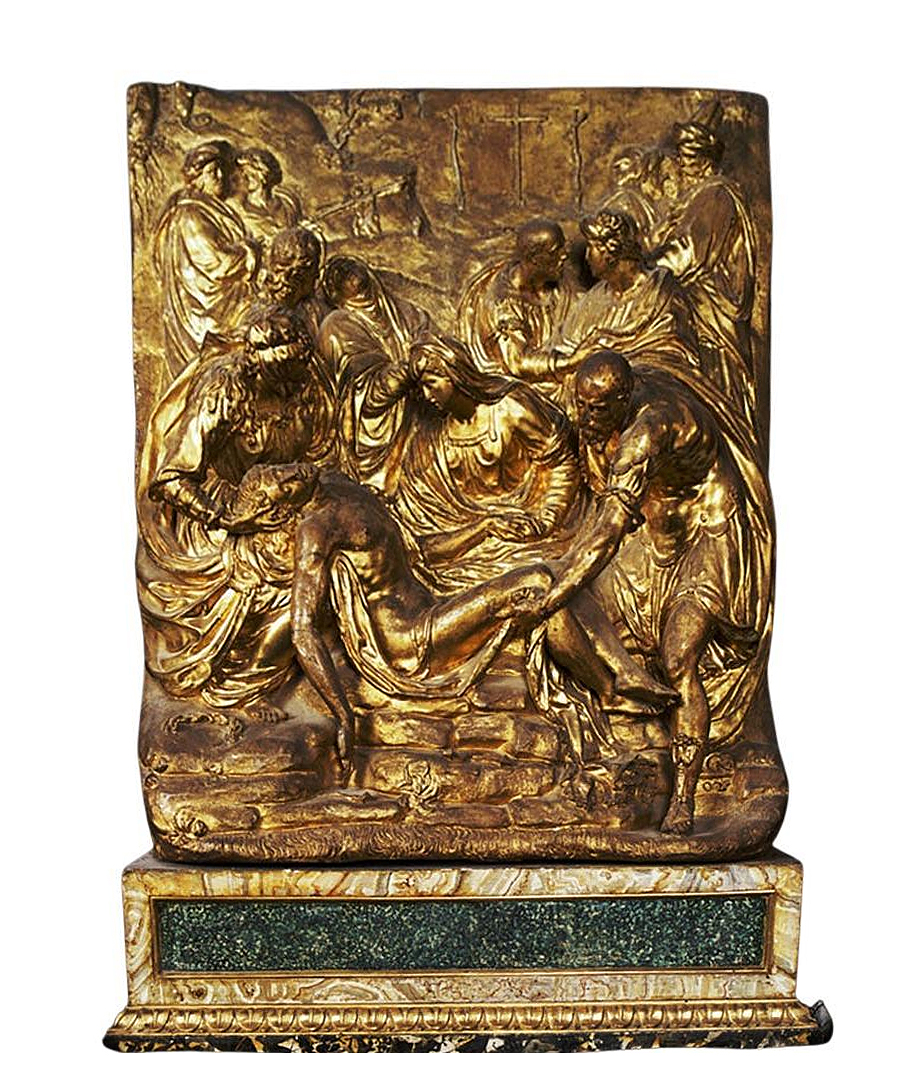
Fig. 40: Gilt terracotta Lamentation attributed to Teodoro della Porta, 1602, after Guglielmo della Porta (Galleria Spada, Rome)
A possible alternative could be a Descent from the Cross equally as rare and preserved by only one identified silver example at the Museo Civico Medievale in Bologna (fig. 41). Its stylistic appearance is indicative of a work designed by Guglielmo, executed in relief by Cobaert and cast and finished by Antonio and his workshop. Unfortunately, it’s scale is not confirmed but it appears to be in its contemporary ebonized wood tabernacle frame. The tabernacle is damaged and lacks what was probably an original pair of fluted ebony columns with silver bases and capitals flanking the relief as well as what could have been additional ornaments decorating other portions of the frame, such as the winged cherubim documented as adorning Centurione’s example of the relief. The construction of the frame aligns with the two Mount Calvary productions at El Escorial (nos. 7, 8) both herewith attributed to Antonio’s production. However, with the scale of Bologna relief unknown, this notion can only remain speculative and the relief itself appears possibly too small to relate to the three by two palmi descriptions noted in the trial records.
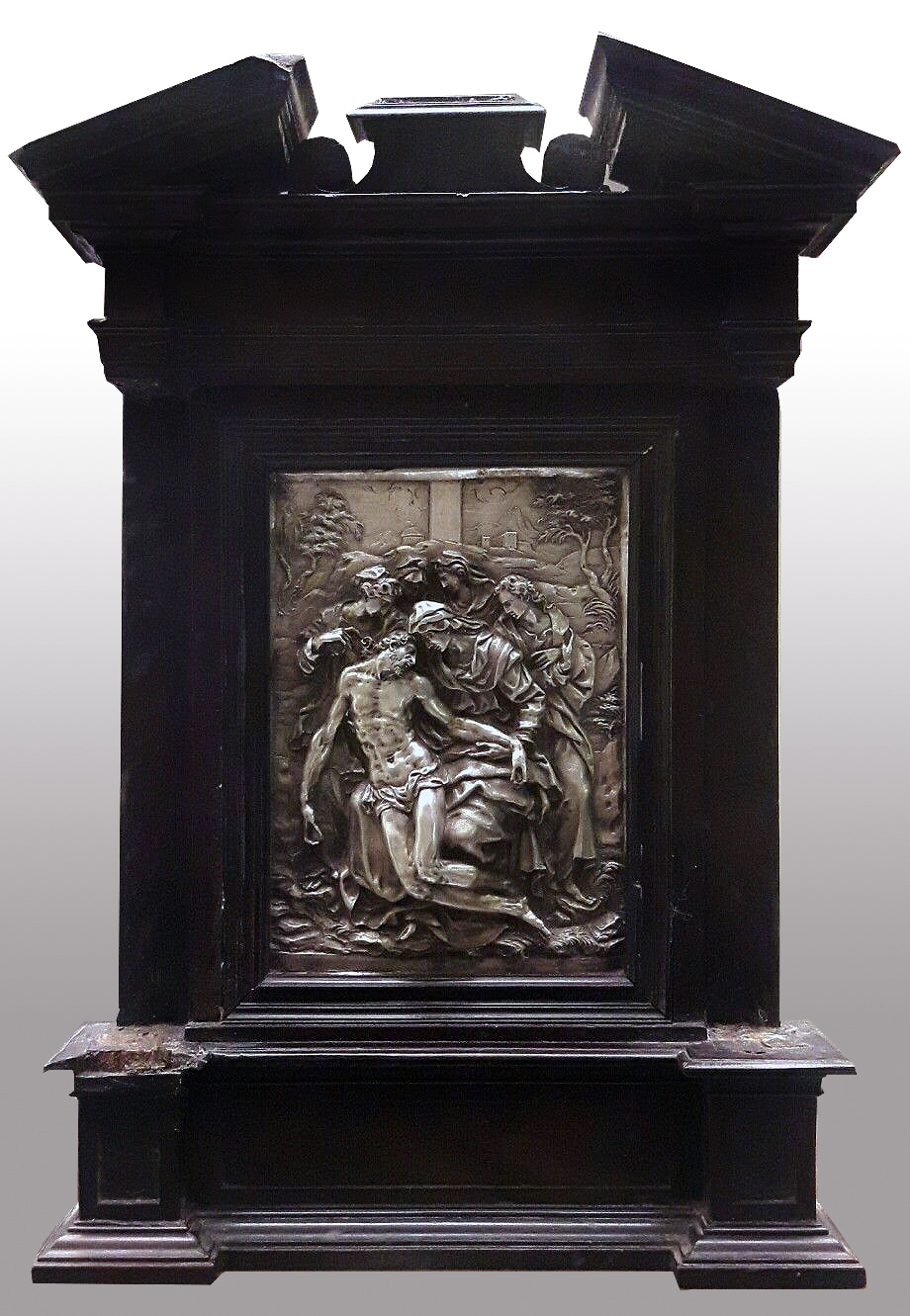
Fig. 41: Silver relief of the Deposition, possibly by Antonio Gentili, after a possible design by Guglielmo della Porta, set in a contemporary ebony wood tabernacle frame, probably last quarter of the 16th century or first decade of the 17th century (Museo Civico Medievale, Bologna)
However, either of these two latter compositions connected with Guglielmo, especially the terracotta Lamentation (fig. 40), could reproduce Guglielmo’s wax model of ‘Christ taken down from the Cross’ described by Giorgio Vasari and originally intended, but presumably never produced, for one of three altars at St. Peter’s.78
Endnotes – Unlocated Works:
1 Werner Gramberg (1960): Guglielmo della Porta, Coppe Fiamingo und Antonio Gentili da Faenza, Jahrbuch der Hamburger Kunstsammlungen, V, pp. 31-52.
2 Giovanni Baglione (1642): Le vite de’ pittori scultori et architetti. Dal pontificato di Gregorio XIII del 1572. In fino a’ tempi di Papa Vrbano Ottauo nel 1642. (…e modellava da sculture Eccelentemente…), p. 109.
3 Wolfgang Fritz Volbach (1948): Antonio Gentili Da Faenza and the Large Candlesticks in the Treasury of St. Peter’s. The Burlington Magazine, vol. 90, no. 547, pp. 281–286.
4 Costantino G. Bulgari (1958): Argentieri, gemmari e orafi d’Italia, vol. I, Roma: Lorenzo Del Turco, pp. 509-10.
5 Anna Beatriz Chadour (1980): Antonio Gentili Und Der Atarsatz von St. Peter. Westfälische Wilhelms-Universität, doctoral thesis, pp. 182-92.
6 Minna Heimbürger Ravalli (1977): Architettura scultura e arti minori nel barocco italiano: Ricerche nell’archivio Spada. Florence, p. 85.
7 See Sotheby’s auction, London, 2 April 1993, Lot 96.
8 Jennifer Montagu (1996): Gold, Silver & Bronze: Metal Sculpture of the Roman Baroque. Princeton University, pp. 14-15.
9 W.F. Volbach (1948): op. cit. (note 3). The watercolor is found in the Chigi Codex, p.VI, I, fol. 9 (Biblioteca Apostolica, Vatican). Chadour agreed that this singular sketch was closest and most probably a work connected with Antonio and his workshop. See B. Chadour (1980): op. cit. (note 5), pp. 93-95.
10 Medici Archivio, Stato von Florenz: Guardaroba, filza 79. 1576-1577 Guardaroba del Taglio appartenente al Cardinale Ferdinando, fol. 164r.
11 Medici Archivio, Guardaroba, filza 79. Invetarij Generale a Casi A. 1571-1588, fols. 9v, 9r.
12 Medici Archivio (1571-88): op. cit. (note 11), fol. 6v.
13 Ibid., fol. 407v.
14 John Forrest Hayward (1977): Roman Drawings for Goldsmiths’ Work in the Victoria and Albert Museum in The Burlington Magazine, vol. 119, no. 891, pp. 412-21.
15 A. B. Chadour (1980): op. cit. (note 5), p. 88-92.
16 Simonetta Prosperi Valenti Rodinò (2001): Officina farnesiana: Disegni per oreficerie in Francesco Salviati et la Bella Maniera. Actes des Colloques de Rome et de Paris, pp. 405-28.
17 Giuseppe Campori (1870): Raccolta di Cataloghi ed Inventarii inedita, Modena.
18 S. Rodinò (2001): op. cit. (note 16).
19 Carlo Grigioni (1988): Antonio Gentili detto Antonio da Faenza in Romagna arte e storia, XXIV, p. 91.
20 S. Rodinò (2001): op. cit. (note 16).
21 Medici Archivio (1571-88): op. cit. (note 11), fol. 13v.
22 Ibid., fol. 13v.
23 Ibid, fol. 26v.
24 Ibid, fol. 2v.
25 Ibid, fol. 373v.
26 Ibid, fols. 2v – 2r.
27 Ibid, fol. 373r.
28 Ibid, fol. 15v.
29 Ibid, fols. 399v and 399r. See also B. Chadour (1980) op. cit. (note 5), p. 204.
30 Christies auction, 28 January 2014, Lot 175 (ex-collection of Victor Cavendish, 9th Duke of Devonshire).
31 Una testa d’una Madonna di mano di Scipione gaetano con Cornice Indorate alta palmi uno, et ¾. See Alexandra Dern (2003): Scipione Pulzone (c. 1546-1598). Weimar, p. 126, no. 31, fig. 37.
32 Medici Archivio (1571-88): op. cit. (note 11), fol. 2v.
33 Ibid, fols. 4v, 4r, 407r. See also B. Chadour (1980) op. cit. (note 5), pp. 200, 205.
34 Ibid, fol. 407v.
35 Ibid, fols. 373v, 373r.
36 Ibid, fol. 373r.
37 Michael Riddick (2017): A Renowned Pieta by Jacob Cornelis Cobaert. Renbronze.com (accessed June 2022).
38 Cobaert states: …modelli di terra della detta pietà doue è stata get tata detta pietà et dico che l’ ho fatto io il modello di creta. See Antonino Bertolotti (1881): Artisti lombardi a Rome nei secoli XV, XVI, XVII. Studi e ricerche negli archivi romani, 2 vols., Milan, vol. 2, p. 137.
39 Ibid., pp. 142-44.
40 Formo ancora altri modelli di cose sacre, e tra le altre un Christo morto in braccio alla Vergine Madre, affai bello. G. Baglione (1642), op. cit. (note 2), pp. 100-01.
41 Emmanuel Lamouche (2011): L’activité de Bastiano Torrigiani sous le pontificat de Grégoire XIII. “Dalla gran scuola di Guglielmo Della Porta.” in Revue de l’art, no. 173, pp. 51-58, see his footnote 54.
42 C. Grigioni (1988): op. cit. (note 19).
43 A. Bertolotti (1881): op. cit. (note 38), p. 141.
44 Carlo Celano (1692): Notitie del bello, dell’antico e del curioso della città di Napoli, 10 giornate. Napoli: Giacomo Raillard. Vol. VI, p. 37.
45 Raffaele Tufari (1854): La certosa di San Martino in Napoli. Descrizione storica ed artistica, Napoli. Giovanni Ranucci, p. 86.
46 Stefano De Mieri (2022): Don Severo Turboli e il cantiere della Certosa di Napoli: precisazioni su Giovanni Antonio Dosio, Lorenzo Duca, Ruggiero Bascapè, Antonio Gentili da Faenza e Pietro Bernini in Il capitale culturale, n. 26, pp. 13-56, see Doc. 4.
47 C. Bulgari (1958): op. cit. (note 4). See also S. De Mieri (2022): op. cit. (note 46) Doc. 3. ASN, Corporazioni religiose soppresse, 2142 (F. 23, N. 31), cc. 283r-283v.
48 Citations of the cross at the Monastery of San Martino reference that Antonio spent 14 years producing the cross although documents appear to indicate that final payment for the project was completed in 1603. S. De Mieri (2022): op. cit. (note 46).
49 Ibid, see docs. 4-6.
50 Pompeo Sarnelli (1688): Guida de’ forestieri curiosi di vedere e d’intendere le cose più notabili della regal città di Napoli e del suo amenissimo distretto. Napoli: Antonio Bulifon, p. 394.
51 Raffaele Tufari (1854): op. cit. (note 45).
52 S. De Mieri (2022): op. cit. (note 46), see Doc. 4.
53 A. Bertolotti (1881): op. cit. (note 38), vol. 1, p. 285.
54 Giuseppe Sigismondo (1789): Descrizione della città di Napoli e suoi borghi, III. Napoli: Fratelli Terres, pp. 111-112.
55 Raffaello Causa (1973): L’arte nella certosa di San Martino a Napoli, Cava dei Tirreni: Di Mauro editore., pp. 84-85.
56 S. De Mieri (2022): op. cit. (note 46): See Doc. 4. ASN, Corporazioni religiose soppresse, 2142, cc. 383r-384v and Doc. 6. ASN, Corporazioni religiose soppresse, 2142 (F23. N.79), cc. 387v-388r.
57 Bulgari (1958): op. cit. (note 4).
58 A. Bertolotti (1881): op. cit. (note 38), p. 137.
59 Ibid, pp. 120-30.
60 Ibid, p. 137.
61 Antonio’s memory of the payment seems foggy. In one account he cites being paid 160-170 scudi, and in another, more than 200 scudi. A. Bertolotti (1881): op. cit. (note 38).
62 Konrad Eubel (1923): Hierarchia Catholica Medii et Recentioris aevi, Vol. III. Münster: Libreria Regensbergiana, p. 215.
63 A. Bertolotti (1881): op. cit. (note 38).
64 Emmanuel Lamouche (2022): Les fondeurs de bronze dans la Rome des papes (1585-1630); Ecole Francaise de Rome, p. 184.
65 A. Bertolotti (1881): op. cit. (note 38).
66 Ibid, pp. 134-35. It is to be wondered if d’Armuis may have desired this for a French client sponsoring works at the French National church in Rome, S. Luigi dei Francesi, where it is presumed Guglielmo’s larger models of his 14 Passion reliefs may have been intended for use in that church as well.
67 Ibid.
68 Other members of this entourage who were likewise victims of this theft included Cristoforo Vischer’s brother, Giorgio, Eugenio Clodio, Cristoforo Vuger and his collaborator Vincenzo Cocchi (also called Vincenzo de Cochis) and a certain Flemish silversmith, Pietro Giovanni Bulli. Ibid., p. 285.
69 Ibid.
70 According to Baldo Vazzano, the original model was formed in black wax which seems to have been a preferred medium used by Jacob Cornelis Cobaert in the execution of his original models. Ibid.
71 Rosario Coppel (2012): Guglielmo della Porta in Rome in Guglielmo della Porta: A Counter-Reformation Sculptor. Coll & Cortes, pp. 28-57.
72 A. Bertolotti (1881): op. cit. (note 38), vol. 1., p. 135. Lothar Sockel has pointed out that this series of 14 reliefs was subsequently purchased from Bastiano Torrigiani by Diomede Leoni, possibly on behalf of Matteo Contarelli who may have intended to have Torrigiani finally produce them in bronze perhaps for the French national church in Rome, S. Luigi dei Francesi, and apparently never realized. Lothar Sickel (2014): Guglielmo della Porta’s Last Will and the Sale of his ‘Passion of Christ’ to Diomede Leoni in Journal of the Warburg and Courtauld Institutes, vol. 77, pp. 229–39.
73 A common relief known by various examples in bronze, terracotta and plaster have been frequently misidentified as Guglielmo della Porta’s Descent from the Cross. More recently, Charles Avery has corrected this, commenting that the relief has much more in common with the manner and style of Alessandro Vittoria, agreed upon also by the present author. Charles Avery (2016): Joseph de Levis & Company. Renaissance Bronze-founders in Verona. London, UK, no. 45, p. 135.
74 Ulrich Middeldorf (1935): “Two wax reliefs by Guglielmo della Porta”, in The Art Bulletin, XVII, pp. 90-96.
75 Charles Avery (2012): Guglielmo della Porta’s Relationship with Michelangelo in Guglielmo della Porta, A Counter-Reformation Sculptor. Coll & Cortés, pp. 113-137.
76 Ulrich Middeldorf (1977): In the Wake of Guglielmo Della Porta in Connoiseur, 194, pp. 75-84. Antonia Nava Celllini (1982): The sculpture of the seventeenth century, Turin, p. 10.
77 Maria Lucrezia Vicini (2022): Alla Galleria Spada, una scultura in terracotta dorata di Teodoro della Porta, raffigurante “La Deposizione di Cristo”, secondo il Vangelo di Giovanni. AboutArtOnline.com (accessed July 2022).
78 Giorgio Vasari (1568): Le vite de più eccelenti pittore scultori ed architettori scrite da Giorgio Vasari, pittore aretino, con nuove annotazione e commenti di Gaetano Milanesi, vol. V. Firenze, 1880; vol. VII, 1881, pp. 548-549. Ulrich Middeldorf likewise posited this same idea with respect to the wax Crucifixions, attributed to Guglielmo, which survive at the Galleria Borghese in Rome and in the Howing & Winborg Collection in Stockholm, Sweden. See U. Middeldorf (1935): op. cit. (note 74).
 Renaissance Bronze
Leave a comment