by Michael Riddick
Preview / download PDF in High Resolution
Preview Italian version at Antiqua Nuova Serie
PART 3 of a SERIES OF FIVE PLAQUETTE STUDIES CONCERNING MODERNO AND HIS SCHOOL
Galeazzo Mondella, called Moderno, was the most prolific producer of small bronze reliefs of the Renaissance. While some of his productions were evidently conceived as independent works-of-art others were likely intended to be grouped in a series. Further examples ostensibly sought to preserve creations conceived by him originally in more precious materials.
Throughout the course of scholarship various bronze plaquettes attributed to Moderno have instead been reallocated to followers or presumed anonymous workshop assistants. These artists are today identified by pseudonyms like the Master of the Herculean Labors, the Coriolanus Master, Master of the Orpheus and Arion Roundels, Master of the Corn-Ear Clouds, the Lucretia Master, et al.
While many of these pseudonyms have been applied only in the last few decades, the proposed identity of these artists or their possible reassessment back to Moderno has been little explored due to an absence of information or further critique. However, certain observations may yield reasonable suggestions concerning their context or authorship, particularly as regards the work of Matteo del Nassaro, a gem-engraver whom Giorgio Vasari noted had been a pupil of Moderno as well as a pupil of Moderno’s Veronese contemporary Niccoló Avanzi.
Giorgio Vasari notes the Veronese Matteo del Nassaro was trained in gem engraving by his municipal peers Galeazzo Mondella (called Moderno) and Niccoló Avanzi. He also notes Matteo’s distinction as a lutenist and singer, having trained under the musicians Marco Carrà and Bartolorneo di Luigi (called il Tromboncino).1
While it is almost certain Matteo’s musical training occurred chiefly in a Mantuan environment,2 no documentation has surfaced concerning his tutelage under these two musicians who were both collectively active at the court of Francesco II Gonzaga throughout the last decade of the 15th century.3 Nonetheless, if one takes Vasari’s record into account against the known data concerning the Mantuan activity of these two musicians, a most probable period for Matteo’s musical tutelage would have been ca. 1496-99.4
Matteo’s artistic training as a gem-engraver may have followed after his initial instruction in music.5 His presence in Mantua and his Veronese origins would certainly have acquainted him with Moderno, whom during this period, was at a high-point in his career serving his first term as head of the Veronese Goldsmiths guild between 1496-97.
While the circumstances of Matteo’s mentorship under Moderno is not known, his mentorship or activity alongside Avanzi is recorded in a 1512 letter. Matteo was working with Avanzi in Rome during this period and went to visit Isabella d’Este in Mantua in July of 1512 to deliver an amended emerald of Christ at Calvary, presumably made by Avanzi.6 By 1514-15 Matteo was active in Milan, probably under the continued patronage of Isabella, where he received a precious topaz from her, presumably to be carved.7 It can be estimated that the celebrated mottled jasper Deposition Matteo made for Isabella, as cited by Vasari,8 was realized sometime between 1512-15. This jasper was celebrated on account of Matteo’s ingenuity in organizing the composition such that the wounds of Christ were expressed by the distinctive reds of the jasper.

Fig. 01 – Carved bloodstone of the Entombment possibly by Matteo del Nassaro (?), ca. 1500’s (left; Hermitage Museum, inv. K-684); Bronze plaquette of the Entombment or Christ in the Tomb, supported by the Virgin, Saint John, and an Angel by Moderno, ca. 1505-13 (right; National Gallery of Art, DC, inv. 1996.41.1)
This work seems to be lost-to-time; however, a foreshadowing of this ingenuity can be observed in a carved bloodstone depicting the Entombment of Christ in which Christ’s featured wound uniquely aligns with the red veining of the stone (Fig. 01, left). As noted by Douglas Lewis, this bloodstone may indeed be the work of Matteo while active under Moderno’s instruction.9 Moderno’s Entombment composition (Fig. 01, right), from which this carved bloodstone derives its effigy, has traditionally been considered a later work by Moderno, chiefly presumed on account of a dated example he produced for the Duke of Mantua in 1513. However, the present author and Paola Venturelli have suggested a possible earlier origin for Moderno’s most famous composition, possibly realized instead during the first years of the 16th century10 and presumably copied by Matteo during this early period while under the instruction of Moderno.
Suggested here is the notion that Matteo’s interests in music may help bring insight into the deficiency of knowledge concerning his Italian artistic period and his intimate work alongside the most prolific producer of small bronze reliefs of the Renaissance: Moderno.
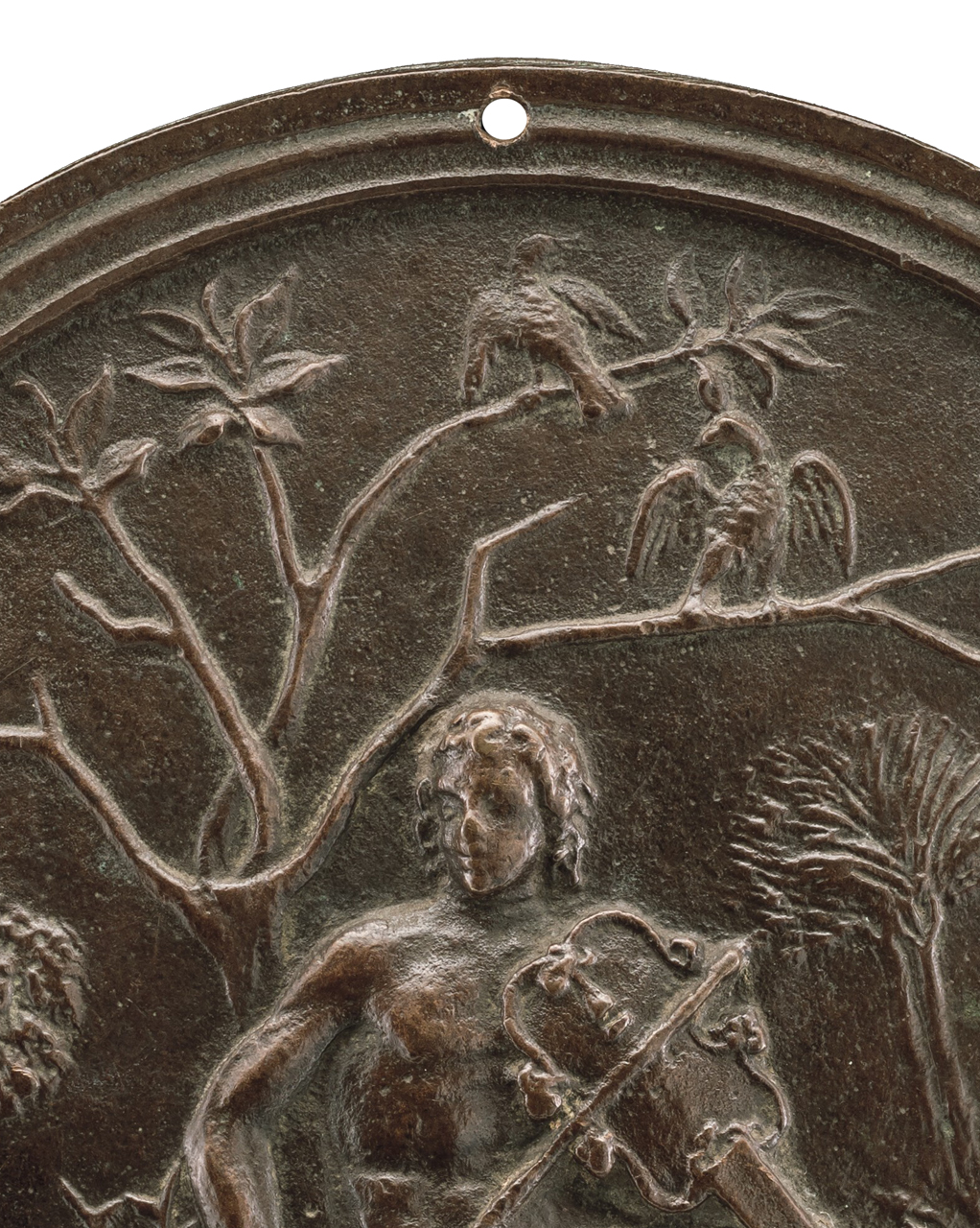
We may take for instance, the Master of the Orpheus and Arion roundels which are certainly made in Moderno’s ambit and studio (figs. cover, 02, 04), adjudged by their filleted circular frames, approximately 10.5 cm in diameter, which employ a workshop template and were clearly used in various other of Moderno’s productions, namely his series of Herculean-themed roundels executed for the Mantuan court.11
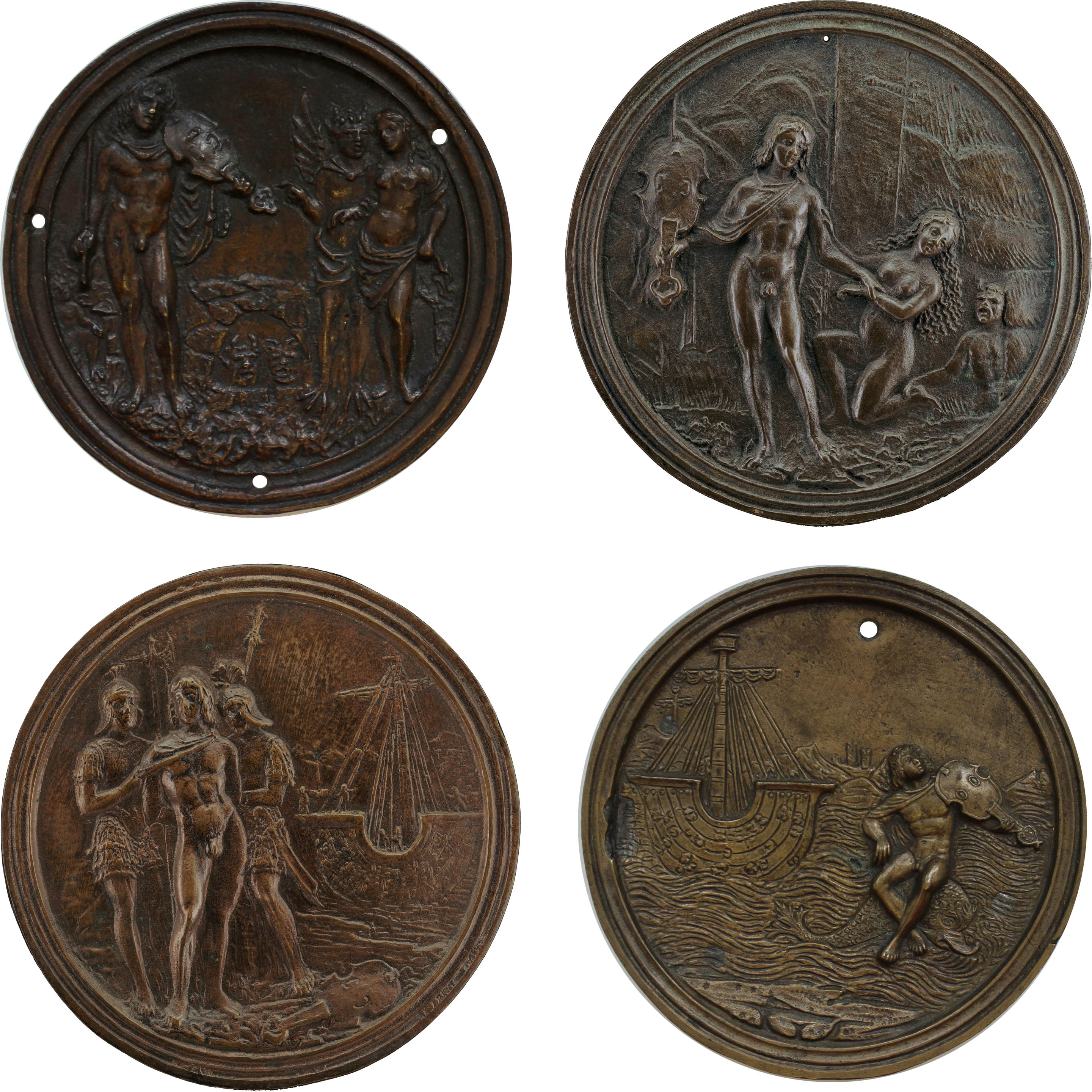
Fig. 02 – Bronze plaquette of Orpheus Redeeming Eurydice (top-left; British Museum, inv. 1915,1216.15); Bronze plaquette of Orpheus Losing Eurydice (top-right; National Gallery of Art, DC, inv. 1957.14.332); Bronze plaquette of Arion Capturing by Pirates (bottom-left; National Gallery of Art, DC, inv. 1957.14.328); Bronze plaquette of Arion Rescued by the Dolphin (bottom-right; British Museum, inv. 1915,1216.4); herewith all possibly by Matteo del Nassaro at the workshop of Moderno, ca. 1514-18, Milan, Italy (?)
While the style of the Orpheus and Arion roundels do not align with Moderno’s own hand, as first noted by Francesco Rossi and followed by subsequent scholars,12 they do show his influence and it is the subject matter of these roundels that most evidently point to Matteo. Matteo’s love for music would naturally engage this young artist in subjects regarding the triumph and power of music, as observed in Ovid’s tale of these two regarded poet-musicians: Orpheus and Arion. The courts of Mantua and Milan were likewise the Italian epicenter of music and poetry, promulgated by the great patronage of Francesco II Gonzaga and Isabella d’Este in the former and the Sforza family in the latter. A series of roundels—not by the hand of Moderno, but under his influence; realized and executed in his workshop and reproducing subjects related to poetry and music—point directly to the possibility of Matteo’s authorship.
The roundels could belong to a Mantuan orbit with regard to their subject matter, recalling the faux pendentives featured earlier on Mantegna’s trompe-l’œil ceiling at the Camera degli Sposi which exclusively depict stories of Hercules, Orpheus and Arion. The project had been commissioned by Ludovico III Gonzaga and executed between 1465-74.13 The Arion and Orpheus roundels would have been appropriate for the patrons sponsoring the poets and musicians of the Mantuan court, to which strata Matteo was already integrated by the late 1490s. Thus, the realization of these roundels could adequately be placed during this period or during the first years of the 16th century although a later production during Matteo’s Milanese period from 1514/15-18 should not be ruled out nor the period of Matteo’s return from France to Verona during the exile of King Francis I between 1525-29. Moderno is also in Verona during this latter period and Matteo reprises the subject of Arion again on a pair of tapestry designs he completed for the French king upon returning to France following this exilic period.14
If by Matteo, we may note the general rigidness but beautiful creativity found in the style of these roundels, indicative of a novice sculptor with burgeoning talents. The realization of these works showcases a developing naturalism. There is a general contrapossto in the figural forms. The upper body of male figures depict wide chests which taper into small, albeit muscular waist lines, often defined by two stacked external obliques along the hips, not unlike Moderno’s treatment of such forms. Female figures feature small chests with panniculus-like stomachs. The full lips and eyes and lids of the characters in these reliefs are a particular trademark of the artist’s hand, being deeply set and sloping downwardly along the outer edges of the face with the pupils articulated in a single dash of the modeling tool. The precursor of this manner is observed in the aforementioned Entombment bloodstone and can be observed in a little known jacinth cameo bust of Cleopatra in the Beverly collection of the Duke of Northumberland at Alnwick Castle that bears Nassaro’s name inscribed on its reverse (fig. 03).15
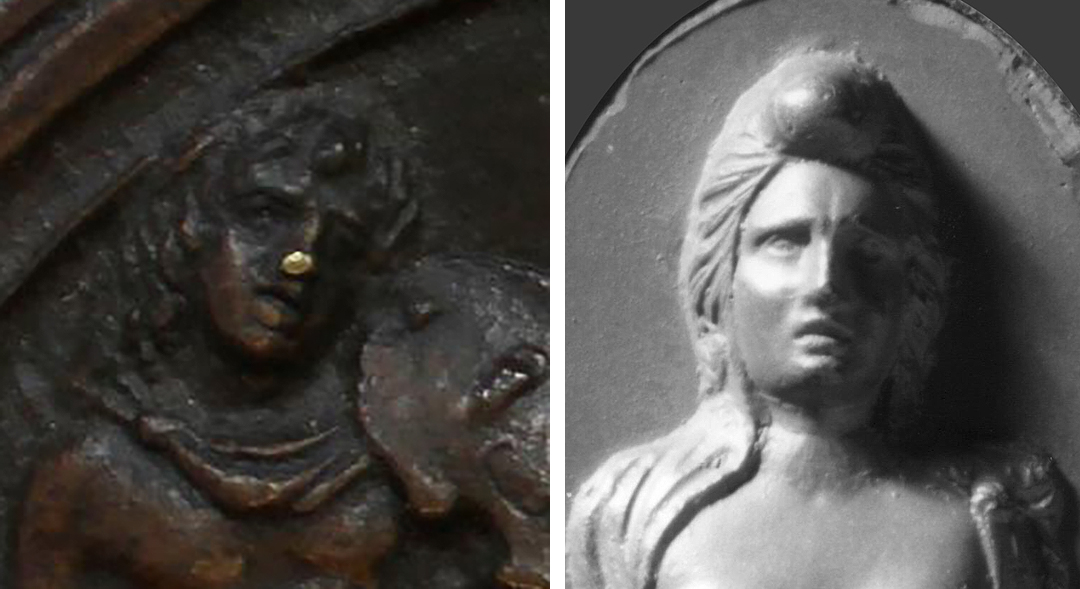
Fig. 03 – Enlarged detail of a bronze plaquette of Orpheus Redeeming Eurydice possibly by Matteo del Nassaro, ca. 1513-18, Milan, Italy (?)(left; British Museum, inv. 1915,1216.15); James Tassie plaster impression , after a jacinth, gold and ruby cameo of Cleopatra (right; Tassie impression: Beazley Archives 12472; original from the Beverley Collection at Alnwick Castle, inv. K8)
The landscapes and characterization of the animals and monsters on the Orpheus and Arion roundels appear to recall the influence of illuminators of the late Gothic period (fig. 04). In particular their manner seems to echo a possible awareness of illuminations by the Master of the Vitae Imperatorum and his Milanese workshop from the first half of the 15th century.16 The notion of Matteo’s natural interest in illuminations may be surmised with his probable experience working with illuminated manuscripts used in the study and performance of music. Alternatively, this theoretic influence could also suggest the roundels form part of Matteo’s later activity in Milan. Indeed, portions of the Vita Imperatorum Master’s illuminated edition of Dante’s Inferno was one of numerous works brought to France after the French conquest of Milan in 1515.17
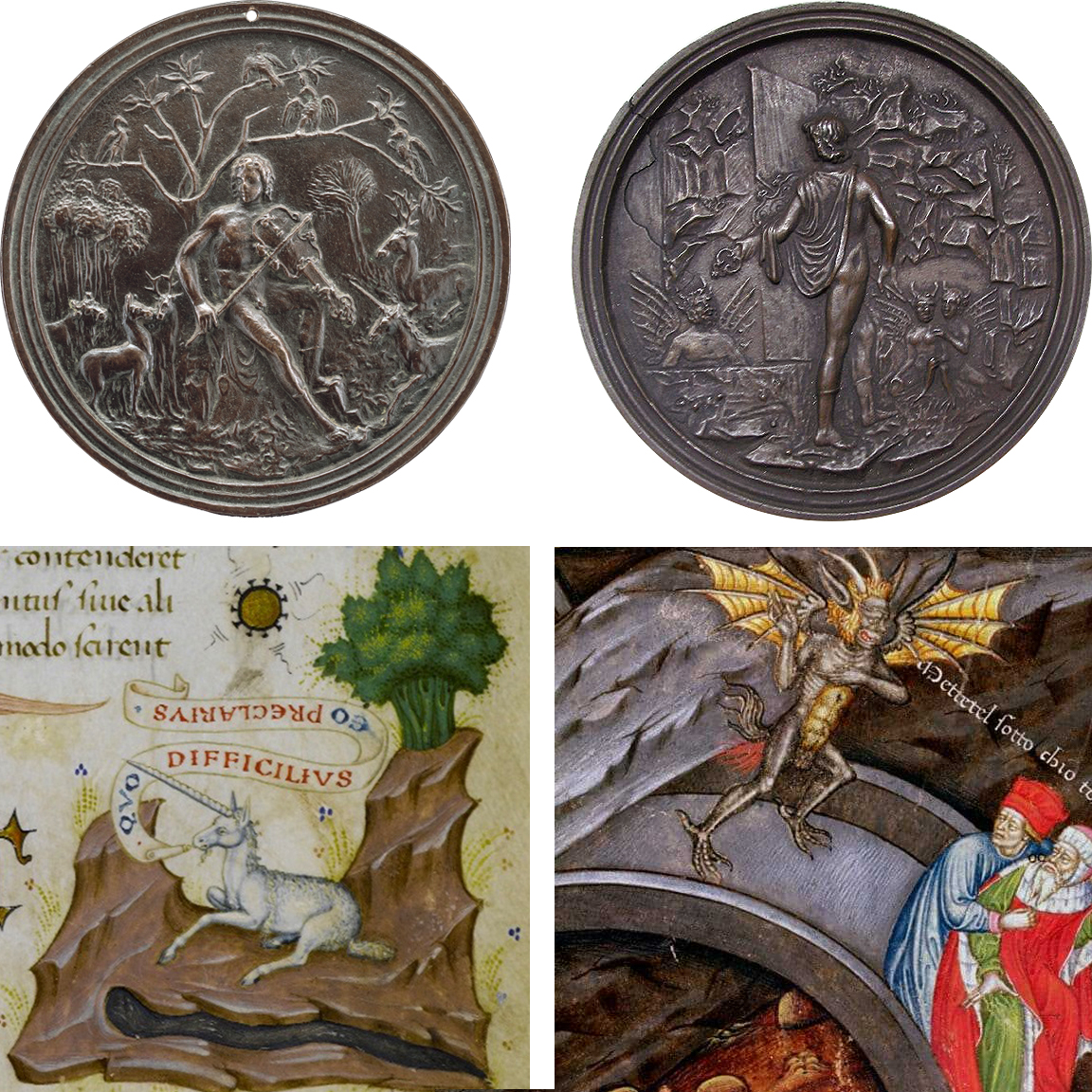
Fig. 04 – Bronze plaquette of Orpheus Playing to the Animals and Trees (top-left; National Gallery of Art, DC, inv. 1942.9.248); Bronze plaquette of Orpheus Descending into Hades (top-right; Palazzo Madama, inv. 1173), herewith possibly by Matteo del Nassaro at the workshop of Moderno, ca. 1514-18, Milan, Italy (?); detail of the frontispiece from Suetonius’ Lives of the Twelve Caesars by the Master of the Vitae Imperatorum, 1444 (bottom-left; Archivio Storico Civico e Biblioteca Trivulziana Cod Triv 696, fol. 1); detail of Dante’s Inferno by the Master of the Vitae Imperatorum, ca. 1430-50 (bottom-right; Bibliotheque Nationale, Paris)
While many works of inconsistent style have been attributed to Matteo only a minority can be ascribed to him with reasonable confidence. From a conservative angle and unwitting of the Cleopatra cameo at Alnwick, Philippe Malgouyres notes the only acceptably secure work is his documented teston of Francis I realized in 152918 (fig. 05) while a less-reserved, but still thorough analysis, has historically and contemporaneously added to his repertoire, inclusive of: a related chalcedony cameo portrait19 (fig. 06, left)—known also by a previously uncited cast in bronze herewith published for the first time (fig. 06, right); a medal commemorating the 1515 French victory of the Battle of Marignano;20 a double ducat of Milan—of which an example survives in gold and in silver—completed before 1519 but never put into production; a medal of Cérisoles, ca. 1538-44 which depicts a late portrait bust of Frances I on the obverse and the king flanked by Mars and Victory on the reverse; 21 and more recently, the jacinth cameo bust of Cleopatra, previously cited.
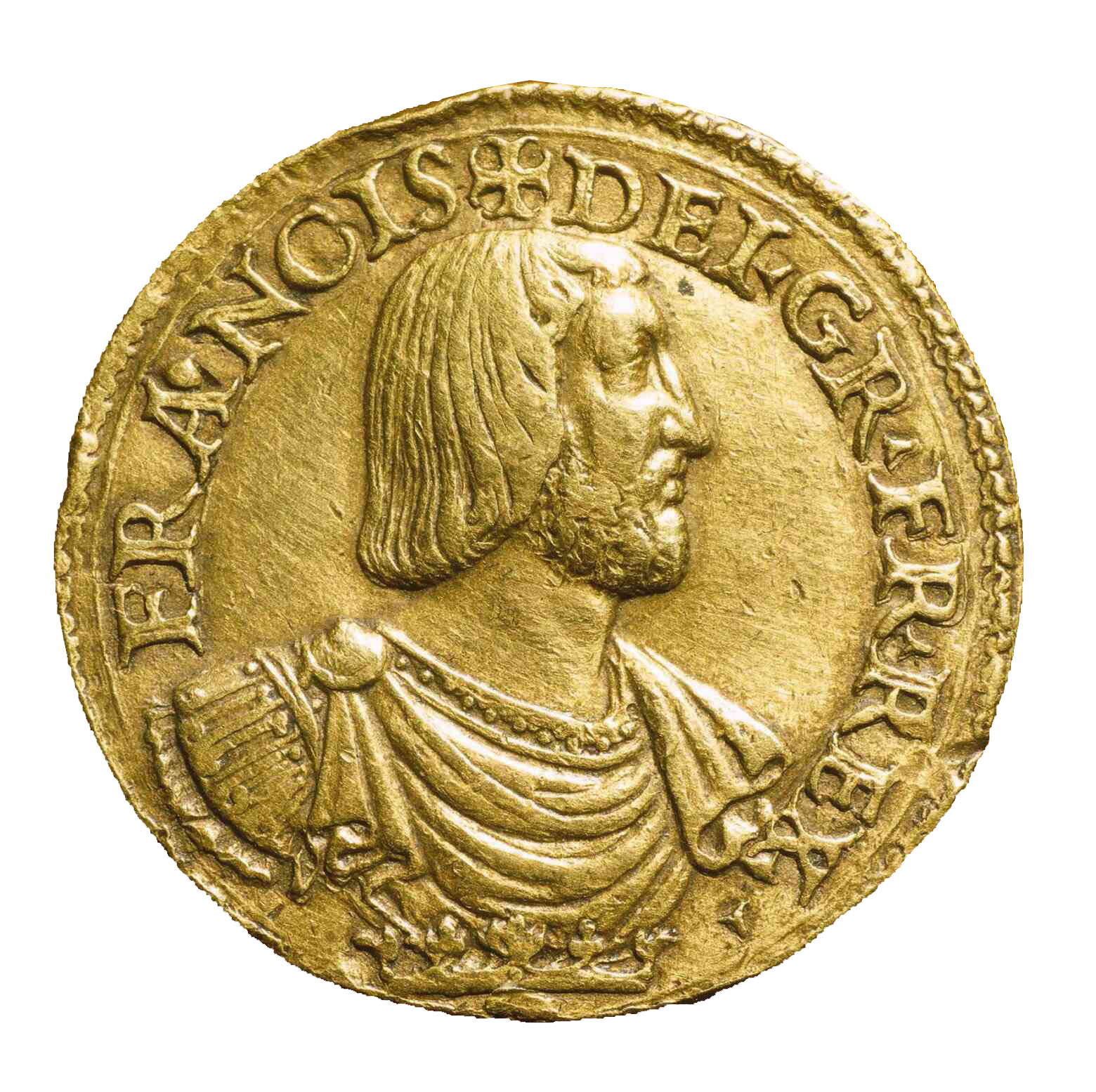
Fig. 05 – Gold teston of King Francis I by Matteo del Nassaro, 1529, Paris (Cabinet des médailles at the Bibliotheque Nationale, Paris, inv. AF 208)
It is questioned whether the Marginano medal, gold and silver testons and chalcedony bust of Francis I were realized in French-occupied-Milan22 or in France, bringing speculation about the dating of Matteo’s eventual move to France which must have occurred at least by 1518 according to a surviving document.23
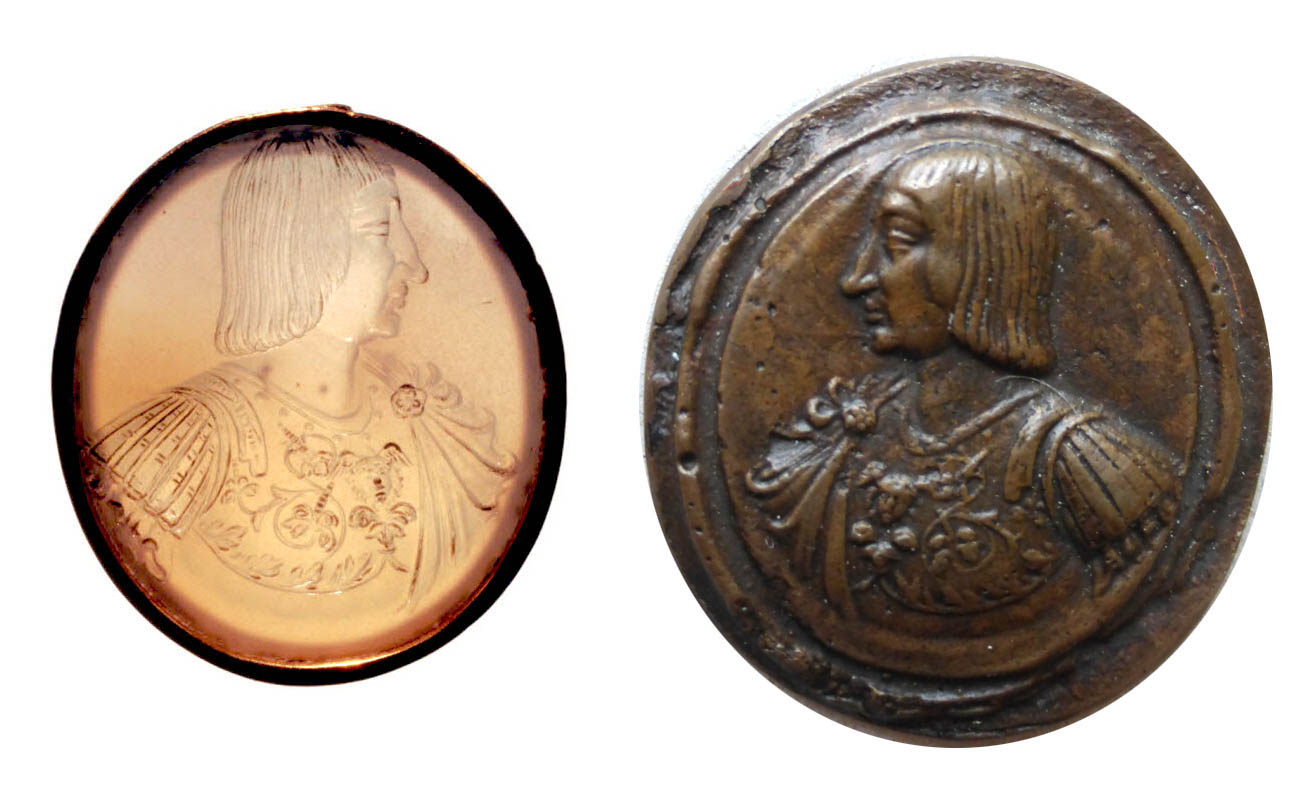
Fig. 06 – Chalcedony intaglio of King Francis I attributed to Matteo del Nassaro, 1515-16, Milan Italy (?) (left; Cabinet des médailles at the Bibliotheque Nationale, Paris, inv. 58.2485); Bronze plaquette cast after the aforenoted intaglio (right; Ubertazzi collection)
There are two theories concerning Matteo’s arrival in France and they are relevant here because Vasari casually mentions, without any specifics, that Moderno himself had gone to France for a period.24 Lewis has reasonably suggested Moderno’s sojourn to France was in coincidence with the advent of Matteo’s activity there and the present author agrees with this logical idea.
The date and circumstances of the arrival of Matteo in France and his introduction to the king are undocumented. One theory suggests he arrived in France in early 1516, when the king and his troops left Milan to return to France. According to Vasari, Matteo would have had artworks on-hand ready to present to the king with the hope of gaining an appointment to the court by way of an intermediary.25 Another theory is that Matteo was in Italy when initially meeting the king, either directly or through another unidentified intermediary and later traveled to France circa 1517-18.
There are several reasons to suggest this latter theory is more suggestive. One consideration is Marine Sauvage’s observation that the earliest record of Matteo’s activity in France is noted in a document recording his name in a haphazard manner, implying perhaps he was still establishing himself as a recognized patron to the nobility.26 There is also the reasonable suggestion that Moderno and Matteo went to France together, possibly inspired by the protections extended to Italian artists under Francis I’s new rule in Milan.27 Moderno was still in Verona between 1516-17, and thus a journey to France would most likely have taken place in 1518, which coincides also with Matteo’s earliest documented presence there.
Furthermore, Moderno’s models appear reproduced on the façade of Francis I’s lodges at Château de Blois whose construction was subsequently in-progress by 1519.28 The appearance of Moderno’s models—reproduced in stone—may have been one impetus for him to travel to France seeking perhaps to memorialize and diffuse his successful compositions beyond Lombardy, and particularly in the form of stone, having observed already such immortalization of his designs on the Porta della Rana at the Cathedral of Como, the façade of the Carthusian monastery in Pavia, the funerary chapel of Bartolomeo Colleoni in Bergamo and on the door of Palazzo Stanga in Cremona, Italy.
A possible contextual link between Moderno, Matteo and the French nobility is Jean Grolier de Servières whose family were originally from Verona. Grolier served as a Treasurer for King Louis XII in Milan ca. 1509-12, and again under Francis I in Milan between 1515-21.29 In addition to his humanist interests, Grolier’s appreciation of music and poetry may have brought Matteo into his orbit, as we know Grolier shared camaraderie with other talents of the era like the Veronese musician Franchino Gaffuri, who like Matteo, was also present in Mantua and Milan.30 Grolier himself could equally be a possible patron for the Orpheus and Arion roundels, if not the poets and scholars also active in Milan during this period of French influence. As treasurer to the king, it could be easily surmised that Grolier could have played a role in Matteo’s commission to create the early testons of Francis I that were never put into production.
Grolier’s collection of medals and antique coins, prized in its time and whose importance was discussed and indexed in publications made as early as the third quarter of the 16th century, also indicate his interests in small reliefs.31 Most notable, however, was his role as a bibliophile and his taste for fine bindings, today recognized as “Grolier Bindings.” Grolier is also uniquely credited with the art of incorporating plaquette designs into various bindings for a quantity of the books in his collection, today referred to as “plaquette bindings,” which were made almost exclusively in Milan between 1510-16.32 Several of these bindings feature plaquettes by Moderno and his studio, for example, indicating he also likely owned original bronze casts by Moderno, or as Paolo Venturelli has suggested, possibly even commissioning and owning the original models of one or two compositions.33
While there remains little stylistic data to prescribe any secure attribution to Matteo del Nassaro for the Orpheus and Arion roundels realized in Moderno’s studio, the possibility of their authorship by him seems a plausible and open possibility.
Endnotes:
1 Giorgio Vasari (1568): Lives of the most Eminent Painters Sculptors and Architects. Vol. 06 (of 10), Fra Giocondo to Niccolo Soggi. Translated by Gaston du C. De Vere, 1913. Macmillan and co. ld. & the Medici Society, London, pp. 79-80.
2 Marine Sauvage (2019): Matteo del Nassaro: un artiste véronais polyvalent à la cour de François Ier, PhD Thesis. Université de Liège, p. 19.
3 Marco Carrà was likewise originally from Verona and was consistently active in Mantua from May 1494-1525 whereas Tromboncino’s activity began in 1494 but was variably interrupted with his only presumed consistent period in Mantua landing between 1496-99. William Prizer (1978): Marchetto Cara at Mantua: New Documents on the Life and Duties of a Renaissance Court Musician in Musica Disciplina, vol. 32, pp. 87-110.
4 While Marco Carrà was a staple of the Gonzagan court, Tromboncino’s steadiest period of activity in Mantua conforms to this latter period and is the most likely time for Matteo’s musical training. W. Prizer (1978): op. cit. (note 3).
5 It could be presumed Matteo’s earliest artistic training was with Moderno but Moderno was in Verona during this period, serving as the Head of the Goldsmiths Guild, at-this-time. See D. Lewis (1989): op. cit. (note 9).
6 Alessandro Luzio and Rodolfo Renier (1896): Il lusso di Isabella d’Este in Nuova antologia, no. 64, pp. 323-24.
7 This is deduced by his mention in a letter between Isabella and Count Strozzi. Antonino Bertolotti (1889): Le arti minori alla corte di Mantova nei secoli XV, XVI e XVII: ricerche storiche negli archivi mantovani. Milano, p. 59.
8 G. Vasari (1568): op.cit. (note 1).
9 Douglas Lewis (1989): The Plaquettes of ‘Moderno’ and His Followers in Studies in The History of Art, vol. 22, National Gallery of Art, Washington, DC., pp. 105-41.
10 Michael Riddick (2020): Galeazzo Mondella’s original Entombment. Renbronze.com (accessed July 2023); Paola Venturelli (2012): La ‘Pace del Moderno’ del Museo Diocesano Francesco Gonzaga di Mantova. OADI – Osservatorio per le Arti Decorative in Italia. DOI: 10.7431/RIV06042012.
11 D. Lewis (1989): op. cit. (note 9).
12 Francesco Rossi (1974): Placchette. Sec. XV-XIX. Vicenza, Italy: Neri Pozza Editore.
13 Anne Dunlop (2009): Painted Palaces: The Rise of Secular Art in Early Renaissance Italy. Pennsylvania State University Press, p. 211.
14 In 1536 Matteo del Nassaro traveled to Brussels to oversee two large tapestries he designed for Francis I, based on stories of Actaeon and Orpheus, now lost, but cited in the French royal collection inventories of 1551. Sophie Schneebalg-Perelman (1971): Richesses du Garde-Meuble Parisien de François Ier: inventaires inédits de 1542 et 1551 in Gazette des Beaux-Arts.
15 Diana Scarisbrick, Claudia Wagner, and Sir John Boardman (2016): The Beverley Collection of Gems at Alnwick Castle. Bloomsbury Publishing, no. 1, pp. 4-5. It should be added that the present author opted to depict the Tassie plaster cast after the original cameo for sake of properly showcasing its sculptural qualities which are harder to observe in the gleaming jacinth. It should also be noted that the hair is rendered in gold (along with a partially enameled setting along the base) and the knot above the bust’s head is actually an inset ruby cabochon, altogether characteristic of the elaborate goldsmiths work Marine Sauvage theoretically elaborates upon in her thesis. See M. Sauvage (2019): op. cit. (note 2), pp. 54-55. The present author speculates if a circular sardonyx cameo of a rider on his rearing horse, set in an enameled gold setting with the inscription, CELVUM ET TERRAM, on its reverse, could be a production of Matteo del Nassaro’s. It was formerly kept in the Rothschild Kunstkammer and sold at Christie’s auction house on 12 Oct 2023, Lot 117.
16 Note for example the almost verbatim portrayal of the devils, observed by their webbed wings, curved and protruding horns, sideburns, long pointed ears and crow-like feet.
17 Fabrizio Lollini (2006): Miniature nella biblioteca comunale di Imola, exh. cat. 16 Dec 2006—9 February 2007, Biblioteca comunale di Imola.
18 Philippe Malgouyres (2018): Le Livre d’Heures de Francois I. Paris, Somogy, p. 37.
19 M.H. De La Tour (1893): Matteo dal Nassaro in Revue numismatique, no. 11, p. 540; Jean Mariette (1750): Traité des pierres gravées, t. II; and Anatole Chabouillet (1858): Catalogue général et raisonné des camées et pierres gravées de la Bibliothèque impériale, Paris.
20 Lewis and Sauvage have called attention to the influence of Moderno and his workshop models in this composition. D. Lewis (1989): op. cit. (note 9); M. Sauvage (2019): op. cit. (note 2), pp. 72-81.
21 M. Sauvage (2019): op. cit. (note2).
22 Sergio Guarino (1990): Del Nassaro Matteo in Dizionario Biografico degli italiani. Istituto della Enciclopedia italiana, Rome, pp. 162-64.
23 A document mentioning Matteo del Nassaro’s presence in France is cited in a 1521 account that mentions a series of figural designs he produced three years earlier, based on Virgil’s Bucoliques, for a suite of woven tapestries commissioned by the King’s mother, Louise de Savoie. Laure Fagnart (2015): Louise de Savoie et la chambre des Bucoliques, Brioist, Pascal, pp. 206 and 209. See also Jules Guiffrey (1879): Matteo del Nassaro de Vérone. Graveur en pierres fines et en monnaies du roi Francois I in Nouvelles archives de l’art francais, no. 7, p. 54.
24 Vasari (1586): op. cit. (note 1).
25 Ibid.
26 There recorded as Mathieu de Luazar. For an explanation see M. Sauvage (2019): op. cit. (note 2), p. 22, and footnote 91.
27 Leonard Forrer (1904): Biographical dictionary of medallists; coin, gem, and seal-engravers, mint-masters, ancient and modern, with references to their works B.C. 500-A.D. 1900. London.
28 Moderno’s designs of Hercules and Antaeus and Hercules and Cacus are among its stone reliefs depicting Herculean Labors. See Bertrand Bergbauer (2006): Images in Relief. La Collection de Plaquettes du Musee National de la Renaissance. Editions de la Reunion des musees nationaux, Paris, France. See also Michael Riddick (2019): Glyptics, Italian Plaquettes in France and their Reproduction in Enamel. Renbronze.com (accessed May 2023).
29 Anthony Hobson (1999): Renaissance book collecting: Jean Grolier and Diego Hurtado de Mendoza, their books and bindings. Cambridge University.
30 Franchini Gafuri Laudensis (1518): …de Hannonia musicorum instrumentorum opus… Gotardum Pontanum.
31 John Cunnally (1999): Images of the Illustrious. The Numismatic Presence in the Renaissance, Princeton, pp. 208-09.
32 These bindings were originally presumed made ca.1506-08 but have been more recently assessed to a dating of 1510-16. Geoffrey Dudley Hobson (1988): Studies in the History of Bookbinding. London.
33 Paola Venturelli (2002): Legature a placchetta per Jean Grolier, tesoriere generale di Luigi XII a Milano. Considerazioni sul maestro IO.F.F. in Milano e Luigi XII. Ricerche sul primo dominio francese in Lombardia (1499-1512) in Storia-Studi e ricerche, vol. 292.
 Renaissance Bronze
Leave a comment